
State of Connecticut Minimum Wage 2024 Updates
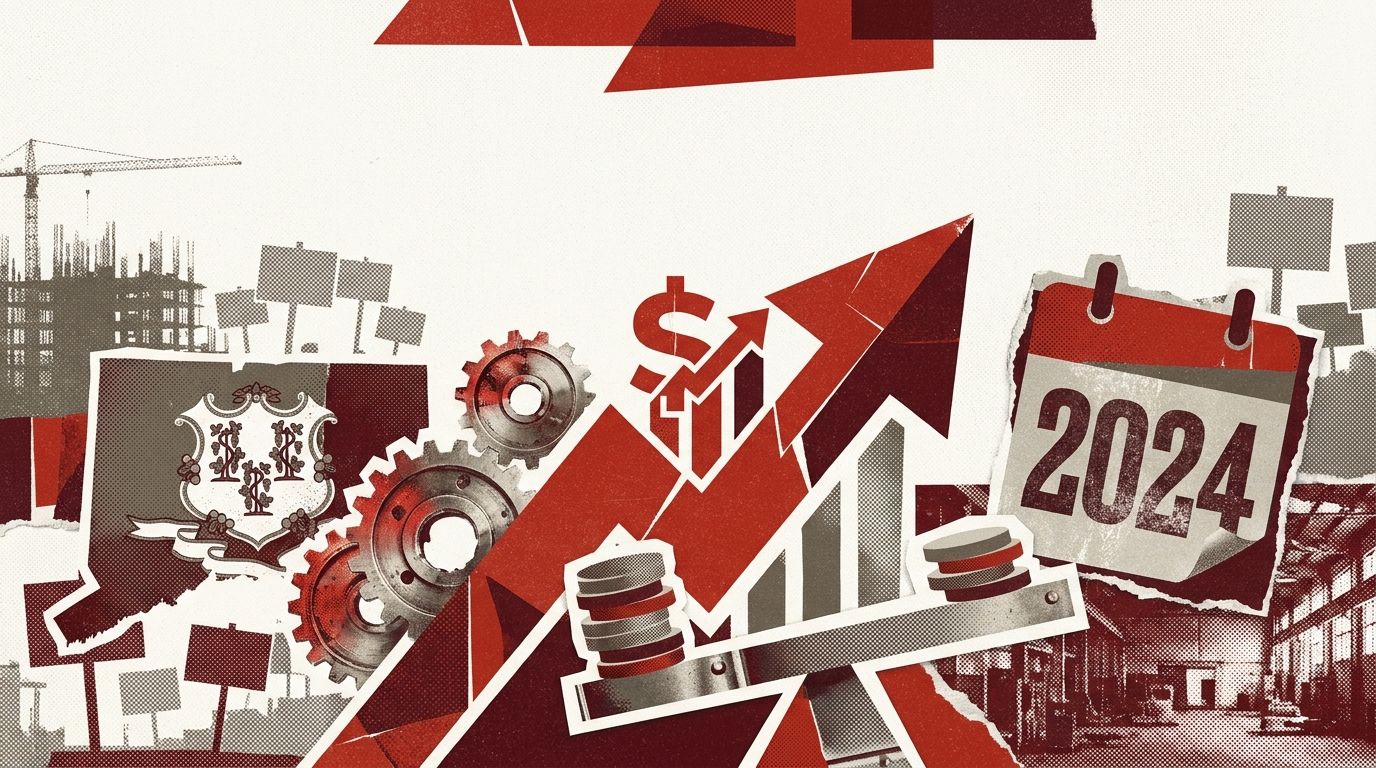
Public Act 19-4 transformed Connecticut's minimum wage from a number set by legislators into a self-adjusting rate indexed to the federal Employment Cost Index. For 2024, that mechanism pushed the state of Connecticut minimum wage from $15.00 to $15.
State of Connecticut Minimum Wage 2024: How the Auto-Indexing Mechanism Works
Public Act 19-4 transformed Connecticut's minimum wage from a number set by legislators into a self-adjusting rate indexed to the federal Employment Cost Index. For 2024, that mechanism pushed the state of Connecticut minimum wage from $15.00 to $15.69 per hour automatically on January 1, with no legislative vote and no employer lobbying window.
How Public Act 19-4 Replaced Legislative Wage-Setting
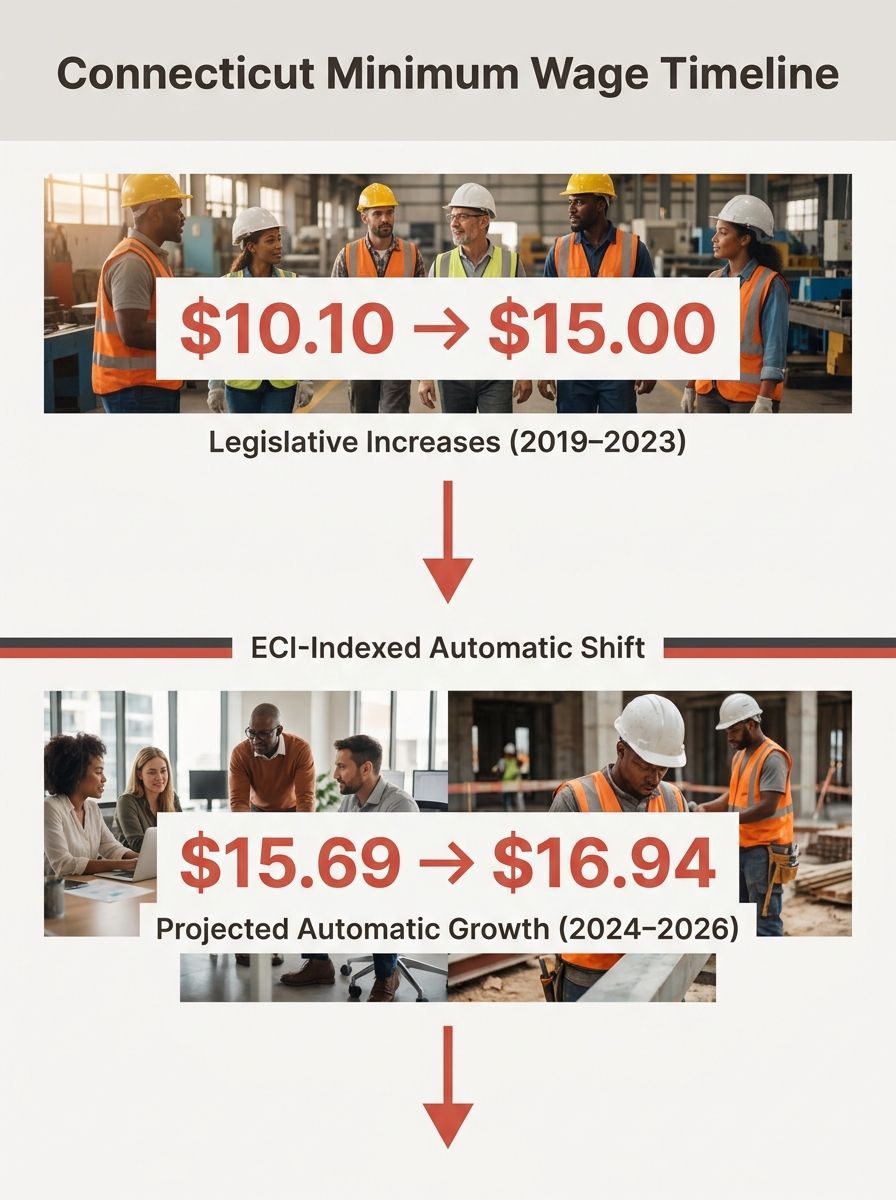
Before 2024, every minimum wage increase in Connecticut required a bill, a committee hearing, floor votes in both chambers, and a governor's signature. That process gave employer lobbying groups multiple chances to delay, water down, or kill proposed raises. Public Act 19-4, signed into law in 2019, created a different path: it set a schedule of fixed increases from $10.10 to $15.00 (the last of which took effect on June 1, 2023), then switched to automatic annual adjustments starting January 1, 2024.
The law is specific about the trigger. Once the minimum wage reached $15.00, future increases would be calculated using the federal Employment Cost Index for civilian workers, as published by the U.S. Bureau of Labor Statistics. The Connecticut Department of Labor is required to announce the new rate by October 15 of each year, giving employers roughly ten weeks to update payroll before the January 1 effective date.
This matters for workers' rights because it removes the political vulnerability from an annual wage increase. Legislators no longer have to spend political capital defending a wage bill, and opponents can't target specific lawmakers for supporting a raise. The increase happens by formula. The Connecticut House Democrats confirmed that the 2024 adjustment was the state's "first-ever economic indicator adjustment."
The Employment Cost Index: What It Measures
The Employment Cost Index tracks how much employers across the United States spend on wages and benefits for civilian workers. It's published quarterly by the Bureau of Labor Statistics and captures changes in labor costs across industries, occupations, and regions. Connecticut's law uses the twelve-month ECI change ending on June 30 of each year as the basis for the next year's minimum wage adjustment.
For the 2024 rate, the relevant ECI period ran from July 2022 through June 2023. For 2025, it was July 2023 through June 2024. Connecticut Labor Commissioner Danté Bartolomeo reported that the ECI increased by 4.2% over the twelve months ending June 30, 2024, producing a $0.66 increase that brought the 2025 rate to $16.35.
Why the ECI instead of the Consumer Price Index or another inflation measure? The ECI specifically measures what employers pay workers. It reflects changes in the labor market rather than changes in consumer prices, which means the minimum wage tracks whether overall compensation is rising or falling across the broader economy. When wages go up nationally, Connecticut's minimum wage follows. The choice of index matters because CPI can spike from energy or food price shocks while wages remain flat, and tying a wage floor to consumer costs could create volatile year-to-year swings. The ECI ties the minimum floor to what the economy is actually paying people.
From Index to Paycheck: The Three-Stage Calculation
Understanding the three stages of this process helps workers verify whether their employer is paying the correct rate.
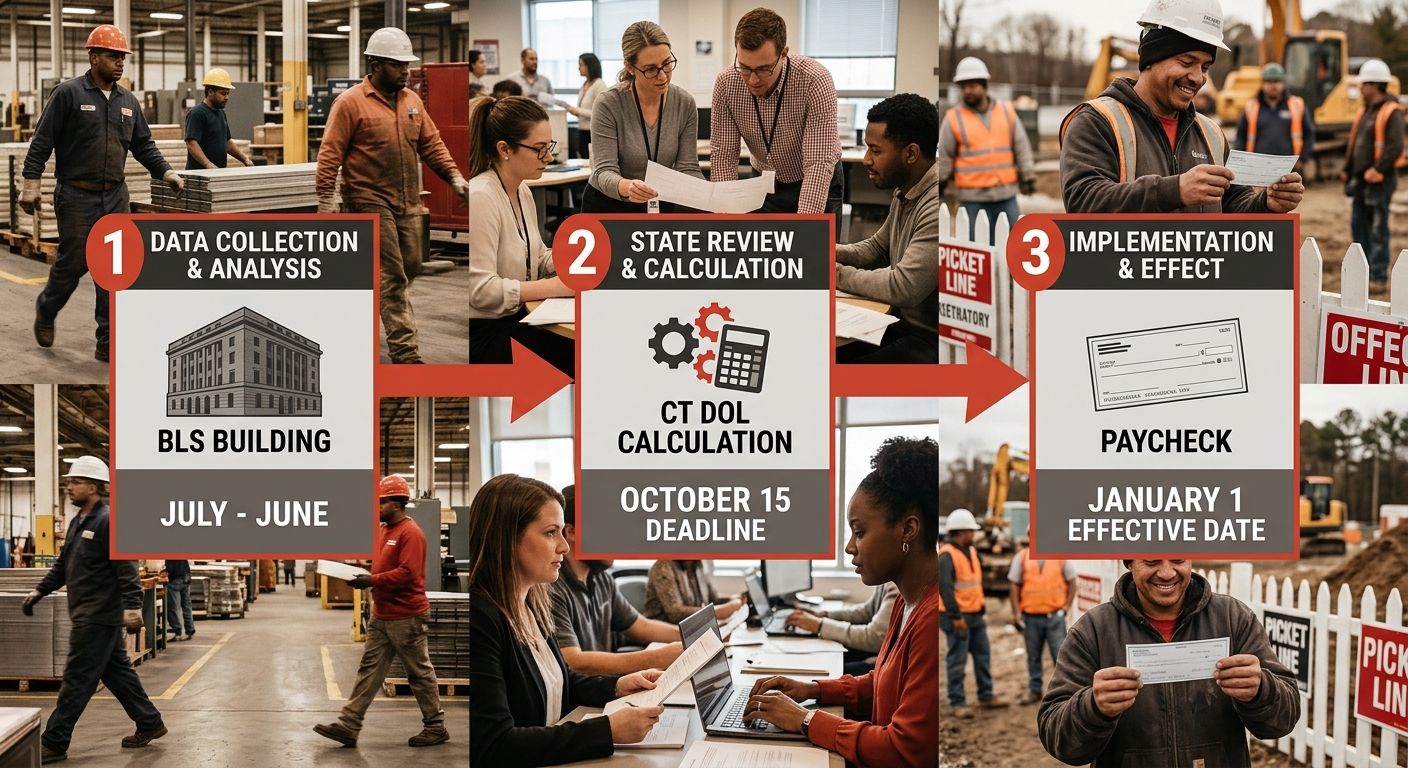
Stage one runs from July 1 through June 30 of the preceding year, when the Bureau of Labor Statistics collects ECI data. This happens at the federal level with no involvement from Connecticut officials. The twelve-month window captures a full economic cycle and smooths out seasonal fluctuations.
Stage two occurs between July and October 15. The Connecticut Department of Labor takes the published ECI percentage change, applies it to the current minimum wage, rounds to the nearest cent, and announces the result. For 2024, the Department applied the ECI change to the $15.00 base and announced the $15.69 rate in the fall of 2023.
Stage three is implementation on January 1. Employers are required to update pay rates, post the new minimum wage notice in the workplace, and adjust payroll records. Workers whose pay doesn't reflect the new rate on their first paycheck of the year have grounds for a wage complaint with the Connecticut Department of Labor.
The timeline is predictable by design. Workers and employers know the announcement will come by mid-October and the new rate will take effect on New Year's Day. That predictability is itself a worker protection: it eliminates the uncertainty of waiting for a legislature to act. For a more detailed breakdown of Connecticut's wage rate requirements, including overtime rules and salary thresholds, the specifics go deeper than the minimum wage alone.
Who the Mechanism Protects: A Civil Rights Dimension
Approximately 60% of Connecticut's minimum wage earners are women, many of them heads of households. This demographic reality makes the minimum wage mechanism a civil rights question as much as an economic one. When wage increases stall in legislative gridlock, women and their families absorb the cost of inaction disproportionately.
The auto-indexing mechanism does something that legislative wage-setting historically failed to do: it ensures consistent annual raises without requiring vulnerable workers to organize a political campaign every year. Workers in low-wage service industries, retail, and food service (sectors that skew heavily female and disproportionately employ people of color) receive automatic cost-of-living adjustments that didn't exist before 2024.
This tracks with broader patterns other states face. Massachusetts, for example, reached its $15.00 minimum wage through scheduled increases under the 2018 "Grand Bargain" legislation but has no automatic indexing mechanism in place, leaving future increases dependent on legislative action. Connecticut's approach offers a structural advantage: the raise arrives regardless of which party controls the statehouse. Workers in states like Illinois face similar questions about what happens after scheduled increases run out and no indexing exists. And states like Virginia have seen their minimum wage stall entirely, leaving workers stuck at rates that inflation quietly erodes each year.
Special Wage Categories and Exceptions
The $15.69 rate applied to most workers in 2024, but Connecticut law carves out specific categories with different rules. These exceptions matter because they affect some of the most economically vulnerable workers in the state.
Tipped employees. Servers and other service workers who regularly receive gratuities have a lower direct-pay minimum. In 2024, employers were required to pay tipped employees at least $6.38 per hour in direct wages. If an employee's tips combined with direct pay didn't reach the full $15.69 minimum, the employer was legally obligated to make up the difference. This "tip credit" system places a compliance burden on employers, but in practice, enforcement relies heavily on workers knowing their rights and tracking their hours and tips carefully.
Workers under 18. Minors can be paid 85% of the standard minimum wage during their first 90 days of employment. In agriculture and government roles, the reduced rate can apply indefinitely, creating a permanent sub-minimum for young workers in those sectors.
Training wages. Certain new employees in approved training programs can temporarily earn less than the full minimum, though the conditions for this exception are narrow and time-limited.
For workers covered by union contracts, the minimum wage serves as a floor. Collectively bargained wages almost always exceed the state minimum, but the auto-indexed floor protects workers if a contract lapses or if non-union employees work alongside organized labor in the same workplace.
Worker Category | 2024 Minimum Rate | Key Condition |
|---|---|---|
Standard employee | $15.69/hr | All non-exempt workers |
Tipped employee (servers, bartenders) | $6.38/hr base | Employer must cover shortfall to $15.69 |
Minor (under 18) | ~$13.34/hr (85%) | First 90 days; indefinite in agriculture/government |
Training program | Below $15.69 | Approved programs only, time-limited |
Where the Indexing Formula Falls Short
The auto-indexing mechanism solves the political problem of getting annual increases passed, but it has real structural weaknesses that workers and organizers should understand before treating it as a finished victory.
The ECI can undercount inflation's impact on low-wage workers. The Employment Cost Index measures average compensation changes across all civilian workers, including higher-paid professionals. If wages for software engineers rise 8% while wages for food service workers rise 1%, the blended ECI number suggests a healthy increase that doesn't reflect what low-wage workers actually experience. The minimum wage goes up by the average, even when the workers who earn it aren't part of that average growth.
There's no catch-up provision. If the minimum wage was too low when the indexing started at $15.00, the formula locks in that baseline. Annual ECI adjustments maintain purchasing power relative to 2023 wages, but they don't close the gap between $15.00 and what workers actually needed in 2023. Labor economists have argued that $15.00 was already below a living wage in most Connecticut cities when the indexing began, meaning the formula perpetuates an insufficient floor.
The formula has no guaranteed floor. Public Act 19-4 doesn't explicitly guarantee that the minimum wage can never decrease. If the ECI turned negative during a severe economic contraction, the statute's language could theoretically allow a reduction. The ECI has never posted a twelve-month decline in its history, but the structural possibility exists and remains unaddressed in the law.
Enforcement gaps persist. The mechanism raises the wage on paper, but wage theft remains a serious problem. Workers who don't know the new rate, who work off the books, or who fear retaliation for reporting violations don't benefit from an automatic increase they never receive. The Connecticut Department of Labor's enforcement capacity determines whether the formula translates into actual dollars in workers' pockets.
The 2024 Rate in Full Context
The $15.69 rate that took effect on January 1, 2024 represented a 4.6% increase over the prior $15.00 floor. The 2025 rate jumped to $16.35 (a 4.2% increase reflecting the ECI for the period ending June 2024), and the 2026 rate reached $16.94 (a 3.6% increase). The declining percentage increases suggest that wage growth across the broader economy is cooling, which means minimum wage workers in Connecticut will see smaller annual bumps going forward if the trend continues.
Year | Minimum Wage | Increase | ECI Period |
|---|---|---|---|
2023 | $15.00 | Legislative (final step) | N/A |
2024 | $15.69 | $0.69 (4.6%) | July 2022 – June 2023 |
2025 | $16.35 | $0.66 (4.2%) | July 2023 – June 2024 |
2026 | $16.94 | $0.59 (3.6%) | July 2024 – June 2025 |
Workers earning the state of Connecticut minimum wage received a cumulative $1.94 increase over three years through the indexing formula. For a full-time worker putting in 2,080 hours annually, the difference between $15.00 and $16.94 equals roughly $4,035 per year in additional gross wages. For workers who'd otherwise have waited years for a legislature to act, the mechanism delivered raises they might never have gotten. But whether $16.94 in 2026 constitutes a genuine living wage in Hartford, Bridgeport, or Stamford depends on housing, childcare, and healthcare costs that the ECI formula was never designed to address. The mechanism works. The baseline it started from may not have been high enough, and that gap compounds with every year the formula runs.
Common Questions
Does the Connecticut minimum wage increase apply to all workers?
The standard rate applies to most employees. Exceptions include tipped workers (who had a $6.38 base in 2024, with employers required to make up any shortfall), minors under 18 (who can be paid 85% during their first 90 days), and workers in approved training programs. Union contracts that set wages above the minimum are unaffected, but the indexed floor protects workers if a contract expires or lapses.
Can the Connecticut minimum wage ever go down under auto-indexing?
The statute ties increases to the ECI but doesn't contain an explicit prohibition on decreases. If the ECI posted a negative twelve-month change, the law's language could theoretically allow a reduction. The ECI has never declined in its entire history, so this hasn't been tested. Workers and organizers should push for an amendment adding a "no-decrease" clause to remove the ambiguity.
How do I verify my employer is paying the correct rate?
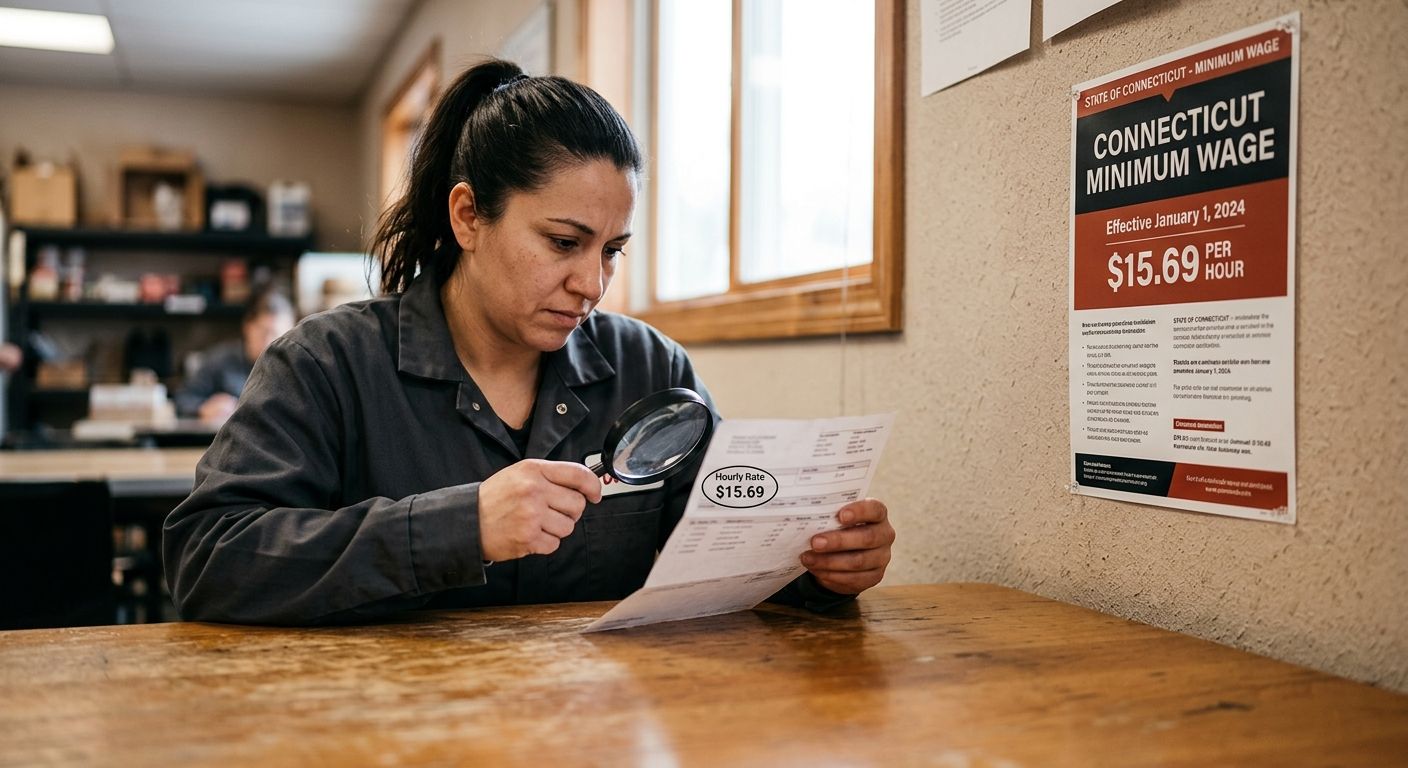
Check your first pay stub of the year. For 2024, the rate should be at least $15.69 per hour; for 2025, $16.35; for 2026, $16.94. If your hourly rate is lower, contact the Connecticut Department of Labor's Wage and Workplace Standards Division. You can also review the current rate at the state's minimum wage information page.
Why the Employment Cost Index instead of the Consumer Price Index?
The ECI tracks what employers pay workers in wages and benefits, while the CPI tracks consumer prices. By using the ECI, Connecticut ties its minimum wage to actual labor market compensation trends rather than fluctuations in food, energy, or housing costs. The advantage is stability; the disadvantage is that ECI growth can lag behind price increases that hit low-wage workers hardest, like rent and groceries.
What should I do if my employer claims I'm exempt from the minimum wage?
Very few workers are genuinely exempt. Federal and state exemptions exist for certain salaried executive, administrative, and professional employees, but those exemptions require meeting specific salary and duties tests. If you're paid hourly and your employer claims you don't qualify for the state minimum, get that claim in writing and bring it to the Department of Labor or a workers' rights organization for review. Misclassification is a common form of wage theft, and the burden of proving an exemption applies falls on the employer, not you.
The Union Edge Staff
Frequently Asked Questions
- What is Connecticut's minimum wage for 2024?
- Connecticut's minimum wage for 2024 is $15.69 per hour, which increased automatically from $15.00 on January 1, 2024, through the state's auto-indexing mechanism based on the federal Employment Cost Index.
- How does Connecticut's auto-indexing minimum wage mechanism work?
- Connecticut's auto-indexing uses three stages: the U.S. Bureau of Labor Statistics publishes the Employment Cost Index, the Connecticut Department of Labor calculates the percentage increase over the prior twelve months ending June 30, and the new rate takes effect on January 1 with no legislative vote required.
- What is the Connecticut minimum wage for tipped employees?
- Tipped employees in Connecticut must receive at least $6.38 per hour in direct wages as of 2024, and employers are legally required to make up the difference if the employee's tips and wages don't reach the full $15.69 minimum wage.
- Can Connecticut's minimum wage ever decrease?
- While the statute doesn't explicitly prohibit decreases, the Employment Cost Index has never posted a twelve-month decline in its history, so a decrease is theoretically possible but has never occurred.
- What was Connecticut's minimum wage before auto-indexing?
- Before 2024, Connecticut's minimum wage required legislative action for each increase. Public Act 19-4 created a schedule of fixed increases from $10.10 to $15.00 (the last taking effect June 1, 2023), then switched to automatic annual adjustments starting January 1, 2024.
- What is the Connecticut minimum wage for workers under 18?
- Workers under 18 can be paid 85% of the standard minimum wage during their first 90 days of employment, which was approximately $13.34 per hour in 2024; in agriculture and government roles, this reduced rate can apply indefinitely.
- Why does Connecticut use the Employment Cost Index instead of the Consumer Price Index?
- Connecticut uses the ECI because it measures what employers pay workers in wages and benefits, reflecting actual labor market compensation trends rather than consumer price fluctuations; this provides stability and ties the minimum wage to what the broader economy is actually paying people.
- What should I do if my employer isn't paying the new Connecticut minimum wage?
- If your employer hasn't updated your pay rate by your first paycheck of January, file a wage complaint with the Connecticut Department of Labor's Wage and Workplace Standards Division, as the auto-indexed increase is mandatory and employers who miss it are violating state law.
Related Articles
Minimum Wage Connecticut: 2024 Rates & Requirements
Connecticut's minimum wage is an annually auto-adjusting rate tied to the federal Employment Cost Index (ECI), set at $15.69 per hour for 2024 and currently $16.94 as of January 2026.

Minimum Wage New Jersey 2024: Rates & Updates
New Jersey's minimum wage for most employees reached $15.13 per hour on January 1, 2024, completing a legislated climb from $8.85 in 2019 and triggering a permanent CPI-indexed adjustment formula. The rate doesn't come from annual legislative votes anymore.

State of Colorado Minimum Wage 2024: Rates & Changes
Colorado's state minimum wage rose to $14.42 per hour on January 1, 2024, set automatically by a Consumer Price Index formula that removes the state legislature from annual rate decisions entirely.
Also in the paper