
Minimum Wage Connecticut: 2024 Rates & Requirements
Connecticut's minimum wage is an annually auto-adjusting rate tied to the federal Employment Cost Index (ECI), set at $15.69 per hour for 2024 and currently $16.94 as of January 2026.
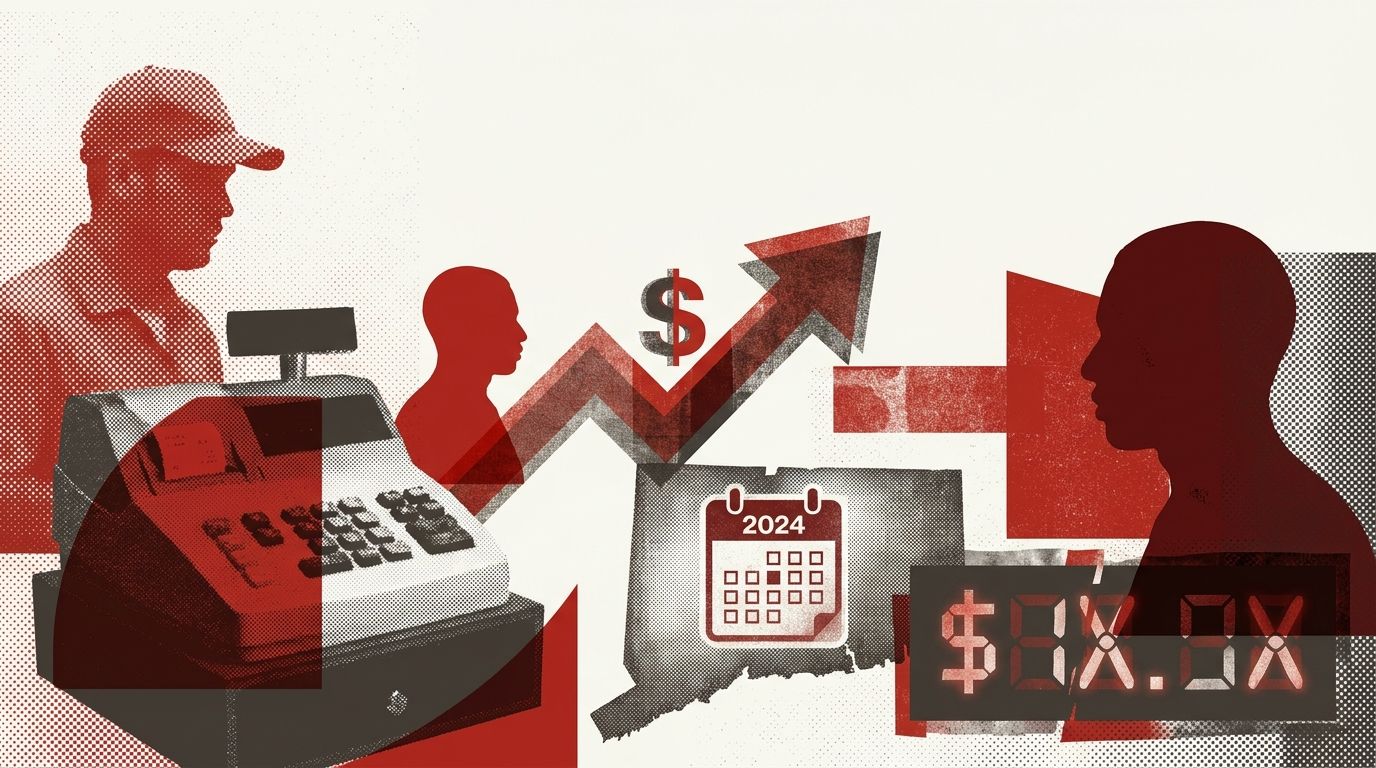
Minimum Wage in Connecticut: 2024 Rates, the ECI Formula, and What Workers Actually Get Paid
Connecticut's minimum wage is an annually auto-adjusting rate tied to the federal Employment Cost Index (ECI), set at $15.69 per hour for 2024 and currently $16.94 as of January 2026. The mechanism matters because Connecticut workers don't have to wait for legislators to vote on raises, the formula does it automatically, and understanding how it works determines whether you're being paid correctly.
Public Act 19-4: The Law That Created Automatic Raises
Public Act 19-4, signed by Governor Ned Lamont, ended Connecticut's old system of one-off legislative minimum wage increases and replaced it with an indexing mechanism pegged to the Employment Cost Index. The ECI is a quarterly measure published by the U.S. Bureau of Labor Statistics that tracks changes in total compensation costs, wages, salaries, and benefits, across private industry. Connecticut's Department of Labor calculates the percentage change in the ECI over a 12-month period ending each June, then applies that percentage to the current minimum wage to determine the next January 1 rate.
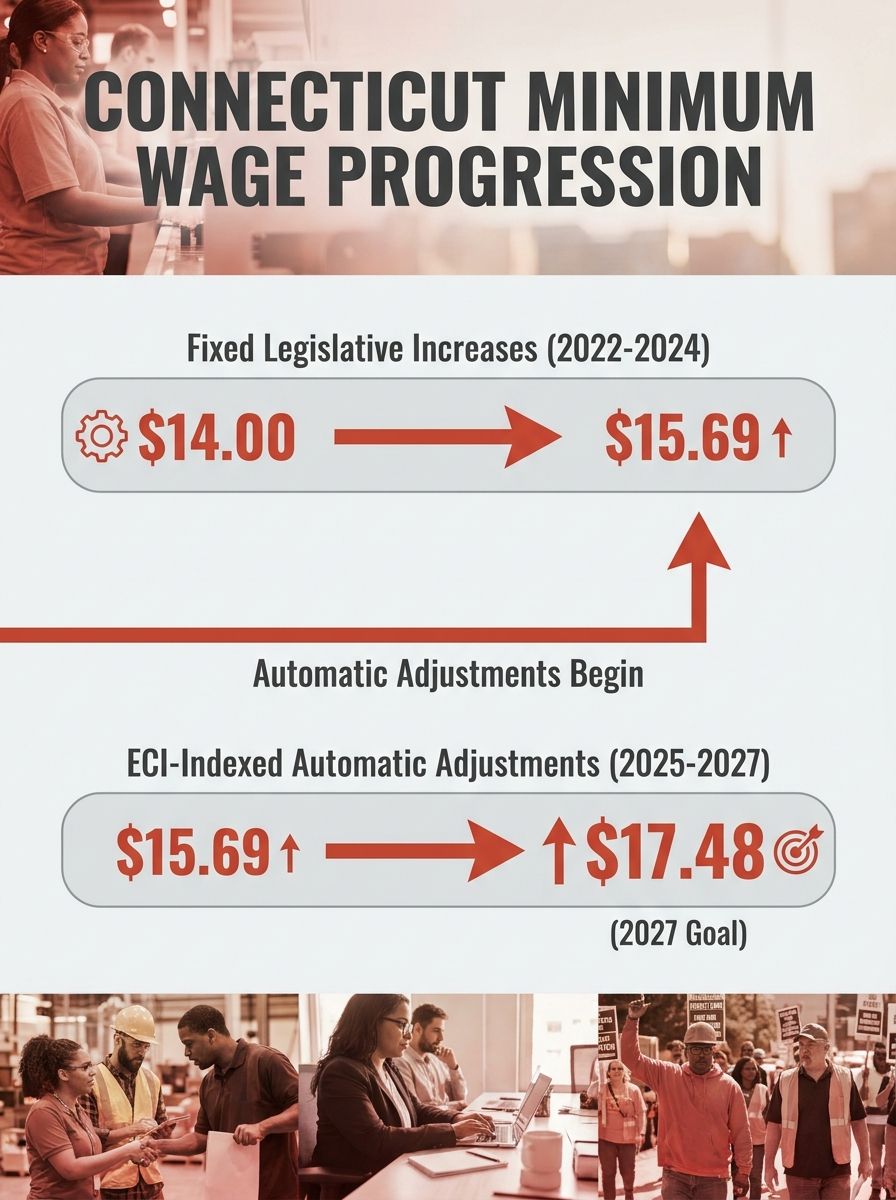
Before this law kicked in, Connecticut's minimum wage moved through a series of fixed increases: $14.00 on July 1, 2022, and $15.00 on June 1, 2023. Once the rate hit $15.00, the ECI indexing took over. The first indexed adjustment produced the $15.69 rate for 2024. The second produced $16.35 for 2025. The third produced $16.94 for 2026. And Governor Lamont announced a $17.48 rate for January 1, 2027, representing a $0.54 increase, a pattern of steady, inflation-responsive growth.
This design has a political purpose. Minimum wage Connecticut workers relied on, historically, would stagnate for years between legislative fights. Indexing removes the need for a new bill every time the cost of living rises. Workers in states like North Carolina, still stuck at the $7.25 federal floor, know what happens when raises depend entirely on political will.
How the ECI Calculation Produces Each Year's Rate
The Connecticut Department of Labor doesn't pick the new minimum wage. A formula does. Each year, the department looks at the ECI change for the 12-month period ending the previous June 30. It multiplies the current minimum wage by that percentage change, rounds to the nearest cent, and publishes the new rate, typically by October 15, giving employers roughly 10 weeks to update payroll.
Here's what that produced in practice:
Year | Effective Date | Minimum Wage | Increase | Mechanism |
|---|---|---|---|---|
2022 | July 1 | $14.00 | $1.00 | Legislative (fixed) |
2023 | June 1 | $15.00 | $1.00 | Legislative (fixed) |
2024 | January 1 | $15.69 | $0.69 | ECI-indexed |
2025 | January 1 | $16.35 | $0.66 | ECI-indexed |
2026 | January 1 | $16.94 | $0.59 | ECI-indexed |
2027 | January 1 | $17.48 | $0.54 | ECI-indexed |
Notice the pattern: the dollar amounts of each annual increase have been shrinking, $0.69, $0.66, $0.59, $0.54. That reflects the ECI itself moderating as compensation growth across the economy cooled from its post-pandemic peaks. The percentage increases have been running between roughly 3% and 4.5%, which tracks general wage inflation but doesn't outpace it. This is by design. The ECI mirrors what's happening economy-wide, so the minimum wage Connecticut sets won't spike unpredictably, but it also won't vault workers ahead of inflation.
The formula contains no provision for decreasing the minimum wage. If the ECI were to go negative in a deflationary period, the statute holds the rate at its current level. Workers can't lose ground through the formula, though they can fall behind if inflation runs higher than the ECI captures.
Compared to neighboring states, the results have been significant. Connecticut's $16.94 rate in 2026 sits well above the Massachusetts rate and dramatically above southern states that defer to the $7.25 federal minimum. Because Connecticut's minimum wage substantially exceeds the federal floor, most covered employers must comply with the state rate regardless of whether they're subject to the Fair Labor Standards Act.
The Tipped Worker Sub-Minimum: Frozen Since 2017
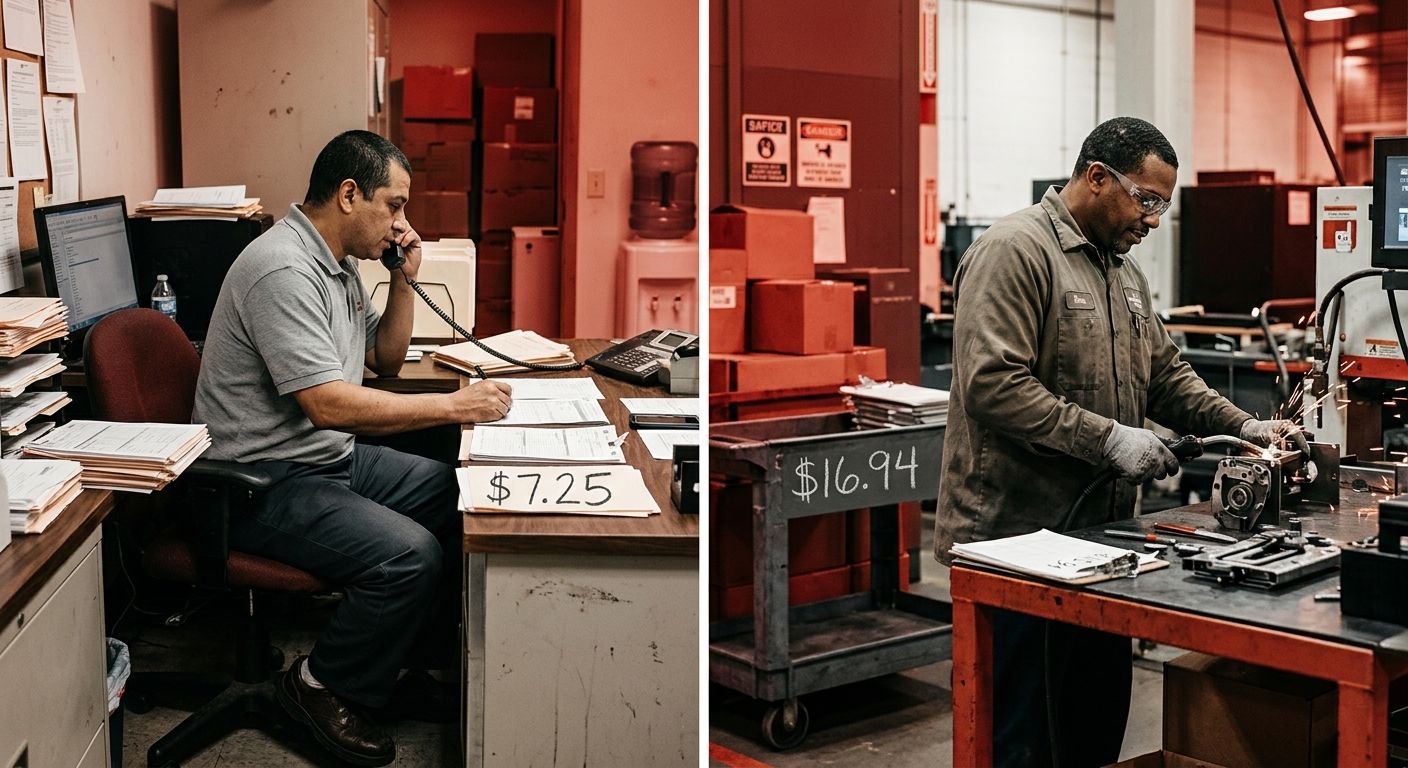
Here's where the mechanism fractures. Connecticut law allows employers to pay tipped workers a base wage far below the standard minimum, $6.38 per hour for restaurant wait staff and $8.23 per hour for bartenders. These sub-minimum rates have not changed since 2017. They are not indexed to the ECI. They are not indexed to anything.
The theory behind tip credits is straightforward: employers pay a reduced base wage, and tips are expected to fill the gap up to the full minimum wage. If a tipped employee's combined earnings (base wage plus tips) don't reach the standard minimum wage in any pay period, the employer is legally required to make up the difference. That's the rule on paper.
In practice, enforcement is uneven and tracking is burdensome. A server earning $6.38/hour needs to pull in $10.56/hour in tips to reach the 2026 standard of $16.94. During slow shifts, off-peak hours, or bad weather, that math doesn't work. The employer's obligation to supplement kicks in, but workers report that claiming those shortfalls can create friction with management.
The "One Fair Wage" movement has pushed Connecticut legislators to eliminate the tipped sub-minimum entirely, as reported by the CT Mirror. The proposal would require all employers to pay the full standard minimum wage, with tips added on top. It has not passed. Restaurant industry groups have lobbied against it, arguing that tipped workers already earn above the minimum when tips are included. Worker advocates counter that relying on customer generosity to meet a legal floor is an inherently unstable system, one that leaves workers particularly vulnerable during economic downturns.
The gap between $6.38 and $16.94 is now $10.56/hour. When the tipped minimum was last set in 2017, the standard minimum was $10.10, making the gap $3.72. The indexing mechanism has widened this disparity every single year without any legislative correction.
Reduced Rates for Minors and Learners
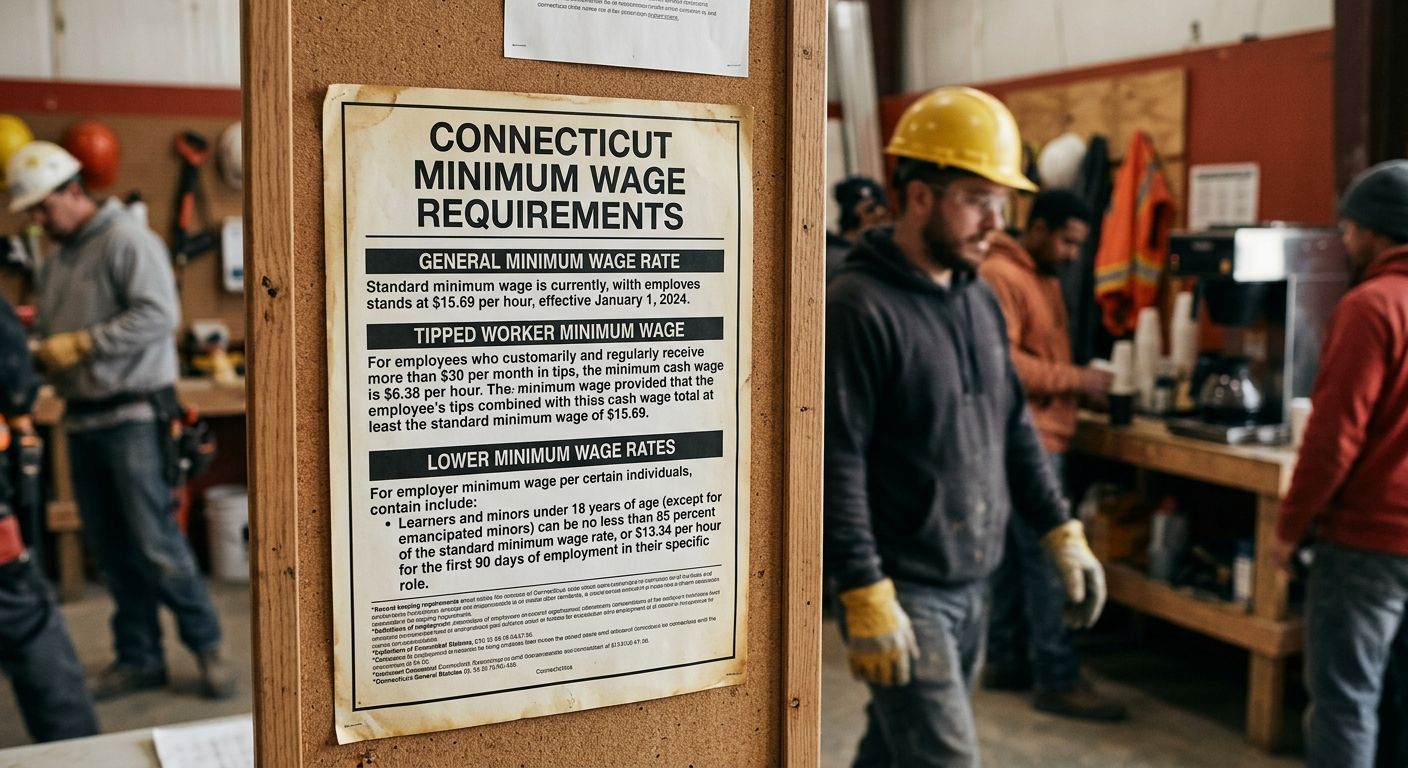
Connecticut permits two categories of reduced-rate employment. Workers under 18 can be paid 85% of the standard minimum wage for their first 90 days of employment. At the 2026 rate, that's $14.40/hour. Learners and trainees, a category defined by the Department of Labor that applies to workers gaining skills in a new occupation, can also be paid 85% of the minimum wage, but only for up to 200 hours of work.
Both exceptions have built-in time limits. After 90 days, a minor must be paid the full rate. After 200 hours, a trainee must be paid the full rate. Employers who extend reduced-rate pay beyond these windows are in violation.
These carve-outs affect a relatively small number of workers, but they matter in industries with high teen employment, fast food, retail, seasonal tourism along the Connecticut shoreline. The 85% provision means a 16-year-old starting a summer job in 2026 earns $2.54/hour less than an adult doing identical work. That difference adds up: over a 90-day period at 25 hours/week, it's roughly $825 in lost wages compared to the full rate.
Overtime, Coverage, and the Statewide Uniformity Rule
Connecticut requires overtime pay at 1.5 times the employee's regular rate for all hours worked beyond 40 in a workweek. At the 2026 minimum wage, overtime pay is $25.41/hour. This applies to most hourly workers, with narrow exemptions for certain executive, administrative, and professional employees who meet specific salary and duties tests.
One feature of Connecticut's minimum wage system that workers should understand: it's uniform statewide. No city or town in Connecticut can set its own minimum wage, there are no municipal overrides. Whether you work in downtown Hartford, rural Litchfield County, or the affluent Fairfield County suburbs, the rate is $16.94. This differs from states like Oregon, which operates a tiered system with different rates for Portland metro, standard counties, and nonurban counties.
The uniformity simplifies compliance for employers operating across multiple Connecticut locations. But it also means workers in high-cost areas like Stamford or Greenwich, where rents track New York City prices, receive the same floor as workers in towns where the cost of living is significantly lower.
Where the ECI Model Breaks
The ECI indexing mechanism is better than waiting for legislative action. But it has real blind spots.
It tracks average compensation, not low-wage compensation. The ECI measures changes in total employer compensation costs across the economy. When highly-paid professionals receive large raises, the index rises, even if low-wage workers saw minimal improvement. The minimum wage Connecticut workers receive goes up accordingly, but the increase reflects economy-wide trends, not the cost pressures specific to minimum-wage earners. Housing, food, and transportation costs in Connecticut can outpace the ECI in any given year.
It can't account for sudden cost shocks. The 12-month lookback period means the index always reflects the past, not the present. If inflation spiked in the second half of 2026, the January 2027 rate wouldn't capture that spike, it would show up in the January 2028 adjustment instead.
It ignores tipped workers entirely. As detailed above, the sub-minimum wage for tipped employees sits outside the indexing formula. The ECI mechanism improves conditions for standard-wage workers while leaving tipped workers stuck at 2017 rates.
It contains no catch-up provision. If the minimum wage falls behind the cost of living over multiple years, as it did nationally between 2009 and 2019, when the federal minimum stayed at $7.25, the ECI formula will only keep pace with future changes. It won't compensate for the ground already lost. States dealing with this problem, like Virginia with its own indexing formula, face similar structural limits.
For workers interested in pushing for stronger protections, including tipped wage reform and higher floors, the organizing infrastructure matters as much as the formula. The growth of union membership nationally has shown that collective bargaining can push wages well above statutory minimums, which function as a floor, not a ceiling.
Common Questions
Does Connecticut's minimum wage apply to all employers?
Connecticut's minimum wage of $16.94 (2026) applies to most employers in the state. Because it substantially exceeds the federal minimum wage of $7.25, employers covered by either state or federal law must pay the higher state rate. Very small employers not covered by state wage law but subject to the FLSA must pay at least the federal rate, though this scenario is rare in practice.
When does the minimum wage change each year?
The Connecticut Department of Labor announces each year's new rate by mid-October, based on the ECI calculation for the preceding 12-month period ending June 30. The new rate takes effect on January 1. The 2027 rate of $17.48 was announced in August 2026 by the governor's office.
Can Connecticut's minimum wage ever go down?
No. The statute specifies that the minimum wage can only increase or stay the same. If the ECI were to show a negative change, reflecting falling compensation costs economy-wide, the rate would hold at its current level until the next positive adjustment.
Why is the tipped minimum wage so much lower than the standard rate?
The $6.38 (wait staff) and $8.23 (bartender) rates were set by the legislature and haven't been updated since 2017. They operate on a "tip credit" system where employers assume tips will bring total compensation up to the full minimum wage. Unlike the standard rate, these sub-minimum wages are not tied to the ECI and require a separate legislative act to change.
What should I do if my employer isn't paying the correct rate?
File a wage complaint with the Connecticut Department of Labor's Wage and Workplace Standards Division. Document your hours worked, pay stubs, and any discrepancies. Connecticut law prohibits employer retaliation against workers who file wage complaints, and the department can order back pay, penalties, and interest on unpaid wages.
The Union Edge Staff
Frequently Asked Questions
- What is Connecticut's minimum wage in 2024 and 2026?
- Connecticut's minimum wage is $15.69 per hour for 2024 and $16.94 as of January 2026. The rate is automatically adjusted annually based on the Employment Cost Index (ECI).
- How does Connecticut's automatic minimum wage adjustment work?
- Connecticut's Department of Labor calculates the percentage change in the ECI over a 12-month period ending each June, then applies that percentage to the current minimum wage to determine the next January 1 rate. This automatic indexing mechanism, established by Public Act 19-4, eliminates the need for legislative votes on wage increases.
- What is the minimum wage for tipped workers in Connecticut?
- Tipped workers in Connecticut earn $6.38 per hour for wait staff and $8.23 per hour for bartenders. These rates have been frozen since 2017 and are not indexed to the ECI, though employers must ensure combined earnings from base wage plus tips meet the full minimum wage.
- Can minors be paid less than minimum wage in Connecticut?
- Yes, workers under 18 can be paid 85% of the standard minimum wage ($14.40 in 2026) for their first 90 days of employment. After 90 days, they must be paid the full minimum wage rate.
- What happens if a tipped worker's tips don't reach the full minimum wage?
- If a tipped employee's combined earnings from base wage plus tips don't reach the standard minimum wage in any pay period, the employer is legally required to make up the difference to ensure the worker receives at least the full minimum wage.
- When does Connecticut's minimum wage change each year?
- Connecticut's new minimum wage takes effect on January 1 each year. The Connecticut Department of Labor announces the rate by mid-October, based on the ECI calculation for the 12-month period ending June 30.
- What is Connecticut's overtime pay requirement?
- Connecticut requires overtime pay at 1.5 times the employee's regular rate for all hours worked beyond 40 in a workweek. At the 2026 minimum wage of $16.94, overtime pay equals $25.41 per hour.
- How do I file a wage complaint with Connecticut if I'm not paid correctly?
- File a wage complaint with the Connecticut Department of Labor's Wage and Workplace Standards Division with documentation of your hours worked and pay stubs. Connecticut law prohibits employer retaliation against workers who file complaints, and the department can order back pay, penalties, and interest.
Related Articles
State of Connecticut Minimum Wage 2024 Updates
Public Act 19-4 transformed Connecticut's minimum wage from a number set by legislators into a self-adjusting rate indexed to the federal Employment Cost Index. For 2024, that mechanism pushed the state of Connecticut minimum wage from $15.00 to $15.

State of Colorado Minimum Wage 2024: Rates & Changes
Colorado's state minimum wage rose to $14.42 per hour on January 1, 2024, set automatically by a Consumer Price Index formula that removes the state legislature from annual rate decisions entirely.
Massachusetts minimum wage: 2024 rates & changes
The mass minimum wage held at $15.00 per hour throughout 2024, unchanged for the first time in five years, after the final scheduled increase under the state's 2018 "Grand Bargain" legislation took effect on January 1, 2023.
Also in the paper