
Minimum Wage Massachusetts: 2024 Updates & Rules
M.G.L. Chapter 151, Section 1 sets the minimum wage in Massachusetts at $15.00 per hour and contains no indexing formula, no inflation trigger, and no scheduled future increase.

Minimum Wage Massachusetts: 2024 Updates and How the Law Actually Works
M.G.L. Chapter 151, Section 1 sets the minimum wage in Massachusetts at $15.00 per hour and contains no indexing formula, no inflation trigger, and no scheduled future increase. That legal dead end means every month the rate stays flat, rising costs carve deeper into workers' real earnings with no automatic correction.
The 2018 Grand Bargain and Its Expiration
The $15.00 rate arrived through a five-year escalator built into the 2018 legislation commonly known as the Grand Bargain. That law raised the minimum wage in Massachusetts from $11.00 per hour in 2018 by $0.75 to $1.00 increments each January, with the final increase taking effect on January 1, 2023. Every scheduled step has now been completed. The escalator ended. No replacement was enacted.
The Grand Bargain was a political trade-off. Workers got the phased wage increases and paid family and medical leave. Business interests got the elimination of time-and-a-half pay for Sunday and holiday retail work, which phased out over the same period. Both sides made concessions, and the deal's minimum wage provisions were designed with a hard stop, not a rolling adjustment.
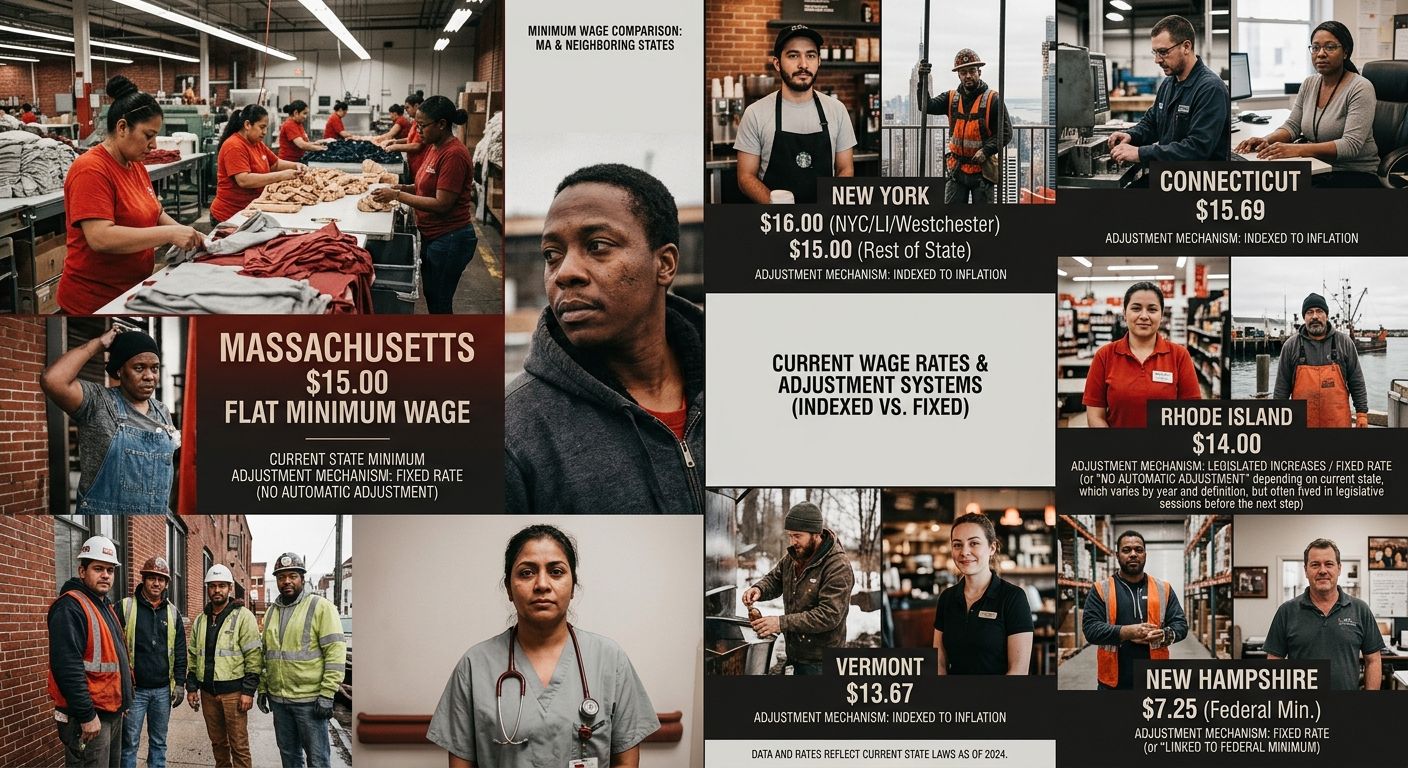
This structure matters because states like Colorado and Connecticut have since moved to automatic annual adjustments tied to the Consumer Price Index or the Employment Cost Index. Massachusetts did not. The state's $15.00 floor was ambitious when the Grand Bargain passed, but the lack of an inflation-adjustment mechanism means the rate loses purchasing power every year it stays frozen. As neighboring states approach or surpass $16.00, as we covered in our piece on Connecticut's auto-adjusting wage structure, Massachusetts workers are falling behind in real terms.
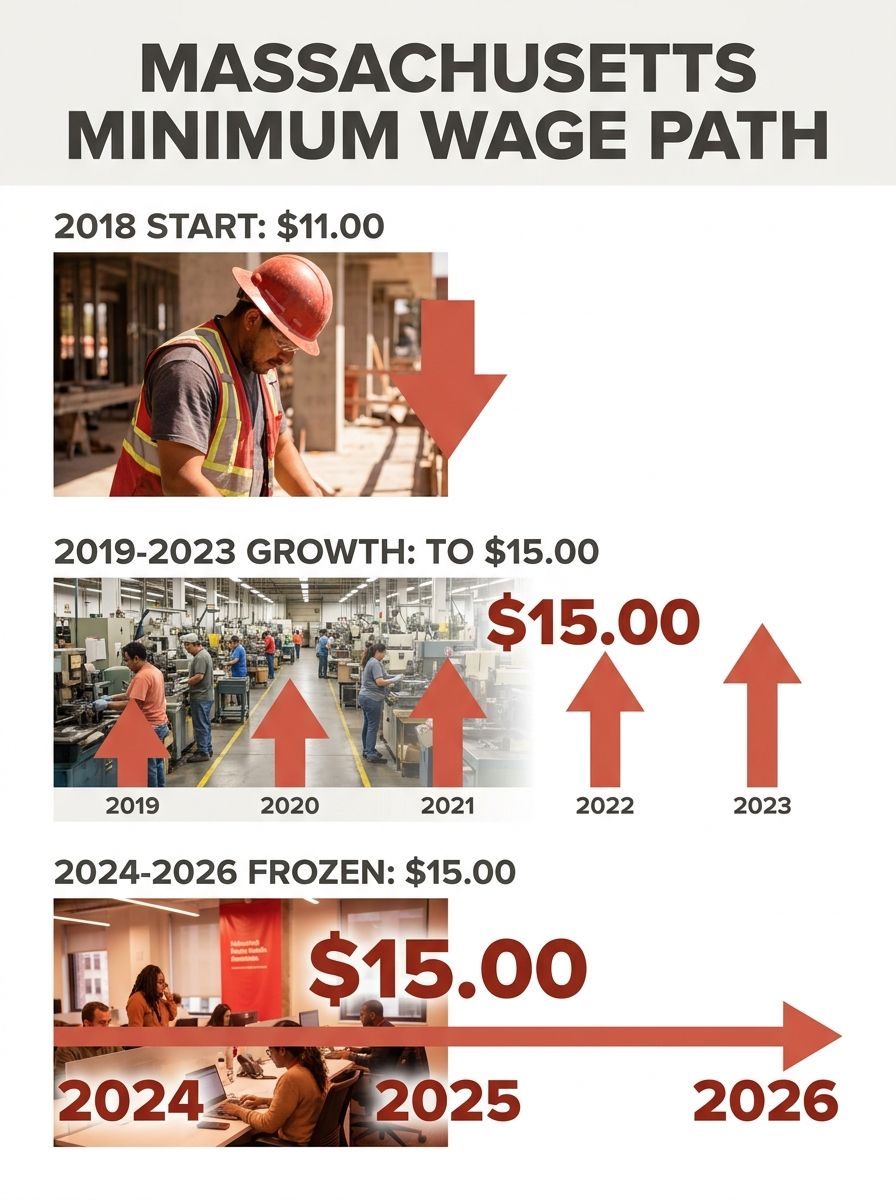
One additional protection exists in the statute: M.G.L. c. 151, § 1 requires that the state minimum wage remain at least $0.50 above the federal rate. With the federal minimum wage stuck at $7.25 since 2009, that backstop provision is irrelevant at current levels. But if Congress ever raised the federal floor above $14.50, the Massachusetts rate would be forced upward automatically, regardless of whether the state legislature acts.
How the Tipped Wage System Functions
Employers in Massachusetts can pay tipped workers a base service rate of $6.75 per hour under M.G.L. c. 151, § 7. The law requires that tips bring the worker's total hourly compensation to at least $15.00. If they don't, the employer must cover the gap immediately at the end of the shift.
That "end of shift" timing is a critical detail and one of the most commonly violated provisions of the Massachusetts minimum wage law. Some employers calculate tip credits over a full pay period instead, which allows a strong Friday night to subsidize a slow Tuesday lunch. The law forbids this. Each individual shift must meet the $15.00 threshold on its own, and shortfalls must be corrected the same day.
The $6.75 service rate creates a gap of $8.25 per hour that tips must fill. For a server working a 6-hour shift, that means $49.50 in tips just to reach the legal minimum. On slow shifts, the employer's obligation to make up the difference can be substantial, and workers who don't understand the rule, or who fear retaliation for raising it, often absorb the loss themselves. Workers dealing with wage theft in other industries face similar enforcement gaps.
The Massachusetts Minimum Fair Wage Law also doesn't distinguish between full-time and part-time employment. A part-time tipped worker on a 3-hour shift has the same per-hour protections as a full-time employee working 40 hours.
The Three-Hour Reporting Pay Rule
If an employer schedules a worker for 3 or more hours but sends them home early, Massachusetts law requires payment for a minimum of 3 hours at the standard minimum wage rate. That means at least $45.00 for any shift where the employee showed up as scheduled, regardless of whether they performed 3 hours of actual work.
This rule protects workers from the practice of "on-call scheduling," where employees travel to the workplace, change into uniforms, and prepare for shifts that get cancelled within minutes of the start time. The 3-hour guarantee ensures employers bear some of the cost of overscheduling rather than pushing the entire burden onto workers who lost time, transportation costs, and childcare arrangements.
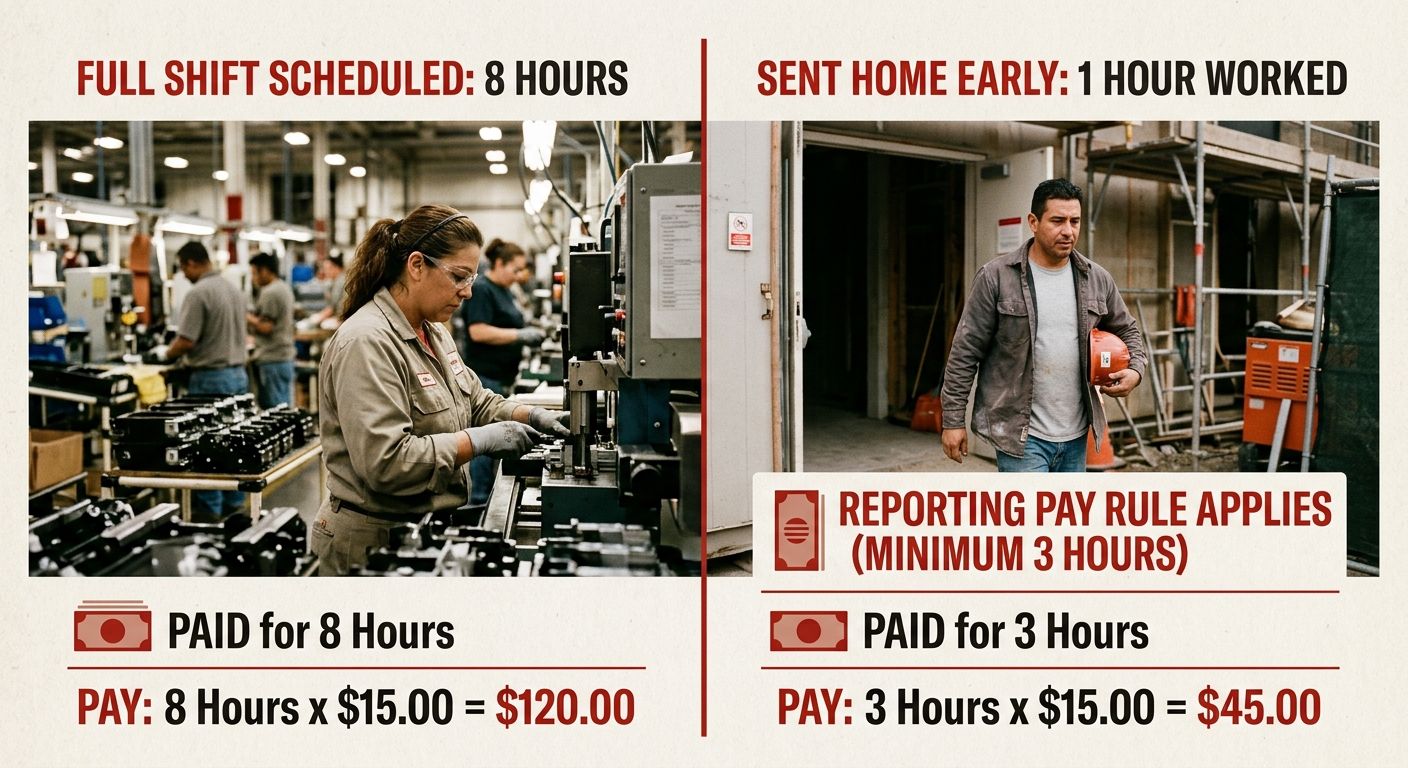
The rule applies to the $15.00 standard rate even for tipped employees. An employer who sends a server home after 45 minutes can't pay the 3-hour guarantee at the $6.75 service rate. The full $15.00 per hour applies, totaling $45.00 for the shortened shift.
Agricultural Workers and Other Carve-Outs
The Massachusetts minimum wage framework carves out several categories of workers from the $15.00 standard. Agricultural workers receive a separate, lower minimum of $8.00 per hour under M.G.L. c. 151, § 2A. That $7.00 gap between agricultural and standard wages is one of the widest in the northeastern states and reflects a longstanding national pattern of excluding farm labor from baseline protections. Workers under 18 and immediate family members of the farm employer fall outside even the $8.00 agricultural floor.
Beyond agriculture, Massachusetts exempts several other worker categories from its minimum wage law entirely. The state's exemption list includes external salespeople, employees being trained or rehabilitated in educational, charitable, or religious institutions, and certain professional service employees.
The exempt-employee salary threshold adds another layer. As of 2024, executive, administrative, and professional employees must earn at least $43,888 annually ($844 per week) to qualify as exempt from overtime. That threshold rose to $58,656 on January 1, 2025. Misclassifying hourly workers as salaried exempt employees to avoid paying overtime or meeting minimum wage requirements carries significant penalties under Massachusetts law, and it remains one of the most common violations the state investigates.
Senate Bill S.1349 and the Push to $20
Filed by Senator Jason M. Lewis, Senate Bill S.1349 proposes raising the Massachusetts minimum wage from $15.00 to $20.00 per hour over a 5-year phased schedule. The bill would also increase the tipped service rate from $6.75 to $12.00 per hour over the same period. After the phase-in, the minimum wage would adjust annually based on inflation.
The bill sits in the Joint Committee on Labor and Workforce Development. It has not advanced to a floor vote, and its prospects depend heavily on the composition of the legislature and the priorities of the governor's office. But the proposal addresses the structural gap left by the Grand Bargain: without a built-in adjustment mechanism, any fixed-dollar minimum wage erodes over time.
The difference between $15.00 and $20.00 per hour for a full-time worker amounts to roughly $10,400 per year in gross pay. For tipped workers, the jump from $6.75 to $12.00 in the base service rate would represent a 78% increase in guaranteed hourly pay before tips. Those numbers explain why the bill generates fierce opposition from restaurant and retail industry groups, who argue the increases would force layoffs and closures, and strong support from labor organizations, who point to the growing gap between wages and the cost of living in metro Boston.
Similar legislative fights play out across the country. States like Illinois and Colorado have adopted their own approaches to phased increases, with varying degrees of inflation indexing built in.
Where the $15 Floor Breaks Down
The Massachusetts minimum wage system contains several fault lines where its protections thin out or disappear entirely.
No local override authority. Massachusetts enforces a uniform statewide minimum wage. Cities like Boston, Cambridge, and Springfield cannot set higher local minimums, even though the cost of living in greater Boston vastly exceeds costs in western Massachusetts. A $15.00 floor that stretches reasonably far in Springfield may cover barely half a studio apartment's rent in Boston's inner neighborhoods.
Enforcement depends on complaints. The state's wage enforcement system is complaint-driven. Workers who don't know their rights, who fear retaliation, or who lack documentation rarely file complaints. Tipped workers, agricultural employees, and undocumented immigrants are disproportionately affected by this gap between the law on paper and the law in practice.
The frozen rate loses ground to inflation. Between January 2023 and mid-2026, cumulative inflation has eroded the $15.00 rate's purchasing power by a meaningful percentage. Every month the rate stays frozen, the real minimum wage drops. Unlike states with CPI-indexed rates, Massachusetts has no mechanism to correct for this without entirely new legislation.
Gig workers and independent contractors exist outside the framework. The minimum wage applies to employees, not independent contractors. Misclassification remains common in industries like ride-hailing, delivery, and construction, and workers classified as contractors receive none of the protections of M.G.L. c. 151, including the minimum wage floor, overtime, and the three-hour reporting pay rule. The NLRB's ongoing classification disputes affect the federal picture, but Massachusetts state law provides its own tests for employee status that workers should understand.
Exempt thresholds can swallow low-salaried workers. The salary threshold for overtime exemption, while rising, still allows employers to classify workers earning around $43,888 as exempt and avoid paying overtime for 50- or 60-hour weeks. That annual salary, divided by actual hours worked, can push effective hourly pay below the minimum wage in practice.
Common Questions
Does the Massachusetts minimum wage go up every year?
No. The final scheduled increase under the 2018 Grand Bargain law took effect on January 1, 2023, bringing the rate to $15.00 per hour. No additional automatic increases are planned. Any future raise requires new legislation or a statewide ballot question.
Can cities in Massachusetts set a higher local minimum wage?
They cannot. Massachusetts enforces a uniform statewide minimum wage of $15.00 per hour. Unlike states such as California or Colorado, municipalities have no authority to establish higher local floors.
What happens if my tips don't bring me to $15.00 per hour?
Your employer is legally required to make up the difference at the end of each shift. The calculation must happen per shift, not averaged over a pay period. If your employer refuses to cover tip shortfalls, that constitutes a wage violation under state law.
Does the $15.00 minimum wage apply to part-time workers?
Yes. The Massachusetts Minimum Fair Wage Law makes no distinction between full-time and part-time employment. Every covered worker earns at least $15.00 per hour regardless of weekly hours scheduled.
What does Senate Bill S.1349 propose?
The bill would raise the minimum wage from $15.00 to $20.00 per hour over five years and increase the tipped service rate from $6.75 to $12.00. After full implementation, the rate would adjust annually for inflation. The bill has been referred to the Joint Committee on Labor and Workforce Development but has not received a floor vote.
The Union Edge Staff
Frequently Asked Questions
- What is the current minimum wage in Massachusetts in 2024?
- The Massachusetts minimum wage is $15.00 per hour as of January 1, 2023, and remains fixed at that rate with no automatic increases scheduled. Any future raise requires entirely new legislation.
- What is the tipped minimum wage in Massachusetts?
- Tipped workers in Massachusetts receive a base service rate of $6.75 per hour, and employers must ensure tips bring the worker's total hourly compensation to at least $15.00. If tips fall short, the employer must make up the difference at the end of each shift.
- Can Massachusetts cities set their own higher minimum wage?
- No, Massachusetts enforces a uniform statewide minimum wage of $15.00 per hour, and cities like Boston and Cambridge cannot establish higher local minimums regardless of local cost of living differences.
- What is the three-hour reporting pay rule in Massachusetts?
- If an employer schedules a worker for 3 or more hours but sends them home early, Massachusetts law requires payment for a minimum of 3 hours at the standard minimum wage rate ($15.00 per hour, totaling at least $45.00).
- What is the agricultural minimum wage in Massachusetts?
- Agricultural workers in Massachusetts receive a minimum wage of $8.00 per hour, which is $7.00 lower than the standard $15.00 minimum wage.
- What does Senate Bill S.1349 propose for Massachusetts minimum wage?
- Senate Bill S.1349 proposes raising the Massachusetts minimum wage from $15.00 to $20.00 per hour over 5 years and increasing the tipped service rate from $6.75 to $12.00 per hour. After implementation, the wage would adjust annually based on inflation.
- How do employers calculate tip credits for Massachusetts minimum wage?
- Massachusetts law requires tip credit calculations on a per-shift basis, not averaged over a full pay period. Each individual shift must meet the $15.00 threshold on its own, and any shortfalls must be corrected the same day.
Related Articles
Massachusetts minimum wage: 2024 rates & changes
The mass minimum wage held at $15.00 per hour throughout 2024, unchanged for the first time in five years, after the final scheduled increase under the state's 2018 "Grand Bargain" legislation took effect on January 1, 2023.
State of Connecticut Minimum Wage 2024 Updates
Public Act 19-4 transformed Connecticut's minimum wage from a number set by legislators into a self-adjusting rate indexed to the federal Employment Cost Index. For 2024, that mechanism pushed the state of Connecticut minimum wage from $15.00 to $15.
Minimum Wage State of Illinois: 2024 Guide
The minimum wage in the state of Illinois is $15.00 per hour for workers 18 and older, the rate that took effect January 1, 2025, completing a phased schedule of six annual increases. But Illinois doesn't operate on a single number.
Also in the paper