
State of Colorado Minimum Wage 2024: Rates & Changes
Colorado's state minimum wage rose to $14.42 per hour on January 1, 2024, set automatically by a Consumer Price Index formula that removes the state legislature from annual rate decisions entirely.

State of Colorado Minimum Wage 2024: Rates, CPI Formula, and What Workers Need to Know
Colorado's state minimum wage rose to $14.42 per hour on January 1, 2024, set automatically by a Consumer Price Index formula that removes the state legislature from annual rate decisions entirely. The mechanism matters for worker safety: wages that fail to keep pace with inflation push employees into longer hours, multiple jobs, and the fatigue-related hazards that follow.
How Colorado's Wage Floor Works Differently from Most States
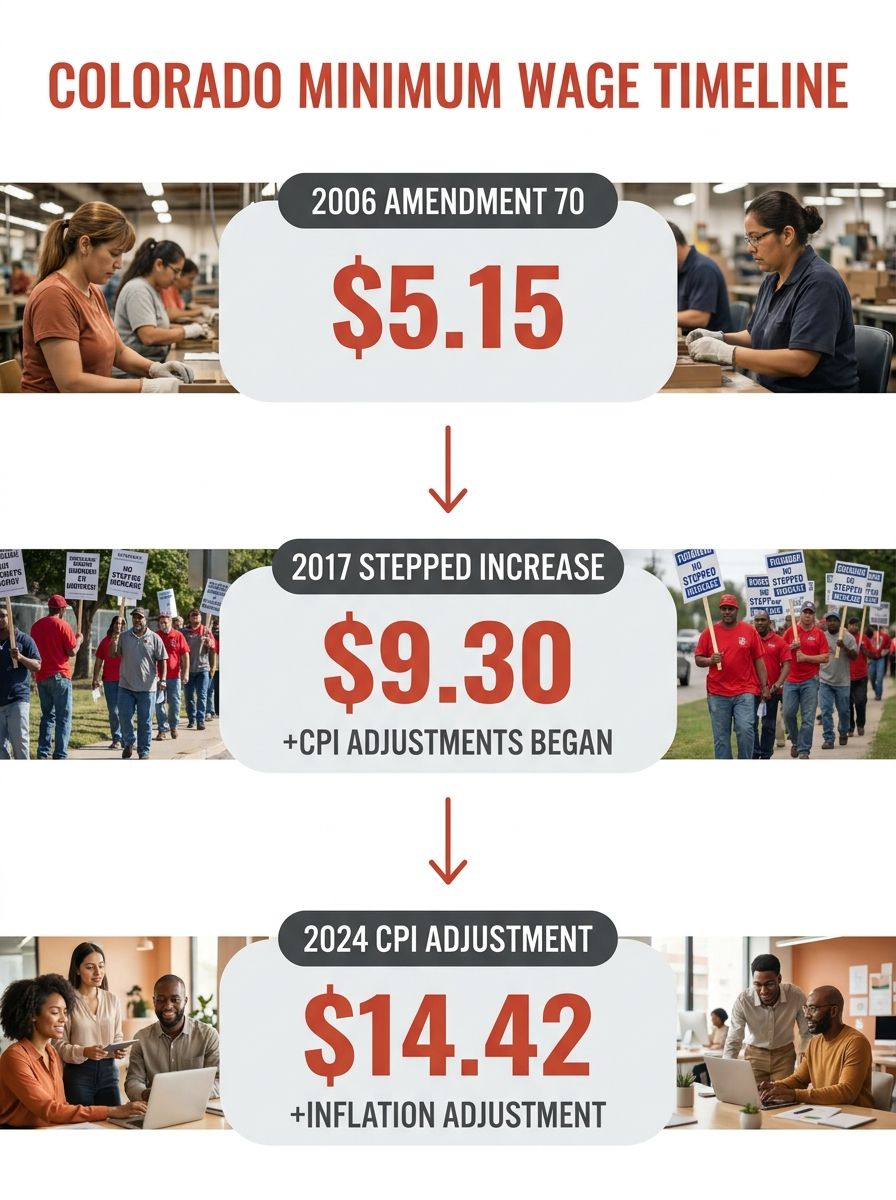
The state of Colorado minimum wage operates through an automatic annual adjustment tied to inflation, a system voters locked into the state constitution through Amendment 70 in 2006. Unlike states such as Virginia, where the governor can freeze the rate through a single veto, Colorado's formula runs regardless of which party controls the statehouse. The St. Louis Federal Reserve tracks the rate through its FRED economic database, confirming that adjustments happen "annually based on changes in the CPI and a cost of living formula."
Before Amendment 70, Colorado's minimum wage sat at $5.15 per hour, identical to the federal floor. The amendment mandated incremental increases to reach $6.85 by 2007 and then pegged all future adjustments to inflation. By 2024, the rate had climbed to $14.42, a figure that reflects a 5.6% inflation adjustment from the 2023 rate of $13.65.
The practical effect: Colorado workers don't have to wait for politicians to act. The formula does the work automatically every January 1. That said, the formula also means the rate can increase by very little during low-inflation years, and it never decreases, even during deflationary periods.
The CPI Calculation Behind the $14.42 Rate
Colorado's Division of Labor Standards and Statistics (DLSS) within the Department of Labor and Employment (CDLE) calculates each year's minimum wage using the Denver-Aurora-Lakewood Consumer Price Index. The CDLE publishes the new rate by September 30 each year, giving employers roughly three months to adjust payroll before the January 1 effective date.
The calculation itself is straightforward: the DLSS takes the percentage change in the regional CPI over the prior year and applies it to the current minimum wage, rounding to the nearest $0.01. For 2024, that meant a $0.77 increase over the 2023 rate of $13.65, reflecting 5.6% inflation in the Denver metro area.
This regional CPI anchor is significant. Colorado doesn't use the national CPI-U that the federal Bureau of Labor Statistics publishes for the country as a whole. The Denver-Aurora-Lakewood index tracks prices specific to the Front Range metro area, where housing costs have risen faster than the national average for more than a decade. Workers in mountain resort towns or rural eastern Colorado live under the same state minimum despite facing very different cost pressures, a tension the formula doesn't resolve.
For context, the CDLE announced on August 13, 2026, that the state minimum wage will rise to $15.71 per hour in 2027, a 3.6% increase from the current rate. That trajectory shows the formula continuing to push wages upward, though at a slower pace than the 5.6% jump workers saw in 2024.
Tipped Workers and the Fixed $3.02 Credit
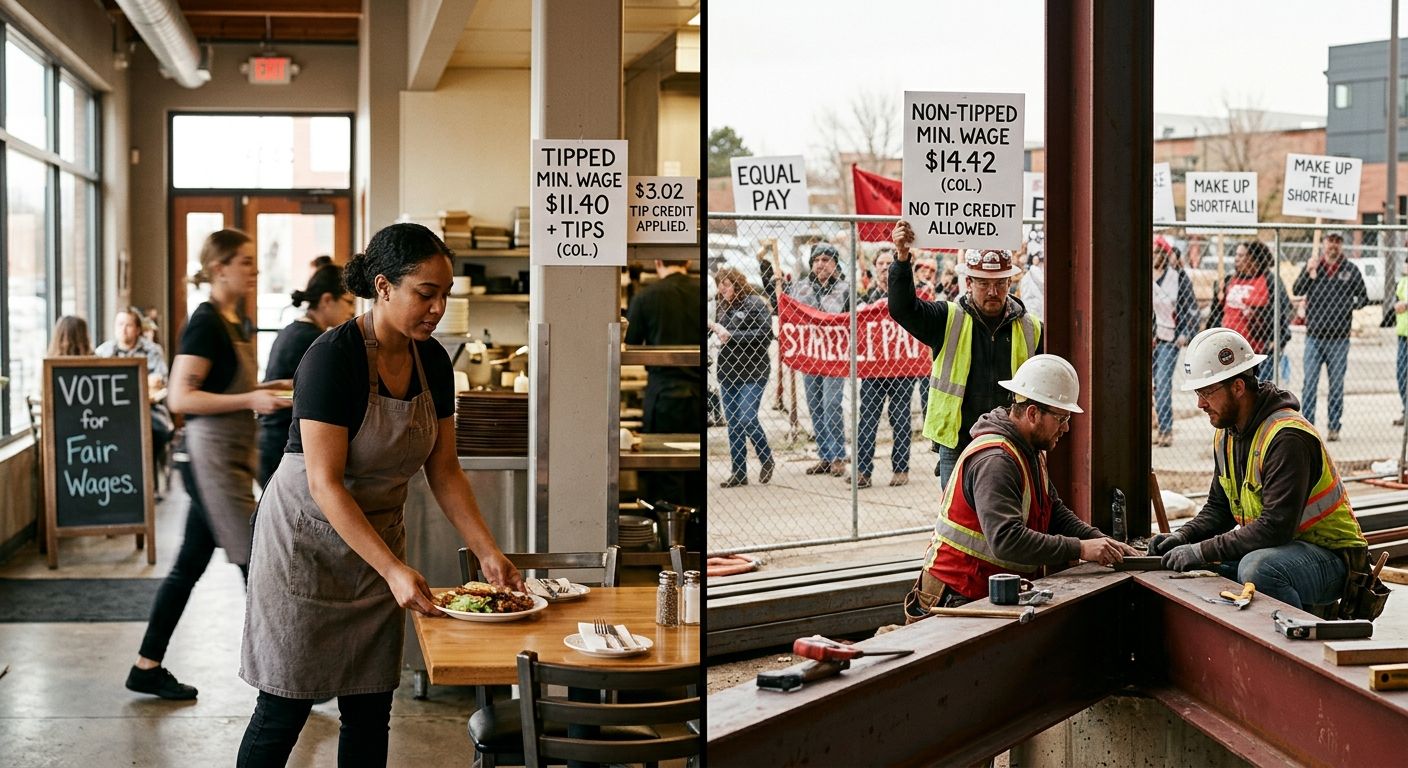
Colorado law permits employers to pay tipped workers $3.02 per hour less than the full minimum wage, setting the 2024 tipped rate at $11.40 per hour. This $3.02 gap is fixed by statute. It does not increase with inflation, which means the tip credit represents a shrinking percentage of total compensation as the base rate climbs.
According to the CDLE's guidance document on tips and tipped employees, "employers can't pay less than $3.02 below full minimum wage, no matter how high tips are." The rule has a critical flip side: if a tipped worker's combined hourly earnings (base pay plus tips) don't reach $14.42 in any pay period, the employer must make up the difference. Failure to do so constitutes a wage violation under the Colorado Wage Act.
This is where the safety connection gets concrete. Tipped workers who depend on customer generosity for a significant portion of their income are statistically less likely to report unsafe working conditions, from wet floors in restaurant kitchens to inadequate ventilation in bars. The fear of employer retaliation, including reduced shifts or unfavorable section assignments, keeps hazard reports low. A higher base wage reduces that dependency and, with it, the pressure to stay silent about dangers on the job.
Local Rates That Override the State Floor
Colorado's minimum wage framework allows municipalities to set rates above the state floor. Three jurisdictions did so for 2024, and the differences are substantial:
Jurisdiction | 2024 Hourly Rate | Tipped Rate | Premium Over State Rate |
|---|---|---|---|
State of Colorado | $14.42 | $11.40 | Baseline |
Denver | $18.29 | $15.27 | +$3.87 (26.8%) |
Unincorporated Boulder County | $15.69 | $12.67 | +$1.27 (8.8%) |
Edgewater | $15.02 | $12.00 | +$0.60 (4.2%) |
As Perkins Coie noted in their 2024 analysis, "Colorado employers should be aware that municipalities within Colorado will also be increasing their minimum wage above the state's minimum wage." The firm emphasized that employers operating across multiple jurisdictions must track and comply with each locality's rate separately.
Denver's $18.29 rate deserves particular attention. It sits 26.8% above the state floor and represents one of the highest municipal minimum wages in the interior United States. Denver's rate also adjusts annually by CPI, with a cap: local increases can't exceed 15% or $1.75, whichever is greater, in a single year. That cap prevents wild swings but still allows the gap between Denver and the state rate to widen over time.
For workers who commute between jurisdictions, the rule is simple: you earn the rate for the jurisdiction where you perform the work, not where your employer is headquartered. A dishwasher employed by a restaurant chain based in Colorado Springs but working a shift at the Denver location earns $18.29, not $14.42.
The $55,000 Exempt Salary Threshold
Colorado's wage protections extend beyond hourly workers. COMPS Order #39, adopted by the CDLE's Division of Labor Standards and Statistics for 2024, raised the minimum salary for exempt employees to $55,000 annually ($1,057.69 per week), up from $50,000 in 2023. As the Baird Quinn law firm documented, COMPS Order #39 "introduces significant changes to wage and hour laws" for the 2024 calendar year.
This threshold determines whether an employee classified as administrative, executive, or professional (the "EAP" categories) qualifies for overtime protections. Below $55,000, employers owe overtime pay at 1.5 times the regular rate for hours worked beyond 40 per week. At the state minimum wage, that overtime floor is $21.63 per hour.
The exempt salary threshold matters for safety because misclassification (labeling a $48,000-per-year assistant manager as "exempt" to avoid paying overtime) directly incentivizes overwork. When employers face no financial penalty for scheduling 50-hour or 60-hour weeks, fatigue accumulates. The National Safety Council has repeatedly linked extended work hours to increased injury rates across industries from construction to healthcare.
Workers in Colorado who suspect they've been misclassified can file complaints with the DLSS. Similar wage floor protections exist in other states: Ohio uses a constitutional CPI formula comparable to Colorado's, while New Jersey has pursued aggressive annual increases through legislative action.
Why Wage Floors Are a Workplace Safety Mechanism
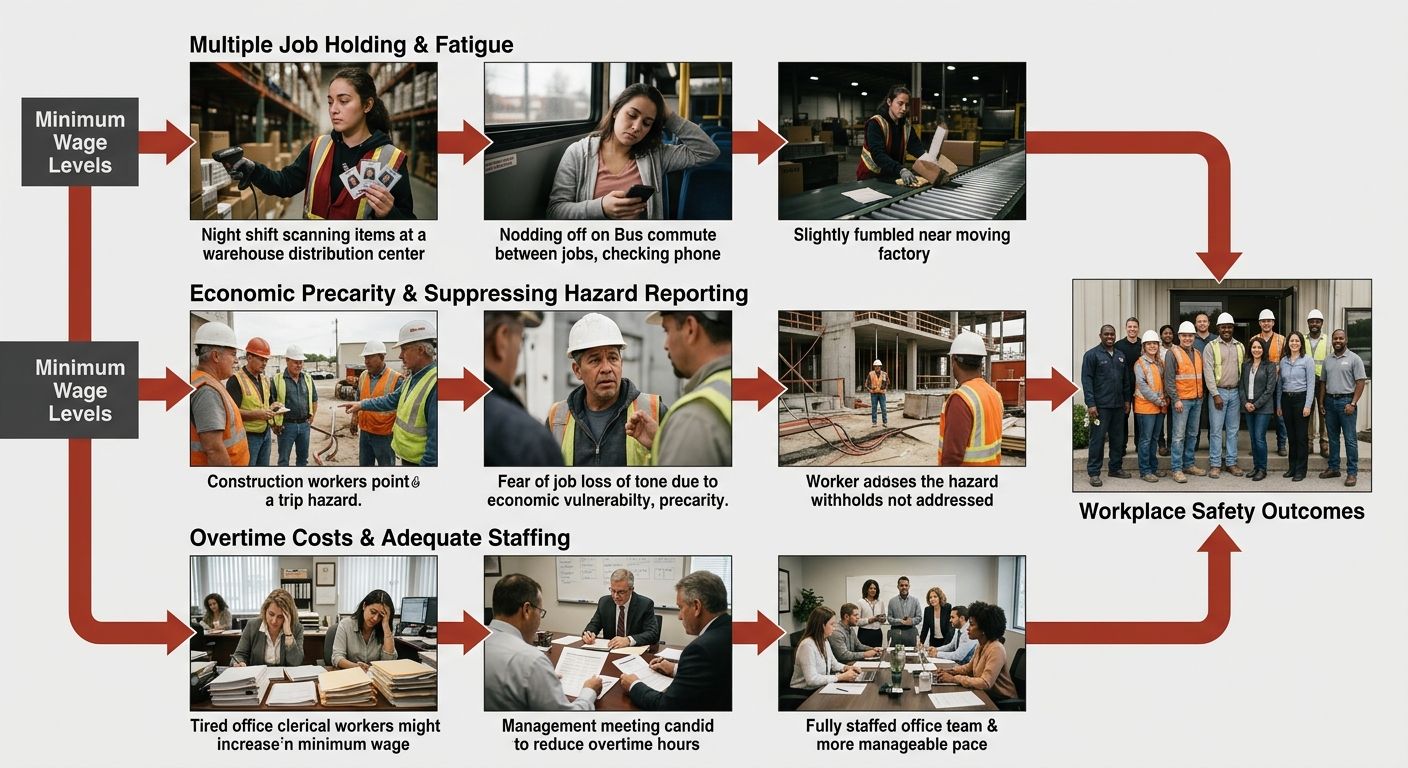
The connection between minimum wage rates and workplace safety runs through three documented pathways.
First, inadequate wages force workers into holding multiple jobs. The Bureau of Labor Statistics reported that 4.8% of U.S. workers held multiple jobs in 2023, with the rate significantly higher among workers earning below $15 per hour. Multiple job holders sleep less, commute more, and arrive at each job with diminished alertness. In physically demanding or hazardous occupations like warehouse work, food service, and construction, that fatigue translates directly into injuries.
Second, low-wage workers report safety violations at lower rates than higher-paid workers. The economic precariousness of earning $14.42 per hour (roughly $30,000 annually before taxes for a full-time worker) makes the threat of reduced hours or termination existentially frightening. Workers who can't afford to miss a single paycheck don't file OSHA complaints. Colorado's wage floor provides a partial buffer, but at $14.42, a worker in Denver, where median rent for a one-bedroom apartment exceeded $1,700 per month in 2024, remains in a deeply vulnerable position.
Third, the overtime protections attached to wage law prevent the kind of extended shifts that produce the highest injury rates. Colorado's 2024 overtime minimum of $21.63 per hour creates a financial disincentive for employers to schedule excessive hours. When overtime is expensive, employers hire additional staff instead, and shorter shifts mean fewer fatigue-related incidents. This is the same logic that drives hospital worker organizing around staffing ratios, where understaffing and mandatory overtime have fueled both injury rates and strike actions.
Where the Formula Breaks
Colorado's CPI-indexed minimum wage is one of the better-designed automatic adjustment systems in the country. It still has gaps that leave workers exposed.
The regional CPI anchor captures inflation in the Denver-Aurora-Lakewood metro area but fails to account for cost variations across Colorado's geography. A worker in Telluride, where seasonal housing costs rival San Francisco's, earns the same $14.42 state minimum as a worker in Pueblo, where the cost of living sits well below the national average. The formula treats Colorado as economically uniform when it isn't.
The fixed $3.02 tip credit erodes the tipped minimum wage's purchasing power relative to the full minimum wage with every annual adjustment. In 2018, when the full rate was $10.20, the tip credit represented 29.6% of total compensation. By 2024, at $14.42, it had dropped to 20.9%. The gap between tipped and non-tipped workers narrows in percentage terms, but the $3.02 hole in base pay persists. Workers in tip-dependent roles carry disproportionate economic risk, and that risk suppresses their willingness to advocate for safer conditions.
Local preemption remains politically contested. Only three Colorado municipalities had enacted local minimum wages by 2024. Efforts to expand local authority face opposition from business groups arguing that a patchwork of rates creates compliance burdens. The counterargument is straightforward: workers in high-cost localities need higher floors, and the state rate alone doesn't protect them adequately.
The formula also can't address the federal tipped minimum wage of $2.13 per hour, which applies to workers in states without their own tipped minimums. Colorado's $11.40 tipped rate is dramatically better than the federal floor, but the existence of that $2.13 baseline elsewhere in the country depresses industry norms and worker expectations across state lines.
Common Questions
Does the state of Colorado minimum wage apply to all workers?
Colorado's $14.42 rate covers most employees, but narrow exceptions exist for certain agricultural workers, some domestic employees, and workers covered by valid training wage provisions. The training wage, available only for the first 90 days of employment for workers under 20, still must meet federal minimums. If you perform work in Colorado and don't fall into a statutory exemption, you're owed at least $14.42 per hour (or your local rate, if higher).
What happens if my tips don't bring me up to $14.42 per hour?
Your employer must make up the difference. Colorado law is explicit: the $3.02 tip credit means your base pay can be $11.40, but your total hourly compensation (base plus tips) must equal or exceed $14.42 in every pay period. If it doesn't, your employer owes you the shortfall. Failing to pay it is a wage violation, and you can file a complaint with the CDLE's Division of Labor Standards and Statistics.
How does Colorado's rate compare to neighboring states?
Colorado's $14.42 sits well above the $7.25 federal minimum that still governs several neighboring states. Wyoming and Utah both default to the federal $7.25 floor. New Mexico set its 2024 rate at $12.00. Nebraska's 2024 rate was also $12.00. Among its neighbors, Colorado's automatic CPI adjustment mechanism is the most aggressive at tracking inflation, similar to the indexed approach Ohio uses.
When will the next increase take effect?
The CDLE announces each new rate by September 30 for the following January 1. The department confirmed on August 13, 2026, that the 2027 rate will be $15.71 per hour (a 3.6% increase) with a tipped rate of $12.69. Workers don't need to petition for these increases; the CPI formula triggers them automatically.
Can my employer retaliate against me for asking about minimum wage compliance?
No. Colorado's wage protection statutes prohibit retaliation against workers who inquire about pay rates, file wage complaints, or participate in CDLE investigations. If you experience reduced hours, termination, or other adverse action after raising wage concerns, that retaliation itself is a separate violation you can report to the DLSS.
The Union Edge Staff
Frequently Asked Questions
- What is the Colorado minimum wage for 2024?
- Colorado's state minimum wage is $14.42 per hour as of January 1, 2024, with a tipped minimum wage of $11.40 per hour. The rate is automatically adjusted each year based on the Denver-Aurora-Lakewood Consumer Price Index formula.
- How is Colorado's minimum wage calculated each year?
- Colorado's minimum wage is calculated automatically using the Denver-Aurora-Lakewood Consumer Price Index, with no legislative vote required. The percentage change in regional CPI over the prior year is applied to the current minimum wage and rounded to the nearest $0.01.
- What is Denver's minimum wage in 2024?
- Denver's minimum wage for 2024 is $18.29 per hour ($15.27 for tipped workers), which is $3.87 higher than the state rate. Denver's rate also adjusts annually by CPI with a cap preventing increases from exceeding 15% or $1.75 in a single year.
- Do employers have to make up tips if they don't reach minimum wage?
- Yes, employers must make up the difference if a tipped worker's combined hourly earnings (base pay plus tips) don't reach the full $14.42 minimum wage in any pay period. Failure to do so constitutes a wage violation under the Colorado Wage Act.
- What is Colorado's exempt salary threshold for 2024?
- Colorado's minimum salary for exempt employees in 2024 is $55,000 annually ($1,057.69 per week). Employees classified as administrative, executive, or professional earning below this threshold are entitled to overtime pay at 1.5 times their regular rate for hours over 40 per week.
- Which jurisdiction's minimum wage applies when I work in multiple Colorado cities?
- You earn the minimum wage for the jurisdiction where you perform the work, not where your employer is headquartered. Employers must pay whichever rate is highest—the state minimum or the local rate where work is actually performed.
- What will Colorado's minimum wage be in 2027?
- Colorado's minimum wage will rise to $15.71 per hour in 2027, a 3.6% increase from the current rate, with a tipped rate of $12.69. The CDLE announced this increase on August 13, 2026.
- Can my employer retaliate against me for asking about minimum wage?
- No, Colorado law prohibits retaliation against workers who inquire about pay rates, file wage complaints, or participate in CDLE investigations. Retaliation through reduced hours, termination, or other adverse action is itself a separate violation.
Related Articles

Minimum Wage in Colorado: 2024 Rates & Changes
Amendment 42, approved by Colorado voters in 2006, turned the state's minimum wage into a self-adjusting constitutional provision indexed to the Consumer Price Index for the Denver-Aurora-Lakewood metro area.

State of Connecticut Minimum Wage 2024 Updates
Public Act 19-4 transformed Connecticut's minimum wage from a number set by legislators into a self-adjusting rate indexed to the federal Employment Cost Index. For 2024, that mechanism pushed the state of Connecticut minimum wage from $15.00 to $15.

state of arizona minimum wage 2024 Guide
Arizona's state minimum wage in 2024 is $14.35 per hour, set by an automatic inflation-adjustment formula that voters embedded in state law through Proposition 206 in 2016.
Also in the paper