
Virginia State Minimum Wage: 2024 Rate & Updates
$12.41 plus ($12.41 × 0.029) equals $12.77. That one-line formula, published by the Virginia Department of Labor and Industry, determines the minimum wage in the state of Virginia taking effect January 1, 2026.
Virginia State Minimum Wage: How the Rate Is Calculated and Where It's Headed
$12.41 plus ($12.41 × 0.029) equals $12.77. That one-line formula, published by the Virginia Department of Labor and Industry, determines the minimum wage in the state of Virginia taking effect January 1, 2026. It adds 36 cents per hour based on the Consumer Price Index, and it governs what the commonwealth's lowest-paid workers earn until a $15.00 statutory floor arrives in 2028.
What Virginia Law Requires
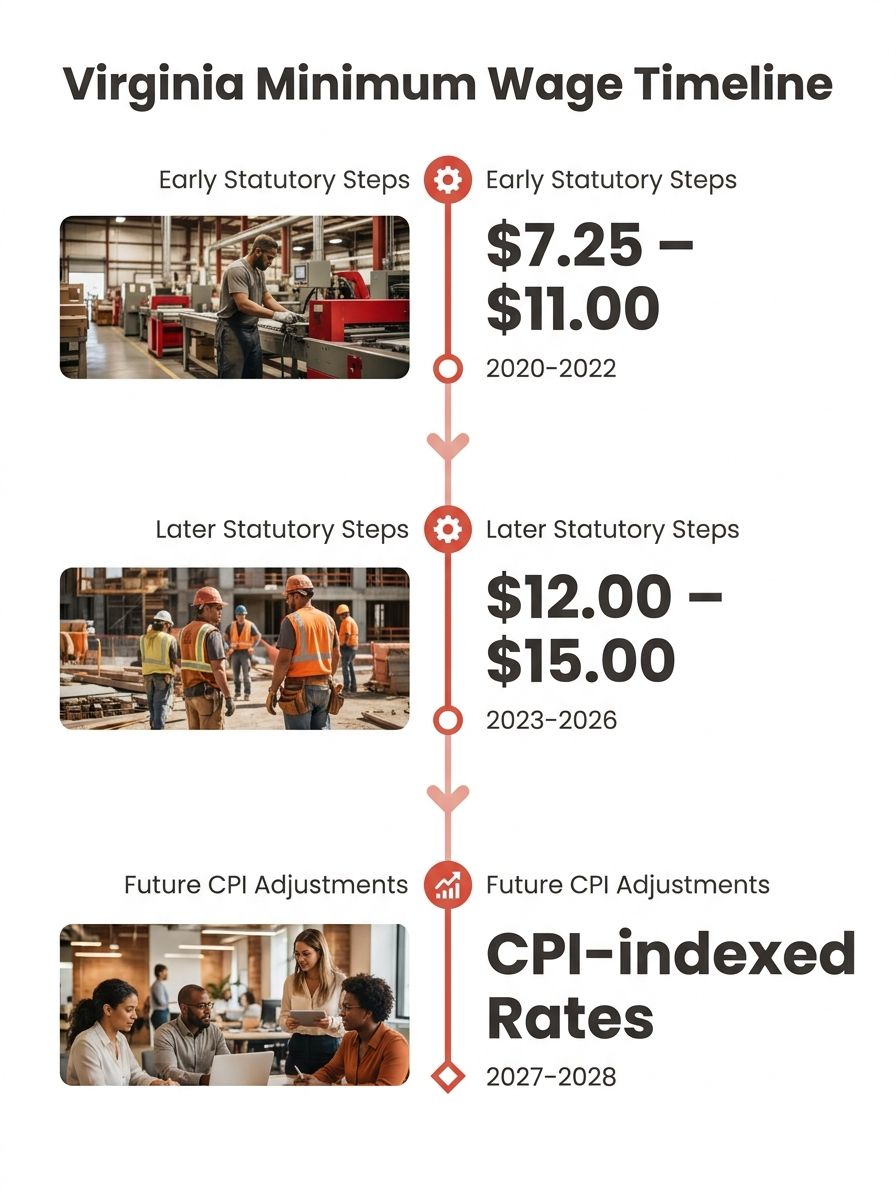
Va. Code § 40.1-28.10 sets the minimum wage for the state of Virginia and spells out, year by year, what employers owe workers. The statute was substantially rewritten in 2020, when the General Assembly passed legislation requiring phased increases from the federal rate of $7.25 per hour to $12.00 per hour by January 2023. Before that law, Virginia had no state minimum above the federal floor, meaning workers in the commonwealth earned the same $7.25 that had been frozen nationally since 2009.
The 2020 law didn't stop at $12.00. It built a staircase. The original plan called for $12.00 in 2023, higher steps in subsequent years, and an eventual $15.00 floor. But the schedule hit a wall. The rate held flat at $12.00 for both 2023 and 2024 after the General Assembly failed to reenact the next scheduled increase on time. According to The Commonwealth Institute, 1 in every 10 Virginia workers was still paid less than $15 an hour in late 2023 and early 2024. A CPI-based fallback clause in the statute eventually activated, producing the $12.41 rate for 2025 and the $12.77 rate now in effect.
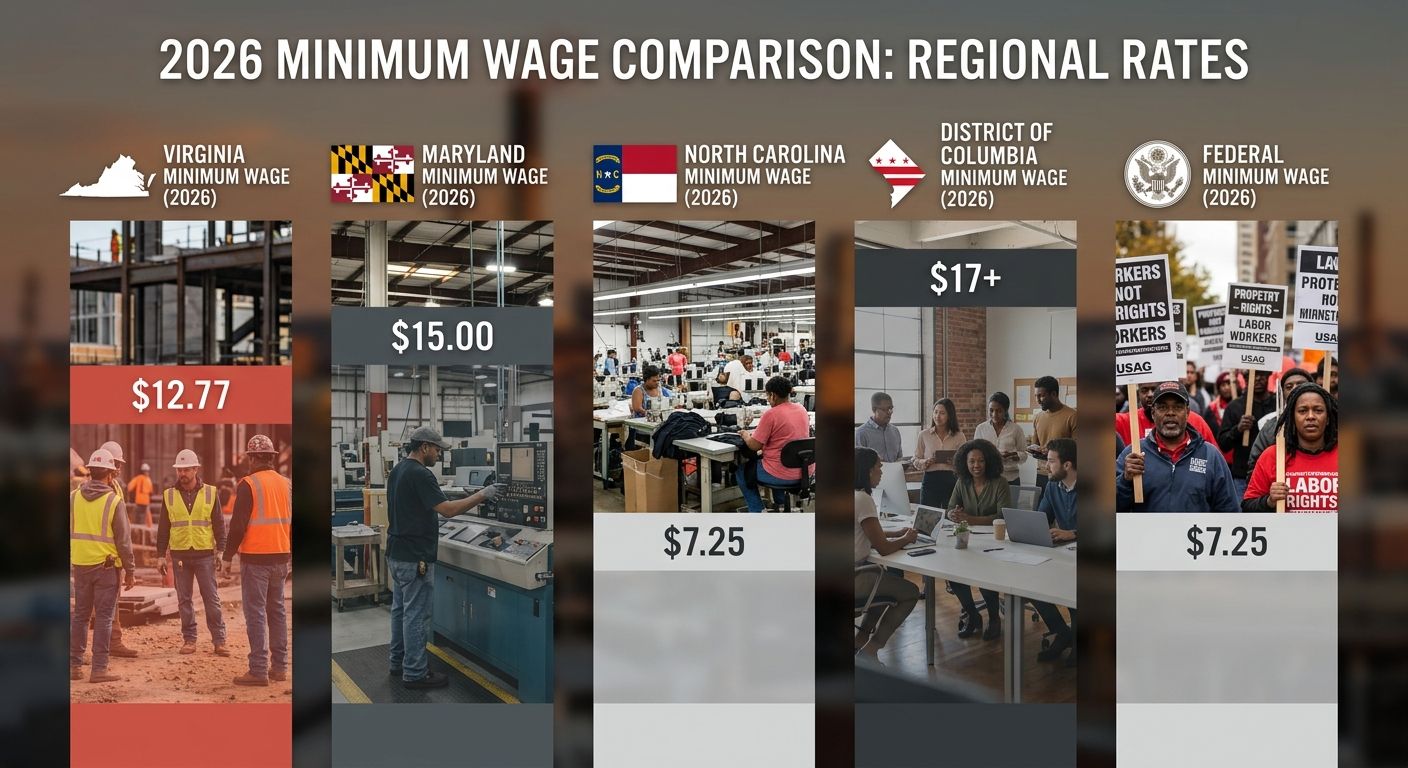
For workers in neighboring states, the contrast is sharp. Maryland's minimum sits at $15.00 for all employers, as covered in our breakdown of Maryland's minimum wage structure. States like North Carolina still sit at the federal floor of $7.25. Virginia occupies a middle position on the East Coast wage map, trailing its northern neighbors while outpacing the states to its south.
How the CPI-U Adjustment Formula Works
The Virginia Department of Labor and Industry calculates each year's rate by taking the prior year's minimum wage, multiplying it by the annual percentage change in the Consumer Price Index for All Urban Consumers (CPI-U) as measured by the U.S. Bureau of Labor Statistics, and adding that product to the prior rate. The result becomes the new floor.
For 2026, the math broke down as follows. The 2025 rate of $12.41, multiplied by the 2024 CPI-U increase of 2.9%, yields $0.36. Add $0.36 to $12.41, and you arrive at $12.77. The DOLI published this exact formula on its website: "$12.41 + [$12.41 x .029] = $12.77."
The 2025 rate of $12.41 was itself derived through the same process. The DOLI's 2024 wage notice documented the calculation: a $12.00 base rate adjusted by the 2023 CPI-U percentage, which came out to roughly 3.4%, producing $12.41.
This CPI mechanism has a floor built in. The virginia state minimum wage can never drop below the federal minimum wage of $7.25. If CPI-U turned negative in a deflationary year, the adjusted rate would hold at its prior level rather than falling. Oregon uses a similar CPI-indexed system, though with three separate geographic rate tiers. Virginia applies a single statewide number with no regional variation, which creates problems we'll get to below.
The Scheduled Path to $15.00
The CPI formula governs the present, but Virginia law also hardcodes two major increases ahead. Under § 40.1-28.10, the minimum wage rises to $13.75 per hour on January 1, 2027, and then to $15.00 per hour on January 1, 2028. These are fixed statutory amounts, calculated by no formula. They take effect regardless of what inflation does between now and then.
Year | Rate | Basis |
|---|---|---|
2023 | $12.00 | Statutory step |
2024 | $12.00 | Flat (reenactment stalled) |
2025 | $12.41 | CPI-U adjustment from $12.00 |
2026 | $12.77 | CPI-U adjustment (2.9%) from $12.41 |
2027 | $13.75 | Statutory step |
2028 | $15.00 | Statutory step |
2029+ | CPI-adjusted | Annual indexing from $15.00 base |
The gap between $12.77 and $13.75 is 98 cents, a 7.7% jump arriving January 1, 2027. The gap between $13.75 and $15.00 is $1.25, a 9.1% increase. Both statutory jumps dwarf the 36-cent CPI adjustment workers received this year. For someone working 40 hours a week, 52 weeks a year, the 2027 increase translates to roughly $2,038 more per year before taxes. The 2028 jump adds another $2,600.
After January 1, 2028, the statute shifts entirely to CPI indexing. By October 1, 2028, and annually after that, the Commissioner of Labor and Industry must publish the adjusted rate for the following January 1. That deadline gives employers about three months' notice before each increase takes effect.
Tipped, Youth, and Agricultural Workers
Virginia's minimum wage law carves out three categories of workers who face different rules, and each category deserves attention from organizers and workers alike.
Tipped employees can be paid a cash wage of $2.13 per hour, provided their tips bring total hourly compensation to at least the full minimum wage of $12.77. The maximum tip credit an employer can claim in 2026 is $10.64 per hour. Under the Code of Virginia, an employer cannot classify a worker as tipped if that worker is prohibited by federal or state law from soliciting tips. This rule exists because some employers have historically misclassified workers to pay sub-minimum cash wages and pocket the difference. Workers in states like Illinois face similar tipped-wage structures, though Illinois sets its tipped minimum higher.
Youth workers under 18 may be paid 75% of the minimum wage, which comes to $9.58 per hour in 2026. That rate will rise proportionally as the base rate increases in 2027 and 2028.
Agricultural workers currently operate under a separate exemption, but that exemption expires on January 1, 2027. Starting that date, farm laborers will be covered by the full state minimum wage for the first time in Virginia's history. This matters enormously. Virginia's agricultural sector employs tens of thousands of workers, many of whom are immigrants and seasonal laborers with limited bargaining power and little access to legal representation.
The tipped cash wage of $2.13 hasn't changed at the federal level in over three decades. It remains one of the most contested provisions in American wage law, and Virginia's adoption of the federal tipped minimum means the state's restaurant and service workers bear a disproportionate share of wage risk.
Where the Formula Falls Short
The CPI-U adjustment mechanism sounds reasonable on paper. Wages rise with inflation. But the formula has structural limitations that consistently shortchange the workers it's supposed to protect.
The base rate problem came first. Virginia's minimum sat frozen at $12.00 through all of 2023 and 2024 because the original schedule of increases required a legislative reenactment that never materialized. Two full years of stagnation while grocery prices, rent, and gas climbed. When the CPI adjustments finally kicked in for 2025, they started from that $12.00 floor, meaning the catch-up has been painfully slow. Workers lost ground they haven't recovered.
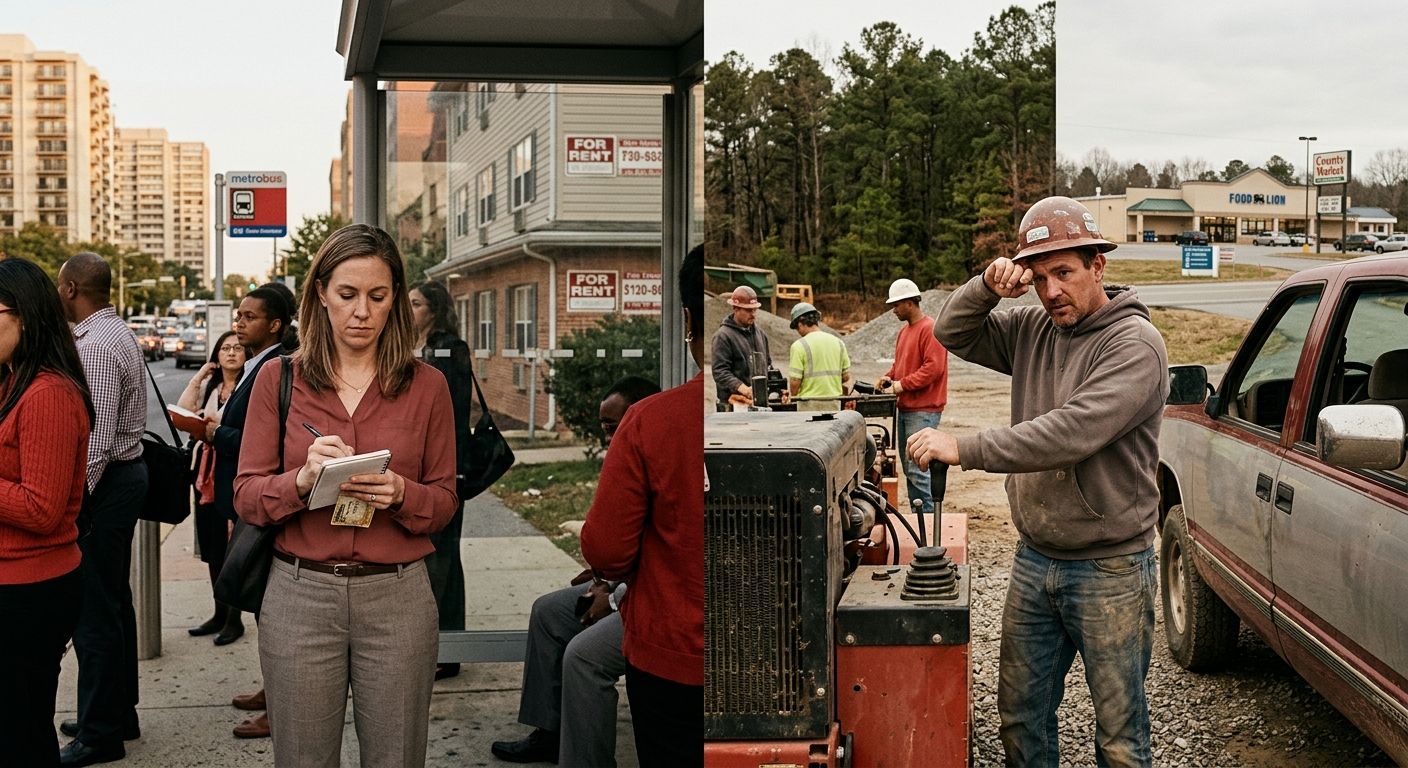
Then there's the geographic mismatch. CPI-U is a national index covering all urban consumers across the country. It's not a Virginia-specific cost-of-living measure. Housing costs in Northern Virginia and Hampton Roads have surged at rates well above the national CPI-U average. A worker in Arlington paying $1,800 a month in rent gets the same minimum wage as a worker in a rural southwestern county where rent runs half that figure. The statewide flat rate ignores dramatic geographic variation within the commonwealth, and Virginia law preempts local governments from setting their own wage floors.
The timing lag compounds the damage. The CPI-U figure used for the 2026 adjustment reflects 2024 price changes. Workers experienced those price increases throughout 2024 and 2025 but didn't see the wage response until January 2026. For families living paycheck to paycheck, the formula is always running a year or more behind reality.
And the tip credit structure sits on top of all this. At $2.13 per hour in guaranteed cash wages, tipped workers depend almost entirely on customer generosity. Employers face three-year back pay liability for underpayments under Virginia law, but enforcement depends on workers knowing their rights and filing complaints with DOLI. That places the burden of policing wage theft on the people least equipped to fight it.
Common Questions
Does any Virginia city or county set its own minimum wage?
No. Virginia law preempts local governments from setting separate private-sector minimum wages. The $12.77 rate applies statewide, from Fairfax County to Lee County, regardless of local cost of living.
When does the virginia state minimum wage reach $15.00?
January 1, 2028. The rate is written directly into Va. Code § 40.1-28.10 as a fixed statutory amount, independent of CPI calculations or future legislative votes.
What happens if CPI-U turns negative?
The statute requires that the minimum wage be no less than the greater of the adjusted state rate or the federal minimum wage. In practice, the rate holds steady or rises. It cannot decrease below $7.25 per hour, and no mechanism in the law allows the state rate to drop below its prior-year level.
Are all Virginia employers covered?
The Virginia Minimum Wage Act covers most employers, but certain categories have historically been exempt, including some agricultural and domestic workers. The agricultural exemption ends January 1, 2027. Federal employees and specific small categories remain subject to federal rather than state wage law.
How does Virginia compare to neighboring states?
Maryland's minimum wage is $15.00. The District of Columbia's exceeds $17.00. North Carolina and West Virginia sit at the federal floor of $7.25. Virginia's $12.77 places it below Maryland and D.C. but substantially above the southern states that haven't enacted their own wage floors. The gap will narrow as the state of Virginia minimum wage moves to $15.00 in 2028.
The Union Edge Staff
Frequently Asked Questions
- What is Virginia's state minimum wage for 2026?
- Virginia's state minimum wage is $12.77 per hour in 2026, up from $12.41 in 2025. This increase of 36 cents was calculated using the Consumer Price Index (CPI-U) adjustment formula.
- When will Virginia's minimum wage reach $15 per hour?
- Virginia's minimum wage will reach $15.00 per hour on January 1, 2028. This is a fixed statutory amount written directly into Virginia law, independent of CPI calculations.
- How is Virginia's minimum wage calculated?
- Virginia's minimum wage is calculated by taking the prior year's rate, multiplying it by the annual percentage change in the Consumer Price Index for All Urban Consumers (CPI-U), and adding that product to the prior rate. For 2026, this formula was: $12.41 + ($12.41 × 0.029) = $12.77.
- What is the tipped minimum wage in Virginia?
- Tipped employees in Virginia can be paid a cash wage of $2.13 per hour, provided their tips bring total hourly compensation to at least the full minimum wage of $12.77. The maximum tip credit an employer can claim in 2026 is $10.64 per hour.
- What is the minimum wage for youth workers in Virginia?
- Youth workers under 18 in Virginia may be paid 75% of the minimum wage, which comes to $9.58 per hour in 2026. This rate will rise proportionally as the base rate increases in 2027 and 2028.
- Can Virginia cities or counties set their own minimum wage?
- No. Virginia law preempts local governments from setting separate private-sector minimum wages. The statewide minimum wage of $12.77 applies uniformly across all Virginia cities and counties.
- What happens to agricultural workers' minimum wage in Virginia?
- The agricultural worker exemption expires on January 1, 2027, meaning farm laborers will be covered by the full state minimum wage for the first time in Virginia's history. Previously, agricultural workers were exempt from minimum wage requirements.
- How does Virginia's minimum wage compare to neighboring states?
- Maryland's minimum wage is $15.00, and D.C. exceeds $17.00, while North Carolina and West Virginia sit at the federal floor of $7.25. Virginia's $12.77 minimum wage places it below Maryland and D.C. but substantially above southern states.
Related Articles

Minimum Wage of Virginia: 2024 Guide
Governor Glenn Youngkin's 2023 veto of House Bill 1 and Senate Bill 1 broke Virginia's planned minimum wage escalator, freezing the rate at $12.00 per hour for both 2023 and 2024.

Minimum Wage New Jersey 2024: Rates & Updates
New Jersey's minimum wage for most employees reached $15.13 per hour on January 1, 2024, completing a legislated climb from $8.85 in 2019 and triggering a permanent CPI-indexed adjustment formula. The rate doesn't come from annual legislative votes anymore.
State of Connecticut Minimum Wage 2024 Updates
Public Act 19-4 transformed Connecticut's minimum wage from a number set by legislators into a self-adjusting rate indexed to the federal Employment Cost Index. For 2024, that mechanism pushed the state of Connecticut minimum wage from $15.00 to $15.
Also in the paper