
State of Georgia Minimum Wage: 2024 Guide
Two minimum wage rates operate in the state of Georgia simultaneously: $5.15 under state statute and $7.25 under the federal Fair Labor Standards Act.

State of Georgia Minimum Wage: Two Rates, One Paycheck, and the Mechanism That Decides Which Applies
Two minimum wage rates operate in the state of Georgia simultaneously: $5.15 under state statute and $7.25 under the federal Fair Labor Standards Act. The higher federal rate controls most workplaces, but the existence of that lower state figure creates a coverage gap that affects a narrow class of workers and confuses many more.
What Georgia Law Actually Says
The Georgia Department of Labor states it plainly: "Georgia's minimum wage is $5.15 per hour, however, with some limited exceptions, the federal minimum wage rate applies." That $5.15 figure is codified in Georgia's Minimum Wage Law (O.C.G.A. § 34-4-3), and it has remained unchanged while 24 states raised their own rates in 2024 alone, according to reporting by Yahoo Finance. Georgia residents didn't see a penny of increase.
The federal minimum of $7.25 has been frozen since July 24, 2009, making it one of the longest stretches without adjustment in the law's history. Georgia's $5.15, set even earlier, has been stagnant for longer. Neither rate includes any automatic cost-of-living adjustment or inflation indexing.
About 13 other states also land at the $7.25 effective minimum, according to the National Conference of State Legislatures. But Georgia belongs to a smaller club: states where the law on the books is actually lower than the federal floor. Wyoming shares that distinction at $5.15. The practical result for most Georgia workers is the same $7.25 rate, but how that number reaches their paycheck involves a specific legal mechanism worth understanding.
How Federal Preemption Overrides the State Rate
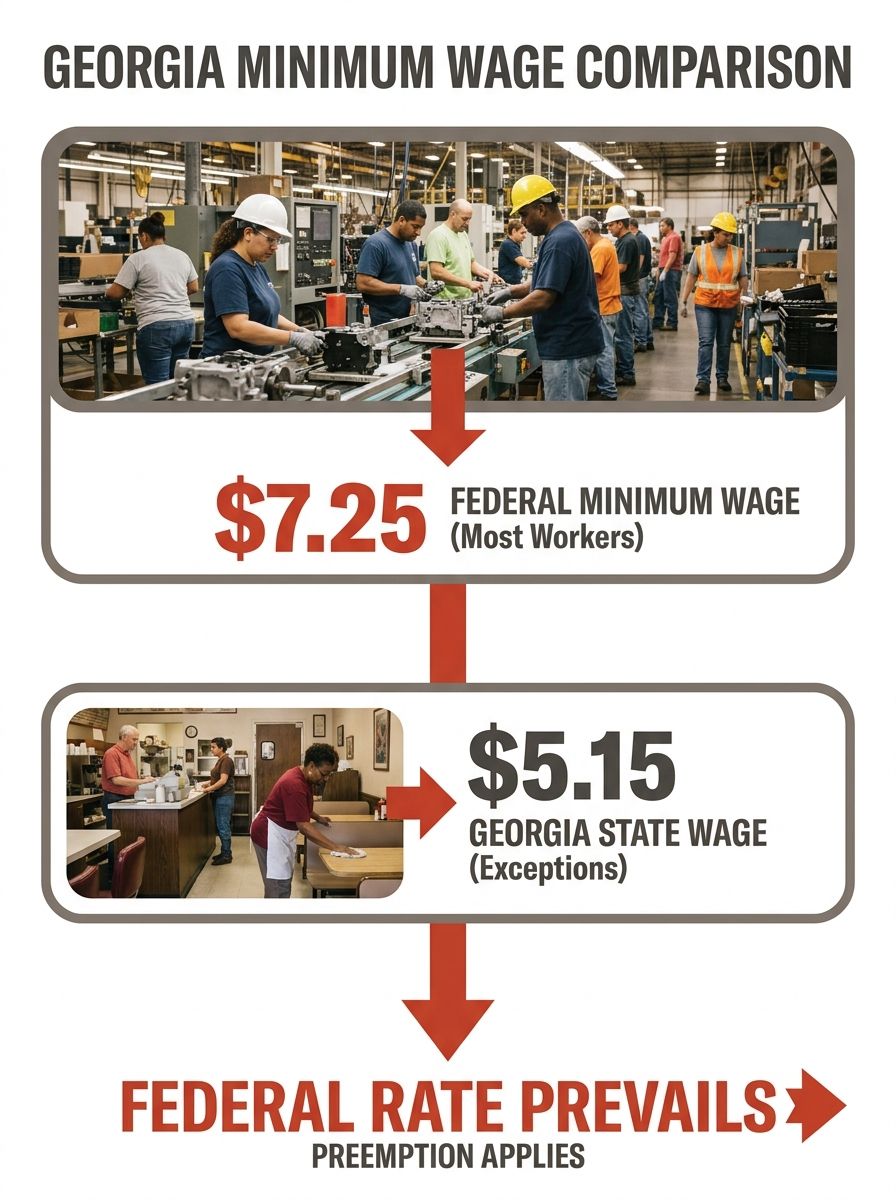
The FLSA doesn't void Georgia's $5.15 law. It sits on top of it. Section 18(a) of the FLSA says that when both a state and federal minimum wage apply to the same worker, the higher rate controls. This is the preemption mechanism, and it's the reason you won't find Georgia employers legally posting $5.15 as the rate on most wage notices.
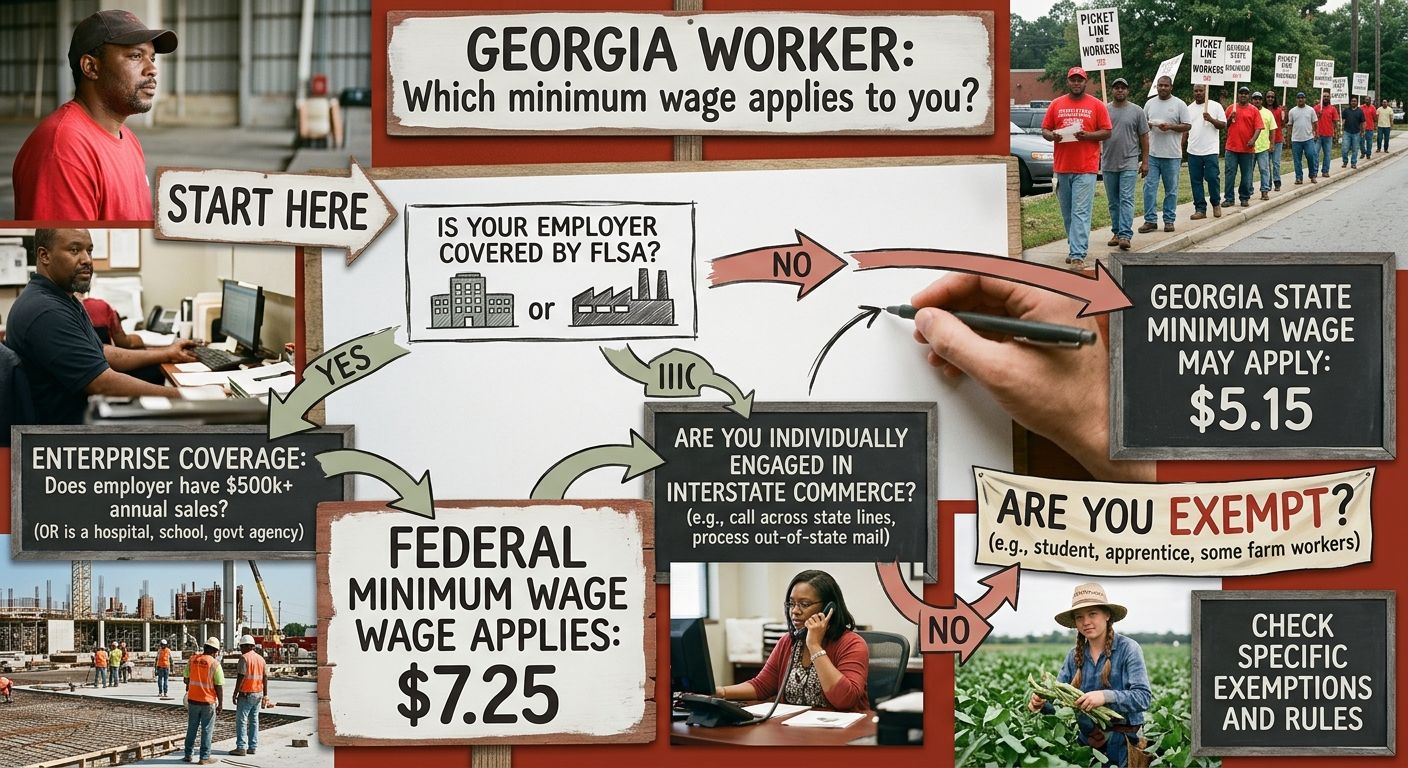
Federal coverage under the FLSA reaches workers through two paths. The first is enterprise coverage: if a business has annual gross sales or business volume of at least $500,000, or operates as a hospital, school, or government agency, every employee at that enterprise falls under FLSA rules. The second is individual coverage: even at a smaller business, any employee whose work involves interstate commerce, handling goods that crossed state lines, using the phone or internet for out-of-state business, processing credit card transactions, is individually covered.
These two gates catch the overwhelming majority of Georgia's workforce. The $5.15 state rate applies only to workers at businesses that fall below the $500,000 revenue threshold AND whose individual work doesn't touch interstate commerce. In a modern economy where credit card readers and email are standard equipment in virtually every workplace, that exception is razor-thin.
For workers trying to understand how federal minimum wage law interacts with state rates, Georgia is a textbook illustration of preemption in action. The state legislature set a floor; the federal government set a higher one; and the higher one wins for almost everyone.
The Workers Who Actually Earn $5.15
The exception exists, and employers who qualify for it know it. A sole proprietorship with no employees involved in interstate commerce and revenue under $500,000, think a small roadside produce stand accepting only cash, could legally pay $5.15. But workers in this situation represent a statistically tiny fraction of Georgia's labor force.
Georgia law also contains its own set of exemptions from even the $5.15 rate. Employers of domestic workers, certain agricultural operations, and some nonprofit establishments may be exempt from the state minimum entirely. When neither the state nor federal minimum applies, no statutory wage floor exists at all.
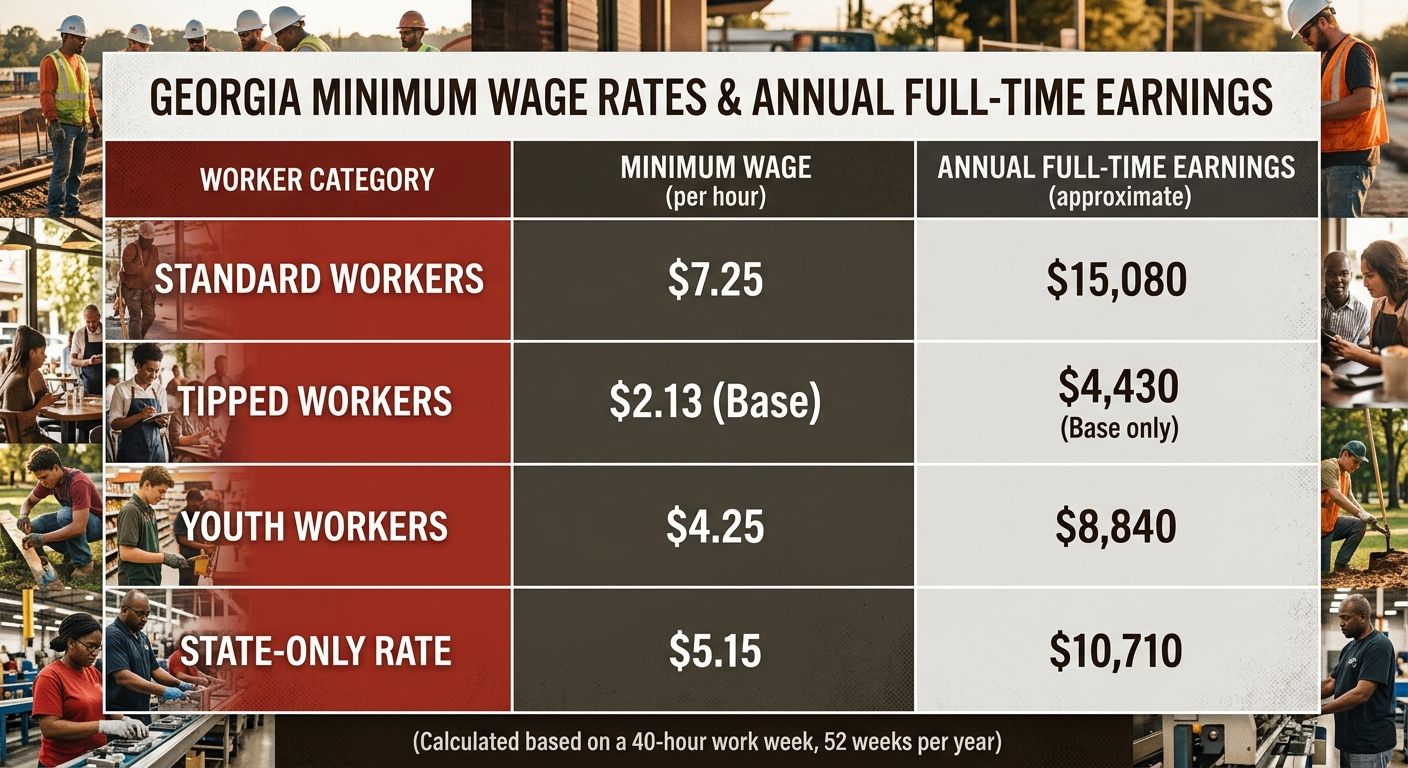
This is where the two-rate system does real damage. Workers without access to legal information may accept $5.15 as their lawful rate because their employer cites "Georgia minimum wage" without mentioning the federal override. For a full-time worker, the difference between $5.15 and $7.25 adds up to roughly $4,368 per year, a significant sum that may constitute wage theft if the employer is actually FLSA-covered.
Sub-Minimum Rates: Tipped Workers, Youth Wages, and the Cracks Below the Floor
The $7.25 floor has its own trapdoors built in, and Georgia workers encounter all of them.
Tipped employees can be paid a direct cash wage of just $2.13 per hour under the FLSA's tip credit provision, provided their tips bring total hourly compensation to at least $7.25. If tips fall short during any pay period, the employer must make up the difference. In practice, enforcement of that makeup obligation is inconsistent, the Department of Labor's Wage and Hour Division has documented widespread violations in tipped industries nationwide.
Youth workers under age 20 can be paid a training wage of $4.25 per hour during their first 90 consecutive calendar days of employment with any employer. After 90 days, or when the worker turns 20, the full $7.25 rate applies. This provision gets abused in fast-food and retail settings where turnover is high enough that employers cycle through workers before the 90-day window closes.
Exempt employees represent another tier. Under the FLSA, salaried workers classified as executive, administrative, or professional must earn at least $844 per week, approximately $43,888 per year, to qualify for overtime exemptions. Misclassification of workers as "exempt" to avoid both overtime and close tracking of hours is one of the most common wage violations in Georgia and nationally.
Georgia's Preemption Wall Against Local Wage Laws
Georgia doesn't allow cities or counties to set their own minimum wages above the state or federal level. This preemption of local authority, distinct from the federal-over-state preemption that boosts wages from $5.15 to $7.25, works in the opposite direction. It prevents municipalities like Atlanta, Savannah, or Augusta from responding to local cost-of-living pressures with higher wage floors.
The effect is that a worker in downtown Atlanta, where the cost of living runs significantly higher than rural Georgia, earns the same $7.25 minimum as a worker in a small town with far lower housing and transportation costs. States like Missouri have gone in the opposite direction, with voters approving ballot measures to push their minimum to $15.00 per hour. Georgia has no ballot initiative process for minimum wage, meaning any change requires action from the General Assembly.
Bills proposing increases to $15.00 and even $22.00 per hour were introduced during the 2025-2026 legislative sessions. Both failed. Without either a legislative path or a citizen ballot initiative mechanism, the state of Georgia minimum wage has no active vehicle for change.
The One Big Beautiful Bill Act and Tipped Income
One recent federal development touches Georgia's minimum wage landscape indirectly. The One Big Beautiful Bill Act, signed into law in July 2025, created a tip tax deduction allowing eligible tipped employees to deduct up to $25,000 annually from their taxable income for qualified tips received through 2028.
This doesn't change the cash wage for tipped workers, they're still at $2.13 per hour before tips, but it reduces the federal income tax burden on tip income. For a tipped worker in Georgia earning $30,000 in annual tips, the deduction could mean several thousand dollars in tax savings depending on their bracket. The provision expires after 2028 unless Congress extends it, and it does nothing to address the base cash wage itself.
Where the Mechanism Breaks
The dual-rate structure between Georgia's $5.15 state law and the $7.25 federal floor assumes functional enforcement at both levels. That assumption doesn't hold cleanly.
The Georgia Department of Labor doesn't actively enforce the federal minimum wage, that falls to the U.S. Department of Labor's Wage and Hour Division. And the federal division is stretched. Workers who believe they're being underpaid must either file a complaint with the federal DOL or pursue a private lawsuit. Neither option is fast, and both require workers to know their rights in the first place.
The structure also breaks in the informal economy. Domestic workers, day laborers paid in cash, and undocumented workers face practical barriers to asserting any minimum wage claim, whether state or federal. Georgia has no state-level agency equivalent to California's Labor Commissioner that aggressively investigates wage violations on its own initiative.
And the mechanism can't compensate for its own inadequacy. With the federal rate frozen at $7.25 for over 17 years, the minimum wage in Georgia has lost roughly 30% of its purchasing power to inflation since 2009. The preemption mechanism faithfully delivers $7.25 to workers' paychecks, the problem is that $7.25 buys dramatically less than it did when that number was set.
Georgia's minimum wage structure is a machine running exactly as designed. The design is the problem. Two rates, both inadequate, locked in place by a legislature that won't raise the state floor and a Congress that won't raise the federal one. Workers caught between those two frozen numbers have no municipal escape valve, no ballot initiative process, and no scheduled adjustment for the rising cost of everything around them.
Common Questions
Does Georgia's $5.15 minimum wage actually apply to anyone?
Technically, yes. Workers at very small businesses with annual revenue below $500,000 that have no involvement in interstate commerce fall under the $5.15 state rate rather than the $7.25 federal rate. In practice, this covers an extremely small share of Georgia's workforce because most businesses meet the FLSA's broad interstate commerce or revenue tests. If you handle credit card transactions, ship goods across state lines, or use the internet for business purposes, you're almost certainly covered by the federal rate.
Can cities like Atlanta set a higher minimum wage?
No. Georgia state law preempts local governments from establishing minimum wages above the state or federal level. Atlanta, Savannah, and all other Georgia municipalities are prohibited from passing local minimum wage ordinances, regardless of local cost-of-living conditions. Any change to the minimum wage in Georgia must come from either the state legislature or federal action.
How much do tipped workers in Georgia actually earn per hour?
Employers can pay a direct cash wage of $2.13 per hour under the FLSA tip credit, but total compensation including tips must reach at least $7.25 per hour. If a tipped worker's earnings fall below $7.25 in any pay period, the employer is legally required to make up the difference. Additionally, the One Big Beautiful Bill Act of 2025 allows qualifying tipped employees to deduct up to $25,000 in annual tip income from their federal taxes through 2028.
Is there any pending legislation to raise Georgia's minimum wage?
Proposals to raise the georgia state minimum wage to $15.00 and $22.00 per hour were introduced during the 2025-2026 legislative sessions. Both failed. Georgia has no citizen ballot initiative process for minimum wage increases, so any future change depends entirely on action by the General Assembly or a federal minimum wage increase from Congress.
What should I do if my employer pays me less than $7.25?
File a complaint with the U.S. Department of Labor's Wage and Hour Division. You can file online, by phone, or in person at a regional office. The complaint process is free, and federal law prohibits retaliation against workers who assert their wage rights. Keep your own records of hours worked and wages received, employers are required to retain payroll records for at least 3 years, but having your own documentation strengthens any claim.
The Union Edge Staff
Frequently Asked Questions
- What is the minimum wage in Georgia?
- Georgia's minimum wage is $7.25 per hour, which is the federal rate that applies to the overwhelming majority of workers. Georgia's state law sets $5.15 per hour, but federal law preempts this lower rate for most employers. The $5.15 state rate only applies to workers at very small businesses with annual revenue below $500,000 that have no involvement in interstate commerce.
- Can Atlanta or other Georgia cities set their own minimum wage?
- No, Georgia state law prohibits cities and counties from setting minimum wages above the state or federal level. Atlanta, Savannah, and all other Georgia municipalities are preempted from passing local minimum wage ordinances, regardless of local cost-of-living conditions.
- What is the minimum wage for tipped workers in Georgia?
- Tipped employees can be paid a direct cash wage of $2.13 per hour under federal law, provided their tips bring total compensation to at least $7.25 per hour. If tips fall short in any pay period, the employer must make up the difference to reach $7.25.
- When was Georgia's minimum wage last increased?
- Georgia's state minimum wage of $5.15 has not been increased and remains frozen since it was originally set. The federal minimum wage of $7.25, which applies to most Georgia workers, has been frozen since July 24, 2009, making it over 17 years without an adjustment.
- What should I do if my employer is paying me less than $7.25 per hour?
- File a complaint with the U.S. Department of Labor's Wage and Hour Division, which can be done online, by phone, or in person at a regional office. Keep your own records of hours worked and wages received, as federal law prohibits employer retaliation against workers who assert their wage rights.
- Who qualifies to be paid Georgia's $5.15 minimum wage instead of $7.25?
- Only workers at very small sole proprietorships with annual revenue below $500,000 and whose work involves zero interstate commerce—such as a cash-only produce stand—could legally be paid $5.15. This represents an extremely small fraction of Georgia's workforce because most modern businesses meet federal coverage requirements through internet use, credit card transactions, or interstate commerce.
- Can teenagers in Georgia be paid less than minimum wage?
- Yes, youth workers under age 20 can be paid a training wage of $4.25 per hour during their first 90 consecutive calendar days of employment. After 90 days or when the worker turns 20, the full $7.25 federal minimum wage applies.
- What is the One Big Beautiful Bill Act and how does it affect Georgia tipped workers?
- The One Big Beautiful Bill Act, signed into law in July 2025, allows eligible tipped employees to deduct up to $25,000 annually from their taxable income for qualified tips received through 2028. This reduces federal income tax burden on tip income but does not change the base cash wage of $2.13 per hour for tipped workers.
Related Articles

Georgia Minimum Wage: Current Rates & 2024 Updates
Only two U.S. states maintain a minimum wage below the federal floor of $7.25 per hour: Georgia and Wyoming. Georgia's rate, $5.15 an hour and frozen since 1999, ranks among the lowest statutory wage floors in the country. But that $5.

Minimum Wage for Georgia: 2024 Rules & Requirements
Georgia's minimum wage operates through a two-tier legal structure: the state sets one rate at $5.15 per hour, the federal government enforces a higher rate at $7.25, and which number appears on your paycheck depends entirely on whether your employer falls under the Fair Labor Standards Act.

Federal Minimum Wage: What You Need to Know
The federal minimum wage is $7.25 per hour, set by the Fair Labor Standards Act (FLSA) and enforced by the U.S. Department of Labor's Wage and Hour Division. That rate has been frozen since July 24, 2009, making it the longest period without an increase since the FLSA became law in 1938.
Also in the paper