
Minimum Wage for Georgia: 2024 Rules & Requirements
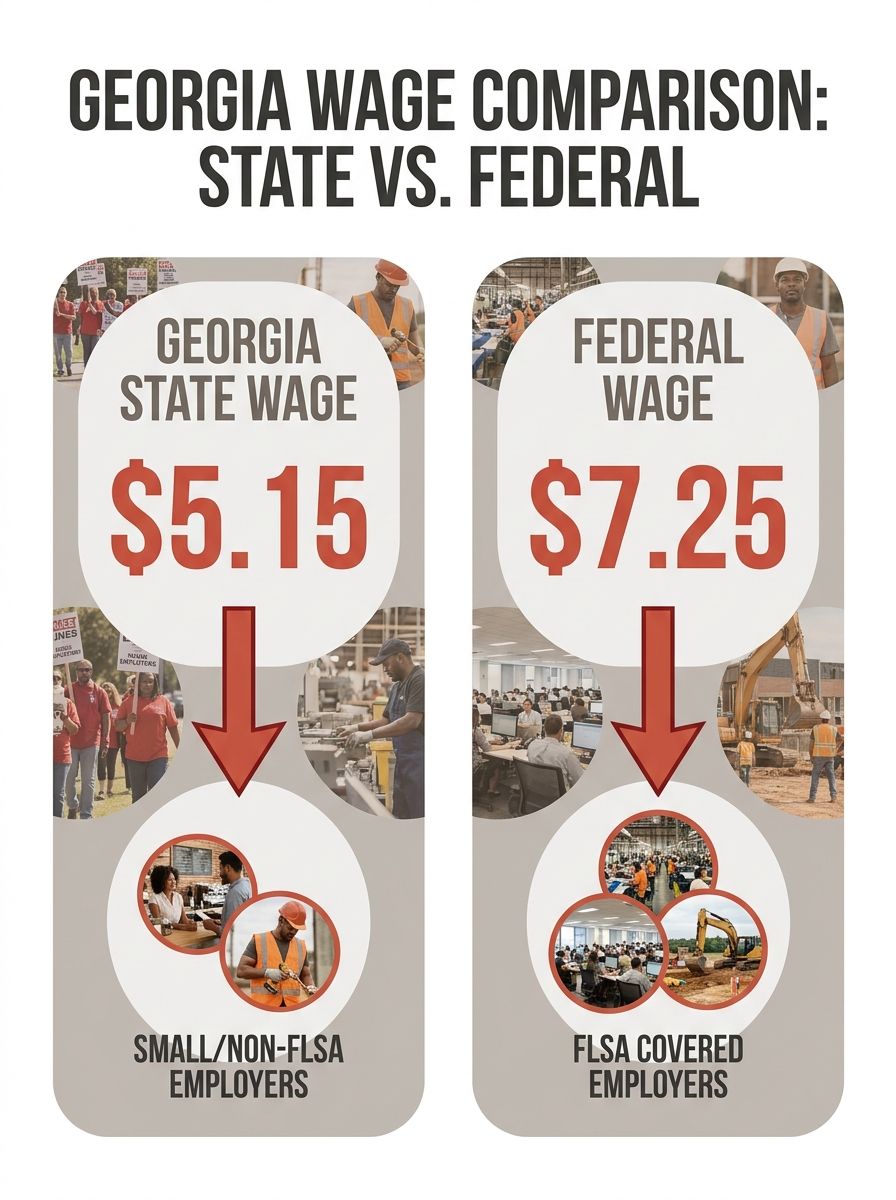
Georgia's minimum wage operates through a two-tier legal structure: the state sets one rate at $5.15 per hour, the federal government enforces a higher rate at $7.25, and which number appears on your paycheck depends entirely on whether your employer falls under the Fair Labor Standards Act.

Minimum Wage for Georgia: How the State's Two-Tier Wage System Actually Works
Georgia's minimum wage operates through a two-tier legal structure: the state sets one rate at $5.15 per hour, the federal government enforces a higher rate at $7.25, and which number appears on your paycheck depends entirely on whether your employer falls under the Fair Labor Standards Act. The result is a system where workers in functionally identical jobs can be legally owed different hourly rates based on their employer's revenue, not their labor.
What Georgia's Minimum Wage Law Actually Says
The Georgia Department of Labor defines the state minimum wage as $5.15 per hour, a rate that has been frozen since 1999. Georgia and Wyoming are the only two states in the country that maintain a statutory wage floor below the federal minimum of $7.25. The state's minimum wage law, codified in Georgia Code Title 34, Chapter 4, applies to employers not covered by federal law. For every other employer, and that's the vast majority, the federal Fair Labor Standards Act supersedes Georgia's number.
This dual structure matters because it creates a false impression. Workers searching for the minimum wage in Georgia will find $5.15 in state records and $7.25 on federal posters. Both numbers are technically correct. The question is which one governs your specific employment relationship, and that depends on a coverage test most workers have never heard of.
According to AARP reporting cited by the Augusta Chronicle, more than 20 states raised their minimum wages heading into 2024, but no Southern states were among them, Georgia included. The state has shown no legislative appetite for adjusting its $5.15 rate, which means the federal floor is doing all the heavy lifting for Georgia's low-wage workforce.
The FLSA Coverage Test That Determines Your Rate
The minimum wage for Georgia workers hinges on a single regulatory question: does the employer meet the threshold for FLSA coverage? The test has two prongs, and meeting either one pulls the employer into federal jurisdiction.
Enterprise coverage applies to any business with annual gross revenue of $500,000 or more. That's the threshold. A restaurant, a retail chain, a warehouse, a hotel, if the business clears half a million in annual sales, every employee is entitled to the federal $7.25 per hour, regardless of what Georgia's state law says. Hospitals, schools, and government agencies are covered automatically regardless of revenue.
Individual coverage captures workers whose jobs involve interstate commerce, even if the business itself falls below the $500,000 mark. If you handle goods that cross state lines, make phone calls to out-of-state clients, process credit card transactions routed through national networks, or use the internet for business purposes, you're individually covered. In practice, this sweeps in nearly every worker in a modern economy.
The result: the $5.15 state rate applies only to employees of very small businesses, those earning under $500,000 annually, whose work doesn't touch interstate commerce. That's an extraordinarily narrow category. As OnPay's Georgia wage guide puts it, Georgia's state rate of $5.15 "only applies in limited cases when federal coverage does not."
Tipped Workers and the Tip Credit Mechanism
Georgia's tipped-worker wage structure follows the federal model exactly: employers can pay a cash wage as low as $2.13 per hour, provided the worker's tips bring total hourly compensation to at least $7.25. The difference, $5.12 per hour, is called the "tip credit," and the employer claims it against their wage obligation.
The mechanism works like this: an employer pays $2.13 in direct wages. The employee earns tips throughout the shift. If the combined total equals or exceeds $7.25 for every hour worked, the employer has met its legal obligation. If tips fall short, say the employee earns only $4.00 in tips during a slow lunch shift, bringing the total to $6.13, the employer must make up the $1.12 gap out of pocket.
That's the law. Enforcement is another matter. Wage theft among tipped workers remains one of the most common labor violations in the country, and Georgia's lack of a state-level wage enforcement mechanism beyond the federal system compounds the problem. Workers who suspect tip credit violations must file complaints with the U.S. Department of Labor's Wage and Hour Division, a federal agency with limited regional staff relative to the number of complaints it receives. We've covered similar wage theft patterns in Chicago, where daycare workers fought for months to recover stolen pay.

Youth Wages, Exemptions, and the Workers Who Fall Outside
The federal minimum wage of $7.25 already represents a thin floor. Several legal carve-outs cut through even that.
Youth subminimum wage: Workers under age 20 can be paid $4.25 per hour for their first 90 consecutive calendar days of employment. After day 90, the full $7.25 applies. Employers cannot displace existing workers to take advantage of this lower rate, doing so is a violation of the FLSA.
Exempt employees: Certain categories of workers are excluded from minimum wage requirements entirely. Executive, administrative, and professional employees paid on a salary basis above the federal salary threshold don't receive hourly minimum wage protections. Outside sales employees and certain computer professionals also fall outside the FLSA's minimum wage provisions.
Student learners and full-time students: The Department of Labor can issue certificates allowing employers to pay full-time students 85% of the minimum wage ($6.16 per hour) in retail, service, agriculture, or at colleges and universities. This provision is narrower than most people realize, it requires a specific DOL certificate, not just enrollment status.
Georgia's minimum wage landscape, then, isn't one number. It's a stack of rates, $5.15, $7.25, $4.25, $2.13, $6.16, each governed by different eligibility rules, applied to different workers, and enforced by different mechanisms. Understanding which rate applies requires knowing your employer's revenue, your age, your job classification, and your role's connection to interstate commerce.
How Georgia Compares to Surrounding States
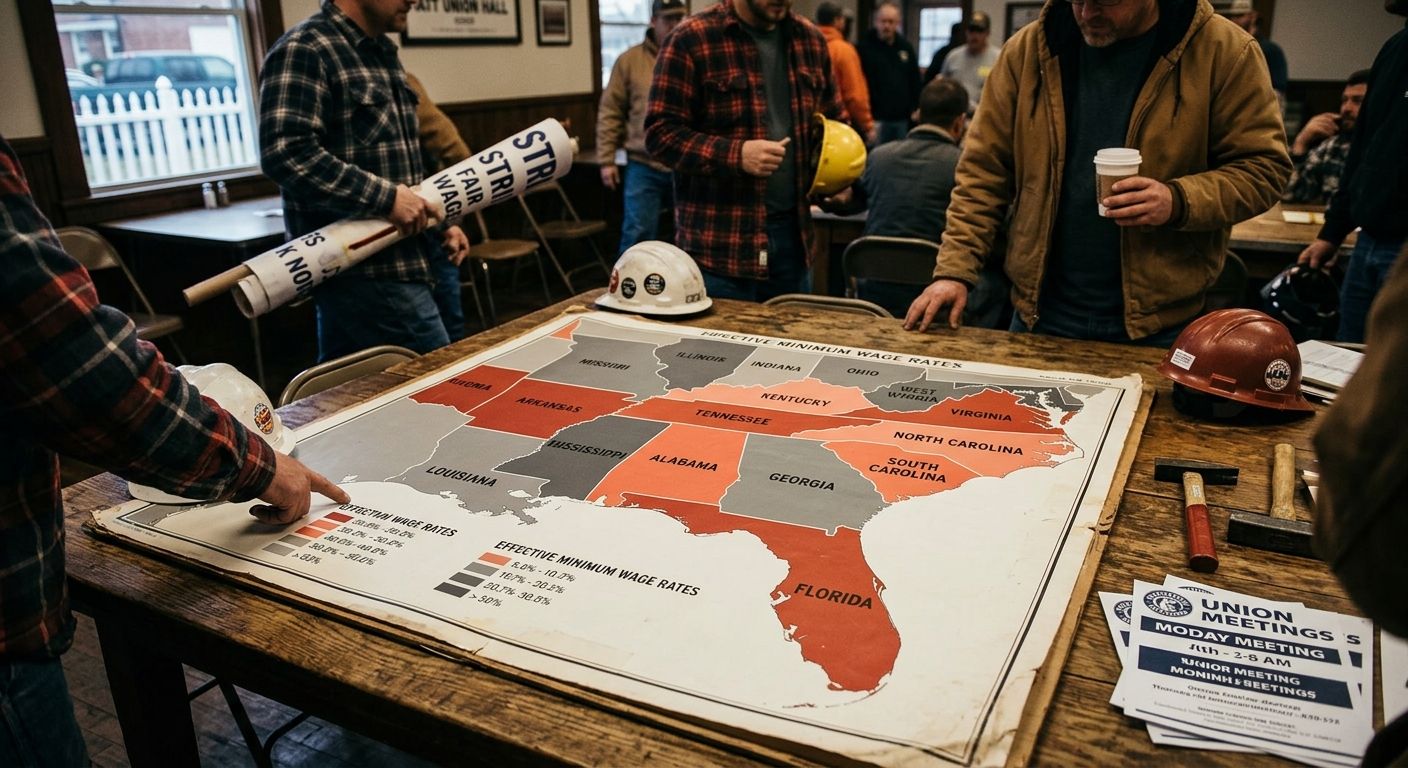
Georgia's reliance on the federal floor puts it at the bottom of a region already characterized by low wages. Comparing the minimum wage in Georgia to its neighbors reveals how isolated the state's position has become.
State | State Minimum Wage | Indexed to Inflation? | Tipped Cash Wage |
|---|---|---|---|
Georgia | $5.15 (federal $7.25 applies) | No | $2.13 |
Florida | $13.00 | Yes (constitutional amendment) | $9.98 |
South Carolina | None (federal $7.25 applies) | No | $2.13 |
Alabama | None (federal $7.25 applies) | No | $2.13 |
Tennessee | None (federal $7.25 applies) | No | $2.13 |
North Carolina | $7.25 | No | $2.13 |
Florida's trajectory is instructive. After voters approved a constitutional amendment in 2020, Florida's minimum wage has climbed in annual $1.00 increments, and it's now indexed to inflation. Georgia has no equivalent mechanism, no pending ballot initiative, and no automatic adjustment. States like Washington have taken the indexing approach even further, tying their wage floors directly to the Consumer Price Index so workers don't lose ground to inflation year after year.
The gap between Georgia's frozen $5.15 and the rising floors in states like Illinois will continue to widen as long as the state legislature declines to act. Legislative proposals like GA SB273, which would have raised the state minimum to $22.00 per hour with automatic cost-of-living adjustments, have failed to advance.
Where the Model Breaks
Georgia's two-tier system has structural weaknesses that leave certain workers exposed. The model assumes federal coverage acts as a reliable safety net, but gaps exist in at least three areas.
Micro-businesses below $500,000 in revenue are the most obvious gap. A small landscaping crew, a neighborhood barbershop, a family-run food stand, if the business earns less than $500,000 annually and the worker's duties don't involve interstate commerce, the employer's legal obligation is $5.15 per hour. These workers are disproportionately people of color, immigrants, and workers in informal employment arrangements. No reliable count exists of how many Georgia workers fall into this category precisely because these employers often lack the formal record-keeping that would make them visible to enforcement agencies.
Enforcement relies almost entirely on federal resources. Georgia has no state minimum wage enforcement division. Workers must navigate the federal Wage and Hour Division complaint process, which requires identifying your employer's FLSA coverage status, a legal determination most hourly workers aren't equipped to make on their own. The complaint backlog in the Southeast region can stretch months. The state's wage and hour gap mirrors what we've documented in CEO-to-worker pay ratio analysis, where enforcement mechanisms consistently lag behind the scale of the problem.
The absence of inflation indexing means the federal $7.25 floor, Georgia's de facto minimum, loses purchasing power every year it remains unchanged. The federal minimum hasn't increased since 2009. Adjusted for inflation, $7.25 in 2009 would need to be over $10.50 today to maintain the same purchasing power. Georgia workers living on the minimum wage of Georgia are earning significantly less in real terms than their counterparts were 17 years ago.
Record-keeping requirements offer one slim protection: employers covered by the FLSA must maintain accurate records of wages and hours for at least 3 years. Workers who discover violations within that window can file for back wages and liquidated damages. But the burden of proof falls heavily on the worker, and penalties for non-compliance are modest enough that some employers treat them as a cost of doing business.
Common Questions
Does Georgia really have a $5.15 minimum wage?
Yes. Georgia's state minimum wage is $5.15 per hour, set by state law and unchanged since 1999. But the federal minimum wage of $7.25 per hour supersedes it for any worker or employer covered by the Fair Labor Standards Act. Since FLSA coverage reaches nearly all businesses with $500,000 or more in annual revenue and most workers involved in interstate commerce, the practical minimum wage for Georgia workers is $7.25 in the overwhelming majority of cases.
Can an employer in Georgia legally pay $5.15 per hour?
Only if the employer is not covered by the FLSA. This requires the business to have less than $500,000 in annual gross revenue AND the individual worker's job to have no connection to interstate commerce. Meeting both conditions is rare in a modern economy where internet use, credit card processing, and supply chains routinely cross state lines.
What should tipped workers in Georgia actually earn?
Tipped workers must receive at least $7.25 per hour in combined compensation, $2.13 in cash wages from the employer, with tips making up the remainder. If tips don't bring hourly pay to $7.25, the employer must cover the shortfall. Employers who fail to do this are committing a wage violation under the FLSA, and workers can file complaints with the U.S. Department of Labor or pursue civil action within 3 years.
Are there any proposals to raise Georgia's minimum wage?
GA SB273 proposed raising the state minimum to $22.00 per hour with automatic cost-of-living adjustments. The bill has not advanced through the legislature. No ballot initiative mechanism currently exists for Georgia voters to raise the minimum wage directly, unlike in states such as Florida where voters approved incremental increases through a constitutional amendment.
How do I file a wage complaint in Georgia?
Because Georgia lacks a dedicated state wage enforcement agency, complaints about minimum wage violations go to the U.S. Department of Labor's Wage and Hour Division. You can file online, by phone (1-866-487-9243), or at a regional office. Complaints can be filed anonymously, and you're protected from retaliation under the FLSA. Document your hours, pay stubs, and any communications about pay before filing.
Georgia's minimum wage system survives on a structural dependency: the federal floor does the work the state has declined to do for over two decades. For the small number of workers who fall outside federal coverage, the $5.15 rate represents one of the weakest wage protections in the country. And for everyone else, $7.25, unchanged since 2009, represents a floor that's been sinking in real purchasing power every year. The mechanism functions, in the narrowest technical sense. Whether it protects workers is a different question, and the answer has been getting worse since the day Georgia stopped updating its own number.
The Union Edge Staff
Frequently Asked Questions
- What is the minimum wage in Georgia in 2024?
- Georgia's state minimum wage is $5.15 per hour, but the federal minimum wage of $7.25 per hour applies to most workers because it overrides state law for employers covered by the Fair Labor Standards Act, which includes nearly all businesses with $500,000 or more in annual revenue.
- When was Georgia's minimum wage last increased?
- Georgia's state minimum wage of $5.15 has been frozen since 1999 and has not been increased since then. Georgia is one of only two states in the country that maintains a statutory wage floor below the federal minimum.
- How much do tipped workers earn in Georgia?
- Tipped workers in Georgia must receive at least $7.25 per hour in combined compensation—$2.13 in cash wages from the employer plus tips. If tips don't reach that total, the employer must make up the difference.
- Can employers in Georgia pay $5.15 per hour?
- Employers can only pay $5.15 per hour if they are not covered by the Fair Labor Standards Act, which requires the business to earn less than $500,000 annually and the worker's job to have no connection to interstate commerce—a rare situation in modern economies.
- What is the minimum wage for workers under 20 in Georgia?
- Workers under age 20 can be paid $4.25 per hour during their first 90 consecutive calendar days of employment, after which the full $7.25 minimum wage applies.
- How do I file a wage complaint in Georgia?
- Georgia has no state wage enforcement agency, so complaints must be filed with the U.S. Department of Labor's Wage and Hour Division by phone at 1-866-487-9243, online, or at a regional office. Complaints can be filed anonymously and are protected from retaliation.
- What should I do if my employer isn't paying minimum wage in Georgia?
- Document your hours, tips, and pay stubs daily. You can file a complaint with the U.S. Department of Labor and have up to 3 years to file a civil lawsuit for unpaid wages, which may entitle you to back wages plus liquidated damages (double the amount owed).
- How does Georgia's minimum wage compare to neighboring states?
- Georgia relies on the federal $7.25 minimum and has shown no legislative action to raise it, while Florida's minimum wage is $13.00 and indexed to inflation following a 2020 constitutional amendment. Most other neighboring states also apply the federal minimum of $7.25.
Related Articles

Georgia Minimum Wage: Current Rates & 2024 Updates
Only two U.S. states maintain a minimum wage below the federal floor of $7.25 per hour: Georgia and Wyoming. Georgia's rate, $5.15 an hour and frozen since 1999, ranks among the lowest statutory wage floors in the country. But that $5.

State of Georgia Minimum Wage: 2024 Guide
Two minimum wage rates operate in the state of Georgia simultaneously: $5.15 under state statute and $7.25 under the federal Fair Labor Standards Act.

US Minimum Wage Florida: 2024 Rates & Updates
Amendment 2, the constitutional provision Florida voters approved on November 3, 2020, locked the state's minimum wage into a fixed $1-per-year escalator that no governor or legislature can repeal.
Also in the paper