
5 First-Contract Bargaining Mistakes That Destroy New Unions — and How to Recover From Them
Workers at The New Yorker, Pitchfork, and Ars Technica voted to join the NewsGuild of New York in 2018. Their first contract didn't arrive until June 2021.

5 First-Contract Bargaining Mistakes That Destroy New Unions — and How to Recover From Them
Workers at The New Yorker, Pitchfork, and Ars Technica voted to join the NewsGuild of New York in 2018. Their first contract didn't arrive until June 2021. That three-year gap tracks with the data: a study of 226 NLRB elections found 63% of new unions failed to secure a first contract within twelve months, and 43% still had nothing after two years.
The pattern behind these new union mistakes is consistent across industries. Management attorneys know how to exploit gaps in bargaining committee strategy, whether the unit is a newsroom, a warehouse floor, or a hospital ward. The five rules below draw from documented contract campaign errors and the workers who survived them. Where each rule applies and where it breaks are both worth understanding before your committee sits down at the table.
Never assume negotiations will move on the election's timeline
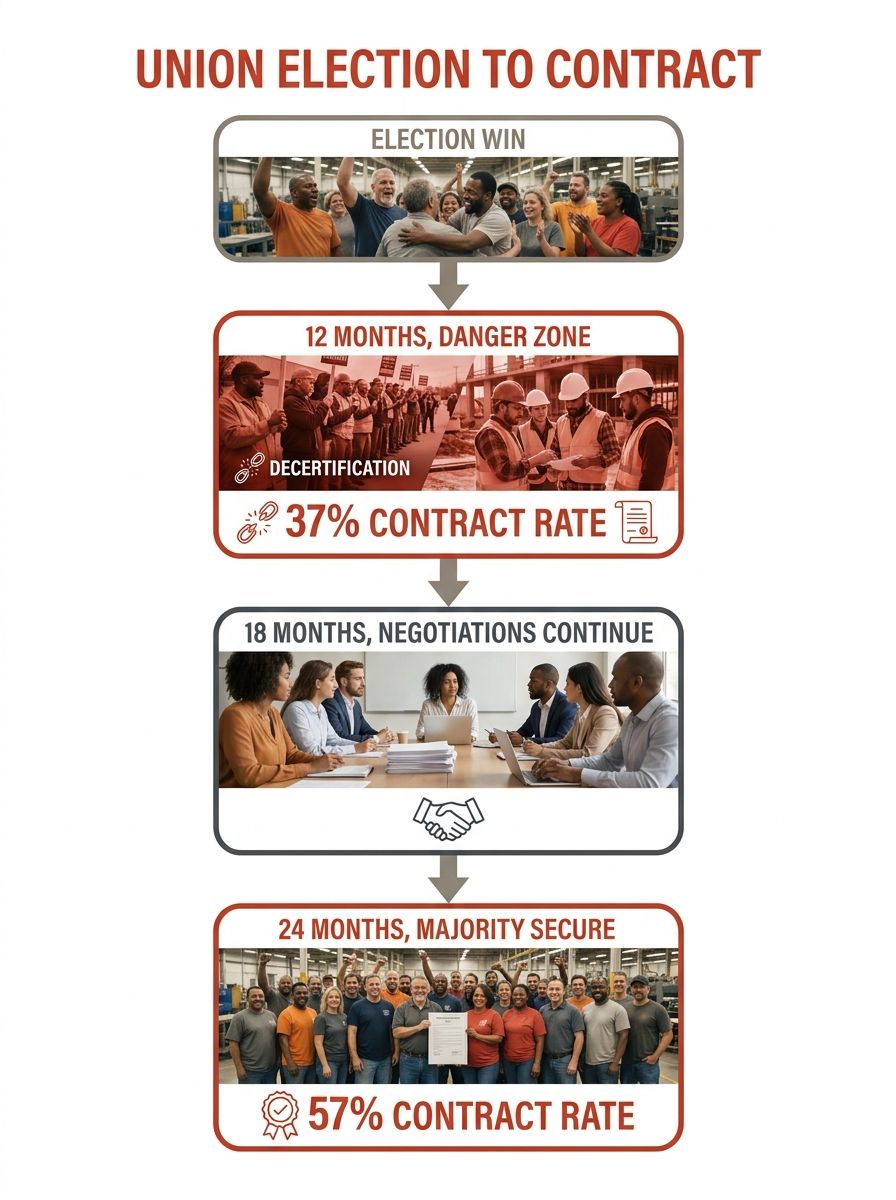
The single most damaging expectation a newly certified unit carries into bargaining is that a contract will follow the election by weeks or months. The average time from certification to first-contract ratification has exceeded 500 days in recent study periods. Only 37% of bargaining units achieved a first contract within 12 months, and just 57% reached one within 24 months.
Employers know these numbers better than most union members do. Terri Gerstein of Harvard Law School explained the logic plainly: "Employers delay to make the union seem ineffectual in the hopes that workers will petition to decertify the union after a year of failed negotiations," according to a UnionTrack analysis of first-contract stalling.
That 12-month mark matters because it's the earliest point at which employees can file a decertification petition with the NLRB. Management delay tactics are calibrated around this window. Every month your bargaining committee sits without visible progress, the employer's decertification strategy gains ground.
Recovery: On the day you certify, tell your members the truth about the timeline. Set the expectation that bargaining will take 12 to 18 months at minimum, and explain why. A unit that understands the delay strategy can't be demoralized by it. We've written about how the post-election period demands its own deliberate bargaining roadmap, and skipping that planning stage is where the timeline illusion takes root.
Build a member feedback pipeline before you sit down at the table
Why do bargaining committees walk into their first session with vague, unfocused proposals? Because they skipped the hardest pre-bargaining work: systematically collecting and ranking what their coworkers actually want in a contract. Without structured input from every shift, department, and job classification, a committee drafts proposals based on the loudest voices in the room. That produces a sprawling wish list instead of a focused set of 5 to 10 achievable priorities.
The UFCW's bargaining education materials describe the employer's legal obligations clearly: violations include refusing to bargain at reasonable times and intervals or making changes to working conditions without negotiating first. But knowing what the employer owes you is only half the equation. Knowing what your members need, ranked by priority and supported by unit-wide data, is what gives your bargaining committee the standing to reject bad proposals and hold out for good ones.
The Harvard Program on Negotiation emphasizes that "thorough preparation and value creation across issues are the keys to success" in labor negotiations. That preparation starts with your own people, not with the employer's opening offer.
Recovery: If you're already at the table without structured member feedback, pause and go get it. Distribute a written survey covering wages, scheduling, safety, benefits, discipline procedures, and grievance rights. Ask members to rank their top three priorities. Use that data to narrow your proposal set and give your committee clear authority to trade lower-priority items for gains on the issues that matter most. The organizing principle behind effective listening as a root-cause exercise applies directly to bargaining prep.
Document every management delay tactic as it happens
The Condé Nast bargaining case is a textbook example. After workers at three publications voted to unionize in 2018, management allegedly "delayed and undermined the bargaining process by refusing to respond to proposals and information requests for months at a time," according to union filings. The contract didn't come until 2021.
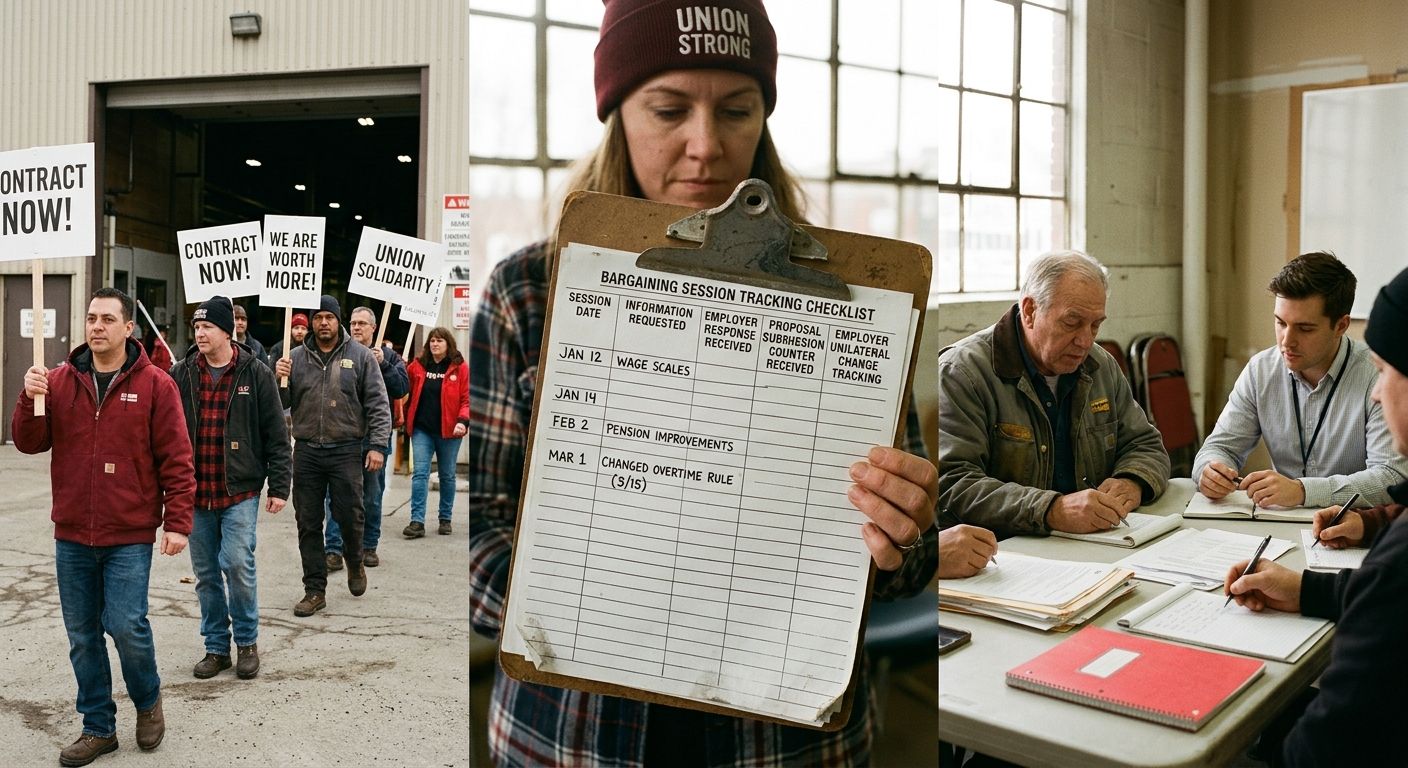
Documentation is the difference between a frustrating experience and a winnable unfair labor practice charge. Under the National Labor Relations Act, an employer that refuses to meet at reasonable times, withholds requested information, or makes unilateral changes to working conditions without bargaining is committing a Section 8(a)(5) violation. But the NLRB can't act on violations it doesn't know about, and generalized complaints about "stalling" don't carry the same weight as timestamped records showing that management canceled 4 of 6 scheduled sessions in a quarter, or that an information request submitted on March 3 went unanswered for 97 days.
The stakes are severe. Research shows the odds of securing a first contract within 18 months decrease by approximately 71% when an employer commits unfair labor practices during negotiations. Filing an 8(a)(5) charge has been associated with a 67% reduction in first-contract achievement in some studies, partly because the charge itself signals a broken process.
Recovery: If you've been bargaining for months without documentation, reconstruct what you can from emails, text messages, and committee members' notes. Then file your charges. The process for filing an unfair labor practice charge is straightforward, and it creates a legal record that constrains the employer's ability to keep stalling without consequence.
Don't lead with wages — anchor proposals to working conditions first
Every management negotiator expects your opening salvo to be about money. When you oblige, you hand them their preferred battlefield. Wage proposals are the easiest for employers to stall on because they can point to budget constraints, competitive benchmarks, and actuarial projections that consume weeks of back-and-forth before any real movement happens. And while your committee is grinding through wage counterproposals, the non-economic provisions that shape daily work life are sitting untouched at the bottom of the agenda.
U.S. employers spent $1.7 billion fighting unions as reported in 2025 data, and a large share of that spending goes to consultants who train management negotiators to run out the clock on economic proposals. Thirty-nine percent of employers retain anti-union consultants after certification specifically to slow-walk the first contract process. The playbook is well-funded and well-rehearsed.
Non-economic proposals covering discipline and discharge procedures, scheduling rights, health and safety committees, seniority protections, and grievance arbitration often face less employer resistance in early sessions. Locking in these provisions first accomplishes two things: it gives your members visible proof that bargaining is producing results, and it narrows the remaining open items so the employer has less room to drag out the process.
Recovery: If your committee has been stuck on wages for months, shift strategy. Table the economic proposals temporarily and push to close out 3 to 5 non-economic articles. Each tentative agreement you reach shrinks the employer's ability to claim that "we're still far apart on everything." It also generates concrete wins you can report back to the membership, which directly combats the demoralization that management delay tactics are designed to produce.
Run a contract campaign, not a legal proceeding
The National Labor Relations Act requires good-faith bargaining. It does not require an agreement. That distinction matters enormously for new unions that treat the legal framework as their primary tool. If your entire first contract bargaining strategy consists of showing up to sessions, making proposals, and waiting for the employer to say yes, you're operating inside a system that was designed to produce patience, not contracts.
The Chicago Teachers Union learned this when the Chicago School Board delayed negotiations over a new contract, leaving only weeks for the parties to reach agreement on salaries, evaluations, classroom supplies, and school building conditions. The resolution came through public mobilization and strike authorization, not through procedural compliance alone.
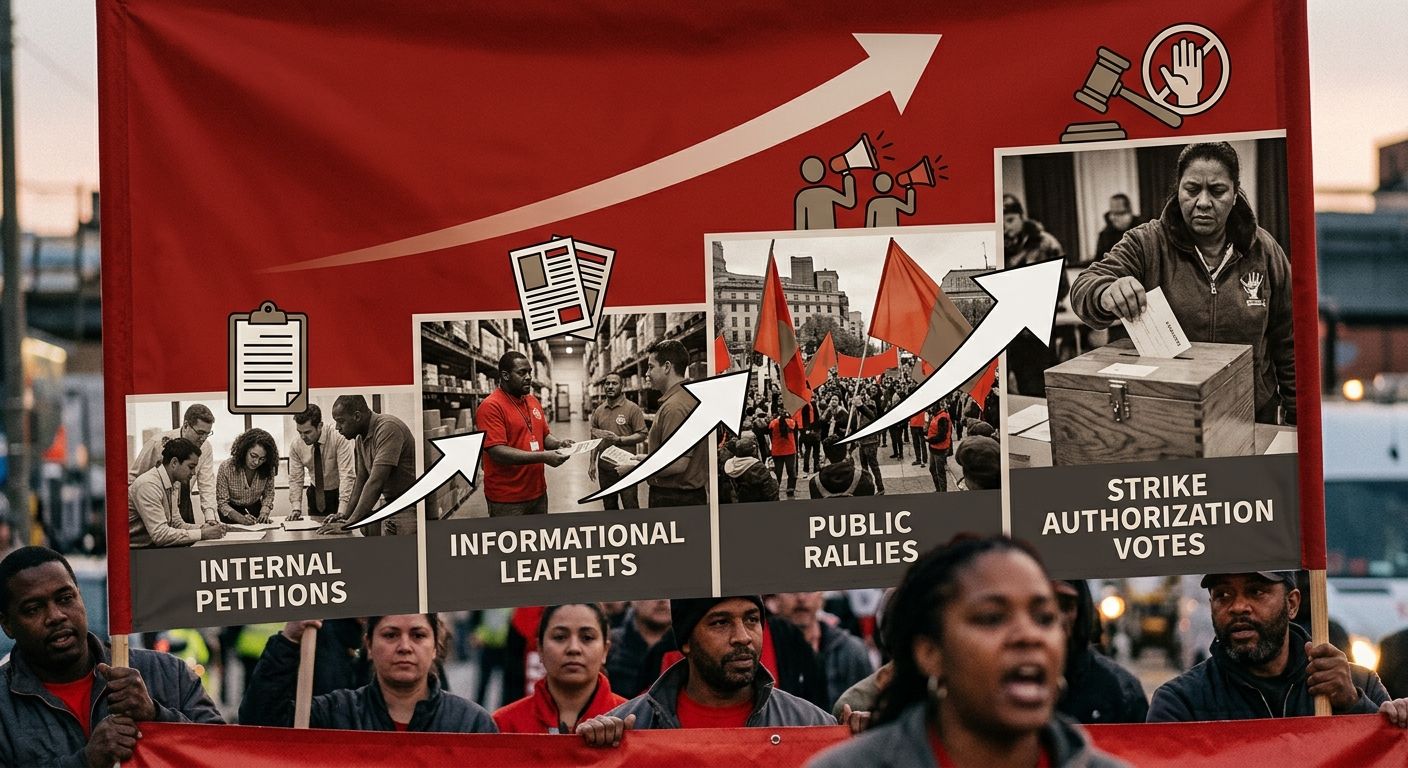
A contract campaign brings pressure from outside the bargaining room: informational picketing, community ally coalitions, public petitions, media outreach, and, where legal, strike authorization votes. The DART paratransit workers who authorized a strike by a 160-1 margin demonstrated the kind of collective action that moves an employer who has shown no interest in moving at the table. The Seattle hotel workers preparing for a strike vote tied to the FIFA World Cup recognized that timing external pressure to maximum economic impact is what turns a stalled negotiation into a signed contract.
Recovery: If you've been running a purely legalistic bargaining process and it's stalled, escalate. Hold a membership meeting focused specifically on contract campaign tactics. Identify the employer's public pressure points: major clients, community reputation, upcoming events, regulatory relationships. Build an escalation ladder that starts with internal actions (petition signing, work-to-rule) and progresses toward public action. Every step should be communicated to management so they understand that the cost of delay is rising.
When These Rules Aren't Enough
Some employers will break every rule of good-faith bargaining regardless of how well your committee prepares. The 39% consultant-retention rate and the $1.7 billion annual anti-union spending figure represent an industry built on ensuring that first contracts either never happen or arrive so late and so weak that workers conclude the union wasn't worth the fight. When you're facing an employer who has made the calculated decision that absorbing ULP penalties is cheaper than signing a fair contract, even a perfectly run bargaining campaign can stall.
This is where the question of binding arbitration versus strike rights becomes unavoidable. Several states and localities have enacted or proposed first-contract arbitration provisions that impose a neutral arbitrator when bargaining reaches impasse. These laws exist because the NLRA's enforcement mechanisms are too slow and too weak to prevent determined employers from running out the clock. A ULP charge filed today might not produce a Board order for 18 to 24 months, by which point the decertification window has opened and closed.
The structural fix for first-contract failure is legislative: mandatory mediation and arbitration timelines, stronger penalties for surface bargaining, and faster NLRB processing of 8(a)(5) charges. Until those reforms arrive, the burden falls on bargaining committees to run campaigns disciplined enough to survive the delay. The five rules above won't guarantee a contract, but the unions that follow them reach the table with a membership that's informed, organized, documented, strategically sequenced, and publicly visible. That combination is what makes an employer calculate that signing is cheaper than fighting. And when that calculation shifts, the contract follows.
The Union Edge Staff
Related Articles

From Recognition to Results: The Post-Election Bargaining Roadmap Unions Get Wrong
Forty-four percent of newly certified unions between 1999 and 2004 never reached a first contract, according to a study of more than 8,000 successful elections by sociologist John-Paul Ferguson. The election was the easy part.

Collective Bargaining Agreement Contracts: A Guide
A collective bargaining agreement contract is the legally binding document that sets wages, benefits, hours, and working conditions between a union and an employer, protected under Section 7 of the National Labor Relations Act.

From First Contact to First Contract: The Hidden Gaps in Union Organizing Timelines and How to Navigate Them
Winning a union election takes weeks. Reaching a first contract takes 465 days on average, according to Bloomberg Law's analysis of federal labor databases.
Also in the paper