
What Is Minimum Wage in Texas: 2024 Guide
Texas does not set its own minimum wage dollar amount. The state's minimum wage law, administered by the Texas Workforce Commission, defers entirely to the federal Fair Labor Standards Act, which means workers in Texas earn a floor of $7.25 per hour, a rate unchanged since July 24, 2009.

What Is Minimum Wage in Texas: 2024 Guide
Texas does not set its own minimum wage dollar amount. The state's minimum wage law, administered by the Texas Workforce Commission, defers entirely to the federal Fair Labor Standards Act, which means workers in Texas earn a floor of $7.25 per hour, a rate unchanged since July 24, 2009. For the roughly 120,000 Texas workers earning at or below that threshold, the practical effect is stark: they work in the second-largest state economy in the country at the lowest hourly floor federal law allows.
What the Texas Minimum Wage Act Actually Says
The Texas Minimum Wage Act, codified in Chapter 62 of the Texas Labor Code, establishes employer obligations around wage payment but does not contain a current dollar minimum within the statute itself. According to the U.S. Department of Labor's state minimum wage comparison, "The Texas State minimum wage law does not contain current dollar minimums." Instead, the Act directs that covered employers must pay the federal minimum wage rate, $7.25 per hour since July 24, 2009, when Texas formally adopted that figure.
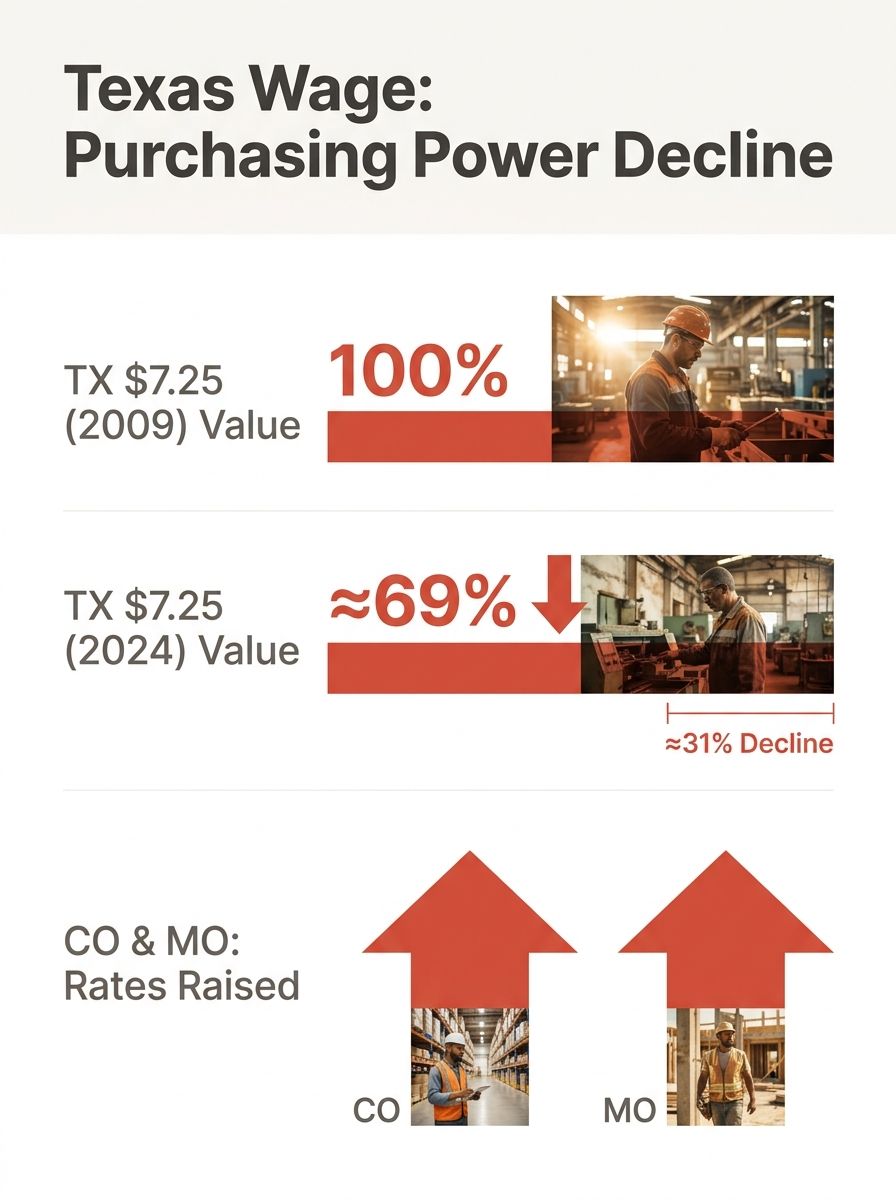
This distinction matters. Texas didn't simply "fail to pass a higher wage." The state legislature made a structural choice: tie the floor to whatever Congress decides. When the federal rate hasn't moved in over 17 years, that choice produces a wage floor stuck at its 2009 value. Adjusted for inflation using Bureau of Labor Statistics CPI data, $7.25 in 2009 would need to be roughly $10.50 today to have the same purchasing power. Workers earning $7.25 in Texas have experienced a real-wage cut of approximately 31% without a single change to their paycheck.
Compare that with neighboring states and the gap becomes concrete. Workers looking at Colorado's indexed minimum wage, which adjusts automatically with the Consumer Price Index, see a system designed to prevent exactly this kind of erosion.
Who Is Covered, and Who Isn't
The Texas Minimum Wage Act has a primary exemption that swallows a large share of the workforce: any employee already covered by the federal FLSA is exempt from the state law. Since the FLSA covers enterprises with annual gross revenue of at least $500,000, plus hospitals, schools, and government agencies regardless of revenue, most Texas workers fall under federal jurisdiction rather than state.
The state act picks up workers whose employers are too small for FLSA coverage. For those workers, the Texas Workforce Commission enforces the $7.25 rate. The Act also provides civil remedies for violations, a worker whose employer pays below the minimum can file a wage claim with the TWC.
Beyond the FLSA overlap, the Act lists specific exemptions. Under TX Labor Code Section 62.155, employers in the agricultural industry are exempt from minimum wage and overtime provisions if they used fewer than 500 "man-days" of agricultural labor in any calendar quarter of the preceding year. The Commissioner of Agriculture sets "piece rates" for agricultural workers picking or harvesting plants and crops, based on what an average worker can produce in a given time period. These piece rates can fall well below $7.25 per hour in practice.
Other exemptions include:
Employees of certain seasonal amusement or recreational establishments
Workers in some fishing operations
Domestic employees under specific conditions
Certain newspaper delivery workers
If you're trying to understand whether your employer falls under state or federal jurisdiction, the test is straightforward: does the business meet the FLSA's $500,000 gross revenue threshold, or do you individually engage in interstate commerce? If yes, federal law governs your wage floor. If neither applies, the Texas Minimum Wage Act fills the gap, at the same $7.25 rate.
How Tipped Wages Work in Texas
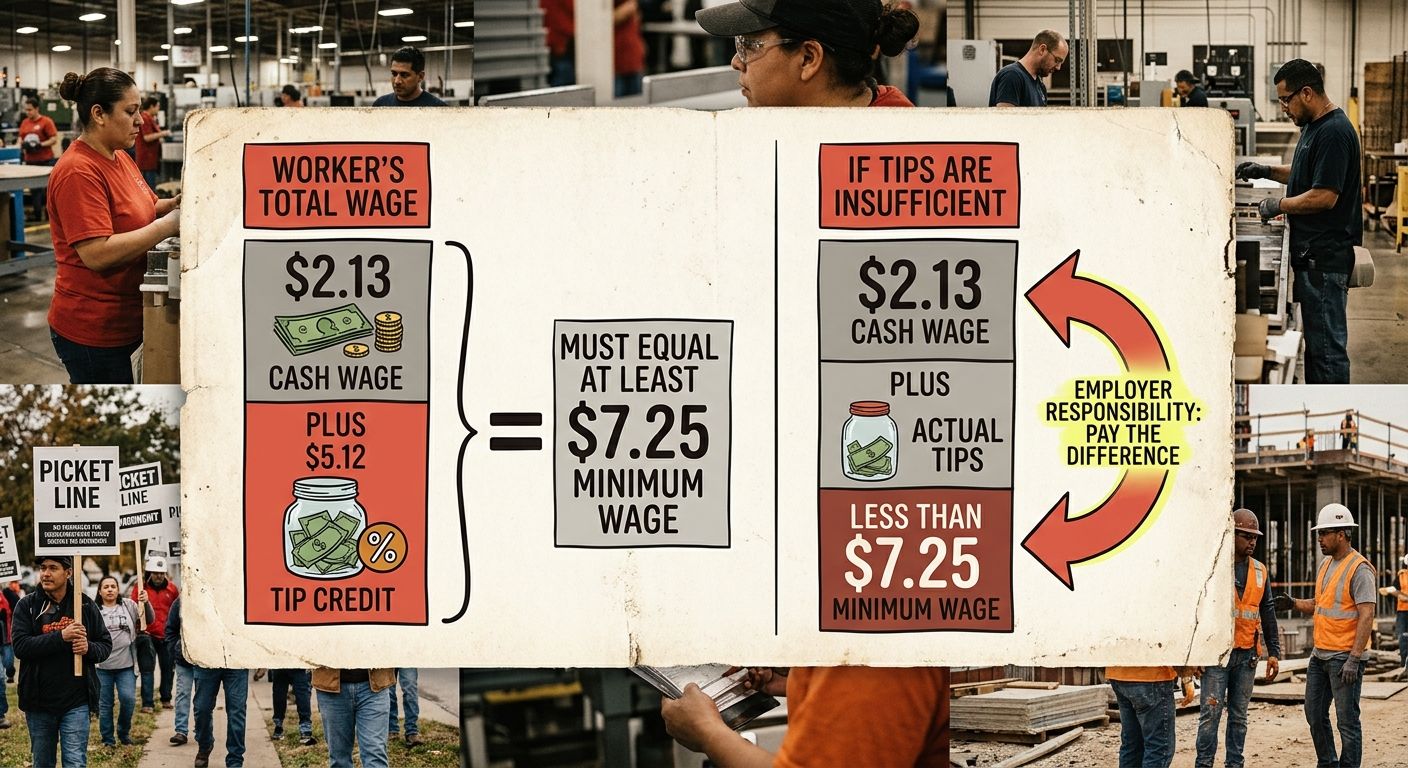
Tipped employees in Texas can be paid a cash wage of $2.13 per hour under the FLSA's tip credit provision. The employer claims a "tip credit" of $5.12 per hour, meaning the worker's tips must bring total compensation to at least $7.25 per hour. If tips fall short in any workweek, the employer is legally required to pay the difference.
Texas has its own definition of who qualifies as a tipped employee. According to OnPay's analysis of Texas wage law, "Texas defines it as receiving more than $50 a month in tips, while the federal standard is $20 a month." That higher threshold means some workers who would qualify as "tipped" under federal law might not meet the Texas definition, though in practice, since most Texas employers are governed by the FLSA's $20 threshold, the federal definition usually controls.
The tipped wage system creates a structural enforcement problem. Workers earning $2.13 per hour who don't track their tips precisely may never realize their employer owes them a make-up payment. Wage theft in tipped industries, restaurants, bars, hotels, remains one of the most common violations the TWC investigates. Employers must maintain detailed records of hours, wages, and tips for at least three years to facilitate Texas Workforce Commission inspections.
Sub-Minimum Rates for Youth Workers and Students
The federal minimum wage framework that Texas adopts includes several sub-minimum wage provisions. Youth workers under the age of 20 can be paid $4.25 per hour during their first 90 consecutive calendar days of employment with any employer. After 90 days, or when they turn 20, whichever comes first, the full $7.25 rate applies. Employers cannot displace existing employees to hire youth workers at the lower rate.
Full-time students employed at retail or service establishments, farms, or at their college or university can be paid 85% of the minimum wage, $6.16 per hour, under a certificate issued by the U.S. Department of Labor. The student must work no more than 8 hours per day and 20 hours per week when school is in session, though those limits expand during breaks.
Student learners in vocational education programs can also be paid sub-minimum rates under DOL certification, typically at 75% of the federal minimum ($5.44 per hour). Workers whose productive capacity is impaired by physical or mental disability may be paid below the minimum wage under a Section 14(c) certificate from the DOL's Wage and Hour Division, though these certificates have faced growing legal and political challenges nationwide.
These sub-minimum provisions collectively create a tiered wage system that disproportionately affects young workers and workers with disabilities. For a 19-year-old starting a first job at a fast-food restaurant in Houston, the first three months at $4.25 per hour means earning roughly $680 per month on a 40-hour week, before taxes.
State Preemption Blocks Local Wage Floors
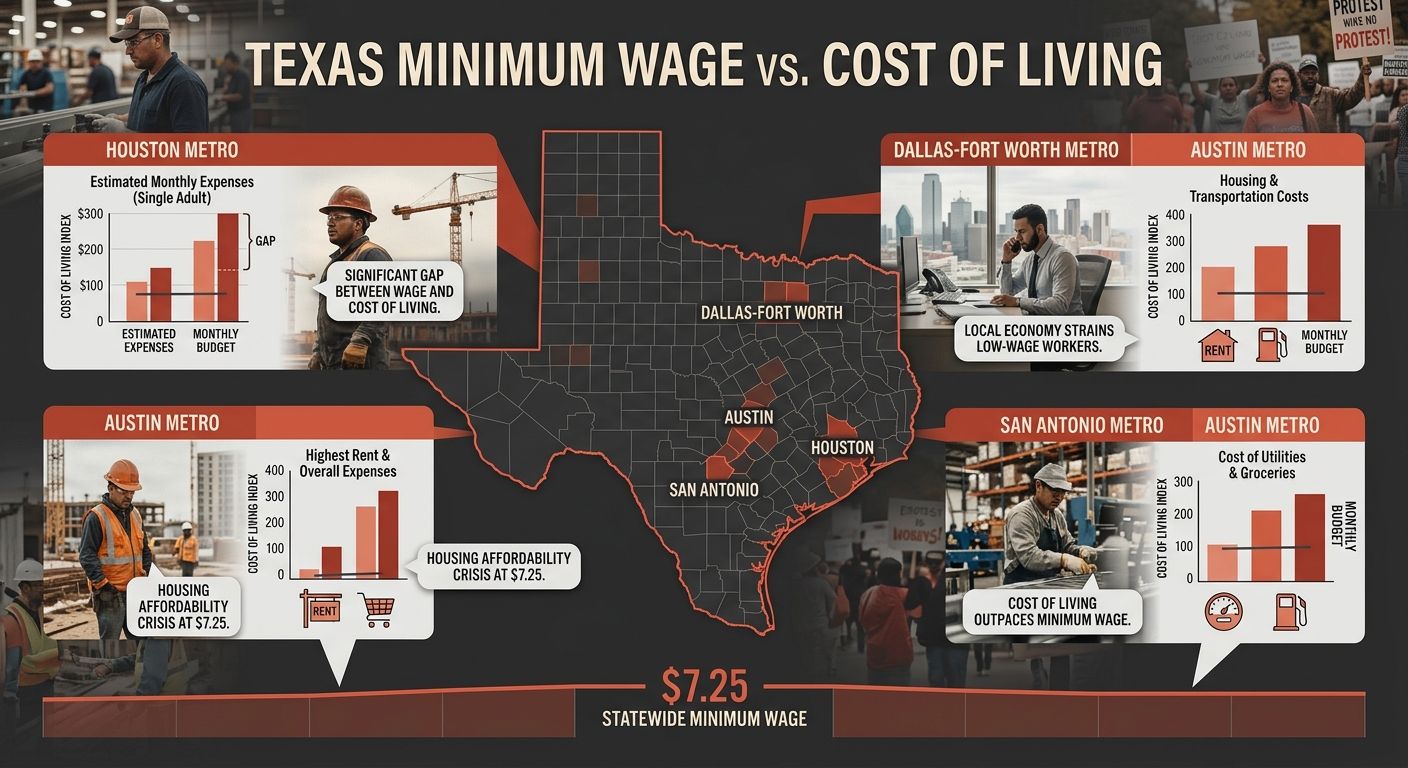
Texas Labor Code Section 62.0515 prohibits municipalities and counties from mandating minimum wages for private-sector employers that exceed the state (and therefore federal) rate. This preemption law means cities like Houston, Dallas, San Antonio, and Austin cannot pass local minimum wage ordinances for businesses operating within their borders.
Austin has set its own municipal employee wage floor at $22.05 per hour for fiscal year 2025–26, and several Texas cities attach higher wage requirements to city contracts. But these apply only to public employees and government contractors. For the hundreds of thousands of private-sector workers earning at or near $7.25, the preemption law blocks the most common local remedy.
This preemption framework puts Texas in a different category from states like Missouri, where voter-approved ballot initiatives have pushed the rate to $12.30 and beyond. Texas has no ballot initiative process at the state level, meaning voters cannot bypass the legislature to raise the minimum wage directly. Any increase must come through a bill signed by the governor or a federal increase enacted by Congress.
The political math has stalled both paths. No state bill raising the minimum wage has passed the Texas legislature in the modern era, and the federal rate hasn't moved since 2009. The 2026 gubernatorial race has surfaced the issue, candidate Bobby Cole has campaigned on a $15 rate, but no legislation is pending.
Pay Frequency and Enforcement Mechanics
Texas requires that non-exempt employees be paid at least twice per month. If the employer does not specify paydays, the default schedule falls on the 1st and 15th of each month. Employers must also provide wage statements showing hours worked and pay calculations.
The Texas Workforce Commission handles wage claims from workers who believe they've been underpaid. The process starts with filing a claim within 180 days of the alleged violation. The TWC investigates, and if it finds a violation, it can order the employer to pay back wages. Civil remedies under the Texas Minimum Wage Act allow workers to sue for unpaid wages plus additional penalties.
Enforcement capacity matters here. Texas employs far fewer wage-and-hour investigators per capita than states like California or New York. The federal Wage and Hour Division supplements state enforcement, but its own staffing has fluctuated with administration priorities. Workers in states with stronger enforcement infrastructure, and you can see how this plays out when you look at how the NLRB handles employer-employee disputes at the federal level, tend to recover more stolen wages per capita.
For workers facing wage theft and employer non-compliance, documentation is the single most powerful tool. Keep your own records of hours worked, tips received, and pay stubs. Texas law does not require employers to provide itemized wage statements in all cases, so your personal records may be the only evidence available in a dispute.
Where the Mechanism Breaks
The Texas minimum wage system fails its stated purpose, ensuring a wage floor, under several conditions.
Misclassification as independent contractors. Texas employers who classify workers as 1099 contractors instead of W-2 employees sidestep the minimum wage entirely. The FLSA and Texas Minimum Wage Act cover employees, not independent contractors. Misclassification is rampant in construction, gig delivery, janitorial services, and home health care across the state.
Agricultural piece-rate opacity. Because the Commissioner of Agriculture sets piece rates based on average worker productivity, individual workers who are slower, due to age, disability, heat, or inexperience, can earn effective hourly rates far below $7.25. The averaging method bakes in a structural disadvantage for anyone who isn't a peak performer.
Tip credit abuse. The make-up pay requirement for tipped workers assumes employers are tracking tips accurately and honestly. In practice, enforcement depends on the worker filing a complaint. Workers in the food service industry, many of whom are immigrants or young people in their first jobs, face real barriers to filing claims, fear of retaliation, lack of documentation, language barriers, and simple ignorance that the law requires make-up pay at all.
Preemption as ceiling. The state preemption of local wage ordinances doesn't preserve a "level playing field" as proponents argue. It prevents the economic feedback loop that would otherwise occur: workers in high-cost cities like Austin (where median rent exceeds $1,500 per month) earn the same legal minimum as workers in rural towns where costs run 40-50% lower. The preemption converts a floor into a ceiling for local democratic action.
Common Questions
Does Texas have its own minimum wage separate from the federal rate?
No. The Texas Minimum Wage Act does not contain an independent dollar minimum. It adopts the federal rate of $7.25 per hour, which has been in effect since July 24, 2009. No state legislation has been passed to create a higher Texas-specific rate, and as of 2026, none is pending.
Can cities in Texas set higher minimum wages?
Texas Labor Code Section 62.0515 prohibits cities and counties from mandating higher minimum wages for private-sector employers. Some cities, like Austin, have set higher pay floors for municipal employees and city contractors, Austin pays $22.05 per hour for its own workers, but private employers are bound only by the $7.25 federal floor.
What is the tipped minimum wage in Texas?
Under the federal FLSA, which governs most Texas employers, tipped employees can be paid a cash wage of $2.13 per hour. The employer claims a tip credit of $5.12, and the worker's tips must bring total hourly compensation to at least $7.25. If tips fall short, the employer must make up the difference.
Are any workers exempt from the Texas minimum wage?
Yes. Agricultural workers at small operations (fewer than 500 man-days of labor per quarter in the preceding year) are exempt under TX Labor Code 62.155. Youth workers under 20 can be paid $4.25 per hour for their first 90 days. Full-time students working under a DOL certificate can earn $6.16 per hour (85% of the minimum). And the primary exemption in the state Act covers anyone already governed by the federal FLSA, meaning most workers' wage protections come from federal, not state, law.
How do I file a wage complaint in Texas?
You can file a wage claim with the Texas Workforce Commission within 180 days of the underpayment. The TWC investigates and can order back pay. You also have the right to pursue civil remedies under the Texas Minimum Wage Act, which means suing in court for unpaid wages. Keep your own records of hours, tips, and pay, they're often the strongest evidence in a wage dispute.
The Union Edge Staff
Frequently Asked Questions
- What is the minimum wage in Texas 2024?
- Texas does not set its own minimum wage and instead defers to the federal Fair Labor Standards Act. The minimum wage in Texas is $7.25 per hour, which has been unchanged since July 24, 2009.
- Can Texas cities set their own minimum wage?
- No. Texas Labor Code Section 62.0515 prohibits cities and counties from mandating minimum wages for private-sector employers that exceed the state rate of $7.25 per hour. Cities like Austin can only set higher wages for municipal employees and government contractors, not private businesses.
- What is the tipped minimum wage in Texas?
- Tipped employees in Texas can be paid $2.13 per hour in cash wages under federal rules. The employer claims a tip credit of $5.12 per hour, and if tips don't bring total compensation to $7.25 per hour, the employer must make up the difference.
- How much can employers pay workers under 20 in Texas?
- Youth workers under age 20 can be paid $4.25 per hour during their first 90 consecutive calendar days of employment with any employer. After 90 days or when they turn 20, whichever comes first, the full $7.25 rate applies.
- What are the exceptions to Texas minimum wage requirements?
- Agricultural workers at operations with fewer than 500 man-days of labor per quarter are exempt, along with certain seasonal amusement workers, fishing operations employees, domestic employees under specific conditions, and certain newspaper delivery workers.
- How do I file a wage complaint in Texas?
- You can file a wage claim with the Texas Workforce Commission within 180 days of the alleged underpayment. The TWC investigates and can order back wages. You also have the right to pursue civil remedies in court for unpaid wages.
- What is the minimum wage for full-time students in Texas?
- Full-time students employed at retail or service establishments, farms, or at their college or university can earn $6.16 per hour (85% of the minimum wage) under a certificate issued by the U.S. Department of Labor, provided they work no more than 8 hours per day and 20 hours per week during school.
Related Articles

Minimum Wage Texas: Current Laws & Rates
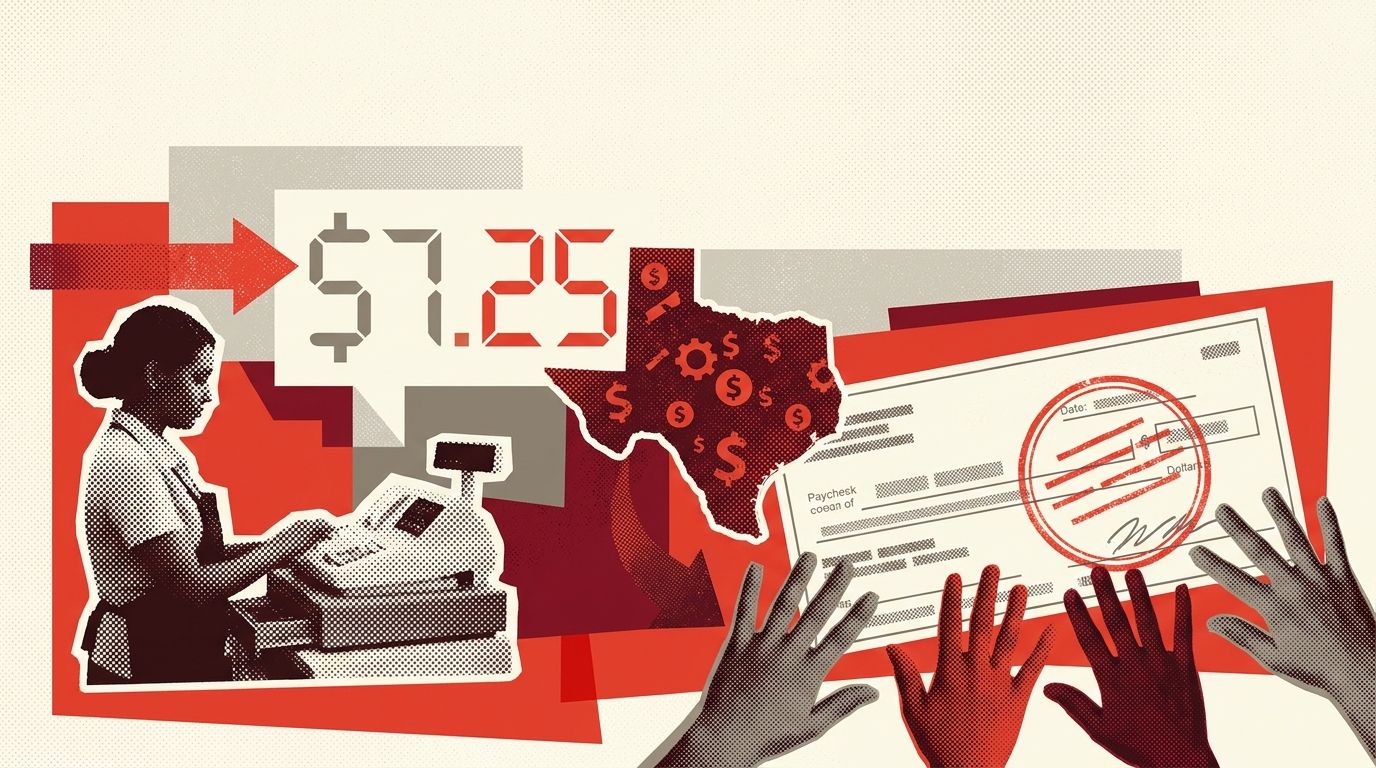
Chapter 62 of the Texas Labor Code contains no independent wage figure. It copies the federal minimum wage by reference, which means the texas minimum wage has been $7.25 per hour since July 24, 2009, and won't change unless Congress acts.
What Is the State of Texas Minimum Wage
The Texas Minimum Wage Act contains no dollar amount. The statute adopts the federal minimum wage rate by reference, making the state of Texas minimum wage identical to the federal floor: $7.

Minimum Texas Wage: What You Need to Know
Unlike 30 states that set independent minimum wage floors above the federal rate, Texas adopted the federal number by reference and then built a legal architecture that prevents any city or county from going higher. The result: the minimum wage in Texas has been $7.
Also in the paper