
Illinois Minimum Wage: 2024 Requirements & Updates
Under the Illinois Minimum Wage Law, every employer in the state owes adult workers at least $15.00 per hour, the final step of a six-year phased increase that reached its target on January 1, 2025.

Illinois Minimum Wage: How the State's Wage Floor Works and Why It Matters for Worker Safety
Under the Illinois Minimum Wage Law, every employer in the state owes adult workers at least $15.00 per hour, the final step of a six-year phased increase that reached its target on January 1, 2025. That rate is fixed by statute, carries no inflation adjustment, and applies unevenly across worker categories in ways that concentrate safety risk on the lowest-paid.
What the Illinois Minimum Wage Law Actually Requires
The Illinois Minimum Wage Law, administered by the Illinois Department of Labor, sets a mandatory hourly floor of $15.00 for all workers aged 18 and older. This rate is more than double the federal minimum wage of $7.25 per hour established under the Fair Labor Standards Act, and it applies to most private-sector employees regardless of whether they work full-time, part-time, or on a temporary basis.
Governor J.B. Pritzker signed the enabling legislation in 2019, establishing fixed dollar-amount increases at predetermined dates. The law does not use a formula or automatic adjustment. Overtime protections sit on top of the base rate: non-exempt workers earn 1.5 times their regular hourly pay for every hour beyond 40 in a single workweek.
Employers must maintain accurate records of hours worked and pay rates for at least two years under the Illinois Wage Payment and Collection Act. Pay stubs must detail earnings and deductions. Workers who believe they're being paid less than the legal minimum can file complaints with the Illinois Department of Labor, which has authority to investigate and order back pay.
The Phased Increase from $8.25 to $15.00
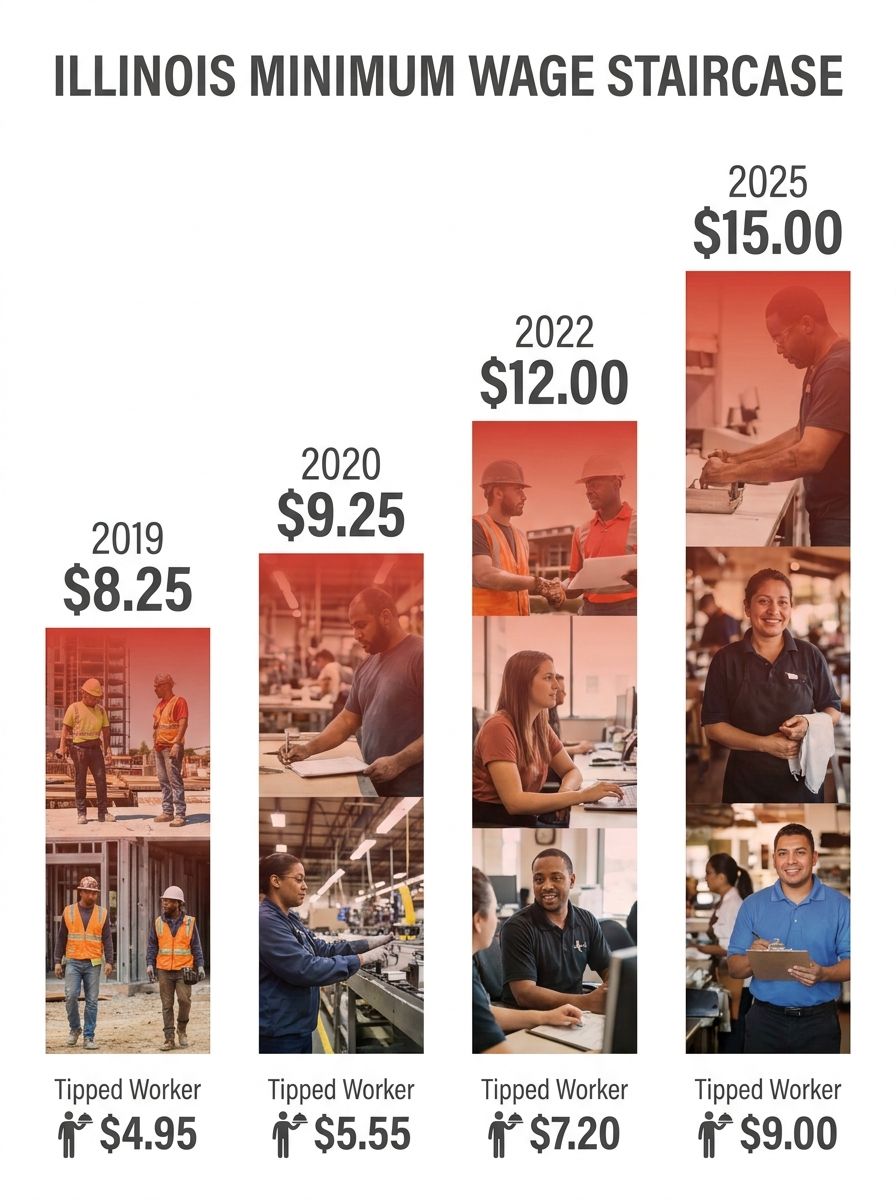
The minimum wage for Illinois didn't arrive at $15.00 in a single jump. The legislature built a staircase that took six years to climb, with each step written into law at a specific dollar amount.
The rate moved from $8.25 in 2019 to $9.25 on January 1, 2020, then to $10.00 on July 1, 2020. From there, it rose by $1.00 every January: $11.00 in 2021, $12.00 in 2022, $13.00 in 2023, and $14.00 on January 1, 2024. The final step to $15.00 took effect on January 1, 2025.
Year | Effective Date | Minimum Wage | Tipped Cash Wage (60%) |
|---|---|---|---|
2020 | January 1 | $9.25 | $5.55 |
2020 | July 1 | $10.00 | $6.00 |
2021 | January 1 | $11.00 | $6.60 |
2022 | January 1 | $12.00 | $7.20 |
2023 | January 1 | $13.00 | $7.80 |
2024 | January 1 | $14.00 | $8.40 |
2025 | January 1 | $15.00 | $9.00 |
This phased structure gave businesses time to budget for each step. But it also meant a worker earning $8.25 in 2019 waited six years for the full increase while inflation chipped away at every step along the way. A dollar in 2019 was worth considerably less by 2025, and the cumulative erosion cut into the real value of each incremental raise.
Tipped Workers, Youth, and the Sub-Minimum Tiers
The $15.00 headline number doesn't reach everyone. Illinois law creates lower floors for specific categories, and these tiers overlap heavily with the jobs where safety problems are worst.
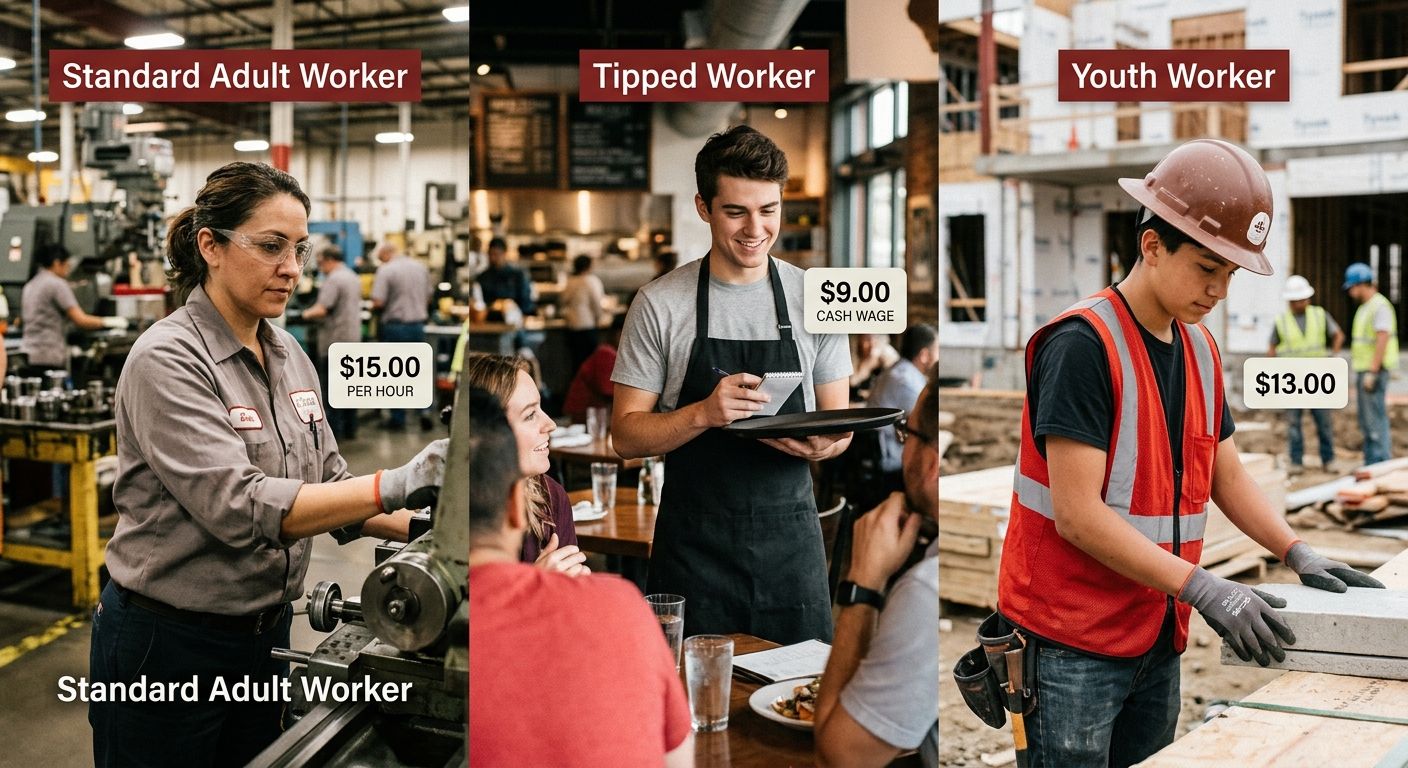
Tipped workers receive a cash wage of $9.00 per hour, 60% of the full minimum. Employers are legally required to make up the shortfall if tips don't bring total compensation to $15.00, but enforcement depends on accurate record-keeping and on workers knowing their rights. Tip credit violations remain among the most common wage theft complaints in the restaurant sector. Workers who earn $9.00 as a base aren't eager to rock the boat by challenging their employer's math.
Youth workers under 18 who log fewer than 650 hours in a calendar year earn $13.00 per hour. Once they cross that threshold, they're entitled to the full $15.00.
Other exemptions include agricultural workers at operations using 500 or fewer person-days of farm labor per quarter, outside salespeople, and student learners holding a special license from the Illinois Department of Labor. In June 2026, Senate Bill 454 added professional Minor League Baseball players covered by a collective bargaining agreement to the exempt list.
The safety dimension here is plain. Workers earning sub-minimum cash wages cluster in restaurants, hotels, and agricultural operations, industries that consistently rank among the highest for workplace injuries and underreported safety violations. When your take-home pay depends on tips, you're far less likely to file a complaint about a broken exhaust hood or a missing blade guard.
Chicago and Cook County Set Their Own Floors
The minimum wage in Illinois isn't uniform across the state. Chicago enforces a higher floor of approximately $16.60 per hour as of mid-2025 for employers with four or more workers, adjusted annually for inflation. The city is also phasing out its separate tipped minimum wage, requiring tipped workers to reach the full city rate by 2028.
Cook County's minimum wage ordinance outside Chicago generally tracks the state rate of $15.00, though several suburban municipalities have opted out of the county's provisions entirely.
This patchwork creates real confusion for workers who cross jurisdictional lines during their commute. A food service worker at a Chicago restaurant earns $16.60; the same job at a franchise location twenty minutes south in unincorporated Cook County pays $15.00. Comparing Illinois to states like Washington or Colorado reveals a deeper structural difference: those states index their rates to inflation, meaning the gap between their floors and Illinois' fixed $15.00 will widen every year the legislature doesn't act.
Where the Wage Floor Meets Workplace Safety
A minimum wage law looks like pure economic regulation. Inside workplaces where workers earn at or near the floor, the wage rate shapes safety outcomes directly.
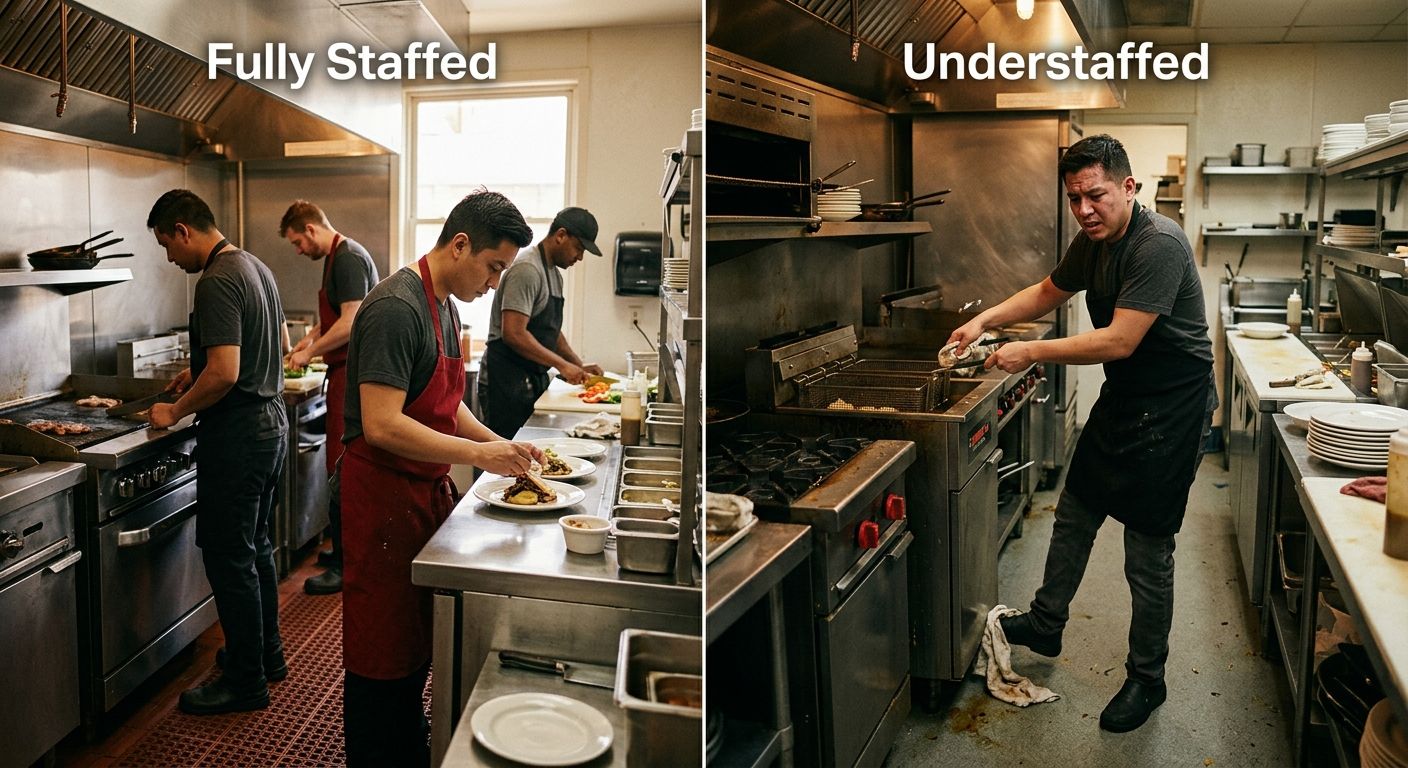
Workers earning minimum wage are concentrated in food service, retail, agriculture, and warehouse operations, the sectors where OSHA documents the highest rates of preventable injuries year after year. An Illinois Restaurant Association survey found that 80% of restaurants planned to raise menu prices in response to minimum wage increases, 66% planned to reduce staff or consolidate positions, and 46% considered adding service charges. Fewer workers doing the same volume of work increases injury exposure. A prep cook who's now also handling the fryer and cleaning the walk-in at close faces a measurably higher risk of burns, falls, and repetitive strain injuries.
And the exempted categories of workers sit at the intersection of low pay and weak safety enforcement. Agricultural workers face some of the most dangerous conditions in any U.S. industry, and Illinois' exemption of small-farm employers from minimum wage obligations overlaps with the exemptions those same employers receive from certain OSHA standards. The workers earning the least are the workers whose employers face the fewest consequences for dangerous conditions.
The relationship runs both directions. Workers who earn enough to cover rent and groceries are workers who can walk away from an unsafe task. Collective bargaining agreements routinely pair wage increases with enforceable safety provisions because unions understand that economic security gives workers the standing to demand physical security. A minimum wage law sets the floor, but a union contract builds the walls.
Where the Model Breaks
Illinois' minimum wage law accomplished what it set out to do: raise the floor from $8.25 to $15.00 over six years. But the model has structural weaknesses that will erode its protections steadily unless the legislature intervenes.
No inflation indexing. The $15.00 rate is locked in place until a new law moves it. With inflation running above zero every year since 2025, the real purchasing power of $15.00 shrinks month by month. Workers are effectively absorbing an annual pay cut while the number on their stub stays the same. States that index to the CPI don't have this problem.
Tip credit enforcement gaps. The legal requirement that employers make up the difference between $9.00 and $15.00 is complaint-driven. Workers who report violations risk retaliation, and workers earning $9.00 an hour can't easily absorb the income disruption that comes with filing a complaint. The gap between what the law promises and what workers actually receive is widest in exactly the workplaces where safety violations are also most common.
Exemption creep. Senate Bill 454's 2026 carve-out for Minor League Baseball players is narrow. But it follows a pattern. Every new exemption invites lobbying from other industries, and each hole in the floor weakens the principle that work performed in Illinois has a legal price.
The housing gap. The National Low Income Housing Coalition has estimated that an Illinois worker needs roughly $23.50 per hour to afford a modest two-bedroom apartment at fair market rent. At $15.00, a full-time minimum wage worker earns about 64% of that threshold. Bridging the gap with second and third jobs produces fatigue, and fatigue is one of the most reliable predictors of workplace injury.
The 14(c) phase-out timeline. Illinois will stop issuing licenses allowing employers to pay disabled workers below the full minimum wage by December 31, 2029. The reform is significant, but the four-year runway means sub-minimum wages for disabled workers remain legal through the end of the decade.
The sharpest illustration of what the floor can't fix may be the distance between it and the top. A recent analysis found that executives at the 100 S&P 500 companies with the lowest median worker pay earned 614 times their typical employee's salary. Illinois' $15.00 establishes a bottom rung. It does nothing about the fact that the ladder's top is pulling away faster than any state legislature can follow.
Common Questions
Does the Illinois minimum wage apply to all workers in the state?
No. The minimum wage in Illinois excludes several categories: agricultural workers at small operations, outside salespeople, student learners with a special license, and professional Minor League Baseball players covered by a collective bargaining agreement (as of June 2026). Tipped employees and youth under 18 receive reduced rates rather than full exemption.
What is the minimum wage in Illinois for tipped workers?
Tipped workers earn a cash wage of $9.00 per hour, which is 60% of the full $15.00 minimum wage. Employers must ensure that tips bring total hourly compensation to at least $15.00 per hour. If tips fall short, the employer is legally required to make up the difference.
Will the minimum wage Illinois mandates increase again?
Not under current law. The $15.00 rate that took effect January 1, 2025, was the final scheduled step in the phased increase signed into law in 2019. Because Illinois doesn't index its minimum wage to inflation, any future increase requires new legislation. Chicago, by contrast, adjusts its local rate annually.
How does Illinois compare to the federal minimum wage?
The minimum wage for Illinois at $15.00 per hour is more than double the federal floor of $7.25. Under federal law, workers receive whichever rate is higher, so the federal minimum is functionally irrelevant for workers employed in Illinois. It remains the operative rate only in states that haven't set their own higher standards.
Can my employer pay less than minimum wage during a training period?
Illinois allows employers to apply for special licenses to pay sub-minimum rates to "learners" for a limited time. These licenses are issued by the Illinois Department of Labor and restrict the duration and type of work involved. Without a valid license, your employer owes the full $15.00 from the first hour you work.
The Union Edge Staff
Frequently Asked Questions
- What is the current minimum wage in Illinois?
- The minimum wage in Illinois is $15.00 per hour for workers 18 and older, effective January 1, 2025. This is the final step of a six-year phased increase that began in 2019.
- What is the minimum wage for tipped workers in Illinois?
- Tipped workers in Illinois earn a cash wage of $9.00 per hour (60% of the full minimum wage). Employers are legally required to make up the difference if tips don't bring total compensation to at least $15.00 per hour.
- How much do youth workers earn in Illinois?
- Youth workers under 18 who work fewer than 650 hours in a calendar year earn $13.00 per hour. Once they exceed 650 hours, they're entitled to the full $15.00 minimum wage.
- What is Chicago's minimum wage compared to Illinois?
- Chicago enforces a higher minimum wage of approximately $16.60 per hour as of mid-2025 for employers with four or more workers, adjusted annually for inflation. This is higher than the state minimum of $15.00.
- Will the Illinois minimum wage increase again in 2025?
- Not under current law. The $15.00 rate that took effect January 1, 2025, was the final scheduled step in the phased increase signed into law in 2019. Any future increase requires new legislation, as Illinois does not automatically adjust its minimum wage for inflation.
- Which workers are exempt from Illinois minimum wage requirements?
- Illinois exempts agricultural workers at operations using 500 or fewer person-days of labor per quarter, outside salespeople, student learners with a special license, and professional Minor League Baseball players covered by a collective bargaining agreement as of June 2026.
- How much more is Illinois minimum wage compared to federal minimum wage?
- Illinois' minimum wage of $15.00 per hour is more than double the federal minimum wage of $7.25 per hour. Workers receive whichever rate is higher, making the federal minimum functionally irrelevant in Illinois.
- Can employers pay less than minimum wage during training?
- Illinois allows employers to pay sub-minimum rates to "learners" only with a special license issued by the Illinois Department of Labor. Without a valid license, employers must pay the full $15.00 minimum wage from the first hour of work.
Related Articles
Minimum Wage State of Illinois: 2024 Guide
The minimum wage in the state of Illinois is $15.00 per hour for workers 18 and older, the rate that took effect January 1, 2025, completing a phased schedule of six annual increases. But Illinois doesn't operate on a single number.

Minimum Wage New Jersey 2024: Rates & Updates
New Jersey's minimum wage for most employees reached $15.13 per hour on January 1, 2024, completing a legislated climb from $8.85 in 2019 and triggering a permanent CPI-indexed adjustment formula. The rate doesn't come from annual legislative votes anymore.

Minimum Federal Wage: Current Rates & Policy
Congress sets the minimum federal wage; it does not update it. The $7.
Also in the paper