
Minimum Wage Washington: 2024 Rates & Changes
Washington's minimum wage is an inflation-indexed floor set by state law, adjusted each September based on the Consumer Price Index for Urban Wage Earners and Clerical Workers (CPI-W), and effective every January 1 without a legislative vote. The 2024 statewide rate reached $16.28 per hour, a 3.

Minimum Wage in Washington: How the CPI Escalator Sets Your Pay Floor
Washington's minimum wage is an inflation-indexed floor set by state law, adjusted each September based on the Consumer Price Index for Urban Wage Earners and Clerical Workers (CPI-W), and effective every January 1 without a legislative vote. The 2024 statewide rate reached $16.28 per hour, a 3.4% jump from the prior year, while several cities within Washington enforce floors above $20.
The Law Behind Washington's Automatic Wage Adjustments
Initiative 688, approved by voters in 1998, first tied Washington's minimum wage to the CPI-W. Initiative 1433, passed in 2016, reinforced and expanded the escalator, raising the base to $13.50 by 2020 and continuing annual CPI adjustments afterward. The Washington State Department of Labor and Industries (L&I) announced the 2024 increase on September 29, 2023, setting the rate at $16.28 per hour for employees sixteen years of age and older.
The legal framework sits in RCW 49.46, the state's Minimum Wage Act. Two features separate Washington's approach from the federal model and from many other states. First, the adjustment is automatic. L&I calculates the new rate using August-to-August CPI-W data, rounds to the nearest cent, and publishes it by September 30. No bill needs to pass the legislature, no governor needs to sign anything. Second, Washington's minimum wage contains no tip credit. Employers cannot count tips toward the hourly obligation. A server, a bartender, and a warehouse worker all receive the same base floor before tips enter the picture.
Workers aged 14 and 15 are entitled to 85% of the standard rate. In 2024, that meant $13.84 per hour. This sub-minimum applies only to the youngest legally employable workers and carries strict hour limitations under both state and federal child labor statutes.
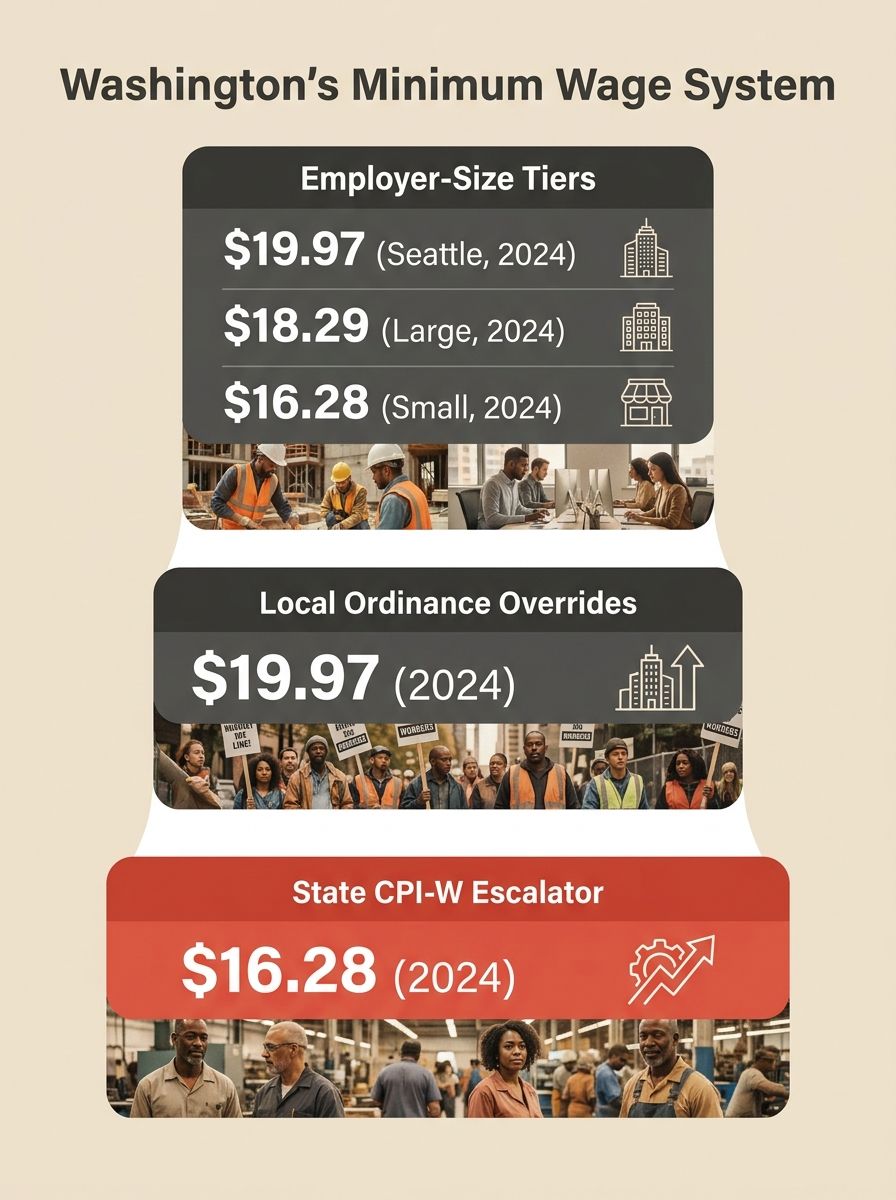
How the CPI-W Formula Calculates Each Year's Rate
The Consumer Price Index for Urban Wage Earners and Clerical Workers measures price changes for a basket of goods and services purchased by hourly and clerical workers. The Bureau of Labor Statistics publishes it monthly, and L&I uses the national CPI-W average from the 12-month period ending in August to calculate the percentage change from the prior year. That percentage is applied to the current minimum wage, and the result becomes the next year's rate.
Here's how the math played out over three consecutive cycles:
Year | State Rate | Year-over-Year Increase |
|---|---|---|
2024 | $16.28 | 3.4% |
2025 | $16.66 | 2.3% |
2026 | $17.13 | 2.8% |
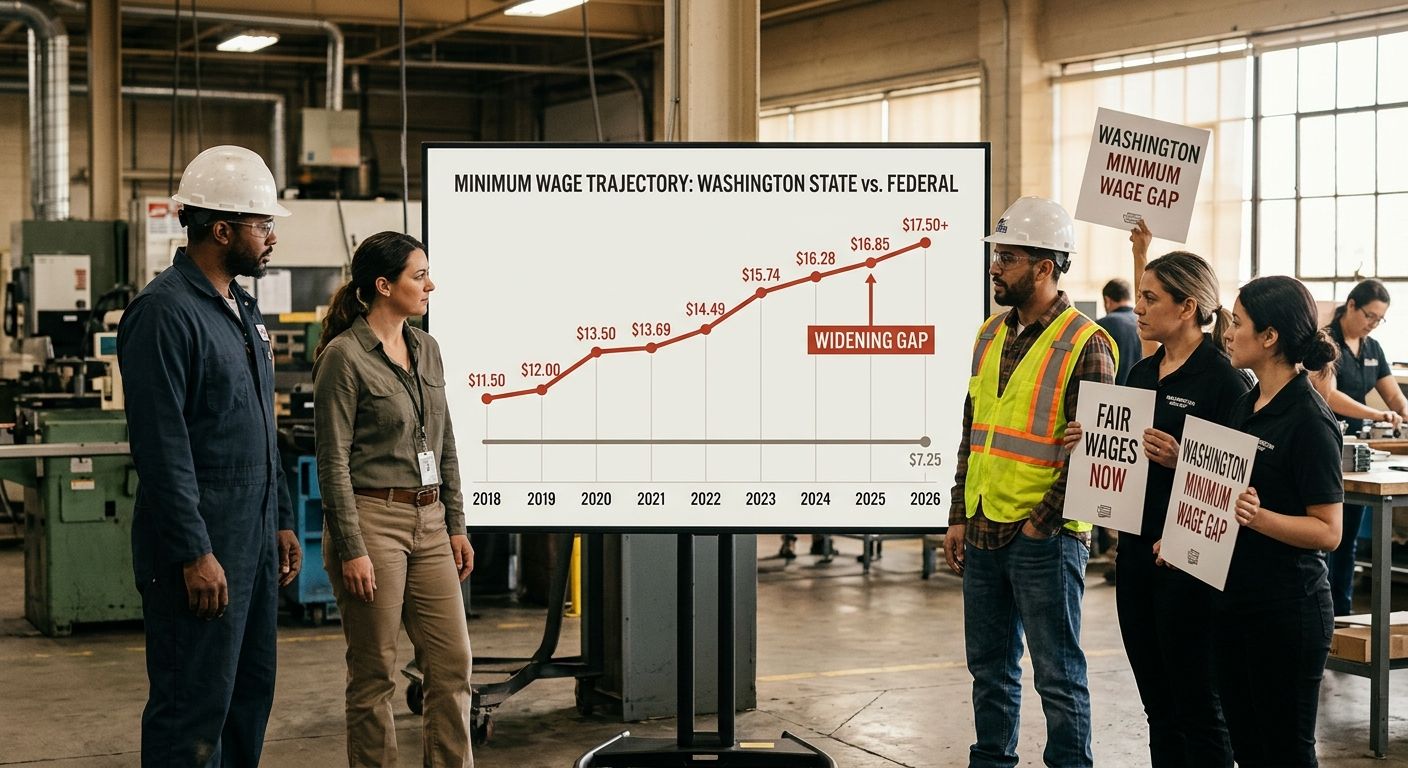
The formula only moves in one direction. If CPI-W declines, Washington's statute prevents the minimum wage from dropping. It stays at the prior year's rate until inflation pushes it higher. This ratchet mechanism means the Washington minimum wage has never decreased since the CPI escalator took effect.
The distinction between Washington's approach and fixed-schedule states matters for workers. States like Florida embed a fixed annual increase into their constitutions, stepping up by a set dollar amount regardless of inflation. Washington's CPI linkage means that in high-inflation years (like 2022-2023), workers see larger jumps. In low-inflation years, the increase is smaller but remains positive. States like Michigan use their own escalator formulas with different base calculations, producing different trajectories even when underlying inflation is the same.
Where Local Ordinances Override the State Floor
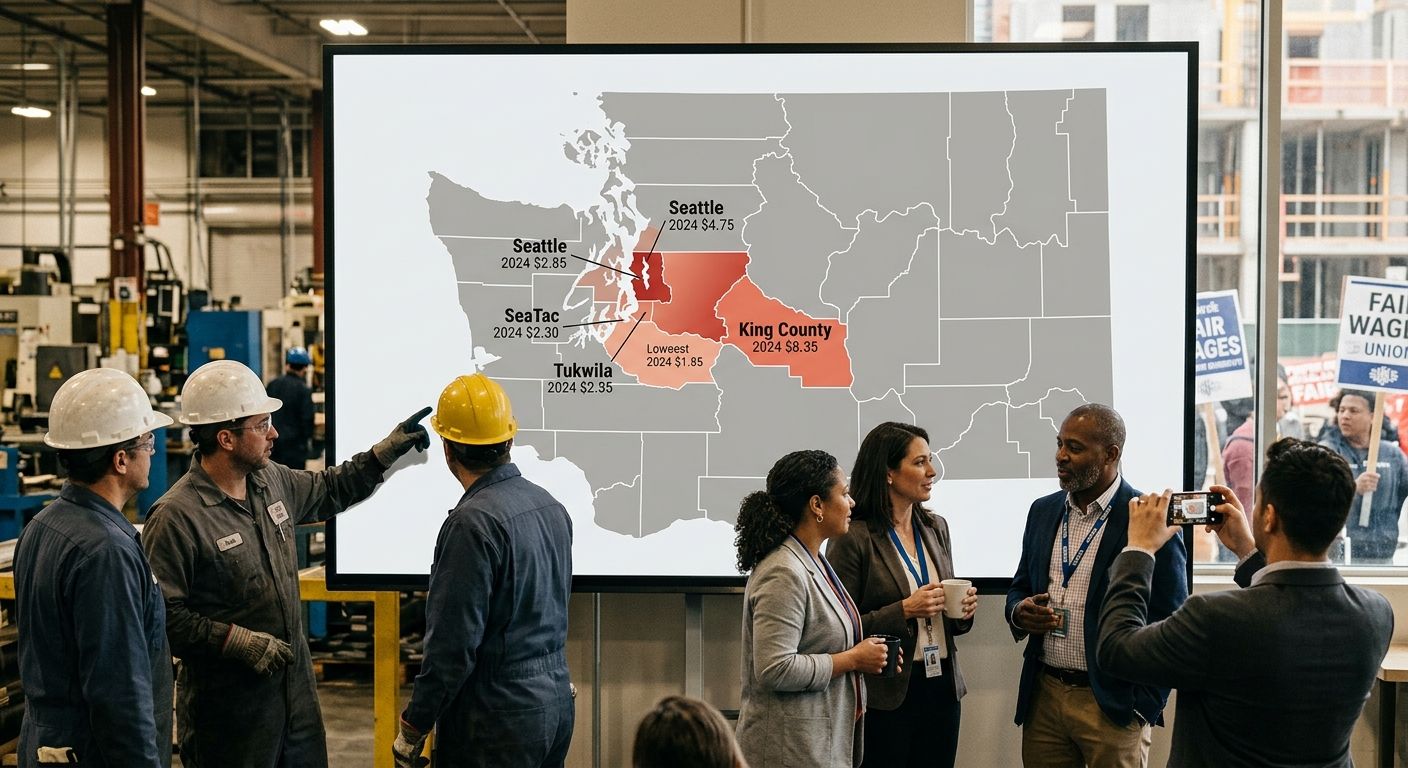
The three-layer wage floor model means that city-level rates in Washington often exceed the state minimum by several dollars per hour. The statewide $16.28 in 2024 was the floor beneath the floor for workers in Seattle, SeaTac, Tukwila, Renton, Bellingham, and Burien.
Seattle operates the most complex local wage structure. The Seattle Office of Labor Standards set the 2024 minimum wage at $19.97 per hour for most workers, effective January 1, 2024. Small employers (500 or fewer employees) that contribute toward medical benefits could pay a lower rate of $17.25 per hour, with the difference made up through employer-paid health coverage. The city's Minimum Wage Ordinance applies to all employees regardless of immigration status, and small employers can no longer count tips or medical benefit payments toward meeting the minimum compensation requirement under Seattle's updated rules.
SeaTac led the way in 2014 when voters approved a $15 minimum wage for hospitality and transportation workers near Seattle-Tacoma International Airport, years before the state or Seattle reached that figure. That rate has continued to climb with its own CPI adjustment.
King County entered the picture in May 2024, when the King County Council approved a minimum wage for unincorporated areas designed to reach just over $20 per hour. By January 1, 2026, the unincorporated King County rate hit $20.82, with three temporary exceptions based on business size and gross revenue.
Jurisdiction | 2024 Rate | Key Details |
|---|---|---|
Washington State | $16.28 | CPI-W adjusted annually |
Seattle (large employers, 500+) | $19.97 | No tip credit allowed |
Seattle (small employers, benefits route) | $17.25 | Medical benefit payments counted toward gap |
SeaTac (hospitality/transport) | $19.71 | Applies near airport zone |
King County (unincorporated, 2026) | $20.82 | Phased in with size-based exceptions |
Workers who are unsure which rate applies should check their work location. The jurisdiction where you clock in determines your minimum wage in Washington, not where your employer's headquarters sits.
The Exempt Employee Salary Threshold
The minimum wage in Washington ripples beyond hourly pay. State law ties the salary threshold for exempt employees directly to the minimum wage rate. Effective January 1, 2024, the minimum annual salary for exempt status rose to $67,724.80 for both small and large employers. That figure equals two times the minimum wage multiplied by 2,080 hours (a standard work year).
This threshold is significantly higher than the federal level of $35,568 under the Fair Labor Standards Act. A Washington employer who classifies a $50,000-a-year manager as exempt and denies overtime is violating state law, regardless of what federal law permits.
The same mechanism governs non-compete agreement enforceability. Washington law requires employees to earn above a certain salary threshold, recalculated annually alongside the minimum wage, for non-compete clauses to be valid. Agreements signed with workers earning below that line are void as a matter of law. Every time the minimum wage in Washington ticks up, these thresholds rise with it, broadening the pool of workers protected from restrictive post-employment covenants.
Understanding how these thresholds interact with collective bargaining agreements is critical for unionized workplaces, where negotiated salary schedules may need annual review to maintain proper classification.
How Union Contracts Interact with the Escalator
Collective bargaining agreements can set wages above the state and local minimums, but they cannot waive the minimum wage floor. This distinction matters because some states have experimented with allowing CBAs to negotiate below local minimums. Washington offers no such exception.
What unions do provide is a faster path to wage gains. Unionized workers in Washington's grocery, healthcare, and construction sectors typically earn $3 to $8 per hour above the applicable minimum wage, according to Bureau of Labor Statistics occupational wage data. The annual CPI escalator provides a floor, but collective bargaining builds the ceiling. When Boeing engineers and technical workers organized around contract terms, their wage negotiations started well above the state minimum and addressed cost-of-living adjustments through separately negotiated formulas.
For workers earning near the minimum, the escalator's annual adjustment often runs behind actual cost-of-living increases in high-cost cities like Seattle and Bellevue. This gap explains why local political campaigns to raise city-level minimums have drawn substantial support from organized labor. Working Washington, the advocacy group that helped push Seattle's $15 minimum wage in 2014, continues to track and advocate for higher Seattle wages, arguing that the state escalator alone doesn't keep pace with housing and transit costs in the Puget Sound corridor.
The pattern mirrors dynamics in states like New Jersey, where escalator mechanisms provide stability but organized labor pushes for rates that exceed the formula.
Where the Escalator Model Breaks Down
Washington's CPI-W mechanism is widely regarded as one of the strongest minimum wage frameworks in the country. It still has structural weaknesses that affect real workers in concrete ways.
The CPI-W lags behind housing costs. The index measures a national basket of goods, but Seattle rents rose 7-10% annually during several recent stretches while CPI-W moved 2-4%. Workers in expensive metro areas see their purchasing power erode even as their nominal wage increases. A statewide formula cannot account for the dramatic cost-of-living variance between downtown Seattle and rural Walla Walla.
Agricultural and seasonal workers face enforcement gaps. While the law covers agricultural employees, L&I has limited field enforcement capacity across a state that stretches from the Cascades to the Palouse. Workers on remote farms and orchards may never see an L&I investigator during their employment. Language barriers compound the problem, particularly for workers who may not know Washington's minimum wage requirements exist or how to file a complaint.
The no-tip-credit rule is strong but doesn't solve income volatility. Tipped workers receive the full minimum wage before tips, which is a genuine advantage over the 43 states that allow some form of tip credit. But the policy doesn't address the scheduling instability that plagues restaurant and hospitality workers, where hours can swing from 35 to 12 in a single week with no notice and no recourse.
Gig workers remain outside the framework entirely. App-based drivers, delivery workers, and freelancers classified as independent contractors don't receive the minimum wage under current Washington law. Seattle passed its own gig worker protections, but the statewide escalator doesn't reach these workers. Until classification rules change or new legislation extends coverage, a growing share of Washington's workforce operates below the floor that the CPI mechanism is designed to protect.
Common Questions
Does Washington allow a tip credit against the minimum wage?
No. Washington is one of seven states that prohibit tip credits entirely. Employers must pay the full state or local minimum wage before tips. A tipped worker earning $16.28 per hour in 2024 kept every dollar of gratuities on top of that base.
Can the Washington minimum wage ever decrease?
The CPI-W escalator includes a ratchet provision. If the index drops, the minimum wage stays at the prior year's level until inflation pushes it higher. The rate has never decreased since the automatic adjustment mechanism took effect under Initiative 688.
Which rate applies if I work in Seattle but my employer is based in Spokane?
Your work location determines the applicable rate. If you perform your work within Seattle city limits, Seattle's minimum wage applies regardless of where your employer's main office sits. The Seattle Office of Labor Standards enforces this based on where the work is performed, not where the company is incorporated.
What is the current Washington minimum wage in 2026?
The 2026 minimum wage in the state of Washington is $17.13 per hour statewide. Local rates in Seattle, King County, and other jurisdictions exceed this amount, with unincorporated King County reaching $20.82 as of January 1, 2026.
Are there different rates for younger workers?
Workers aged 14 and 15 may be paid 85% of the state minimum wage. In 2024, that came to $13.84 per hour based on the $16.28 rate. Workers 16 and older receive the full minimum wage, and Washington does not authorize a training wage or youth sub-minimum for that age group.
The Union Edge Staff
Frequently Asked Questions
- What is the Washington state minimum wage in 2024?
- Washington's statewide minimum wage in 2024 is $16.28 per hour, representing a 3.4% increase from the prior year. However, several cities including Seattle, SeaTac, and King County enforce higher local minimum wages.
- How does Washington's minimum wage adjustment work?
- Washington's minimum wage automatically adjusts each September based on the Consumer Price Index for Urban Wage Earners and Clerical Workers (CPI-W) and takes effect January 1 without requiring a legislative vote. The adjustment is calculated by L&I using August-to-August CPI-W data and rounding to the nearest cent.
- What is Seattle's minimum wage in 2024?
- Seattle's 2024 minimum wage is $19.97 per hour for most workers and $17.25 per hour for small employers (500 or fewer employees) that contribute toward medical benefits. Small employers can no longer count tips or medical benefit payments toward meeting the minimum wage requirement.
- Does Washington allow employers to use tips to meet minimum wage requirements?
- No, Washington prohibits tip credits entirely and is one of only seven states to do so. Employers must pay the full state or local minimum wage before any tips are earned.
- What is the minimum salary for exempt employees in Washington?
- As of January 1, 2024, the minimum annual salary for exempt status in Washington is $67,724.80, calculated as two times the minimum wage multiplied by 2,080 hours. This is significantly higher than the federal threshold of $35,568.
- Can Washington's minimum wage ever decrease?
- No, Washington's minimum wage includes a ratchet mechanism that prevents it from decreasing. If the CPI-W declines, the wage stays at the prior year's level until inflation pushes it higher, and the rate has never decreased since the automatic adjustment mechanism took effect.
- What is the minimum wage in King County unincorporated areas?
- King County's unincorporated minimum wage reached $20.82 as of January 1, 2026, phased in with temporary exceptions based on business size and gross revenue.
- What wage do workers aged 14-15 receive in Washington?
- Workers aged 14 and 15 are entitled to 85% of the standard minimum wage, which was $13.84 per hour in 2024. This sub-minimum applies only to the youngest legally employable workers and carries strict hour limitations under state and federal child labor laws.
Related Articles

Minimum Wage of Washington: 2024 Update
Washington's minimum wage is set by an automatic annual formula tied to the Consumer Price Index for Urban Wage Earners and Clerical Workers (CPI-W), making it one of the few state wage floors in the country that rises without requiring new legislation each cycle. The 2024 rate of $16.

state of washington minimum wage: 2024 Guide
Initiative 1433, which Washington voters approved in November 2016, built an automatic escalator into state law: the minimum wage rises every January 1 by the percentage change in the Consumer Price Index for Urban Wage Earners and Clerical Workers (CPI-W), producing a 2024 rate of $16.

Washington State Minimum Wage: 2024 Rates & Laws
Washington state doesn't have one minimum wage. It has at least seven. The statewide floor sat at $16.28 per hour for 2024 (rising to $17.
Also in the paper