
Minimum Wage Texas: Current Laws & Rates
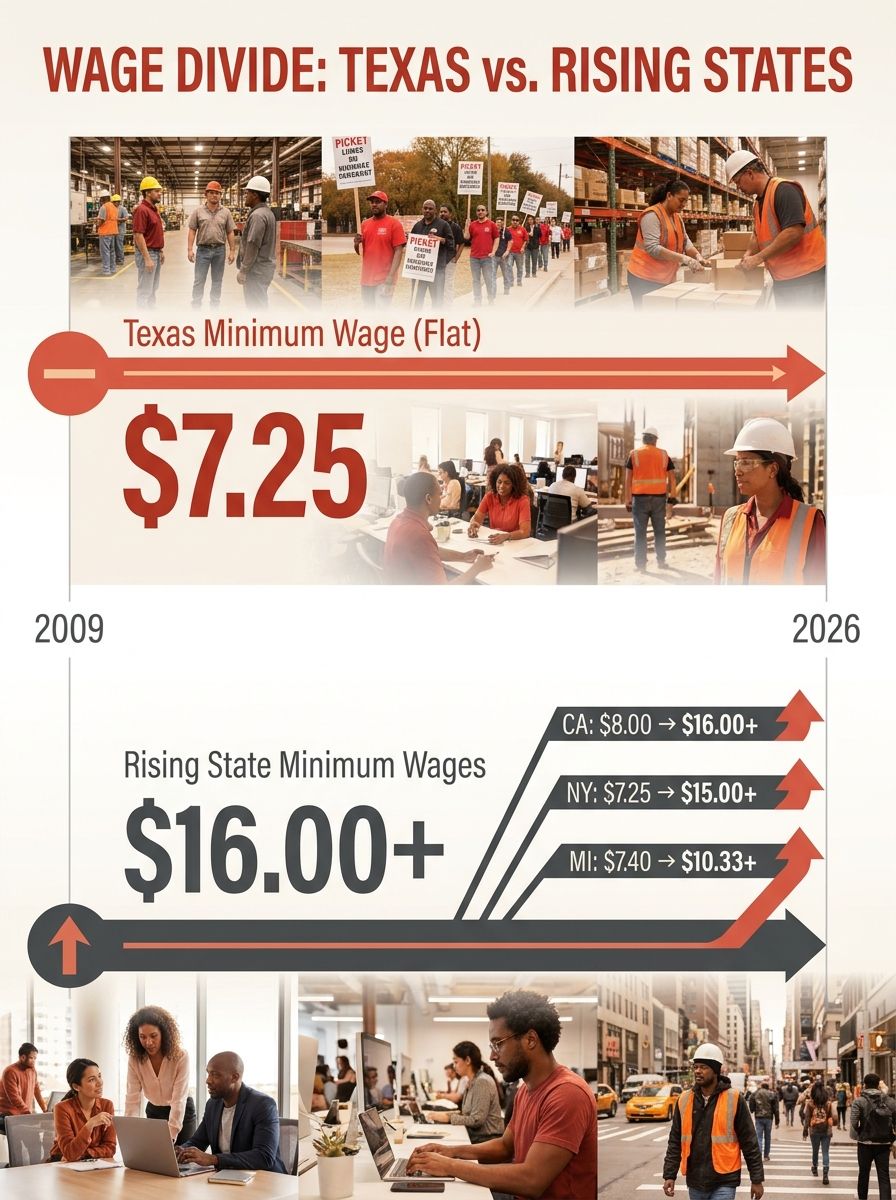
Chapter 62 of the Texas Labor Code contains no independent wage figure. It copies the federal minimum wage by reference, which means the texas minimum wage has been $7.25 per hour since July 24, 2009, and won't change unless Congress acts.

Minimum Wage in Texas: How the Federal Floor Became a Permanent Ceiling
Chapter 62 of the Texas Labor Code contains no independent wage figure. It copies the federal minimum wage by reference, which means the texas minimum wage has been $7.25 per hour since July 24, 2009, and won't change unless Congress acts. That single design choice affects roughly 120,000 workers earning at or below that floor.
How Chapter 62 Locks Texas to the Federal Rate
The Texas Minimum Wage Act, codified in Chapter 62 of the Texas Labor Code, requires employers to pay "not less than the federal minimum wage" as prescribed by Section 6 of the Fair Labor Standards Act. The Texas Workforce Commission (TWC), which administers the law, confirms this federal dependency directly: the state rate rises or falls with the federal rate. Because Congress hasn't raised the federal minimum wage since 2009, the minimum wage for Texas has been static for over 17 years.
The Federal Reserve Bank of St. Louis tracks this in its FRED economic data series for Texas, which shows the state minimum wage moving in lockstep with the federal rate across 54 years of historical data going back to 1972. Every historical increase in the minimum wage of Texas has been triggered by a federal increase, never by independent state legislation.
This stands in sharp contrast to states that have built their own wage floors. Compare the approach taken by Michigan's wage law, where the state Supreme Court intervened to restore voter-approved increases, or New York's multi-zone system, which sets different rates by geography. Texas has no such mechanism. The state legislature has consistently rejected proposals to decouple from the federal floor.
The Tipped Wage and Its Arithmetic
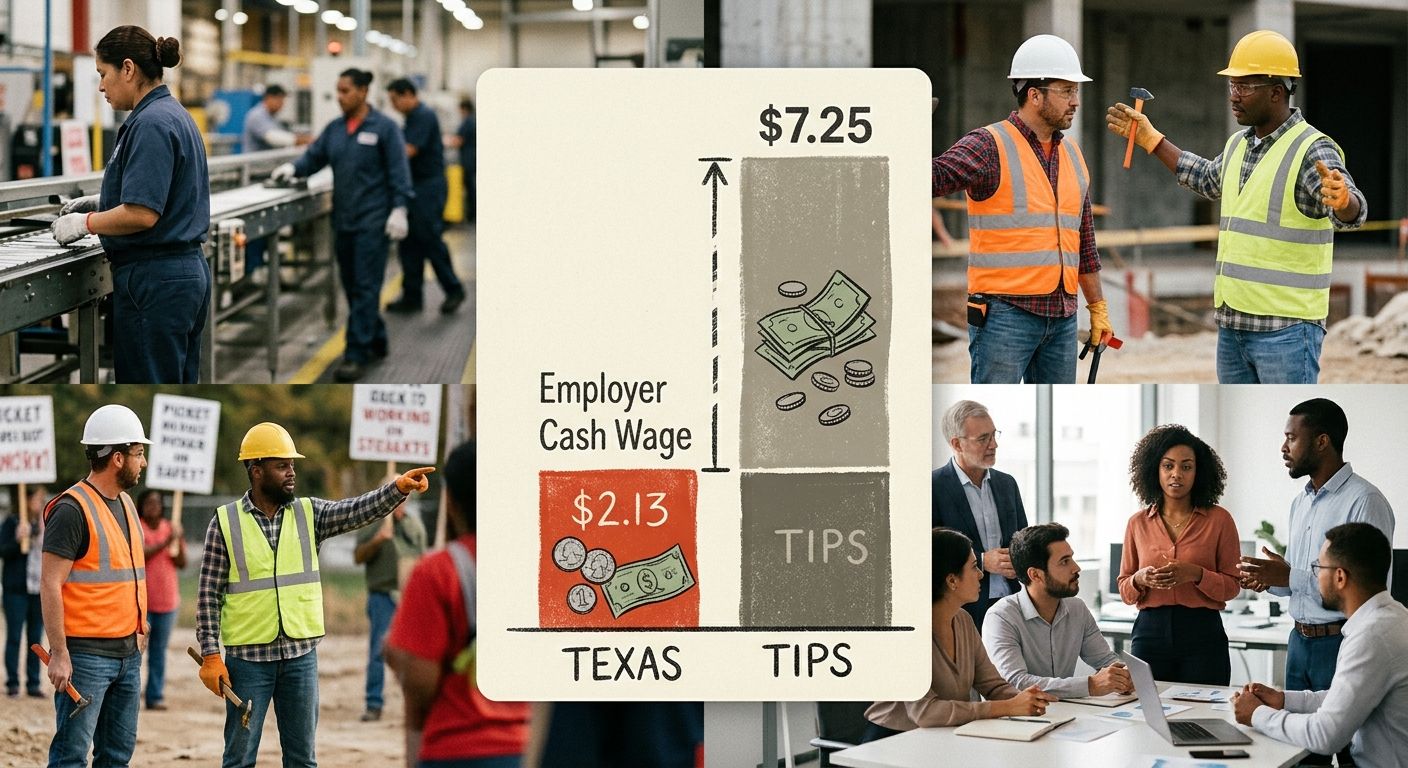
Employers in Texas can pay tipped workers a cash wage of $2.13 per hour, provided the worker's tips bring total compensation to at least $7.25 per hour. This is the federal tip credit structure under the FLSA, applied without modification in Texas. If tips fall short in any pay period, the employer is legally obligated to make up the difference.
The math creates a gap that workers frequently absorb. A server working a slow Tuesday lunch shift who earns $8 in tips over a 5-hour shift has received $1.60 per hour in tips. Added to the $2.13 cash wage, that totals $3.73 per hour. The employer owes the difference: $3.52 per hour multiplied by 5 hours, or $17.60 for that shift. But enforcement depends on the worker tracking their tips accurately and the employer calculating the shortfall honestly every pay period.
The TWC requires employers to provide written earnings statements with enough detail for employees to verify correct payment. When those statements are vague or missing, tipped workers have limited visibility into whether they're actually receiving the full minimum wage for Texas. Congressional efforts to eliminate the tip credit entirely, such as the $25 minimum wage bill introduced by Democratic lawmakers, would close this gap by requiring the full minimum wage before tips.
Worker Type | Cash Wage | Required Top-Up | Total Must Equal |
|---|---|---|---|
Standard non-exempt | $7.25/hr | None | $7.25/hr |
Tipped employee | $2.13/hr | Tips must cover $5.12/hr | $7.25/hr |
Youth (under 20, first 90 days) | $4.25/hr | None | $4.25/hr |
Workers with disability certificates | Varies | None | Below $7.25 permitted |
Sub-Minimum Exceptions for Youth and Workers with Disabilities
The $7.25 floor has legal trapdoors. Two groups of workers in Texas can be paid below the standard minimum texas wage under specific federal and state provisions.
Youth workers under age 20 can be paid $4.25 per hour for their first 90 consecutive calendar days of employment. After day 90, or once the worker turns 20, the full $7.25 rate applies. The provision exists under Section 14 of the FLSA and is adopted by Texas without modification.
Workers with disabilities can be paid sub-minimum wages under certificates issued through the U.S. Department of Labor's Section 14(c) program. Chapter 62 of the Texas Labor Code adds a state-level parallel: employees who are patients or clients of the Texas Department of State Health Services (DSHS) may be paid below minimum wage based on assessed productivity. This provision has drawn sustained criticism from disability rights advocates and labor organizations who argue that paying disabled workers pennies per hour violates basic dignity standards, regardless of assessed productivity. The federal Section 14(c) program has been under political pressure for years, with multiple bills introduced to phase it out, though none have passed as of mid-2026.
Of the approximately 120,000 Texas workers who earned at or below the federal minimum wage in 2024, about 11,000 earned exactly $7.25 per hour. The remaining 109,000 earned below that through legal sub-minimum provisions: tipped wages, youth wages, or disability certificates. That 109,000 figure deserves attention. It means 91% of minimum-wage-affected workers in Texas are actually paid less than the number most people think of as the floor.
Why No Texas City Can Set a Higher Wage
Local preemption is the structural barrier that prevents any Texas municipality from establishing a higher minimum wage for private-sector employers. The Texas Legislature passed HB 2127 in 2023, which bars cities and counties from enacting local ordinances that exceed state standards across several labor and employment categories, including wage requirements.
Before HB 2127, cities like Austin and Dallas had explored local wage floors, but existing legal interpretations already made such efforts fragile. HB 2127 codified the prohibition and shut the door. Cities can still set higher pay rates for their own employees and for workers on city-funded contracts, but they cannot mandate that private businesses within city limits pay above $7.25.
This preemption structure means the minimum wage in Texas is uniform across every county, from Harris County (Houston's 4.7 million residents) to Loving County (population 64). A fast-food worker in downtown Dallas and a ranch hand in the Panhandle operate under the same $7.25 floor, despite cost-of-living differences that can exceed 40% between metro and rural areas. Compare how courts have handled attempts to block state labor board expansions in other states with Texas's top-down preemption model. When state legislatures preempt local labor standards, workers in high-cost cities lose the one mechanism that could close the gap between their wages and their expenses.
Healthcare Workers Caught at the Floor
The minimum wage of Texas hits healthcare workers with particular force. Home health aides, certified nursing assistants, and direct care workers across the state frequently earn wages at or near the $7.25 floor. Texas employs one of the largest healthcare support workforces in the country, and Medicaid reimbursement rates set by the state directly constrain what agencies can pay their frontline staff.
The sub-minimum wage provision for DSHS patients and clients adds another dimension. Workers with disabilities employed in sheltered workshop settings within the Texas healthcare system can legally be paid fractions of the minimum wage. These programs sit at the intersection of healthcare policy and labor law, and the workers inside them have fewer organizing protections and less access to the complaint mechanisms available to standard employees.
Healthcare organizing in Texas has grown partly in response to these wage conditions. When direct care workers earning $8 or $9 per hour see that their wage sits only $0.75 to $1.75 above the legal floor, the fragility of their economic position becomes concrete. A federal minimum wage increase to even $10.10 would compress that gap further and likely push healthcare employers to raise pay across the board to maintain staffing. This is one reason why groups like the physicians organizing at the UC system, though operating in a very different pay bracket, share a structural interest in wage floor policy with the home health aides earning near minimum in Texas.

The Overtime and Salary Exemption Layer
The minimum wage in Texas interacts with federal overtime rules through the FLSA's salary exemption threshold. Workers who earn below a set weekly salary and perform non-exempt duties are entitled to overtime pay at 1.5 times their regular rate for hours exceeding 40 per week.
The Department of Labor attempted to raise the salary exemption threshold significantly in 2024, but a federal district court in Texas vacated that rule in November 2024. As a result, the salary threshold remains at $684 per week ($35,568 annually) going into 2026. Workers earning below that threshold who are classified as salaried must still receive overtime. Employers who misclassify hourly workers as exempt salaried employees avoid both overtime obligations and, in some cases, minimum wage accounting requirements.
For a Texas worker earning exactly $7.25 per hour and working 40 hours, weekly gross pay is $290. That figure falls $394 below the $684 salary exemption threshold, meaning these workers are always overtime-eligible. The gap between the minimum wage floor and the exemption ceiling creates a band of workers whose overtime protections depend entirely on proper classification by their employer.
Where the Model Breaks
The federal-default model works smoothly when Congress periodically adjusts the minimum wage. It breaks down when Congress stops. Seventeen years of stagnation have eroded the real purchasing power of $7.25 by roughly 30% when adjusted for cumulative inflation since 2009. The mechanism assumed regular federal updates that haven't materialized.
The model also fails at the enforcement layer. The TWC requires employers to provide written earnings statements, but Texas lacks the staffing and funding for proactive wage theft investigations at scale. Workers who file complaints face a 180-day statute of limitations, which means violations older than six months are unrecoverable under state law. Federal claims extend that window, but most low-wage workers don't know the difference between state and federal filing options or have access to legal guidance to navigate the distinction.
And the preemption layer creates a structural mismatch: the areas where $7.25 buys the least (major metro areas with high housing and transportation costs) are exactly the areas prohibited from adjusting the wage upward. The model distributes a uniform number across a non-uniform economy, and the workers absorbing the cost of that mismatch are concentrated in healthcare, food service, and retail sectors where organizing power remains thin and employer turnover keeps institutional memory low.
The minimum texas wage won't shift through state action alone. The legislature has shown no appetite for decoupling from the federal rate, and HB 2127 blocks cities from acting independently. Any change depends on Congress raising the federal floor, a political process that has stalled for nearly two decades, leaving Texas workers locked into a rate that buys less with every passing year.
Common Questions
Does Texas have its own minimum wage law separate from the federal rate?
Yes. Chapter 62 of the Texas Labor Code is the state minimum wage statute. But it sets the state rate by reference to the federal rate under the FLSA, so the two numbers are always identical. The Texas Workforce Commission administers the law and processes wage complaints.
Can cities in Texas set a higher minimum wage?
No. HB 2127, passed in 2023, prohibits Texas cities and counties from mandating private-sector wages above the state (and therefore federal) floor of $7.25. Cities can set higher pay for their own municipal employees and contractors, but they cannot require private employers to pay more.
What is the tipped minimum wage in Texas?
Employers can pay tipped workers a cash wage of $2.13 per hour, as long as the worker's total compensation (cash wage plus tips) equals at least $7.25 per hour for every pay period. If tips fall short, the employer must pay the difference. This mirrors the federal tip credit provision exactly.
How do I file a wage complaint if my employer isn't paying the minimum wage in Texas?
File a wage claim with the Texas Workforce Commission within 180 days of the date the wages were due. You can also file a federal complaint with the U.S. Department of Labor's Wage and Hour Division, which allows a two-year window (three years for willful violations). Understanding what Texas wage law requires is the first step before filing.
Will the Texas minimum wage increase soon?
No increase is scheduled or pending in state law. The minimum wage for Texas will remain at $7.25 until Congress raises the federal minimum wage, and no federal increase is currently scheduled as of mid-2026.
The Union Edge Staff
Frequently Asked Questions
- What is the current minimum wage in Texas?
- The minimum wage in Texas is $7.25 per hour, which has been the rate since July 24, 2009. Texas ties its minimum wage to the federal rate through Chapter 62 of the Texas Labor Code, so the state rate remains identical to the federal minimum wage.
- Can Texas cities set their own higher minimum wage?
- No. HB 2127, passed in 2023, prohibits Texas cities and counties from mandating private-sector wages above $7.25 per hour. Cities can set higher pay for their own municipal employees and contractors, but cannot require private employers to pay more.
- What is the tipped minimum wage in Texas?
- Employers in Texas can pay tipped workers $2.13 per hour in cash wages, provided the worker's tips bring total compensation to at least $7.25 per hour. If tips fall short in any pay period, the employer must make up the difference.
- Can employers in Texas pay workers with disabilities below minimum wage?
- Yes. Workers with disabilities can be paid sub-minimum wages under certificates issued through the U.S. Department of Labor's Section 14(c) program, and Texas law allows employees of the Texas Department of State Health Services to be paid below minimum wage based on assessed productivity.
- How long do I have to file a wage complaint with the Texas Workforce Commission?
- You can file a wage claim with the Texas Workforce Commission within 180 days of the date the wages were due. Federal complaints with the U.S. Department of Labor allow a longer window of two years, or three years for willful violations.
- What is the sub-minimum wage for youth workers in Texas?
- Youth workers under age 20 can be paid $4.25 per hour for their first 90 consecutive calendar days of employment. After day 90 or once the worker turns 20, the full $7.25 minimum wage rate applies.
- Why hasn't the Texas minimum wage increased since 2009?
- Texas law ties the state minimum wage to the federal rate through Chapter 62 of the Texas Labor Code, and Congress has not raised the federal minimum wage since 2009. The state legislature has consistently rejected proposals to decouple from the federal floor.
Related Articles

Minimum Texas Wage: What You Need to Know
Unlike 30 states that set independent minimum wage floors above the federal rate, Texas adopted the federal number by reference and then built a legal architecture that prevents any city or county from going higher. The result: the minimum wage in Texas has been $7.

What Is Minimum Wage in Texas: 2024 Guide
Texas does not set its own minimum wage dollar amount. The state's minimum wage law, administered by the Texas Workforce Commission, defers entirely to the federal Fair Labor Standards Act, which means workers in Texas earn a floor of $7.25 per hour, a rate unchanged since July 24, 2009.
What Is the State of Texas Minimum Wage
The Texas Minimum Wage Act contains no dollar amount. The statute adopts the federal minimum wage rate by reference, making the state of Texas minimum wage identical to the federal floor: $7.
Also in the paper