
Minimum Wage State of Oregon: 2024 Rates
Oregon's minimum wage is set by a CPI-indexed formula that automatically adjusts three separate geographic rates every July 1, making it one of the few state wage systems that tracks inflation without requiring annual legislative action. As of July 1, 2024, those rates stand at $15.

Minimum Wage in the State of Oregon: 2024 Rates, Tiers, and the CPI Engine Behind Them
Oregon's minimum wage is set by a CPI-indexed formula that automatically adjusts three separate geographic rates every July 1, making it one of the few state wage systems that tracks inflation without requiring annual legislative action. As of July 1, 2024, those rates stand at $15.95 per hour in the Portland metro area, $14.70 in standard counties, and $13.70 in non-urban counties, covering roughly 89,000 workers who earn at the floor.
Senate Bill 1532 and the Birth of Three Tiers
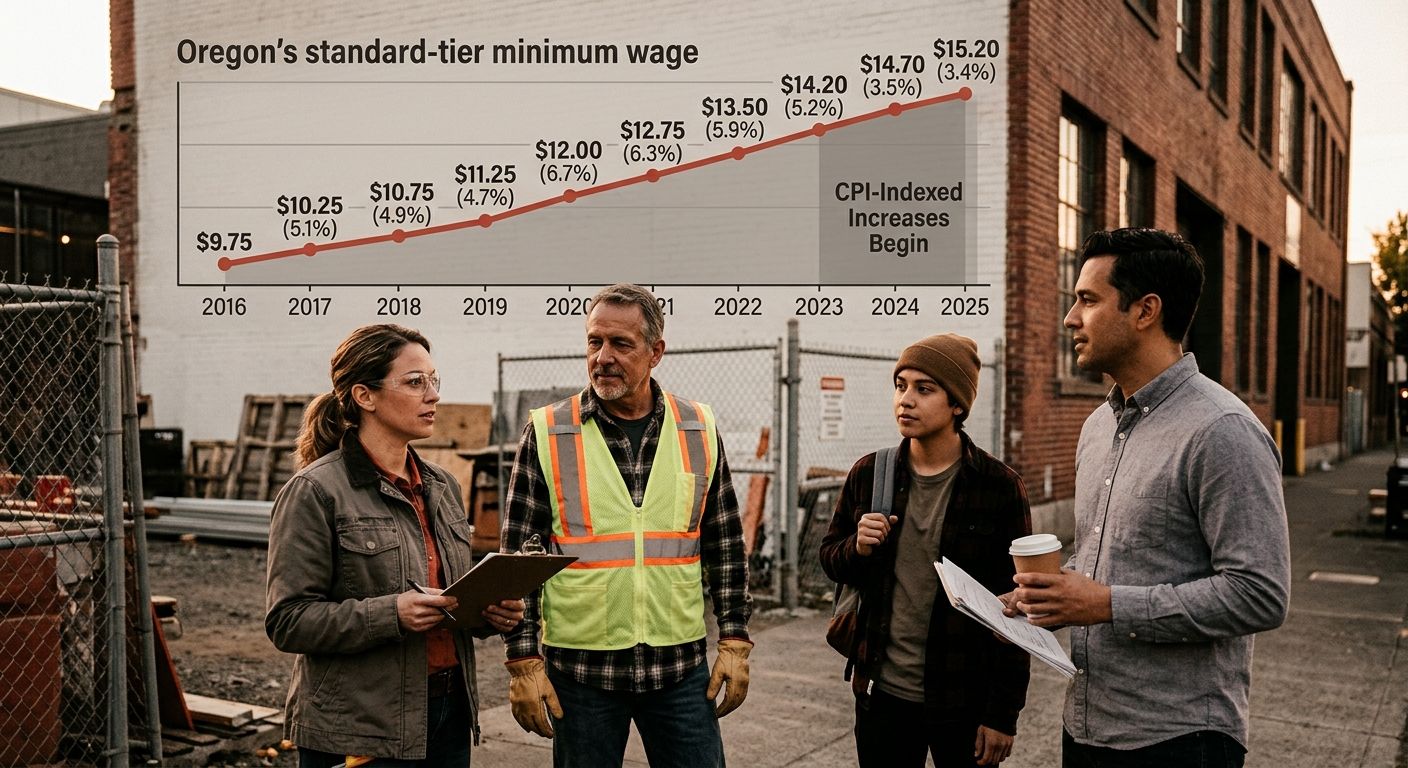
Oregon's geographic minimum wage system traces back to Senate Bill 1532, signed by Governor Kate Brown on March 2, 2016. The law created three tiers defined by named counties, establishing scheduled annual increases that ran through June 30, 2023. After that date, the Bureau of Labor and Industries (BOLI) took over, adjusting each tier annually using the Consumer Price Index for All Urban Consumers (CPI-U) published by the federal Bureau of Labor Statistics.
The 2016 law didn't arrive out of nowhere. Oregon voters passed Measure 25 in 2002, making the state one of the earliest to index its minimum wage to inflation. That measure established a single statewide rate. SB 1532 replaced it with the tiered structure, adding geographic precision to the inflation mechanism Oregonians had already endorsed at the ballot box 14 years earlier.
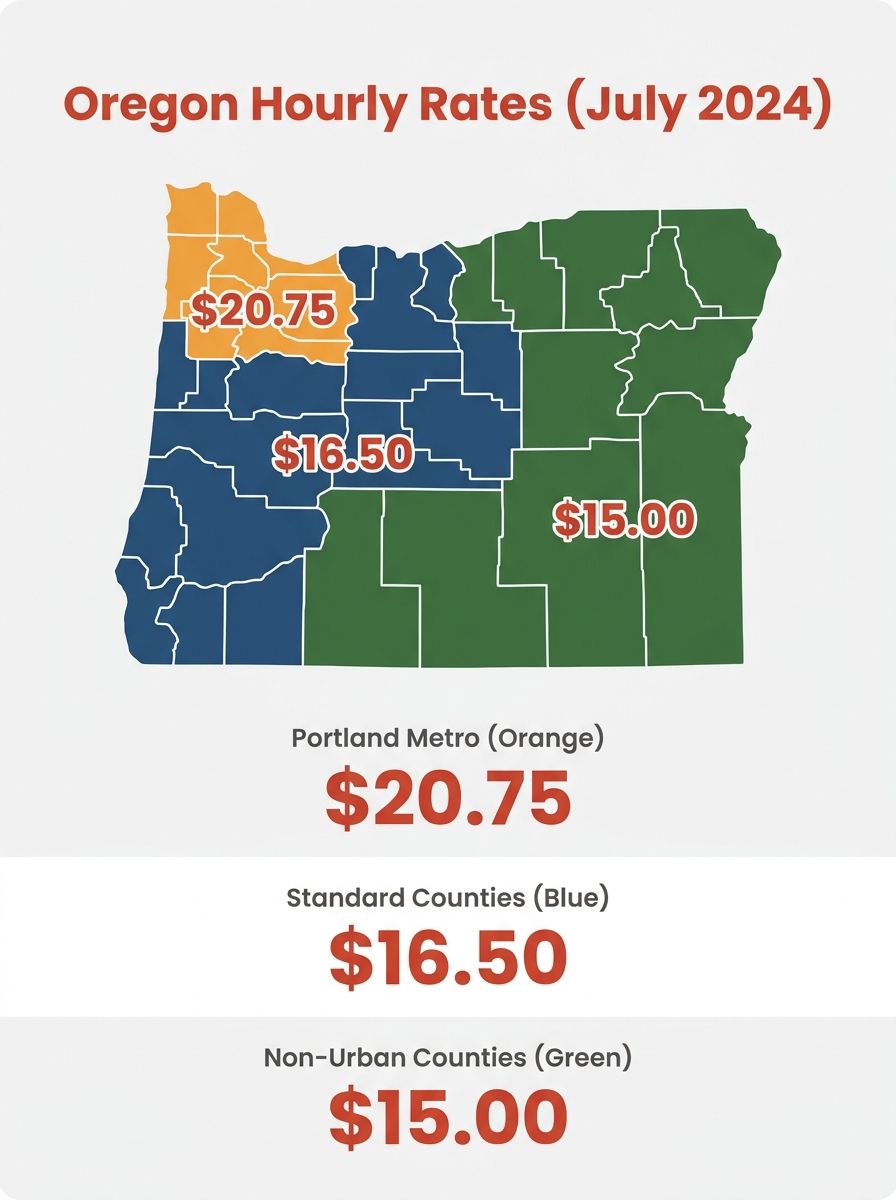
The three tiers are fixed by county name. Portland metro includes Clackamas, Multnomah, and Washington counties. Non-urban includes 18 counties: Baker, Coos, Crook, Curry, Douglas, Gilliam, Grant, Harney, Jefferson, Klamath, Lake, Malheur, Morrow, Sherman, Umatilla, Union, Wallowa, and Wheeler. Every remaining county falls into the standard tier. These classifications haven't changed since the law took effect, and no administrative mechanism exists to reassign a county without new legislation.
The 2024 Rates by Geographic Tier
The minimum wage in the state of Oregon changed on July 1, 2024, when BOLI's annual CPI-based adjustment took effect. All three tiers received a $0.50 per hour increase, calculated from a 3.5% rise in the CPI-U between March 2023 and March 2024.
Tier | Counties | Rate Before July 1, 2024 | Rate After July 1, 2024 | Increase |
|---|---|---|---|---|
Portland Metro | Clackamas, Multnomah, Washington | $15.45/hr | $15.95/hr | +$0.50 |
Standard | All counties not in the other two tiers | $14.20/hr | $14.70/hr | +$0.50 |
Non-Urban | Baker, Coos, Crook, Curry, Douglas, Gilliam, Grant, Harney, Jefferson, Klamath, Lake, Malheur, Morrow, Sherman, Umatilla, Union, Wallowa, Wheeler | $13.20/hr | $13.70/hr | +$0.50 |
The formula works by multiplying the prior standard rate by the CPI increase and rounding to the nearest five cents. For the 2024 cycle, according to BOLI's published minimum wage schedule, that meant $14.20 × 0.035 = $0.497, rounded up to $0.50. The Portland metro and non-urban tiers moved by the same dollar amount, preserving the $1.25 gap between Portland metro and standard, and the $1.00 gap between standard and non-urban.
What do these numbers look like as annual earnings? A worker at the standard minimum of $14.70 per hour, working 40 hours per week for 52 weeks, grosses $30,576 annually before taxes. In the Portland metro tier, that figure reaches $33,176. In non-urban counties, it's $28,496. All three figures fall below the self-sufficiency standard for a single adult in most Oregon counties, meaning the minimum wage alone doesn't cover basic living costs anywhere in the state.
How CPI Indexing Calculates the Annual Raise
BOLI announces new minimum wage rates by April 30 of each year, using CPI-U data from the prior March-to-March period. The adjustment takes effect on July 1. This two-month window gives employers time to update payroll and gives workers a defined date to verify that their paychecks reflect the increase.
The indexing mechanism includes one critical feature: a no-decrease provision. If the CPI-U is flat or negative in a given year, Oregon's minimum wage holds at its current level. It cannot drop. This ratchet design guarantees that wage floors move in one direction only, protecting workers from the theoretical scenario where deflation erodes their guaranteed base pay.
The year-to-year data shows how directly the formula tracks actual price changes. The July 2024 increase of $0.50 reflected 3.5% inflation. Compare that with the July 2025 increase: the Oregon Capital Chronicle reported that the standard rate rose from $14.70 to $15.05, a gain of $0.35, which was the smallest increase in a decade. That drop reflected a cooldown in the national CPI-U. The mechanism worked exactly as designed in both years, but the results looked dramatically different on workers' paychecks.
And that transparency matters. Workers know when to expect their raise (July 1), how it's calculated (CPI-U, March to March), and where to find the announced rate (BOLI's website by April 30). Compare this with states where minimum wage increases require legislators to introduce bills, hold hearings, and vote, a process that can stall for years. The federal minimum wage itself has been stuck at $7.25 since 2009 because no indexing mechanism exists at that level.
Oregon's No-Tip-Credit Rule
Oregon is one of seven states that prohibit tip credits entirely. Employers must pay the full applicable tier rate to every employee regardless of how much the worker earns in tips. There is no reduced "tipped worker" wage anywhere in the state.
This stands in sharp contrast to the federal model under the Fair Labor Standards Act, which allows employers to pay tipped workers as little as $2.13 per hour if tips are expected to bridge the gap to $7.25. Enforcement of that gap-filling obligation is notoriously weak. In states that follow the federal tipped minimum, wage theft complaints from restaurant workers consistently rank among the highest reported violations.
Oregon's approach eliminates that category of underpayment by design. For a restaurant worker in Portland's metro tier, the employer owes $15.95 per hour regardless of whether the worker earns $0 or $200 in tips on a shift. Tips function as genuinely additional income.
Multi-Location Employers and the 50% Rule
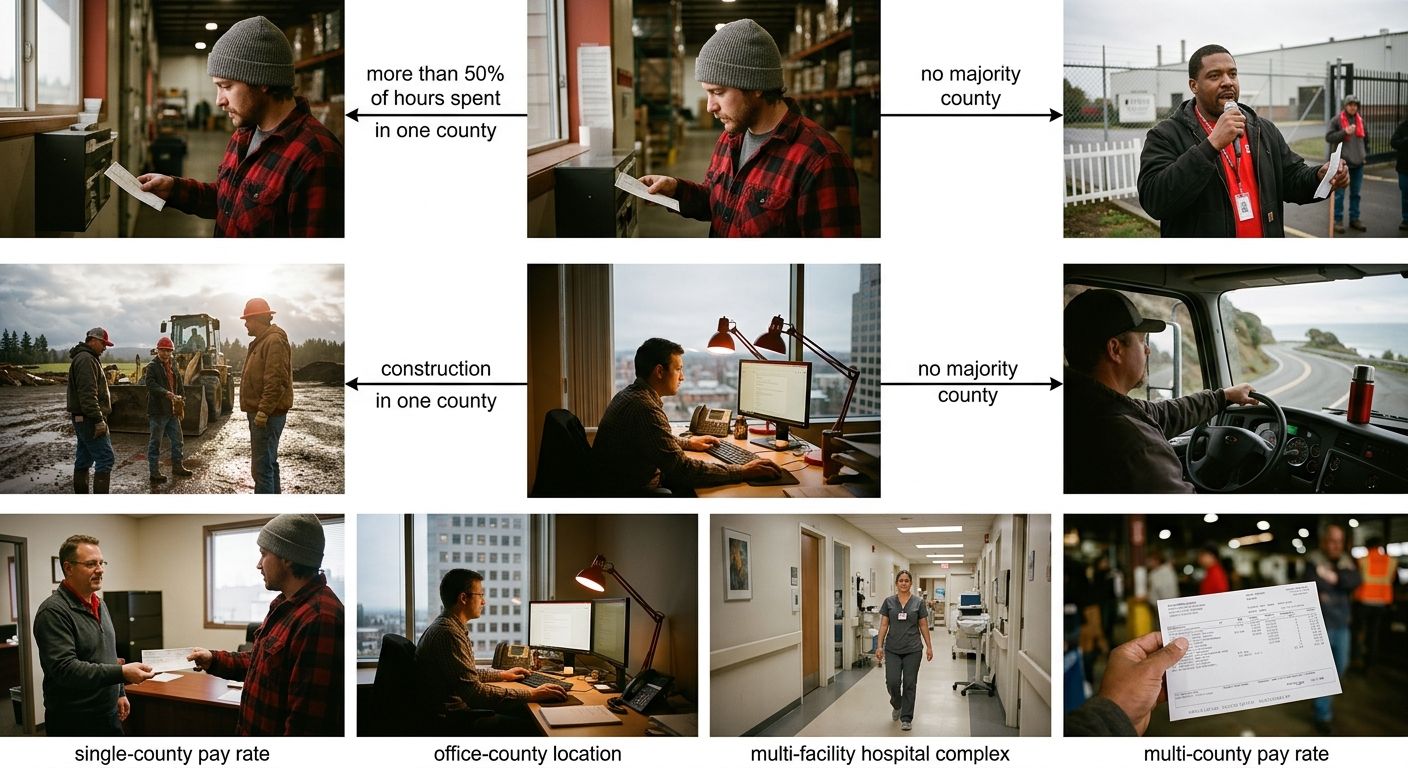
Businesses operating across Oregon's three tiers face a compliance question with real money attached: which rate applies when an employee works in more than one county? BOLI's guidance establishes a 50% threshold. If a worker performs at least 50% of their hours in a given pay period in one county, they're paid the rate for that county's tier. When no single county accounts for a majority of hours, the employer must apply the highest applicable rate to all hours in that pay period.
This rule has practical weight for workers in delivery, healthcare staffing, agricultural labor, and construction, where crossing county lines during a shift is routine. A delivery driver based in Multnomah County ($15.95 Portland metro rate) who occasionally runs routes into Washington County (also Portland metro) faces no conflict. But a driver who splits time between Washington County and Yamhill County ($14.70 standard tier) needs their employer to track hours by location and pay accordingly.
The tracking burden falls on the employer. Workers don't need to calculate their own tier allocation, but they should know which tier their primary work county falls under and verify that their pay stubs reflect the correct rate. This is one area where union representation makes a concrete difference: shops with collective bargaining agreements often negotiate wage floors above the minimum and build explicit language about multi-location pay into contracts, removing the ambiguity that otherwise leads to underpayment. Organized workplaces where contracts guarantee minimum weekly hours add another layer of protection that the minimum wage statute alone can't provide.
Where the Three-Tier Model Breaks
Oregon's tiered system is more precise than a single statewide rate, but it has boundary conditions where the mechanism fails workers.
County lines are blunt instruments. A worker in Deschutes County (home to Bend, one of Oregon's most expensive housing markets) earns $14.70 per hour under the standard tier. That's $1.25 less than a worker in Clackamas County doing the same job, even though Bend's median rent has climbed sharply over the past decade and its population grew over 30%. The tier definitions reference specific county names written into SB 1532 in 2016, and no administrative process exists to reassign a county based on updated economic data. Only new legislation can move Deschutes into the Portland metro tier.
The CPI-U is a national measure. Oregon's adjustments use the national CPI for All Urban Consumers, not a state-specific or regional index. When national inflation cools but Oregon-specific costs (particularly housing and energy) continue rising, the annual adjustment understates the real gap between wages and living expenses. The 2025 increase of $0.35 illustrated this dynamic: the national CPI-U moderated, but several Oregon rental markets didn't follow the same trajectory.
There is no catch-up mechanism. If inflation runs hot for several consecutive years and the minimum wage adjustments compound below the rate of real cost increases in Oregon specifically, nothing in the law triggers a recalibration. The only remedy is new legislation, and legislation requires political votes that minimum-wage workers typically have limited power to influence on their own. Some states like California have layered industry-specific minimum wages on top of their statewide floors. Oregon hasn't adopted that approach.
Hours erosion bypasses the rate entirely. An employer can comply with the minimum wage law while cutting a worker from 40 hours to 25 hours per week, delivering a 37.5% pay cut that never shows up in the hourly rate. The minimum wage statute sets no floor on hours, which is why collective bargaining remains essential for workers who need income stability alongside a fair hourly rate.
Common Questions
Does Oregon's minimum wage differ from the federal minimum wage?
Oregon's minimum wage is significantly higher than the federal floor of $7.25 per hour. Even Oregon's lowest tier (non-urban, at $13.70 as of July 2024) is nearly double the federal rate. When state and federal minimums conflict, employers must pay whichever rate is higher, making the federal minimum effectively irrelevant for Oregon workers.
Do tipped workers in Oregon get a lower minimum wage?
No. Oregon prohibits tip credits entirely. Every employer must pay the full applicable tier rate regardless of tips earned. This has been Oregon law since before SB 1532 and remains one of the strongest tipped-worker protections in the country.
When do Oregon's minimum wage increases take effect?
All increases take effect on July 1 of each year. BOLI announces the new rates by April 30, based on March-to-March CPI-U data from the Bureau of Labor Statistics. Workers should check their first paycheck after July 1 to confirm the new rate is applied.
What happens if inflation is zero or negative?
Oregon's law includes a no-decrease provision. The minimum wage can increase with positive CPI-U changes but will hold steady if inflation is flat or negative. The rate never drops from one year to the next.
How do I know which tier my workplace falls under?
Check which county your workplace is in. Portland metro covers Clackamas, Multnomah, and Washington counties. Non-urban covers 18 named counties (Baker through Wheeler, listed above). All other counties are standard tier. If you work in multiple counties, your employer must apply the 50% rule or pay the highest applicable rate.
The Union Edge Staff
Frequently Asked Questions
- What is the Oregon minimum wage for 2024?
- As of July 1, 2024, Oregon's minimum wage is $15.95 per hour in the Portland metro area, $14.70 in standard counties, and $13.70 in non-urban counties. All three tiers received a $0.50 per hour increase based on a 3.5% rise in the Consumer Price Index.
- Does Oregon allow tip credits for minimum wage?
- No, Oregon prohibits tip credits entirely. Employers must pay the full applicable minimum wage to every employee regardless of tips earned, making tipped workers in Oregon entitled to the full tier rate before any gratuities.
- When do Oregon minimum wage increases take effect?
- Oregon's minimum wage increases take effect on July 1 each year. BOLI announces the new rates by April 30, based on March-to-March Consumer Price Index data from the Bureau of Labor Statistics.
- Which Oregon counties are in the Portland metro minimum wage tier?
- The Portland metro tier, which has the highest minimum wage at $15.95 as of July 2024, covers Clackamas, Multnomah, and Washington counties.
- What is the 50% rule for Oregon minimum wage?
- If a worker performs at least 50% of their hours in one county during a pay period, they're paid that county's tier rate. If no single county accounts for a majority of hours, the employer must apply the highest applicable rate to all hours.
- Can Oregon's minimum wage ever decrease?
- No, Oregon law includes a no-decrease provision. The minimum wage can increase with positive inflation but will hold steady if inflation is flat or negative. The rate never drops from one year to the next.
- How much does an Oregon worker earning minimum wage make per year?
- A worker earning the standard tier minimum of $14.70 per hour, working 40 hours per week for 52 weeks, grosses $30,576 annually before taxes. Portland metro tier workers gross $33,176, while non-urban tier workers gross $28,496.
Related Articles

Oregon Minimum Wage 2024: Rates & Updates
Oregon divides its territory into three wage zones (Portland metro, standard counties, and non-urban counties) and ties each zone's minimum wage to the Consumer Price Index, recalculating every July 1. The 2024 adjustment raised all three tiers by 50 cents, landing at $15.95, $14.70, and $13.

Minimum Wage Ohio: 2024 Rates & Legal Guide
Article II, Section 34a of the Ohio Constitution contains the formula that sets Ohio's minimum wage every January 1, removing the state legislature from the process entirely. The rate adjusts automatically based on the Consumer Price Index, which pushed the minimum wage in Ohio from $10.

State of Colorado Minimum Wage 2024: Rates & Changes
Colorado's state minimum wage rose to $14.42 per hour on January 1, 2024, set automatically by a Consumer Price Index formula that removes the state legislature from annual rate decisions entirely.
Also in the paper