
Massachusetts minimum wage: 2024 rates & changes
The mass minimum wage held at $15.00 per hour throughout 2024, unchanged for the first time in five years, after the final scheduled increase under the state's 2018 "Grand Bargain" legislation took effect on January 1, 2023.
Massachusetts Minimum Wage: 2024 Rates, the Grand Bargain's End, and What Workers Need to Know
The mass minimum wage held at $15.00 per hour throughout 2024, unchanged for the first time in five years, after the final scheduled increase under the state's 2018 "Grand Bargain" legislation took effect on January 1, 2023. That freeze means every Massachusetts worker earning the minimum lost purchasing power to inflation each month of 2024 without a single cent of adjustment.
The Grand Bargain and How Massachusetts Built Its $15 Floor
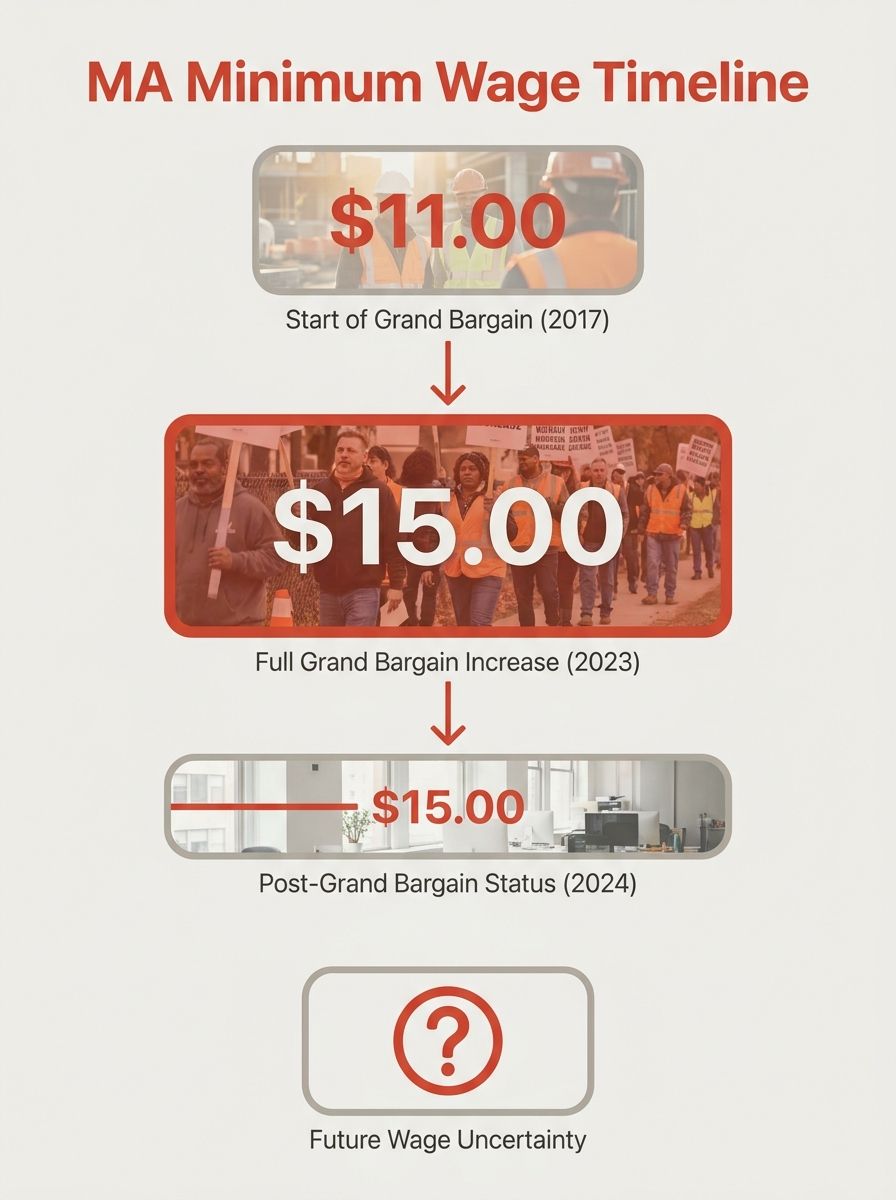
The current $15.00/hour minimum wage in Mass traces back to a single piece of 2018 legislation known as the "Grand Bargain." The law created a phased five-year schedule of annual increases, starting at $11.00/hour in 2017 and climbing $0.75 to $1.00 each January 1 until hitting $15.00 on January 1, 2023. According to the Massachusetts Attorney General's office, that 2023 increase was explicitly the final one under the Grand Bargain, with no additional increases planned for 2024 or beyond.
The Grand Bargain was itself a political trade. Labor organizations had pushed for a $15 minimum wage through a ballot initiative, while a separate ballot measure sought to establish paid family and medical leave. Business interests opposed both. The legislative deal gave workers the wage increase and paid leave, but in exchange, the increase was stretched over five years and a time-and-a-half pay requirement for Sunday and holiday retail work was phased out. Workers gained a higher floor; they lost premium pay protections that had existed since the 1800s.
That trade-off explains why the minimum wage in Mass sat frozen in 2024 with no automatic adjustment mechanism. Unlike states such as Oregon, which uses a CPI-indexed formula to adjust wages automatically, Massachusetts built a fixed endpoint into its law. Once the $15 target was reached, the escalator stopped cold.
What $15.00 Per Hour Actually Buys a Massachusetts Worker
At $15.00/hour, a full-time worker logging 40 hours per week earns $600 before taxes, or roughly $31,200 annually. That figure is more than double what the federal minimum wage of $7.25/hour would yield ($15,080/year), and it places Massachusetts among the higher-paying states in the country. But the MIT Living Wage Calculator estimated that a single adult in Massachusetts needed approximately $23.00/hour to cover basic expenses in 2024. A single parent with one child needed closer to $35.00/hour.
The $15 floor, while substantially above the federal rate, left a gap of roughly $8.00/hour between what the state required employers to pay and what an individual worker actually needed to live without public assistance. For families, the gap widened to $20.00/hour or more.
The Massachusetts Minimum Fair Wage Law, as Mass.gov confirms, makes no distinction between full-time and part-time workers. Both are covered equally. Employers who attempt to classify workers as part-time to avoid wage obligations are violating the same law that applies to their full-time staff. The Attorney General's Fair Labor Division enforces these protections through its Minimum Wage Hotline at (617) 626-6951, where workers can file complaints directly.
The Tipped Wage: $6.75 Per Hour and the Question 5 Fight
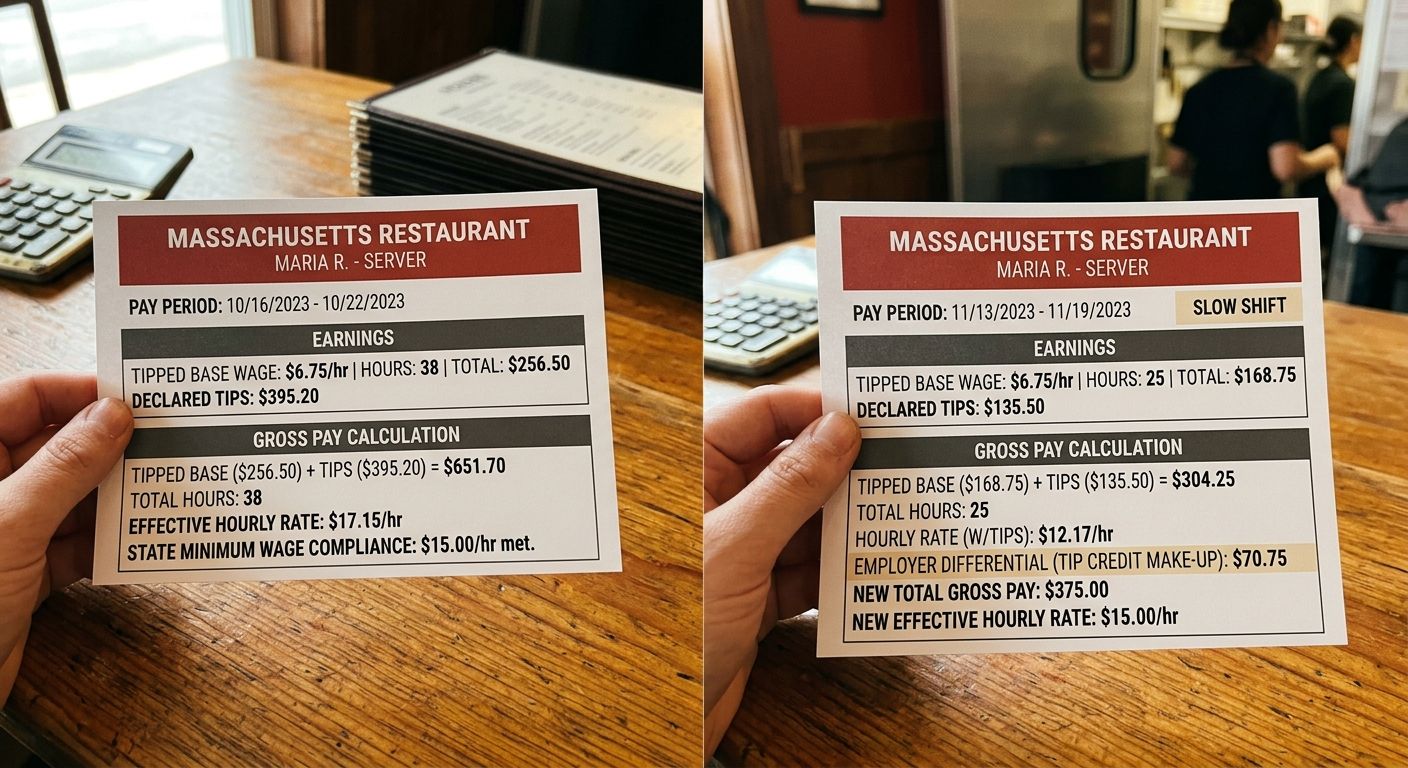
Massachusetts tipped workers earned a base rate of just $6.75 per hour in 2024. That's less than half the standard minimum wage. Employers are legally required to ensure that tips bring total hourly compensation up to at least $15.00. When they don't, the employer must cover the shortfall immediately at the end of each shift.
In practice, enforcement of this "tip credit" provision is uneven. Workers report that shortfalls go unaddressed, particularly in smaller establishments without formalized payroll systems. The burden of tracking and proving a shortfall falls disproportionately on the worker, who may fear retaliation for raising the issue. A tipped worker in Massachusetts earning the $6.75 base rate depends on customer behavior for 55% of their minimum legal compensation, an arrangement that shifts the employer's obligation onto the dining public.
This is where Question 5 entered the picture. The 2024 Massachusetts ballot included a measure, formally titled the Minimum Wage for Tipped Employees Initiative, that would have gradually increased the tipped minimum wage until it matched the full $15.00/hour standard rate, eliminating the two-tier system entirely over a multi-year phase-in period. The measure appeared on the November 2024 ballot after the state legislature took no action on it before the May 1, 2024, statutory deadline.
The restaurant industry organized heavily against Question 5, arguing that eliminating the tipped wage would force menu price increases and reduce overall tipping. Labor advocates countered that tipped workers, disproportionately women and people of color, deserve a stable, predictable wage that doesn't fluctuate with customer generosity or seasonal traffic. The measure ultimately failed, leaving the $6.75 base rate intact and the enforcement gap wide open.
Exemptions and Subminimum Wages Built Into the Law
The $15.00/hour floor has significant holes. Massachusetts law carves out several categories of workers who legally earn less:
Agricultural workers: $8.00/hour, roughly 53% of the standard minimum wage
Workers under age 20: $8.25/hour for the first 90 consecutive calendar days of employment
Tipped service employees: $6.75/hour base rate, as discussed above
These exemptions follow a pattern visible in wage laws across the country. Agricultural worker exemptions trace back to the exclusion of farmworkers from the original 1938 Fair Labor Standards Act, an exclusion rooted in racial politics designed to deny protections to Black and Latino workers who dominated agricultural labor at the time. Massachusetts has partially addressed this by setting an $8.00 agricultural rate rather than the $7.25 federal floor, but the gap between $8.00 and $15.00 remains $7.00/hour, a 47% discount for the same sixty minutes of work.
The youth subminimum wage creates a different incentive problem. Employers can legally pay a 19-year-old $8.25/hour for their first 90 days on the job, a $6.75/hour discount compared to an older colleague doing identical work. After 90 days, the full $15.00 rate kicks in. But the existence of this lower rate creates pressure to cycle through young workers on short-term schedules, and workers who don't know their rights may not realize the subminimum rate has an expiration date.
States like Illinois and Colorado maintain their own exemption structures. Comparing them reveals how much variation exists in who actually receives the "minimum" wage and who gets something less.
The $20 Push and Why the Wage Stays Frozen
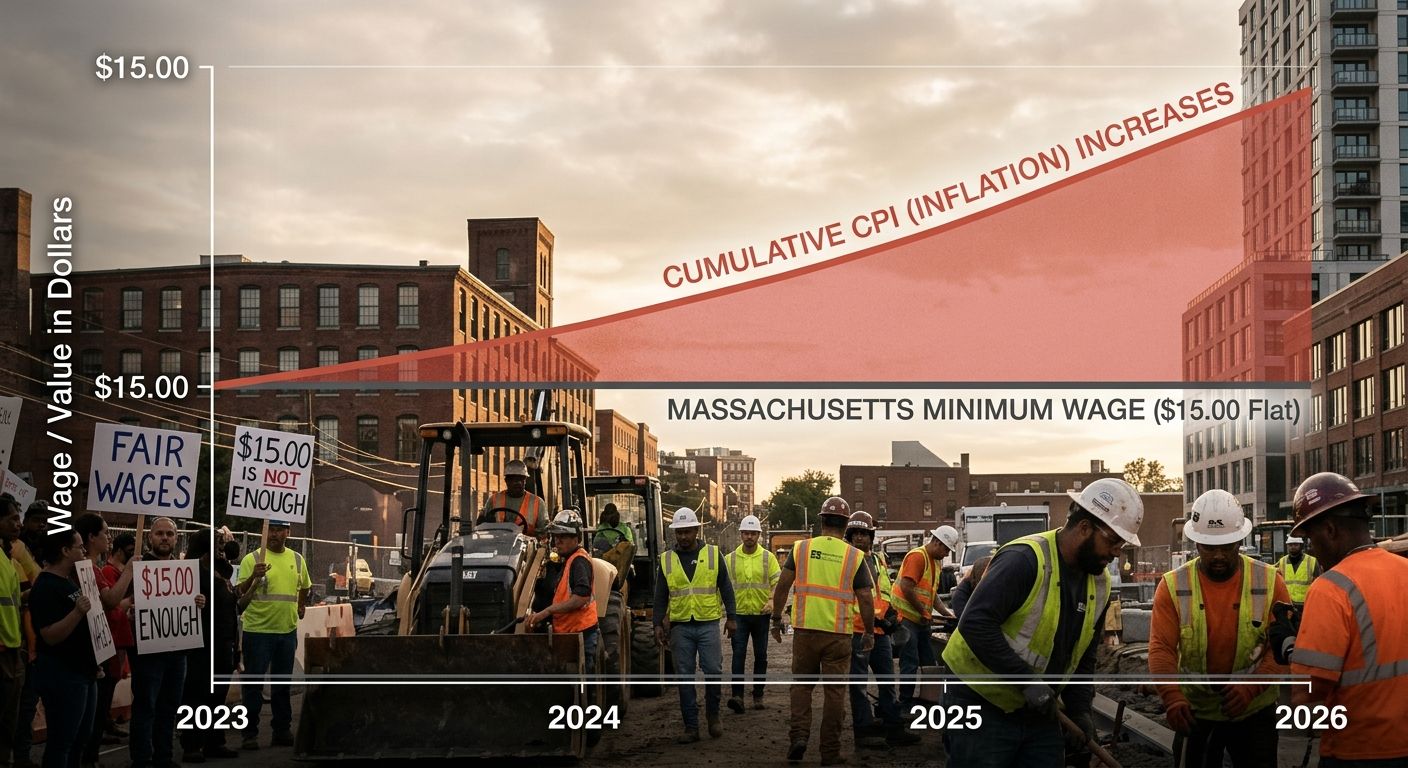
Senate Bill S.1349, filed in the Massachusetts legislature, proposed raising the minimum wage to $20.00/hour by 2029 with annual inflation adjustments afterward. The bill would address the core structural flaw in the Grand Bargain: the absence of an automatic escalator. Without indexing to the Consumer Price Index or another inflation measure, the $15.00 rate loses real value every year it stays flat.
Between January 2023 and December 2024, cumulative inflation eroded roughly 6-7% of the $15 wage's purchasing power. A worker earning $15.00/hour in January 2023 was effectively earning closer to $14.00 in real terms by the end of 2024. The longer the freeze continues, the wider this gap grows, and with it, the real-world cost of groceries, rent, and transit that workers must cover on a paycheck that hasn't budged.
The $20/hour proposal also included a critical mechanism that the Grand Bargain lacked: automatic CPI-based adjustments after the target rate was reached. Oregon already uses this approach, raising wages annually without requiring new legislation each cycle. The absence of this feature in Massachusetts law means every future increase requires a fresh political fight, lobbying, testimony, committee votes, floor votes, and gubernatorial signature. Or another ballot initiative, with all the industry spending that entails.
As of 2026, the minimum wage in Mass remains at $15.00/hour. No increase has been enacted. The $20 bill has stalled in committee. Workers who earn the minimum are now three full years into a wage freeze while the cost of living has continued its climb. A broad coalition of labor-aligned candidates running for state and federal seats have made wage indexing a platform issue, but legislative progress has been slow.
Where the $15 Floor Breaks Down
The $15.00/hour rate functions as advertised for a narrow set of circumstances: a single adult, working exactly 40 hours per week for a single employer, with no dependents and access to affordable housing. The mechanism breaks down along several fault lines that affect hundreds of thousands of Massachusetts workers.
Hours manipulation. Employers who want to avoid overtime obligations or benefits thresholds often cap workers at 29 or 32 hours per week. At 30 hours and $15.00/hour, annual earnings drop to $23,400, well below the poverty line for a family of three and far short of the MIT Living Wage estimate.
Wage theft. The Fair Labor Division receives thousands of complaints annually. Common violations include failing to pay for all hours worked, deducting costs for uniforms or equipment breakage, and misclassifying employees as independent contractors. The $15.00 rate applies only to employees; a worker misclassified as a contractor has no minimum wage protection under state law. Understanding the role of agencies like the NLRB in protecting worker rights becomes critical for anyone navigating these gray areas, particularly when employers use misclassification to avoid both wage and organizing obligations.
Geographic disparity. $15.00/hour stretches very differently in Springfield than in Boston. The state applies a single statewide rate with no regional adjustment, despite housing costs in Greater Boston running 40-60% higher than in Western Massachusetts. Oregon's three-tier geographic system, Portland metro, standard counties, and non-urban counties, represents one alternative, though it adds administrative complexity for multi-location employers.
No automatic inflation adjustment. This remains the single biggest structural weakness. Every year without a legislated increase, the real minimum wage falls. Workers don't get a cost-of-living freeze on their rent, their electric bill, or their grocery tab. A wage floor is supposed to function as a floor. Without indexing, it functions as a surface that slowly sinks beneath the weight of rising prices, and the workers standing on it sink with it.
Common Questions
Does the Massachusetts minimum wage apply to part-time workers?
Yes. The Massachusetts Minimum Fair Wage Law covers all workers regardless of whether they work full-time or part-time hours. There is no hours-per-week threshold that exempts part-time employees from the $15.00/hour rate.
What happens if a tipped worker's tips don't bring them to $15.00/hour?
The employer must cover the difference immediately, at the end of the shift where the shortfall occurred. If a server earned $6.75/hour in base pay and only $5.00/hour in tips during a shift, the employer owes an additional $3.25/hour for those hours. Workers can report violations to the Attorney General's Fair Labor Division at (617) 626-6951.
Is the Massachusetts minimum wage going up in 2026?
No increase has been enacted. The $15.00/hour rate established on January 1, 2023, remains in effect with no scheduled changes. Senate Bill S.1349, which proposed a gradual increase to $20.00/hour by 2029, has not passed the legislature as of September 2026.
How does the mass minimum wage compare to the federal rate?
Massachusetts' $15.00/hour rate is more than double the federal minimum wage of $7.25/hour. When state and federal rates differ, employers must pay the higher of the two. Workers in Massachusetts are entitled to the $15.00 state rate regardless of what federal law allows. For comparison, states like Texas still default to the $7.25 federal floor.
Can employers pay less than $15.00/hour during a training period?
Only for workers under age 20, and only for the first 90 consecutive calendar days of employment. The training wage is $8.25/hour. After 90 days, the full $15.00/hour rate applies automatically, with no employer discretion. Workers age 20 and older must receive $15.00/hour from their first day on the job.
The Union Edge Staff
Frequently Asked Questions
- What is the Massachusetts minimum wage in 2024?
- The Massachusetts minimum wage remained at $15.00 per hour throughout 2024 with no scheduled increases, marking the end of a five-year escalation period under the 2018 Grand Bargain law.
- What do tipped workers earn in Massachusetts?
- Tipped workers in Massachusetts earn a base rate of $6.75 per hour, with employers legally required to ensure tips bring total hourly compensation up to at least $15.00; employers must cover any shortfall immediately at the end of each shift.
- How much do agricultural workers earn in Massachusetts?
- Agricultural workers in Massachusetts are exempt from the standard minimum wage and earn $8.00 per hour, which is significantly lower than the $15.00 minimum wage for other workers.
- What is the training wage for workers under 20 in Massachusetts?
- Workers under age 20 can be paid $8.25 per hour during their first 90 consecutive calendar days of employment; after 90 days, they must receive the full $15.00/hour rate.
- What was the Grand Bargain minimum wage law in Massachusetts?
- The 2018 Grand Bargain was legislation that created a phased five-year schedule of annual wage increases, starting at $11.00/hour in 2017 and reaching $15.00/hour on January 1, 2023, with no additional increases planned afterward.
- How much does a Massachusetts minimum wage worker earn annually?
- A full-time worker earning $15.00/hour working 40 hours per week earns approximately $31,200 annually before taxes, but the MIT Living Wage Calculator estimated that a single adult in Massachusetts needed approximately $23.00/hour to cover basic expenses in 2024.
- Does the Massachusetts minimum wage apply to part-time workers?
- Yes, the Massachusetts Minimum Fair Wage Law covers all workers regardless of whether they work full-time or part-time hours; there is no hours-per-week threshold that exempts part-time employees from the $15.00/hour rate.
- What happened to Question 5 on the 2024 Massachusetts ballot?
- Question 5, the Minimum Wage for Tipped Employees Initiative, which would have gradually increased the tipped minimum wage to match the full $15.00/hour rate, ultimately failed at the ballot box and the $6.75 base rate for tipped workers remained intact.
Related Articles

Minimum Wage Massachusetts: 2024 Updates & Rules
M.G.L. Chapter 151, Section 1 sets the minimum wage in Massachusetts at $15.00 per hour and contains no indexing formula, no inflation trigger, and no scheduled future increase.
State of Connecticut Minimum Wage 2024 Updates
Public Act 19-4 transformed Connecticut's minimum wage from a number set by legislators into a self-adjusting rate indexed to the federal Employment Cost Index. For 2024, that mechanism pushed the state of Connecticut minimum wage from $15.00 to $15.
Minimum Wage State of Illinois: 2024 Guide
The minimum wage in the state of Illinois is $15.00 per hour for workers 18 and older, the rate that took effect January 1, 2025, completing a phased schedule of six annual increases. But Illinois doesn't operate on a single number.
Also in the paper