
minimum wage in the state of north carolina
North Carolina is one of 25 states where the minimum wage sits at the federal floor of $7.25 per hour, unchanged since July 2009, with a preemption law that blocks every one of its 553 municipalities from setting a higher rate for private-sector workers.
Minimum Wage in the State of North Carolina: How the $7.25 Floor Actually Works
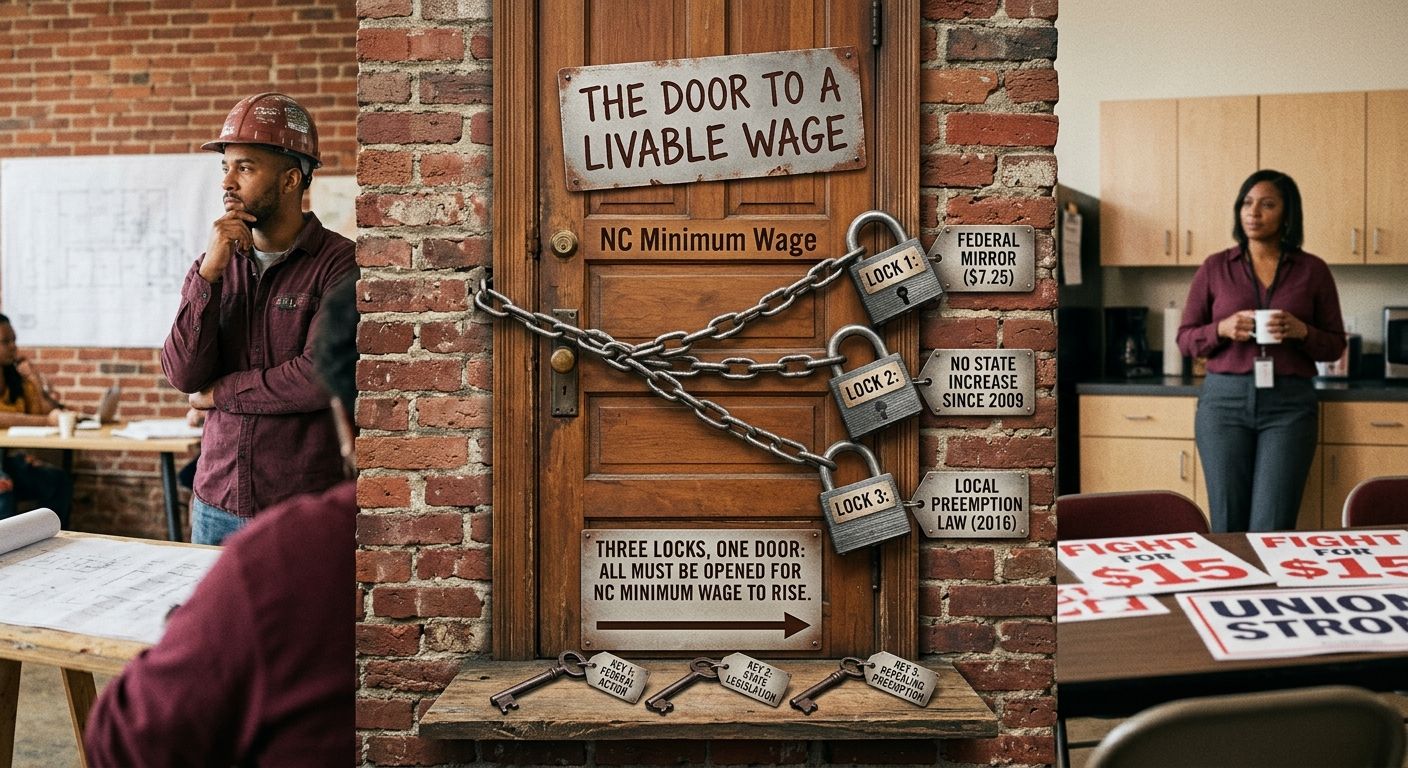
North Carolina is one of 25 states where the minimum wage sits at the federal floor of $7.25 per hour, unchanged since July 2009, with a preemption law that blocks every one of its 553 municipalities from setting a higher rate for private-sector workers. That triple lock, federal mirroring, legislative stagnation, and local preemption, makes North Carolina's wage floor one of the most structurally rigid in the country.
What North Carolina Law Requires
The North Carolina Department of Labor sets the state minimum wage at $7.25 per hour for all covered employees. This rate applies to employers doing business in the state, including county and local government employers. Agricultural and domestic employees fall under the federal minimum wage provisions of the Fair Labor Standards Act (FLSA) rather than the state statute, though the practical rate is identical.
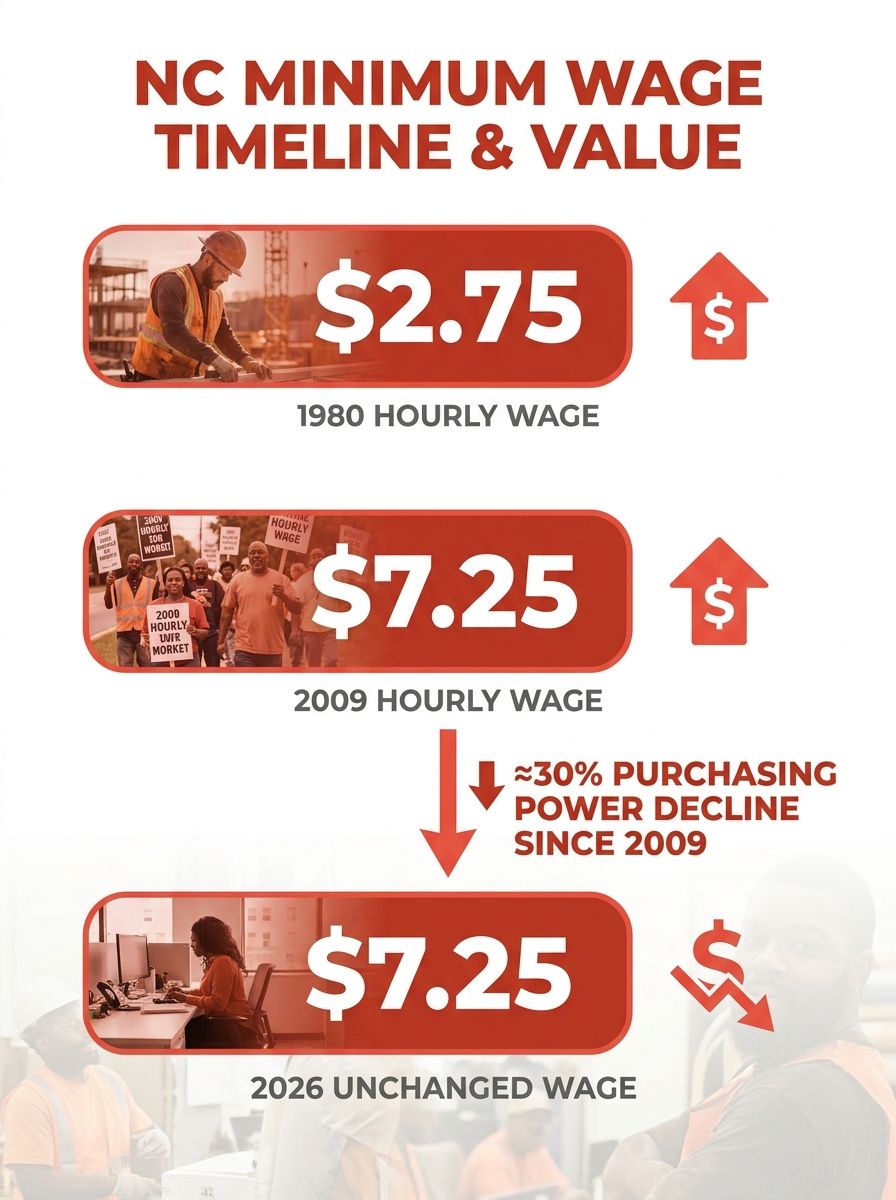
North Carolina's wage history tracks the federal rate almost perfectly. In 1980, the state minimum was $2.75 per hour, actually lower than the federal minimum of $3.10 at that time. Shortly after, the state and federal rates aligned, and they've remained identical ever since. The current $7.25 rate took effect on July 24, 2009, when the final phase of the federal minimum wage increase under the Fair Minimum Wage Act of 2007 kicked in. North Carolina made no independent move, the federal hike simply pulled the state rate upward.
If you're coming from a state like Illinois, where the legislature passed its own schedule of six annual increases reaching $15.00 per hour, or from California, where the rate hit $16.90 statewide with local rates as high as $20.34, North Carolina's system looks dramatically different. There's no independent state escalator. No annual adjustment. No inflation indexing. The rate moves only if Congress raises the federal floor or if the North Carolina General Assembly passes its own legislation. Neither has happened since 2009.
The Federal Peg and Seventeen Years of Stagnation
The federal minimum wage of $7.25 per hour has been frozen since July 2009, the longest stretch without an increase since the federal minimum was established in 1938. North Carolina's decision to mirror this rate without an independent state mechanism means workers in the state have experienced approximately 30% erosion in purchasing power over those 17 years, according to inflation calculations based on CPI data.
To put that erosion in concrete terms: a full-time minimum wage worker in North Carolina earns $15,080 per year before taxes, assuming 40 hours per week and 52 weeks of work. The federal poverty line for a family of four in 2026 sits above $31,000. A single minimum-wage income doesn't reach even half that threshold. And because the rate isn't indexed to any cost-of-living measure, the gap widens every year without legislative action.
Texas operates under a nearly identical structure, pegged to the same $7.25 federal floor with no state-level increase mechanism. But North Carolina's version carries an additional constraint that Texas lacks: active preemption of local wage ordinances.
How Preemption Blocks Local Wage Floors
Legislation passed in 2016 prohibits North Carolina's cities and counties from enacting minimum wage ordinances that exceed the state rate for private-sector employers. This preemption statute is the third lock in the system, and it's the one that distinguishes North Carolina from states where cities have acted independently of stagnant state legislatures.
Without preemption, municipalities like Charlotte, Raleigh, and Durham, metro areas where cost of living has surged over the past decade, could pass local minimum wage ordinances the way cities in California, Washington, and Colorado have done. Charlotte's median rent, for example, has climbed well past the point where a $7.25-per-hour wage covers basic housing. But the preemption statute removes that option entirely. No city council vote, no county commissioner resolution, no local ballot initiative can override the state-set floor for private employers.
The result is a system where the only path to a higher minimum wage runs through the North Carolina General Assembly in Raleigh or through Congress in Washington. Both routes have been blocked for nearly two decades.
Tipped Employees and the $2.13 Cash Wage
The minimum wage in the state of North Carolina includes a tipped-employee provision that allows employers to pay a direct cash wage of just $2.13 per hour, provided the employee's tips bring total compensation to at least $7.25 per hour. The difference, $5.12, is known as the "tip credit," and it matches the federal FLSA allowance exactly.
Here's how the mechanism works in practice: an employer pays a tipped server $2.13 per hour in cash wages. If that server earns $5.12 or more per hour in tips, the employer's obligation is met. If tips fall short in any pay period, the employer is legally required to make up the difference so the worker receives at least $7.25 for every hour worked. That's the law.
The enforcement gap is real, though. Tracking tip income across variable shifts, split duties, and shared tip pools creates opportunities for underpayment that workers may not catch and that state investigators may not audit. The North Carolina Justice Center has documented that low-wage workers, including tipped employees, face disproportionate rates of wage theft, employers failing to make up tip-credit shortfalls, requiring off-the-clock work, or miscalculating overtime.
A youth subminimum wage also exists: employers can pay workers under 20 years old a training wage of $4.25 per hour for the first 90 consecutive calendar days of employment. After 90 days, or once the employee turns 20, the full $7.25 rate applies.
Worker Category | Cash Wage | Tip Credit | Total Minimum |
|---|---|---|---|
Standard employee (18+) | $7.25/hr | N/A | $7.25/hr |
Tipped employee | $2.13/hr | $5.12/hr | $7.25/hr |
Youth (under 20, first 90 days) | $4.25/hr | N/A | $4.25/hr |
Agricultural/domestic worker | $7.25/hr (federal) | N/A | $7.25/hr |
HB 353 and the Legislative Fight for $18 by 2030
The most prominent active proposal to change the minimum wage in the state of North Carolina is House Bill 353, the Fair Minimum Wage Act. The bill would raise the state minimum from $7.25 to $18 per hour on a phased schedule: $10 by 2026, $15 by 2028, and $18 by 2030, with automatic inflation adjustments indexed to CPI thereafter.
Mecklenburg County Representative Caleb Rudow framed the bill's purpose in direct terms when speaking to WCNC: "We are trying to address the cost of living, here in North Carolina and really address workers rights in the state of North Carolina, and continue to be the voice of reason on behalf of workers, and working families, and working people across the state."
HB 353 also includes provisions to end the subminimum wage for workers with disabilities and to amend the tipped-employee wage structure. A separate proposal filed through the UNC School of Government's Legislative Reporting Service would raise the state minimum to $15 over five years and add automatic annual cost-of-living adjustments. Senate Bill 440, another raise proposal, has also stalled in committee.
None of these bills have reached a floor vote. The Republican-controlled General Assembly has shown no indication it will schedule one. Workers and labor organizations waiting for legislative action have been waiting since 2009. And with the preemption law in place, there's no municipal workaround available.
Compare that legislative gridlock to what's happened in Illinois, where lawmakers passed a phased increase schedule reaching $15 per hour, or the broader national picture where worker income's share has hit a 79-year low even as corporate profits climb.
Where the Wage Floor Collides with Market Reality
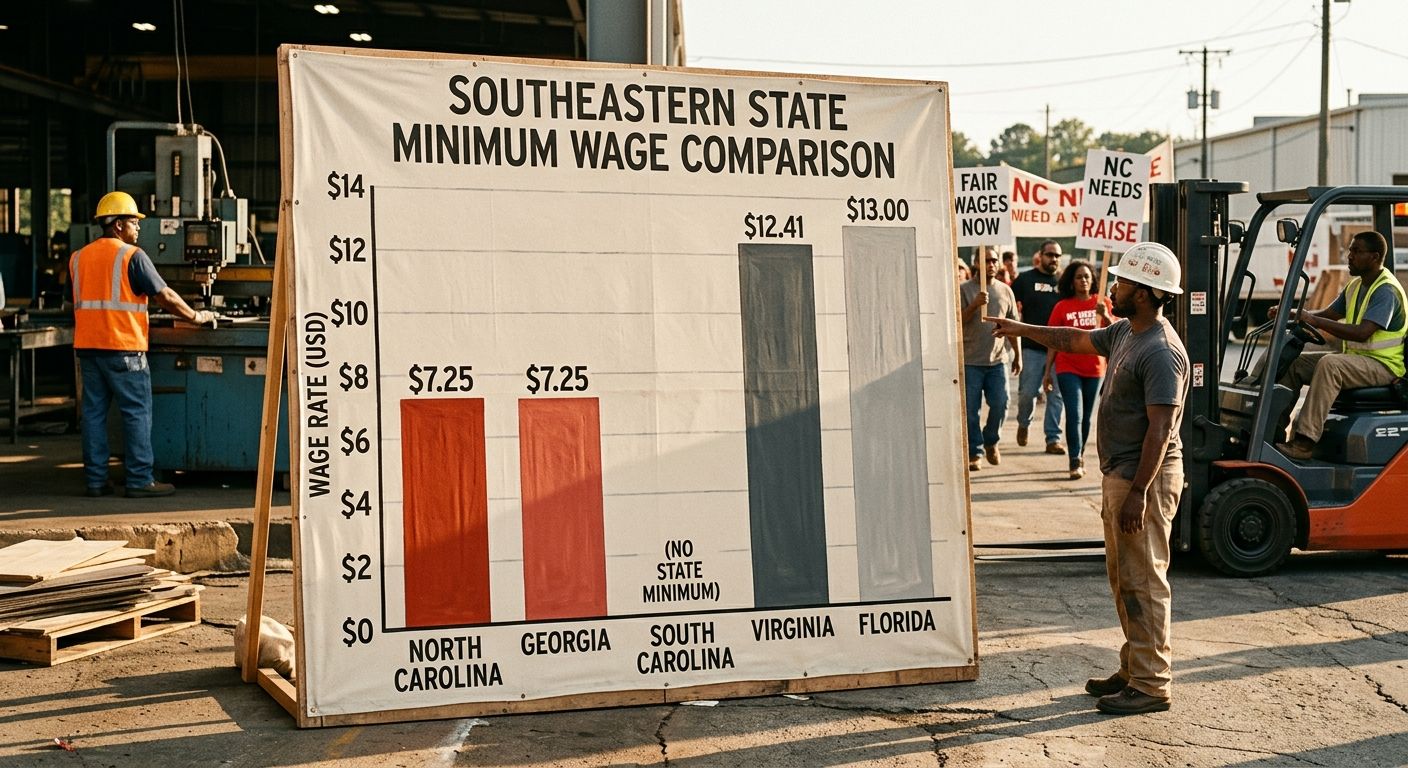
The $7.25 minimum functions as a legal baseline, but the labor market in North Carolina's metro areas has moved far past it. Amazon pays starting wages of $15 to $20 per hour at its North Carolina fulfillment centers. Target's company-wide floor sits at $15. Duke Health and Atrium Health, two of the state's largest healthcare employers, have raised entry-level wages above $15 to address recruitment and retention in a tight labor market.
This gap between the legal floor and the market floor reveals where the mechanism breaks down as a meaningful policy tool. The North Carolina Justice Center argues that raising the minimum wage provides families with bigger paychecks, creates more good jobs, and builds thriving communities, and that the current $7.25 rate fails on all three counts. Their research shows that a higher minimum wage boosts consumer spending, reduces employee turnover, and increases business sales, all effects that benefit employers as well as workers.
But the legal minimum still matters, even when market wages exceed it. Small employers, particularly in rural counties far from Charlotte or Raleigh's labor competition, can and do pay at or near $7.25. The gap between metro and rural wages in North Carolina is significant, and the stagnant minimum wage widens it. Workers in Robeson County, where the poverty rate exceeds 27%, face a different labor market than workers in Wake County. A $7.25 floor offers no protection where it's needed most.
The mechanism also breaks at the boundary of worker classification. Independent contractors, gig workers, and workers misclassified as exempt from overtime all fall outside the minimum wage's coverage. North Carolina's labor department enforces the wage floor for covered employees, but the growing share of the workforce operating in gray-zone classifications reduces the statute's practical reach.
Common Questions
Does North Carolina have its own minimum wage law, or does it just follow the federal rate?
North Carolina has its own minimum wage statute, administered by the NC Department of Labor, but the state rate is set at $7.25 per hour, identical to the federal floor. The state law applies to employers doing business in North Carolina, including state and local government employers. Agricultural and domestic workers are covered under the federal FLSA. The practical effect is the same rate regardless of which statute applies.
Can cities like Charlotte or Raleigh set their own higher minimum wage?
No. A 2016 state preemption law prohibits all North Carolina municipalities and counties from enacting local minimum wage ordinances for private-sector employers. The only path to a higher minimum wage runs through the state legislature or Congress. This distinguishes North Carolina from states like California and Washington, where cities have enacted rates well above their state floors.
What is the minimum wage for tipped workers in North Carolina?
Tipped employees can be paid a direct cash wage of $2.13 per hour, with a $5.12 tip credit, as long as total compensation (cash wages plus tips) equals at least $7.25 per hour. If tips don't bring the worker to $7.25 in any pay period, the employer must make up the difference. This structure mirrors the federal FLSA tipped-employee provisions exactly.
Is there any pending legislation to raise the minimum wage in North Carolina?
House Bill 353, the Fair Minimum Wage Act, proposes raising the state minimum to $10 per hour by 2026, $15 by 2028, and $18 by 2030, with inflation indexing after that. The bill also addresses the subminimum wage for tipped workers and workers with disabilities. It has not received a floor vote. Senate Bill 440, a separate raise proposal, has also stalled in committee.
How much has $7.25 lost in purchasing power since 2009?
Inflation has eroded approximately 30% of the purchasing power of $7.25 since the rate took effect in July 2009. A full-time worker earning the minimum wage takes home $15,080 per year before taxes, well below the federal poverty threshold for a family of four, and increasingly inadequate even for single workers in areas where housing and food costs have risen sharply.
The Union Edge Staff
Frequently Asked Questions
- What is the minimum wage in North Carolina?
- North Carolina's minimum wage is $7.25 per hour, which matches the federal minimum wage floor and has remained unchanged since July 2009.
- Can cities in North Carolina set their own minimum wage?
- No, a 2016 preemption law prohibits all North Carolina municipalities and counties from enacting local minimum wage ordinances for private-sector employers, removing any local option to exceed the state floor.
- What is the minimum wage for tipped employees in North Carolina?
- Tipped employees in North Carolina can be paid $2.13 per hour in direct wages, provided their tips bring total compensation to at least $7.25 per hour; employers must make up any shortfall if tips don't reach that threshold.
- How much purchasing power has the $7.25 minimum wage lost since 2009?
- The $7.25 minimum wage has lost approximately 30% of its purchasing power since July 2009 due to inflation, making it increasingly inadequate for covering basic living expenses.
- Is there a bill to raise North Carolina's minimum wage?
- House Bill 353, the Fair Minimum Wage Act, proposes raising the minimum wage to $10 by 2026, $15 by 2028, and $18 by 2030 with automatic inflation adjustments, but it has not received a floor vote.
- What is the youth minimum wage in North Carolina?
- Employers can pay workers under 20 years old a training wage of $4.25 per hour for the first 90 consecutive calendar days of employment; after 90 days or once the employee turns 20, the full $7.25 rate applies.
- Why hasn't North Carolina's minimum wage increased since 2009?
- North Carolina's minimum wage is locked to the federal rate through state law, and the federal minimum has been frozen at $7.25 since 2009; the state legislature has not passed an independent increase since 2008.
Related Articles

North Carolina Minimum Wage: 2024 Guide
North Carolina's minimum wage is $7.25 per hour, locked to the federal floor under the Fair Labor Standards Act, and it hasn't moved by a single penny since July 24, 2009.

Minimum Federal Wage: Current Rates & Policy
Congress sets the minimum federal wage; it does not update it. The $7.

Minimum Wage State of Maryland: 2024 Guide
The Fair Wage Act of 2023 set the minimum wage in the state of Maryland at $15.00 per hour for all employers regardless of size, effective January 1, 2024, pulling an estimated 163,000 workers above the previous $13.25 floor. But $15.00 is the baseline, not the ceiling.
Also in the paper