
Minimum Wage for Michigan: 2024 Updates
Adopt-and-amend is the legislative tactic that shaped the minimum wage for Michigan for six years, and understanding how it worked, and how it collapsed, explains every dollar amount on a Michigan paycheck today.

Minimum Wage for Michigan: 2024 Updates and the Legal Mechanism Behind Every Rate Change
Adopt-and-amend is the legislative tactic that shaped the minimum wage for Michigan for six years, and understanding how it worked, and how it collapsed, explains every dollar amount on a Michigan paycheck today. The state legislature took a voter-backed ballot initiative, passed it preemptively in 2018, then immediately rewrote its provisions to slow wage increases and preserve the tipped subminimum. On July 31, 2024, the Michigan Supreme Court struck down that rewrite, restoring the original voter-approved schedule and triggering a cascade of increases that will push the minimum wage in Michigan to $15.00 per hour by January 1, 2027.
The Improved Workforce Opportunity Wage Act, Defined
The Improved Workforce Opportunity Wage Act (IWOWA), Public Act 337 of 2018, is the statute that establishes and adjusts Michigan's minimum wage. It replaced the older Workforce Opportunity Wage Act of 2014, which itself succeeded Michigan's original Minimum Wage Law from August 28, 1964. Under the IWOWA, minimum wage Michigan employers must pay is adjusted annually, with the State Treasurer calculating cost-of-living changes each year based on the Consumer Price Index. According to the Michigan Legislature's own statute text, "the adjusted minimum wage rate is effective beginning January 1 of the immediately succeeding year."
But the version of IWOWA that governed Michigan paychecks from 2018 through early 2025 was a deliberately weakened copy of what voters had intended. How that happened, and how it was undone, is the real mechanism behind every rate change in 2024 and beyond.
How the Legislature Used Adopt-and-Amend to Gut a Ballot Initiative
The IWOWA started as a citizen-led petition drive. Organizers gathered enough signatures to place a minimum wage increase on the November 2018 ballot. The original initiative called for annual increases reaching $12.00 per hour by 2022, automatic inflation adjustments after that, and the gradual elimination of the lower tipped wage.
Michigan's legislature saw an opportunity. Under state law, the legislature can adopt a ballot initiative outright, preventing it from going before voters. The advantage for lawmakers: once adopted as a regular statute, the initiative can be amended by a simple majority vote. A ballot initiative that passes through a public vote, by contrast, requires a three-quarters supermajority in both chambers to change.
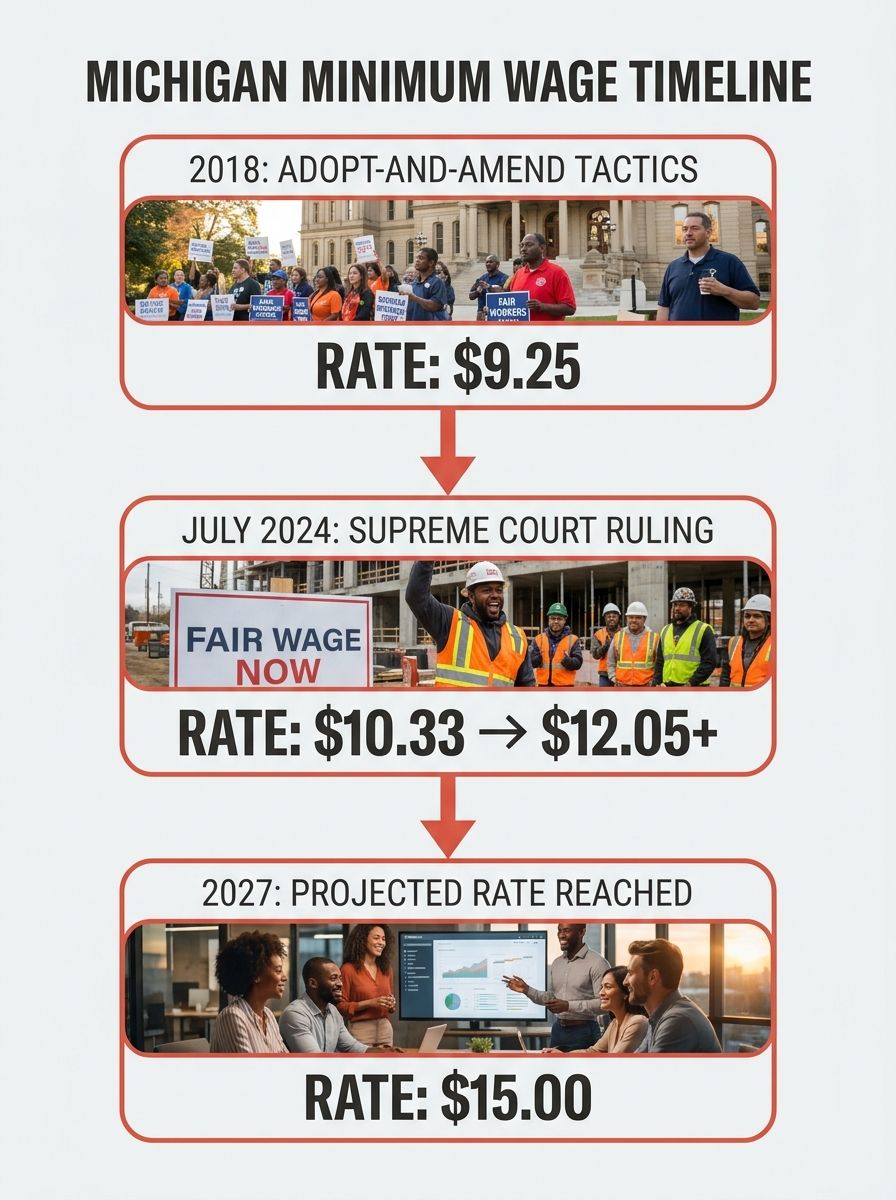
So the legislature adopted the initiative in September 2018. Weeks later, during its lame-duck session, it passed amendments that slowed the annual increases, preserved the tipped subminimum wage, and pushed the timeline out by years. The wage floor that would have hit $12.00 by 2022 was instead stretched toward a slower climb. Workers who had organized the petition drive watched the law they wrote get rewritten without a public vote.
This adopt-and-amend tactic had been used before in Michigan politics, but the IWOWA case became its highest-profile test. The legal question was stark: can a legislature adopt a ballot initiative specifically to strip it down by simple majority, circumventing the supermajority protection voters would have had?

What the July 2024 Supreme Court Ruling Changed
On July 31, 2024, the Michigan Supreme Court answered that question: no. The court ruled that the legislature's lame-duck amendments to the IWOWA were unconstitutional. The original voter-approved text, the version organizers wrote and gathered signatures for, was the legally binding statute.
The practical consequences were immediate and large. Under the legislature's amended version, the minimum wage of Michigan had been set to increase from $10.10 to just $10.33 per hour on January 1, 2024, a $0.23 raise. That was the rate Michigan workers were earning when the Supreme Court issued its decision. The restored original initiative demanded faster, steeper increases.
Governor Gretchen Whitmer signed Senate Bill 8 in February 2025 to create a transitional implementation schedule that complied with the court's ruling while giving employers a defined adjustment period. The result was a 15% jump from $10.56 to $12.48 per hour on February 21, 2025, the sharpest single increase minimum wage Michigan workers had seen in decades.
For workers who'd been tracking their state's broader wage requirements, the court ruling wasn't abstract constitutional theory. It translated directly into dollars: roughly $90 more per biweekly paycheck for a full-time worker at the minimum.
The Rate Schedule from 2024 Through 2027
The full timeline of minimum wage Michigan rate changes shows how dramatically the Supreme Court ruling altered the trajectory. Here's the progression:
Effective Date | Hourly Rate | Trigger |
|---|---|---|
January 1, 2024 | $10.33 | Amended IWOWA schedule |
February 21, 2025 | $12.48 | Senate Bill 8 (post-ruling transition) |
January 1, 2026 | $13.73 | Restored IWOWA schedule |
January 1, 2027 | $15.00 | Restored IWOWA schedule |
January 1, 2028+ | CPI-adjusted | Inflation indexing begins |
The Michigan Department of Labor and Economic Opportunity confirms the $13.73 rate for 2026 and $15.00 for 2027. After 2027, the State Treasurer will calculate annual cost-of-living adjustments based on the Consumer Price Index, and the adjusted rate takes effect on January 1 of the following year.
For context on how Michigan compares to other states navigating wage increases, California's approach involves sector-specific minimum wages that create multiple pay floors within the same state. Michigan's model is simpler, one statewide rate, with carve-outs only for tipped employees and minors.
Minor employees (ages 16 and 17) can be paid 85% of the standard minimum wage, $11.67 per hour in 2026. New hires ages 16-19 may be paid a training wage of $4.25 per hour for the first 90 calendar days of employment.
Tipped Workers and the Disappearing Subminimum
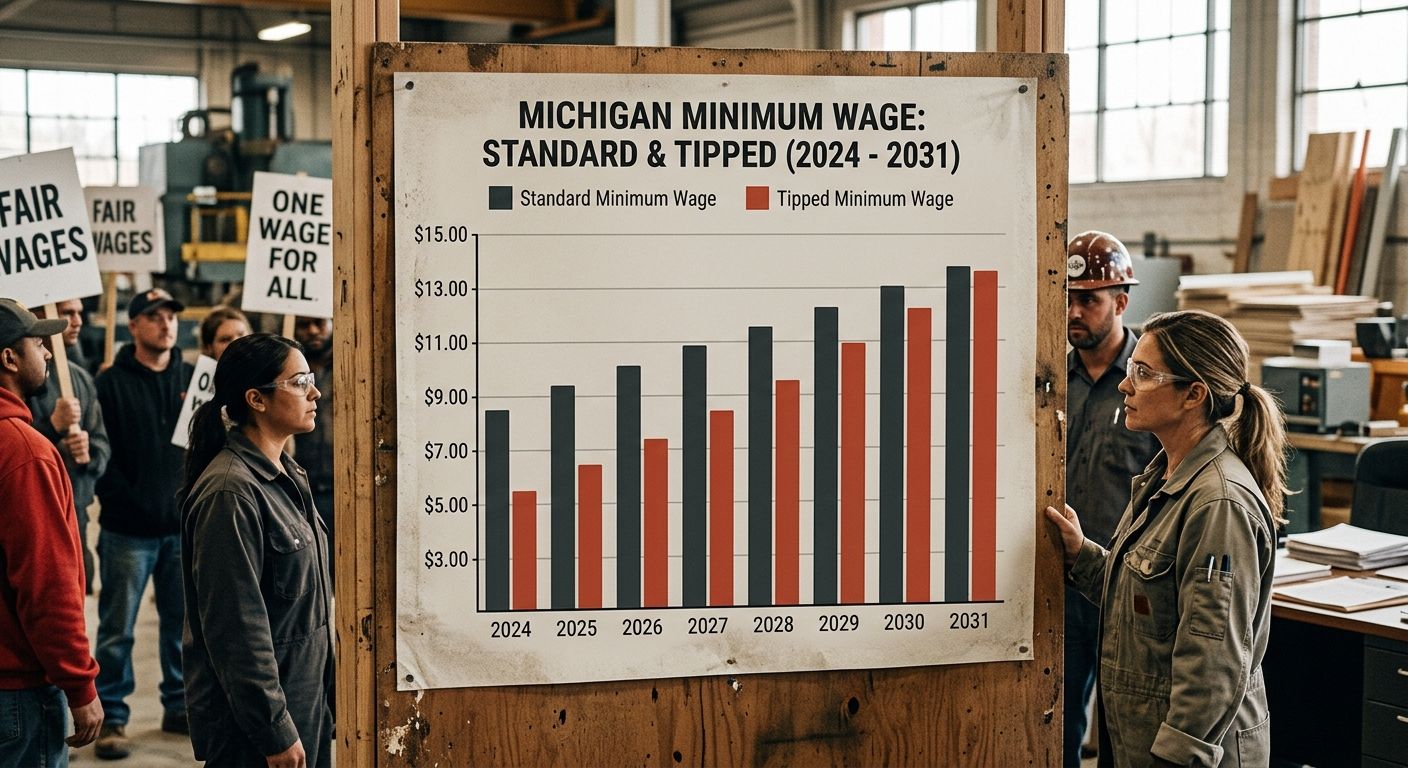
The original voter initiative included a provision that the tipped worker subminimum wage would gradually increase until it matched the full minimum wage, effectively eliminating the tip credit. The legislature's 2018 amendments had frozen that provision. The Supreme Court ruling revived it, but Senate Bill 8 slowed the phase-out timeline.
Under the current schedule, the tipped minimum cash wage is set as a percentage of the standard minimum wage, rising by 2% of the standard rate each year. In 2025, tipped employees earn a base of $5.99 per hour (48% of the standard rate). In 2026, the base is $5.49 per hour (40% of the standard rate). The tipped wage will reach 50% of the base rate by 2031.
Employers remain responsible for making up the difference whenever a tipped worker's hourly earnings (base wage plus tips) fall below the full minimum wage. This is federal law under the Fair Labor Standards Act, and Michigan's statute mirrors it. If tips are slow on a Tuesday lunch shift and total compensation drops below $13.73 per hour in 2026, the employer owes the difference, no exceptions.
The trajectory of Michigan's tipped wage is worth watching alongside federal proposals. Congressional Democrats have introduced a $25 minimum wage bill that would eliminate the restaurant tip credit entirely at the national level. Michigan is, in effect, running a slower version of the same experiment.
The Gap Between the Minimum and a Living Wage
Even at $15.00 per hour in 2027, the minimum wage in Michigan will fall well short of what workers need to cover basic expenses. MIT's Living Wage Calculator estimates the living wage in Michigan at $22.07 per hour for a single adult with no children. That figure accounts for housing, food, transportation, healthcare, and other essential costs. For a single parent with one child, the living wage is substantially higher.
The gap is $8.34 per hour at the 2026 rate. It will narrow to $7.07 when the wage hits $15.00, assuming living costs don't rise, which, of course, they will. After 2027, the CPI-adjustment mechanism is designed to keep the minimum wage from falling further behind inflation. But CPI tracking doesn't close a gap; it prevents the gap from widening. Workers at the minimum in Michigan will still earn roughly 68 cents for every dollar they'd need to cover basic living costs.
In Detroit specifically, the minimum wage has climbed from $9.45 per hour in 2019 to the current statewide rate, yet remains below what researchers consider a living wage for the city's cost of living. The statewide flat rate means a worker in Marquette and a worker in downtown Detroit earn the same floor, despite dramatically different housing costs.
States like Texas, which default to the $7.25 federal minimum with no state-level floor of their own, make Michigan's trajectory look aggressive by comparison. But the living wage math doesn't care about relative progress. It measures whether a worker can pay rent and buy groceries. By that standard, $15.00 is a floor that still leaves Michigan workers short.
Where the Mechanism Breaks
The IWOWA, even in its restored form, has structural limits that no court ruling can fix.
Geographic uniformity in a geographically unequal state. Michigan's single statewide rate treats Traverse City and Flint identically. Housing costs in Ann Arbor have nothing in common with housing costs in the Upper Peninsula. Unlike New York, which uses a two-zone geographic system with separate rates for the city metro area and the rest of the state, Michigan's law offers no regional adjustment.
CPI indexing is backward-looking. The inflation adjustment mechanism uses prior-year Consumer Price Index data. In periods of rapid price increases, like the 2022-2023 surge in food and energy costs, the minimum wage adjustment arrives a year after the damage is done. Workers absorb the hit in real time; the rate catches up later.
Enforcement depends on workers knowing their rights. Employers must maintain payroll records for three years and pay overtime at 1.5 times the regular rate for hours over 40 per week. But wage theft, the failure to pay owed wages, remains a persistent problem in low-wage industries. A higher statutory minimum means nothing if the employer doesn't pay it and the worker doesn't know how to file a complaint.
The tipped wage phase-out is slow enough to stall. At 2% of the standard rate per year, the tipped subminimum won't reach parity with the full minimum wage until well into the 2030s. A future legislature could slow or freeze the phase-out before it completes, though the Supreme Court's 2024 ruling raises the legal bar for doing so.
Common Questions
Does the minimum wage of Michigan apply to all employers?
The IWOWA applies to employers with two or more employees. Federal minimum wage law under the FLSA applies to enterprises with annual gross sales of $500,000 or more, or those engaged in interstate commerce. Very small employers with limited revenue may fall outside one or both statutes, though most Michigan businesses meet the threshold.
Will Michigan's minimum wage keep rising after $15.00?
Yes. Once the rate reaches $15.00 on January 1, 2027, the U.S. Department of Labor confirms that Michigan's minimum wage will be adjusted annually based on the rate of inflation, as measured by the Consumer Price Index. The State Treasurer calculates the adjustment, and the new rate takes effect on January 1 of the following year.
Can tipped workers in Michigan be paid below the minimum wage?
Tipped employees receive a lower base cash wage, $5.49 per hour in 2026, but their total hourly compensation (base plus tips) must equal or exceed the full $13.73 minimum. If it doesn't, the employer must pay the difference. The tip credit is being phased down gradually, with tipped workers' base pay scheduled to reach 50% of the standard minimum by 2031.
What happens if my employer doesn't pay the new rate?
You can file a wage complaint with the Michigan Department of Labor and Economic Opportunity's Wage and Hour Division. Employers who violate the IWOWA face penalties including back pay, liquidated damages, and fines. Keeping your own records of hours worked and pay received strengthens any complaint you file.
How does Michigan's minimum wage compare to the federal minimum?
The federal minimum wage remains $7.25 per hour, unchanged since 2009. Michigan's $13.73 rate in 2026 is 89% higher than the federal floor. In states without their own minimum wage laws, workers earn the federal rate, a gap that will widen further when Michigan reaches $15.00 in 2027.
The Union Edge Staff
Frequently Asked Questions
- What is Michigan's minimum wage in 2024 and 2025?
- Michigan's minimum wage was $10.33 per hour on January 1, 2024. Following a Michigan Supreme Court ruling in July 2024, the minimum wage jumped to $12.48 per hour on February 21, 2025, marking a 15% increase.
- When will Michigan's minimum wage reach $15 per hour?
- Michigan's minimum wage will reach $15.00 per hour on January 1, 2027. After that date, it will be adjusted annually based on the Consumer Price Index.
- What was the Michigan Supreme Court ruling on minimum wage in 2024?
- On July 31, 2024, the Michigan Supreme Court ruled that the legislature's 2018 amendments to the minimum wage law were unconstitutional. The court restored the original voter-approved version of the Improved Workforce Opportunity Wage Act, requiring faster wage increases.
- Do tipped workers in Michigan have a different minimum wage?
- Yes, tipped employees receive a lower base cash wage, which was $5.99 per hour in 2025 and $5.49 per hour in 2026, but their total compensation including tips must equal the full minimum wage. If tips don't bring them to the minimum, employers must pay the difference.
- How does Michigan's minimum wage compare to the federal minimum wage?
- Michigan's minimum wage of $13.73 in 2026 is 89% higher than the federal minimum wage of $7.25 per hour, which has remained unchanged since 2009.
- What is the living wage in Michigan compared to the minimum wage?
- According to MIT's Living Wage Calculator, the living wage in Michigan is $22.07 per hour for a single adult with no children, compared to the minimum wage of $13.73 in 2026—a gap of $8.34 per hour.
- How are new teen hires paid in Michigan?
- New employees ages 16-19 may be paid a training wage of $4.25 per hour for the first 90 calendar days of employment. Minor employees ages 16 and 17 can be paid 85% of the standard minimum wage after the training period.
- What should I do if my employer doesn't pay Michigan's minimum wage?
- You can file a wage complaint with the Michigan Department of Labor and Economic Opportunity's Wage and Hour Division. Keeping your own records of hours worked and pay received strengthens any complaint you file.
Related Articles

Michigan Minimum Wage: 2024 Updates & Requirements
Michigan's minimum wage is $13.73 per hour, effective January 1, 2026, after the Michigan Supreme Court's July 31, 2024 ruling reinstated voter-approved wage increases that the legislature had blocked for six years. The rate reaches $15.

Minimum wage state of michigan: 2024 Guide
Michigan's minimum wage is $13.73 per hour as of January 1, 2026, governed by the Improved Workforce Opportunity Wage Act, a law that was gutted by the state legislature in 2018, restored by the Michigan Supreme Court in 2024, and then rewritten through bipartisan compromise in 2025.

Michigan Minimum Wage: Current Rates & Updates
The Improved Workforce Opportunity Wage Act controls the state of Michigan minimum wage through a fixed annual escalator that raises the floor each January without requiring new legislative votes. As of January 1, 2026, that escalator pushed the standard rate to $13.
Also in the paper