
Michigan Minimum Wage: 2024 Updates & Requirements
Michigan's minimum wage is $13.73 per hour, effective January 1, 2026, after the Michigan Supreme Court's July 31, 2024 ruling reinstated voter-approved wage increases that the legislature had blocked for six years. The rate reaches $15.

Michigan Minimum Wage: How the Court Ruling Rewrote the Rate Schedule
Michigan's minimum wage is $13.73 per hour, effective January 1, 2026, after the Michigan Supreme Court's July 31, 2024 ruling reinstated voter-approved wage increases that the legislature had blocked for six years. The rate reaches $15.00 on January 1, 2027, with inflation indexing taking over in 2028.
The Legal Fight That Reset Michigan's Wage Floor
The current minimum wage for Michigan traces back to a deliberate legislative maneuver in 2018. Voters gathered enough signatures to place two ballot initiatives before the legislature: one raising the minimum wage, the other establishing earned sick time. Under Michigan law, the legislature could adopt the initiatives outright before the election, then amend them with a simple majority afterward. That's exactly what happened. Lawmakers adopted both initiatives, preventing them from appearing on the November ballot, then amended them in the lame-duck session to slow down wage increases and weaken sick leave protections.
The original initiatives would have pushed the minimum wage to $12.00 by 2022. The legislature's amendments stretched the timeline and reduced the target. For six years, Michigan workers earned less than voters had intended.
On July 31, 2024, the Michigan Supreme Court ruled that this adopt-and-amend strategy violated the Michigan Constitution. The court held that the legislature's post-adoption amendments were unconstitutional, reinstating the original ballot initiatives in full. A follow-up Clarification Order on September 18, 2024 rewrote a key footnote addressing how the tip credit would phase out and how annual increases would be calculated going forward.
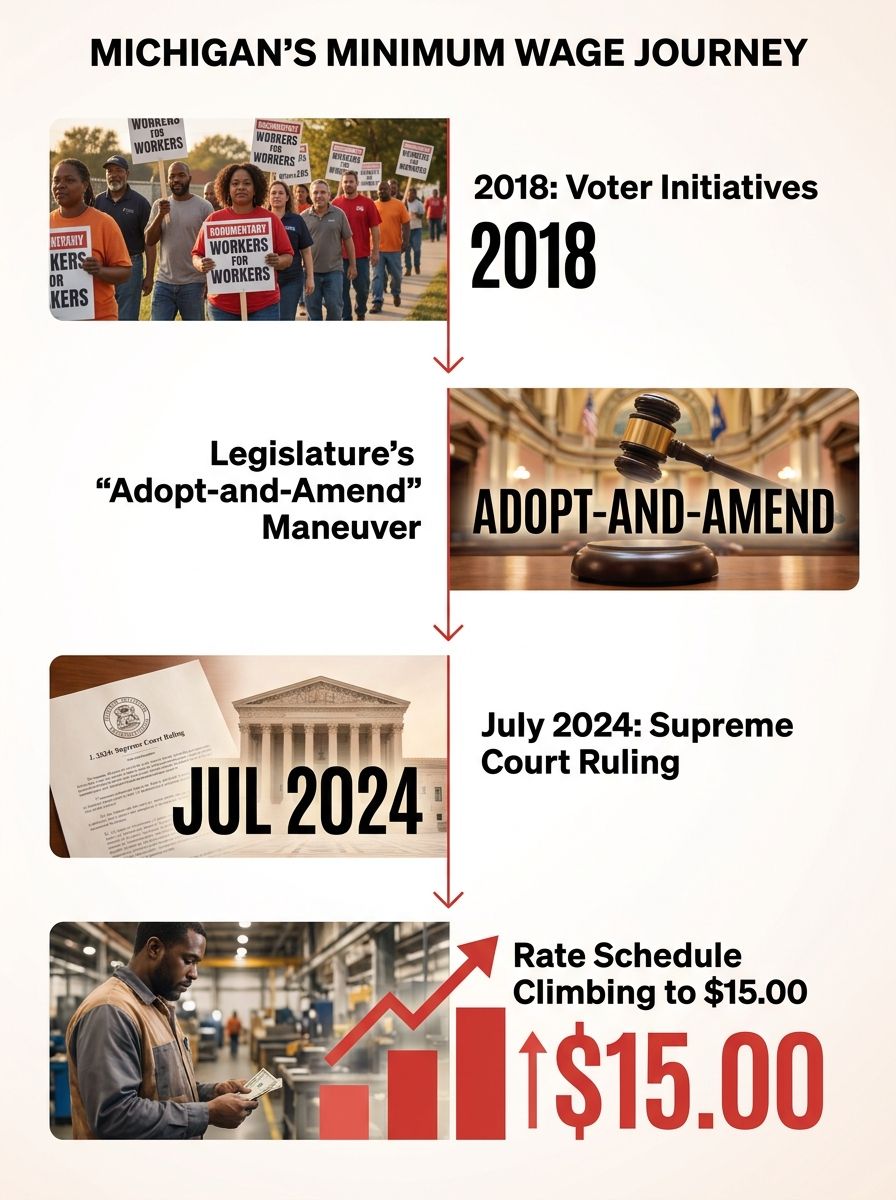
Senate Bill 8, which went into effect on February 21, 2025, was the legislature's response. It created a compromise schedule: faster increases than the gutted 2018 amendments allowed, but with modifications to the tip credit elimination timeline that the restaurant industry had lobbied for. LEO Deputy Director of Labor Sean Egan hosted a public webinar on February 27, 2025, to explain how the new law affects workers and businesses, a signal that even the state recognized widespread confusion about compliance obligations after the rapid legal shifts.
The Rate Schedule from 2024 Through 2027
Each step in the minimum wage of Michigan follows a defined annual increase set by the combination of the court ruling and Senate Bill 8. Most adjustments took effect on January 1 of the respective year, except for the mid-cycle jump triggered by the February 2025 law.
Year | Standard Minimum Wage | Tipped Employee Cash Wage | Maximum Tip Credit |
|---|---|---|---|
2024 | $10.33 | $3.52 | $6.81 |
2025 (post-Feb. 21) | $12.48 | $5.99 | $6.49 |
2026 | $13.73 | $5.49 | $8.24 |
2027 | $15.00 | $6.30 | $8.70 |
2028+ | CPI-MW adjusted | 42%+ of minimum | Varies |
The jump from $10.33 to $12.48 in 2025 was the largest single-year increase in Michigan's minimum wage history. Workers who compare this trajectory to minimum wage rates in states like Texas, where the rate remains at the federal floor of $7.25 per hour, can see how dramatically state-level policy diverges across the country.
The $13.73 rate for 2026 represents a 33% increase over the 2024 rate in just two years. By the time the standard wage hits $15.00 in 2027, Michigan workers will have seen a 45% raise from their January 2024 starting point. That kind of acceleration is a direct product of the court's intervention. Without the ruling, the Workforce Opportunity Wage Act's original amendment schedule had workers on a slower path that wouldn't have reached $12.05 until 2030.
How the Tipped Wage Operates
Michigan's tipped wage system runs on a credit mechanism: employers pay a reduced cash wage and apply tips to make up the difference. If an employee's tips plus their cash wage don't equal at least the full minimum wage for any given pay period, the employer is legally required to cover the gap.
Under federal law (the FLSA), employers must pay tipped employees at least $2.13 per hour. Michigan's state rate is significantly higher. The tipped cash wage for 2026 is $5.49 per hour, more than double the federal floor for tipped workers.
The September 2024 Clarification Order from the Michigan Supreme Court originally set a timeline to eliminate the tip credit entirely by 2030. Senate Bill 8 changed that trajectory. Under the current law, the tipped cash wage will reach 50% of the standard minimum wage by January 1, 2031, but the tip credit structure itself remains in place indefinitely after that point.
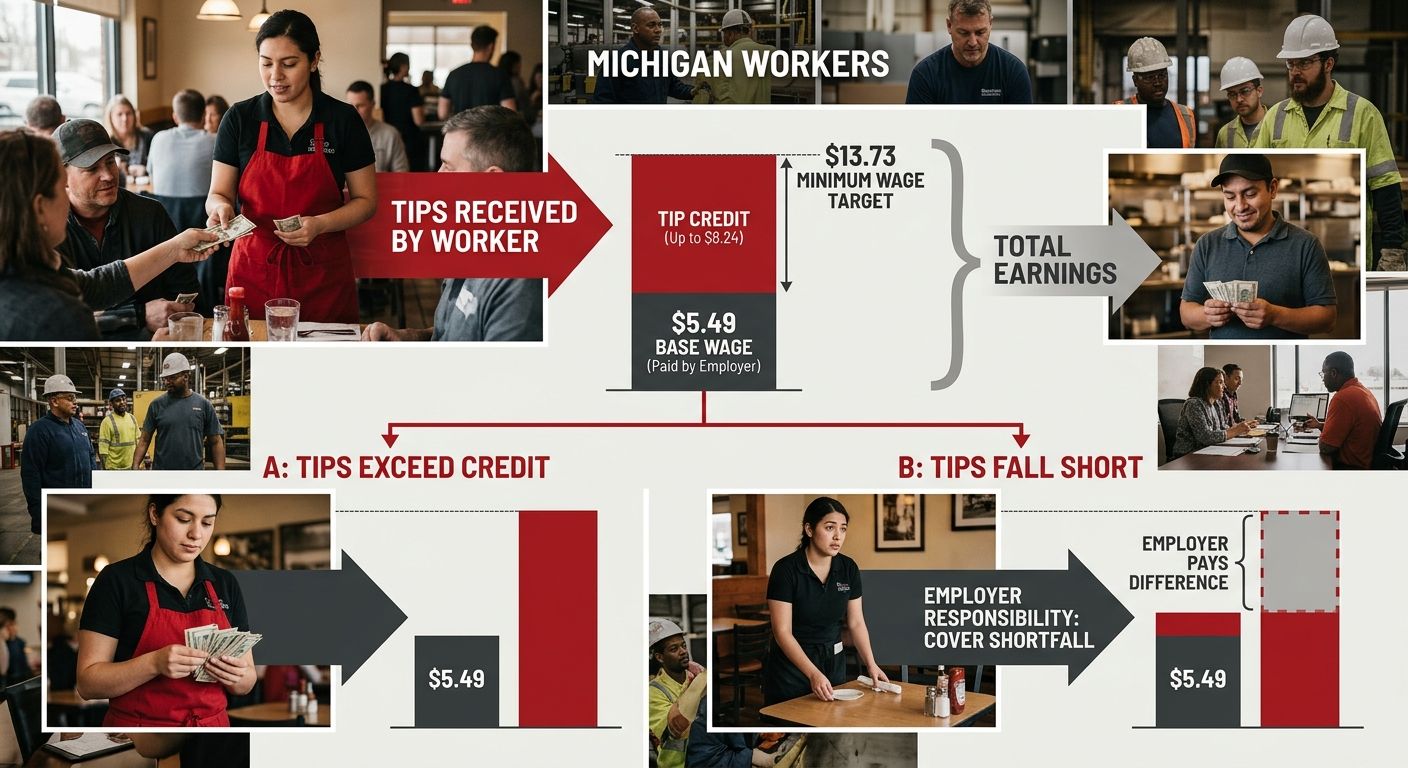
This matters enormously for restaurant and hospitality workers. The difference between the original court order (full tip credit elimination by 2030) and the legislative compromise (50% floor by 2031, tip credit preserved) represents thousands of dollars annually per worker. If you're a tipped employee in Michigan, your employer's obligation is the full $13.73 per hour. The tip credit is a mechanism for how that obligation gets fulfilled, not a discount on what you're owed.
Minors, Training Wages, and the 85% Rule
Michigan carves out two special wage categories. Workers aged 16 and 17 can be paid 85% of the standard minimum wage, which translates to $11.67 per hour in 2026 and $12.75 in 2027. These rates apply regardless of the type of work performed, as long as the minor is legally permitted to do it under Michigan's child labor statutes.
The training wage applies to newly hired employees under age 20 during their first 90 calendar days of employment. That rate is $4.25 per hour and has remained unchanged for years. The 90-day window is strict: it runs from the hire date, not from accumulated work days. An employee who works two shifts per week still exits the training wage window after 90 calendar days.
Both categories share a critical constraint. Employers cannot cycle through new hires at training wages and terminate them before the 90-day mark to avoid paying the full minimum. The Department of Labor and Economic Opportunity tracks patterns of this kind, and it constitutes a violation of the act's intent. Compared to neighboring states like Ohio, which has its own minimum wage structure, Michigan's youth wage provisions are relatively standard, but the gap between $4.25 (training) and $13.73 (standard) is wide enough that employers who misclassify workers or extend the training period beyond 90 days face real liability.
What Happens After 2027: The CPI-MW Index
Once the minimum wage for Michigan reaches $15.00 on January 1, 2027, annual increases shift to an automatic formula tied to the Midwest Consumer Price Index (CPI-MW). The state will calculate each year's increase based on the prior year's inflation data, and the new rate takes effect every January 1 beginning in 2028. This is a similar indexing mechanism to what several other high-wage states use, though the specific index (Midwest CPI rather than national CPI) reflects regional cost-of-living conditions rather than national averages.
The indexed rate cannot decrease from one year to the next. If Midwest CPI deflates, the minimum wage holds at its prior level. This floor protection is standard in state indexing laws but worth emphasizing given Michigan's history. Between 1997 and 2014, the state's minimum wage sat at $5.15 for over a decade before the Workforce Opportunity Wage Act created a new schedule. The adopt-and-amend maneuver in 2018 then stalled increases again. Federal Reserve data on Michigan's minimum wage shows 58 years of rate history, and the pattern of long stagnation periods followed by catch-up spikes is visible across the entire dataset. Automatic indexing breaks that cycle by removing the legislature's ability to freeze wages through inaction, though it also means future raises will track inflation rather than outpace it.
Where the Law Gets Complicated
The mechanism described above has clean lines on paper. Reality introduces friction in several places that workers and employers should understand.
Overtime miscalculation. Michigan's overtime rules require 1.5 times the regular rate for hours over 40 per week. At $13.73, overtime runs $20.60 per hour. For tipped employees, overtime is calculated on the full minimum wage, not the tipped cash wage. Some employers miscalculate this by applying the 1.5 multiplier to $5.49 instead of $13.73. That's a violation that shows up frequently in wage claims.
The Earned Sick Time Act runs in parallel. The same Supreme Court ruling that restored the wage initiatives also reinstated the original Earned Sick Time Act (ESTA). All Michigan employers, regardless of size, now must provide accrued paid sick leave. Before the ruling, sick leave requirements applied only to businesses with 50 or more employees. The interaction between ESTA accrual, overtime calculations, and tipped wage accounting creates a compliance burden that small employers, particularly in food service, struggle to manage without dedicated payroll systems.
Record-keeping obligations. Michigan requires employers to maintain precise payroll records for three years. Violations carry civil fines up to $1,000 per incident plus liability for unpaid wages. But enforcement depends largely on complaints. Workers who don't know their rights or who fear retaliation rarely file. This is one of the clearest arguments for workplace organizing: union shops file wage complaints at higher rates and recover more in back pay, because a collective structure gives individual workers protection that the law alone doesn't provide.
Multi-state employers. Companies operating across Michigan, Ohio, Indiana, and Wisconsin face four different minimum wage structures, four different tipped wage calculations, and varying sick leave mandates. The minimum wage of Michigan at $13.73 sits above Ohio's rate, but the compliance regimes differ enough that a single payroll template can't cover both states without adjustment. The penalty structures vary too, making it easy for multi-location employers to default to the lowest common denominator unless workers hold them accountable.
Common Questions
Does Michigan's minimum wage apply to all employers regardless of size?
Yes. The Workforce Opportunity Wage Act covers all Michigan employers. The Earned Sick Time Act, reinstated alongside the wage law by the same Supreme Court ruling, also now applies to all employers. Before the ruling, sick leave requirements applied only to businesses with 50 or more employees.
What happens if my tips plus my cash wage don't reach $13.73?
Your employer must pay the difference. The tip credit mechanism means the employer takes credit for tips you receive, but the floor is always the full minimum wage. If your combined hourly earnings fall short in any pay period, your employer owes you the gap. Keep written records of your hours and tips for every shift in case of disputes.
Is the $15.00 rate in 2027 guaranteed, or could the legislature change it?
Senate Bill 8 established the $15.00 rate for January 1, 2027, as law. The legislature could theoretically pass new legislation to alter it, but the Supreme Court's 2024 ruling established that the adopt-and-amend procedure used in 2018 was unconstitutional. Any future changes would need either a standard legislative process with the governor's signature or a new ballot initiative approved by voters.
How does Michigan compare to the federal minimum wage?
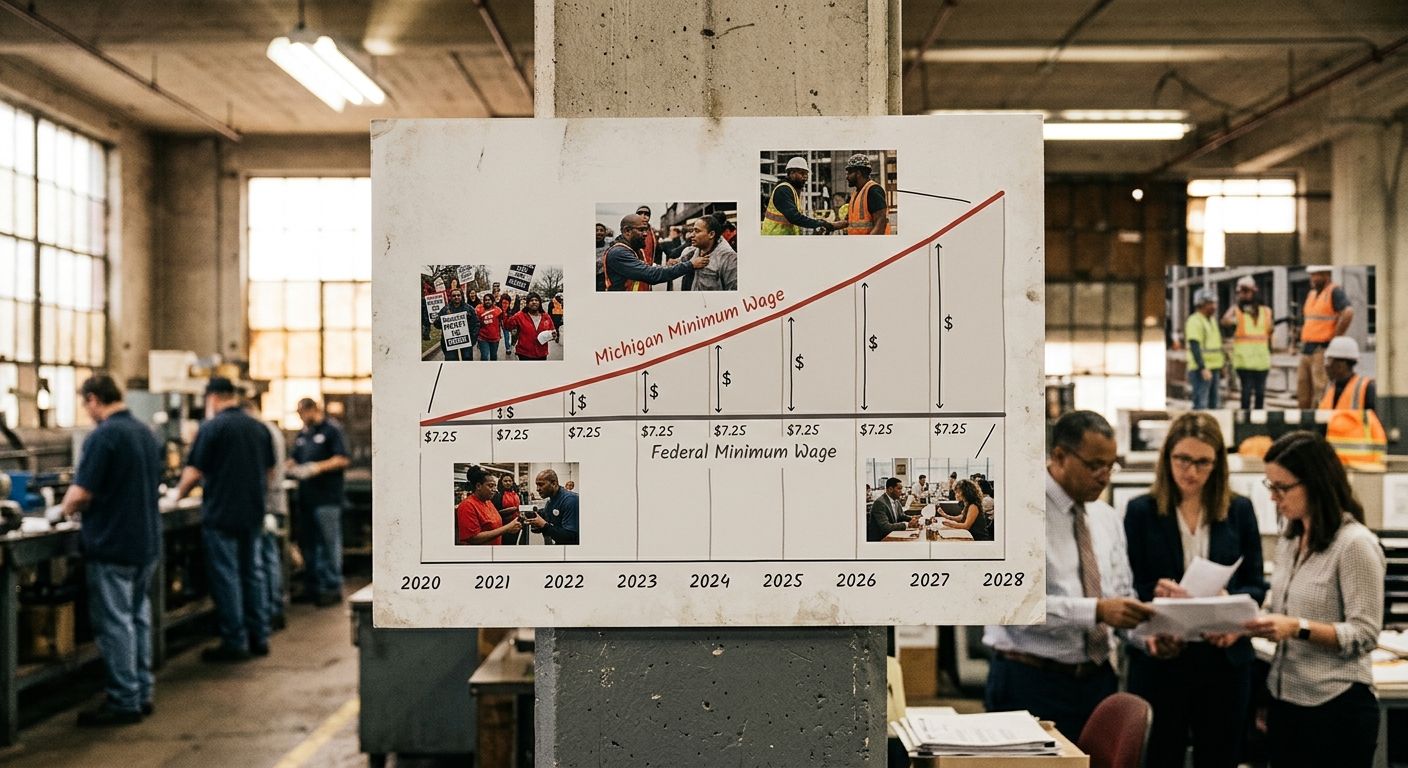
The federal minimum wage has been $7.25 per hour since 2009. Michigan's $13.73 rate is 89% higher. When state and federal minimums differ, workers are entitled to whichever rate is higher. Every Michigan worker covered by both laws earns the state rate. The gap between federal and state rates continues to widen across many states that have adopted their own increase schedules.
Can my employer pay me less during a training period?
Only if you're under 20 years old and in your first 90 calendar days of employment. The training wage is $4.25 per hour. After 90 calendar days or if you're 20 or older, the full minimum wage applies from your first day on the job.
Michigan's minimum wage mechanism is the product of a six-year fight between voter intent and legislative maneuvering. The 2024 Supreme Court ruling resolved the constitutional question, and Senate Bill 8 set the implementation timeline. Workers should know their rate, track their hours, and report violations to the Michigan Department of Labor and Economic Opportunity at michigan.gov/leo. Organized workplaces with union representation recover unpaid wages at higher rates because collective power turns individual complaints into structural accountability. If your workplace doesn't have that structure yet, the conversation with your coworkers is worth having.
The Union Edge Staff
Frequently Asked Questions
- What is Michigan's minimum wage in 2024 and 2025?
- Michigan's minimum wage was $10.33 per hour in early 2024, then jumped to $12.48 per hour on February 21, 2025, following the passage of Senate Bill 8. This represents the largest single-year increase in Michigan's minimum wage history.
- What will Michigan's minimum wage be in 2026 and 2027?
- Michigan's minimum wage will be $13.73 per hour effective January 1, 2026, and will reach $15.00 per hour on January 1, 2027. After 2027, the rate will be adjusted annually based on the Midwest Consumer Price Index (CPI-MW).
- What is Michigan's tipped minimum wage for 2026?
- Michigan's tipped cash wage for 2026 is $5.49 per hour. However, if tips plus the cash wage don't equal the full minimum wage of $13.73, the employer must pay the difference.
- Can employers pay minors less than the minimum wage in Michigan?
- Yes, workers aged 16 and 17 can be paid 85% of the standard minimum wage, which is $11.67 per hour in 2026 and $12.75 in 2027. A training wage of $4.25 per hour applies to newly hired employees under age 20 during their first 90 calendar days of employment.
- Why did Michigan's minimum wage increase so dramatically in 2025?
- The Michigan Supreme Court ruled on July 31, 2024, that the legislature's 2018 adopt-and-amend procedure was unconstitutional, reinstating voter-approved wage increases that had been blocked for six years. Senate Bill 8 then set a path to $15.00 by 2027.
- How is overtime calculated for tipped employees in Michigan?
- Overtime for tipped employees is calculated at 1.5 times the full minimum wage of $13.73 per hour, not the tipped cash wage. This means overtime runs $20.60 per hour, and employers who miscalculate using the tipped wage instead are committing a wage violation.
- What is Michigan's minimum wage compared to the federal minimum wage?
- Michigan's minimum wage of $13.73 is 89% higher than the federal minimum wage of $7.25 per hour, which has remained unchanged since 2009. Workers are entitled to whichever rate is higher.
- How will Michigan's minimum wage be adjusted after 2027?
- Starting in 2028, Michigan's minimum wage will be automatically adjusted annually based on the Midwest Consumer Price Index (CPI-MW). The indexed rate cannot decrease from one year to the next, and the new rate takes effect every January 1.
Related Articles

Minimum wage state of michigan: 2024 Guide
Michigan's minimum wage is $13.73 per hour as of January 1, 2026, governed by the Improved Workforce Opportunity Wage Act, a law that was gutted by the state legislature in 2018, restored by the Michigan Supreme Court in 2024, and then rewritten through bipartisan compromise in 2025.

Minimum Wage for Michigan: 2024 Updates
Adopt-and-amend is the legislative tactic that shaped the minimum wage for Michigan for six years, and understanding how it worked, and how it collapsed, explains every dollar amount on a Michigan paycheck today.

Michigan Minimum Wage: Current Rates & Updates
The Improved Workforce Opportunity Wage Act controls the state of Michigan minimum wage through a fixed annual escalator that raises the floor each January without requiring new legislative votes. As of January 1, 2026, that escalator pushed the standard rate to $13.
Also in the paper