
New York State Minimum Wage: 2024 Rates & Requirements
The new york state minimum wage is a two-zone geographic system where workers in New York City, Long Island, and Westchester earn one hourly floor, and workers everywhere else in the state earn a lower one. As of January 1, 2024, those floors sat at $16.00 and $15.

New York State Minimum Wage: 2024 Rates & Requirements
The new york state minimum wage is a two-zone geographic system where workers in New York City, Long Island, and Westchester earn one hourly floor, and workers everywhere else in the state earn a lower one. As of January 1, 2024, those floors sat at $16.00 and $15.00, respectively, with separate rules for tipped workers, fast food employees, and home care aides layered on top.
How the Two-Zone Structure Works
New York doesn't set a single statewide minimum wage. Instead, the New York State Department of Labor divides the state into two wage zones, and the zone you work in determines your legal hourly floor, your employer's tip credit allowance, and the exempt salary threshold that governs whether you're eligible for overtime.
Zone 1 covers New York City plus Nassau, Suffolk, and Westchester counties. These four jurisdictions share the same minimum wage rate because their cost of living, particularly housing costs, clusters together statistically. Zone 2 covers the remaining 58 counties, everything from Albany to Buffalo to the Adirondacks.
The distinction matters because a cashier at a chain pharmacy in Yonkers (Westchester County) and a cashier at the same chain in Poughkeepsie (Dutchess County) work under different legal wage floors, even though they're separated by roughly 40 miles. Employers operating across zone boundaries carry compliance obligations for each location independently.
This geographic split has been a point of contention among worker advocates. Tal Frieden, campaign manager for Raise Up New York, told the Democrat and Chronicle that "upstate workers need the same minimum wage as those in the New York City area" because they face the same rising housing and grocery costs. The gap between the two zones in 2024 was $1.00/hour, roughly $2,080 per year for a full-time worker.
The 2024 Rate Schedule
On January 1, 2024, the minimum wage state of new york employers must pay rose by different amounts depending on geography. Zone 1 went from $15.00 to $16.00/hour. Zone 2 went from $14.20 to $15.00/hour. According to Greenberg Traurig's analysis, this was part of a legislative schedule signed into law as part of the state's 2023 budget deal, which locked in $0.50 annual increases for both zones through January 1, 2026.
Here's how the full schedule breaks down:
Effective Date | Zone 1 (NYC, Nassau, Suffolk, Westchester) | Zone 2 (Rest of State) |
|---|---|---|
January 1, 2024 | $16.00/hr | $15.00/hr |
January 1, 2025 | $16.50/hr | $15.50/hr |
January 1, 2026 | $17.00/hr | $16.00/hr |
January 1, 2027 | CPI-indexed | CPI-indexed |
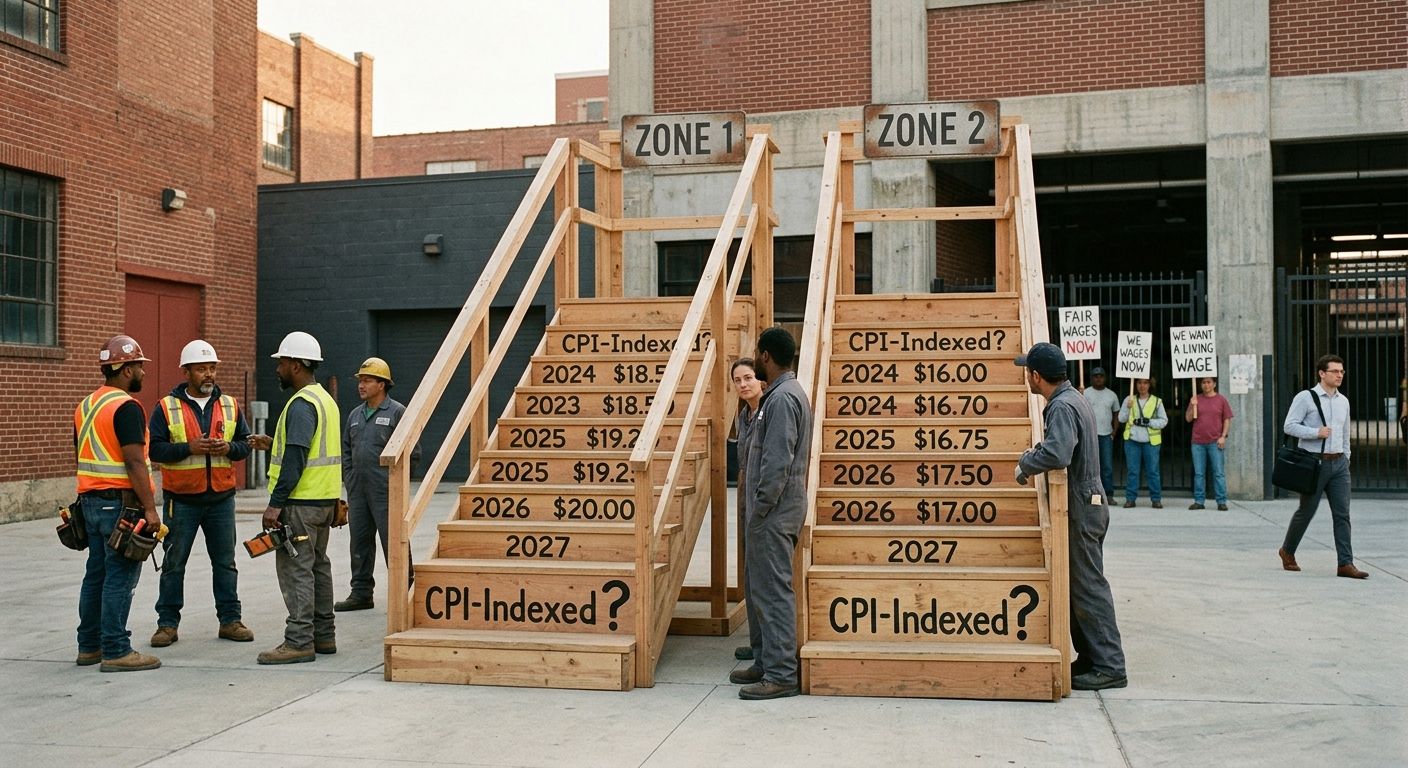
The $0.50 annual increases apply uniformly to both zones, which means the $1.00 gap between them persists through 2026. Whether the CPI-indexed formula narrows or widens that gap starting in 2027 depends on how the state implements the inflation adjustment. For workers tracking how New York's current rates compare to prior years, the progression from 2024 through 2026 follows a predictable staircase.
Tipped Workers and Industry-Specific Carve-Outs
The base hourly minimum is only part of the picture. New York maintains separate wage structures for several worker categories, each with its own rules about how much employers can subtract from the base rate when tips, meals, or lodging are provided.
Tipped hospitality workers in Zone 1 earned a cash wage of $13.35/hour in 2024, with their employer taking a $2.65/hour tip credit. The math is supposed to work so that tips plus the cash wage equal or exceed the full $16.00 minimum. If they don't, the employer is legally required to make up the difference. Zone 2 tipped hospitality workers earned $12.50/hour in cash wages with a $2.50 tip credit.
Fast food workers statewide earn $15.00/hour as of 2024, the same rate regardless of zone. The state eliminated the tip credit entirely for fast food workers in 2019, meaning no employer in this sector can pay below the full hourly minimum.
Home care aides are paid above the standard minimum wage in both zones: $18.55/hour in Zone 1 and $17.55/hour in Zone 2 as of 2024. These rates reflect supplemental wage requirements enacted through the state budget process and carry their own scheduled increases, reaching $19.65 and $18.65 by 2026.
The interaction between these categories and the base rate can be confusing. A worker at a fast food restaurant inside a hotel, for example, might fall under fast food rules, hospitality rules, or both, depending on how the establishment is classified and who employs them. The congressional debate over eliminating the tip credit at the federal level adds another dimension to this already complicated landscape.
Exempt Salary Thresholds
The minimum wage mechanism extends beyond hourly workers. New York sets exempt salary thresholds, the weekly pay floor below which an employee classified as "administrative" or "executive" must receive overtime pay regardless of their job title or duties. These thresholds track the minimum wage upward.
In 2024, the exempt salary threshold for Zone 1 administrative and executive employees was $1,200/week ($62,400/year). For Zone 2, the threshold was $1,124.20/week ($58,458.40/year). By January 1, 2026, those numbers rise to $1,275/week and $1,199.10/week.
One conspicuous gap: New York has no state-level salary threshold for the "professional" exemption. Workers classified as exempt professionals are governed by the federal standard of $684/week ($35,568/year), which hasn't been updated to reflect New York's higher cost of living. An employer in Manhattan can classify a salaried professional as exempt from overtime at $35,568/year, roughly $27,000 below the Zone 1 administrative threshold. For workers trying to understand how NYC's wage rules differ from the state framework, this professional-exemption gap is one of the least visible but most impactful discrepancies.
The CPI Indexing Mechanism Starting in 2027
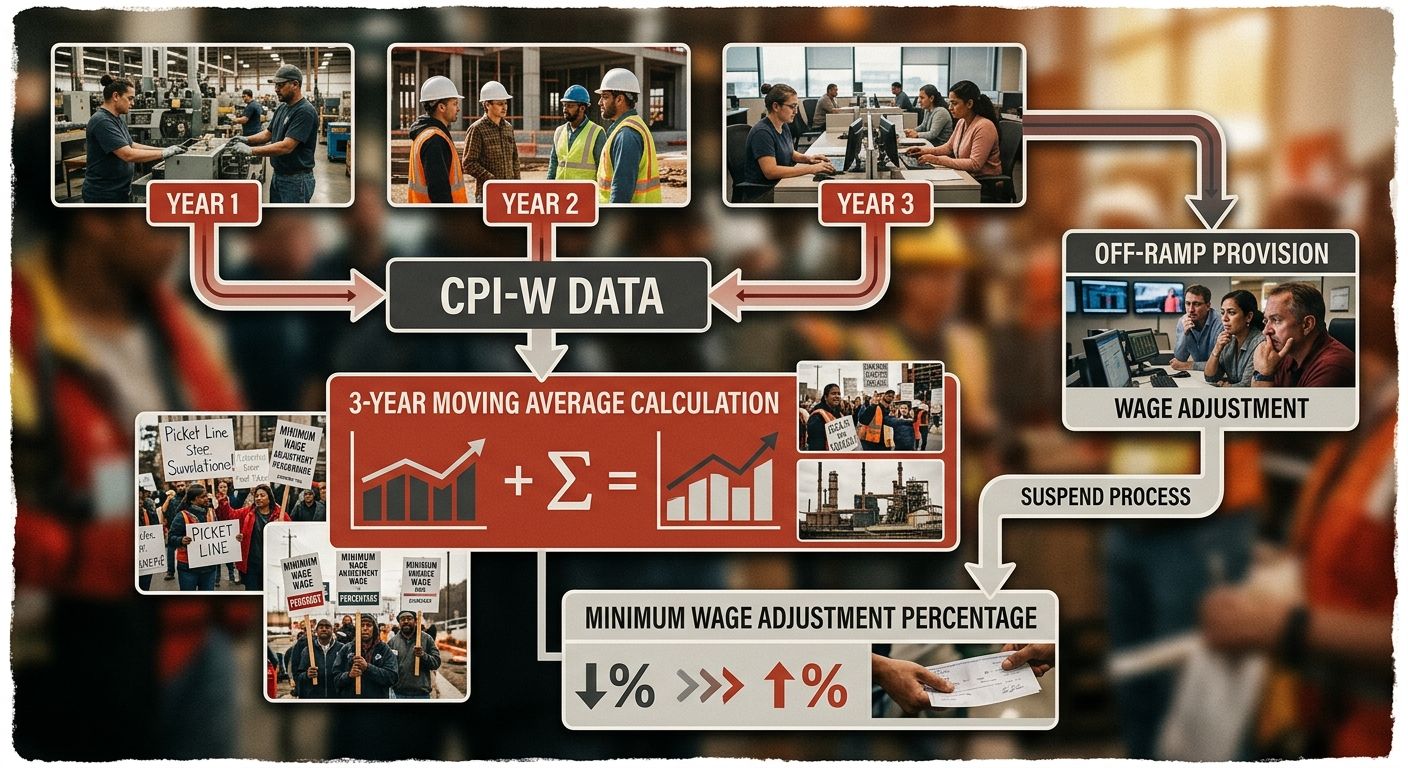
The scheduled $0.50 annual increases end after January 1, 2026. Beginning in 2027, the state of new york minimum wage will adjust annually based on the three-year moving average of the Consumer Price Index for Urban Wage Earners and Clerical Workers (CPI-W) for the Northeast Region.
This formula matters because it shifts control over the wage floor from the state legislature to an economic index. Legislators no longer vote on each increase. Instead, the Bureau of Labor Statistics publishes CPI-W data, and the state applies a rolling three-year average to determine the next year's increase automatically.
The three-year average smooths out short-term price spikes. A single year of 6% inflation won't produce a 6% wage increase, it gets averaged with the two preceding years. That dampening effect protects employers from sharp cost jumps but also means workers' wages lag behind inflationary surges.
The off-ramp, described in the state's official minimum wage guidance, is available "in the event of certain economic or budget conditions." The statute doesn't define those conditions with precision, which gives the governor and legislature discretion to freeze wages if they determine the economy can't absorb a scheduled increase. Worker advocates have flagged this provision as a potential escape hatch that could stall wage growth during the periods when workers need relief most.
Additional 2024 Compliance Requirements
Beyond the wage rates themselves, New York enacted several payroll rules that took effect alongside the 2024 minimum wage increase. Employers must now pay certain manual workers on a semi-monthly basis, not monthly, which affects cash flow planning for businesses with large hourly workforces. Employers are also required to obtain written consent before enrolling workers in direct deposit programs.
And under S.B. 2832-A, New York reclassified wage theft as a form of larceny. An employer who systematically underpays workers below the minimum wage can face criminal charges in the same category as theft of property. This is a sharper enforcement tool than the civil penalties that previously governed most wage-and-hour violations. For context on how this compares to other states, the minimum wage structure in Texas still relies on the federal $7.25 floor with no state-level enhancement and minimal state-specific enforcement provisions.
Where the Model Breaks
New York's two-zone system is cleaner than many states' wage frameworks, but it has real boundary problems.
The most obvious: the $1.00/hour gap between Zone 1 and Zone 2 treats all 58 upstate and central New York counties as economically identical. A worker in Albany, where median rents have risen sharply, earns the same minimum wage as a worker in a rural county with housing costs half that level. The zones don't reflect the actual cost-of-living gradient across the state; they approximate it with a binary split.
The CPI indexing mechanism introduces its own vulnerabilities. Because the formula uses a three-year moving average, there's a built-in lag. If inflation spikes in year one, the full effect won't register in the wage increase until year three. Workers absorb higher prices in real time while their wage adjustments trail by 12 to 36 months.
The off-ramp provision creates additional uncertainty. If a governor suspends CPI-indexed increases during a recession, precisely when low-wage workers are most economically vulnerable, the automatic mechanism that's supposed to replace legislative wage fights becomes inoperative. Workers are back to lobbying for increases during the worst possible political conditions.
And the professional exemption gap remains unresolved. A state that sets its hourly minimum at $16.00 or $17.00 still allows salaried "professionals" to be classified as overtime-exempt at $684/week, a figure set by federal regulators and disconnected from New York's cost of living. Until the state establishes its own professional threshold, this carve-out will continue to affect workers who earn well below the administrative exemption line but don't qualify for overtime protection.
Common Questions
Does every worker in New York State earn the same minimum wage?
No. The state of new york minimum wage varies by geographic zone and by industry. Zone 1 (NYC, Nassau, Suffolk, Westchester) carried a $16.00/hour floor in 2024. Zone 2 (the remaining 58 counties) carried $15.00/hour. Tipped workers, fast food employees, and home care aides each have separate rate structures that differ from the base minimum.
What happens to the minimum wage after 2026?
Beginning in 2027, New York's minimum wage will be adjusted annually based on the three-year moving average of the CPI-W for the Northeast Region. The scheduled $0.50 increases end after January 1, 2026. An off-ramp provision allows the state to suspend CPI-indexed increases during economic downturns.
Can my employer pay me less than the minimum wage if I earn tips?
Your employer can pay a lower cash wage if they claim a tip credit, but only if your tips plus cash wages equal or exceed the full minimum wage in every pay period. If they don't, the employer must make up the difference. Fast food workers are excluded from tip credit provisions entirely. Failure to pay the difference is classified as wage theft under New York law.
Does the New York minimum wage apply to salaried workers?
The minimum wage itself applies to hourly compensation, but it drives the exempt salary thresholds that determine overtime eligibility. In 2024, salaried administrative and executive employees in Zone 1 needed to earn at least $1,200/week ($62,400/year) to be classified as exempt from overtime. The professional exemption, however, defaults to the lower federal threshold of $684/week.
How does New York's 2024 rate compare to neighboring states?
New York's Zone 1 rate of $16.00/hour in 2024 was among the highest state-level minimums in the country. For comparison, the federal minimum remained at $7.25/hour, and many states, including Texas, still default to that federal floor. Connecticut and New Jersey both operated above $15.00 in 2024, but New York's Zone 1 exceeded both.
The Union Edge Staff
Frequently Asked Questions
- What is the New York State minimum wage in 2024?
- New York has two geographic zones: $16.00/hour for NYC, Nassau, Suffolk, and Westchester counties, and $15.00/hour for the remaining 58 counties, effective January 1, 2024.
- How much will New York minimum wage increase in 2025 and 2026?
- The minimum wage will increase by $0.50 annually through 2026, reaching $16.50/hour (Zone 1) and $15.50/hour (Zone 2) in 2025, then $17.00/hour and $16.00/hour respectively in 2026.
- What is the minimum wage for tipped workers in New York?
- Tipped hospitality workers in Zone 1 earn a cash wage of $13.35/hour with a $2.65/hour tip credit, while Zone 2 tipped workers earn $12.50/hour with a $2.50 tip credit; employers must make up the difference if tips plus cash wages don't reach the full minimum.
- Do fast food workers in New York get paid differently?
- Fast food workers statewide earn $15.00/hour as of 2024 regardless of zone, and employers cannot take a tip credit for these workers.
- What happens to New York minimum wage after 2026?
- Beginning in 2027, New York's minimum wage will automatically adjust annually based on a three-year moving average of the Consumer Price Index for Urban Wage Earners and Clerical Workers (CPI-W) for the Northeast Region, though an off-ramp provision allows the state to suspend increases during economic downturns.
- What is the exempt salary threshold for salaried workers in New York?
- In 2024, administrative and executive employees in Zone 1 must earn at least $1,200/week ($62,400/year) to be classified as exempt from overtime, while Zone 2 employees must earn $1,124.20/week ($58,458.40/year).
- What is the minimum wage for home care aides in New York?
- Home care aides earn $18.55/hour in Zone 1 and $17.55/hour in Zone 2 as of 2024, with scheduled increases to $19.65 and $18.65 respectively by 2026.
- What are the consequences if an employer doesn't pay minimum wage in New York?
- Under New York law, wage theft is classified as a form of larceny, meaning employers who systematically underpay workers can face criminal charges, not just civil penalties.
Related Articles

Minimum Wage in NYC: 2024 Rates & Requirements
Section 652 of New York's Labor Law sets the minimum wage in NYC at $16.00 per hour as of January 1, 2024. That headline number hides a tiered system of tip credits, industry-specific floors, and geographic zones that can reduce a worker's guaranteed cash wage to $10.

New York City Minimum Wage: 2024 Updates & What Changed
New York City's minimum wage is the legal hourly floor every employer in the five boroughs must pay, and on January 1, 2024, it climbed from $15.00 to $16.00 per hour. That dollar increase was the first move in a three-year legislated schedule that reaches $17.

NYS Minimum Wage 2026: What's Changing
New York's minimum wage operates through a three-layer structure: a regional hourly floor ($17.00 downstate, $16.00 upstate as of January 1, 2026), a set of sub-rates for tipped and salaried workers, and starting in 2027, an automatic inflation-indexing formula.
Also in the paper