
Michigan Minimum Wage: Current Rates & Updates
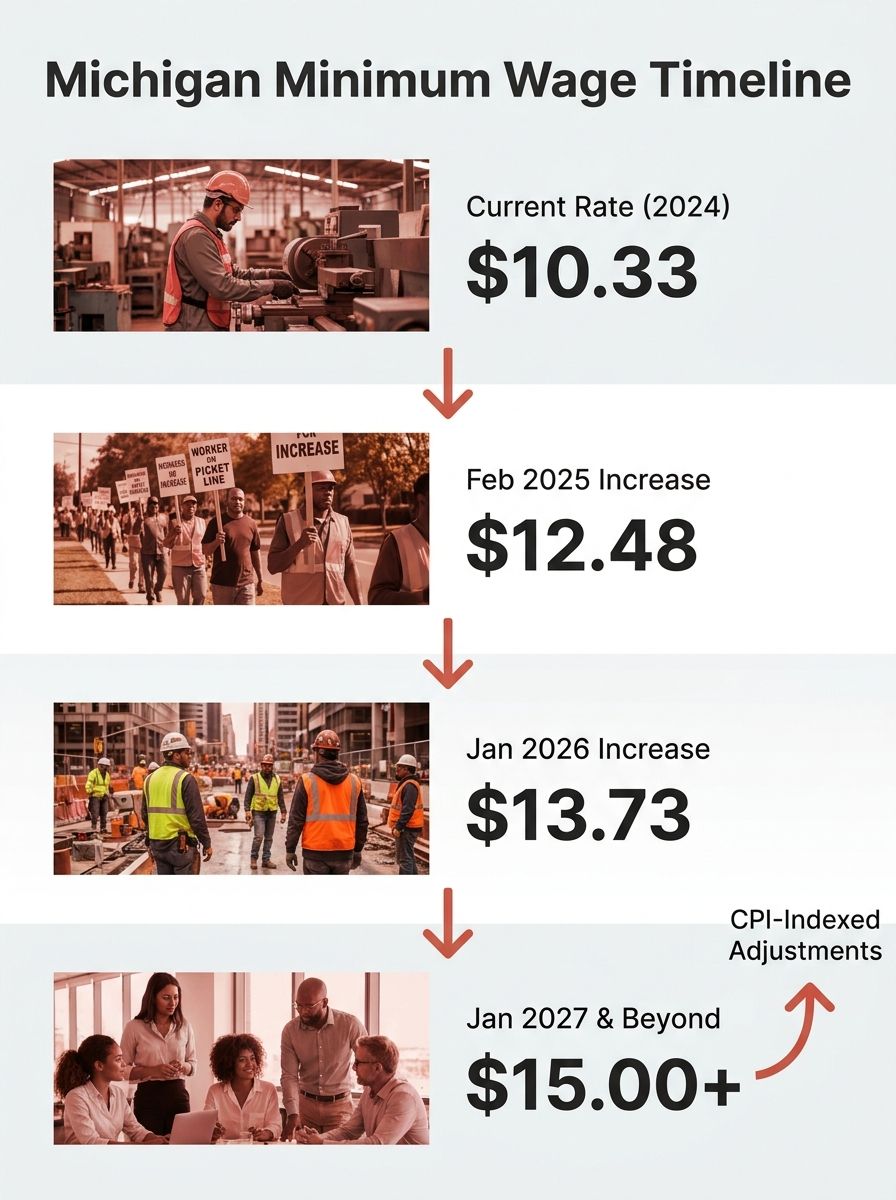
The Improved Workforce Opportunity Wage Act controls the state of Michigan minimum wage through a fixed annual escalator that raises the floor each January without requiring new legislative votes. As of January 1, 2026, that escalator pushed the standard rate to $13.

Michigan Minimum Wage: Current Rates and How the Escalator Works
The Improved Workforce Opportunity Wage Act controls the state of Michigan minimum wage through a fixed annual escalator that raises the floor each January without requiring new legislative votes. As of January 1, 2026, that escalator pushed the standard rate to $13.73 per hour, and it will keep climbing until it hits $15.00 in 2027, after which adjustments get pegged to the Midwest Consumer Price Index.
The Law That Replaced the Annual Fight
Michigan's minimum wage framework is the Improved Workforce Opportunity Wage Act, codified as Public Act 337 of 2018. The law replaced the old approach, where each raise required a separate legislative battle, with a scheduled series of annual increases written directly into the statute. The Michigan Department of Labor and Economic Opportunity (LEO) announced the 2026 rate in December 2025, confirming the increase "from $12.48 to $13.73 per hour as set by Michigan's Improved Workforce Opportunity Wage Act which establishes the annual schedule of increases."
The Act's current form grew out of contentious politics. A 2018 ballot initiative proposed faster increases and the elimination of the tipped sub-minimum wage. The Michigan legislature adopted the initiative's language before the election, a procedural maneuver that allowed lawmakers to then amend it with a simple majority during a lame-duck session. The resulting law kept the tip credit and slowed the rate increases. A Michigan Court of Claims ruling later found this adopt-and-amend approach unconstitutional, which set up a court-ordered schedule that would have raised wages faster and killed the tip credit entirely.
A February 2025 bipartisan compromise rewrote that court-ordered schedule. The deal preserved the tip credit while still pushing the minimum wage to $15.00 by 2027, slower than the court order demanded, but faster than the original amended law. That compromise is the law workers and employers operate under today.
The 2026 Rate Schedule by Worker Classification
The minimum wage in the state of Michigan breaks into four distinct tiers. Each uses a different formula, and workers need to know which one applies to them.
Worker Classification | 2026 Hourly Rate | How It's Calculated |
|---|---|---|
Standard employees | $13.73 | Set by statute |
Tipped employees | $5.49 | 40% of standard minimum |
Minors (ages 16-17) | $11.67 | 85% of standard minimum |
Training wage (under 20, first 90 days) | $4.25 | Federal training wage, unchanged |
The standard $13.73 rate covers the vast majority of Michigan workers. Because Michigan's rate exceeds the federal minimum wage of $7.25 per hour, employers must pay the higher state rate whenever both laws apply. The gap between the two has grown enormous: Michigan's minimum is now 89% above the federal floor, which hasn't moved since 2009.
For context, the $1.25 jump from 2025 to 2026 followed a much larger leap. The February 2025 bipartisan deal moved the rate from $10.33 (where it sat at the start of 2024) to $12.48, a $2.15 increase that represented the largest single year-over-year jump in the Act's history. Workers who were earning $10.33 at the start of 2024 have seen their base pay rise 33% in just two years.
As the Michigan Restaurant and Lodging Association noted, the changes include "increases the minimum wage to $12.48 per hour on February 21, 2025 while maintaining the tipped wage of 38% for the rest of the year" before further scheduled increases took effect in January 2026. Businesses across the hospitality sector have had to absorb these raises in rapid succession.
How the Tipped Wage Ratchet Operates
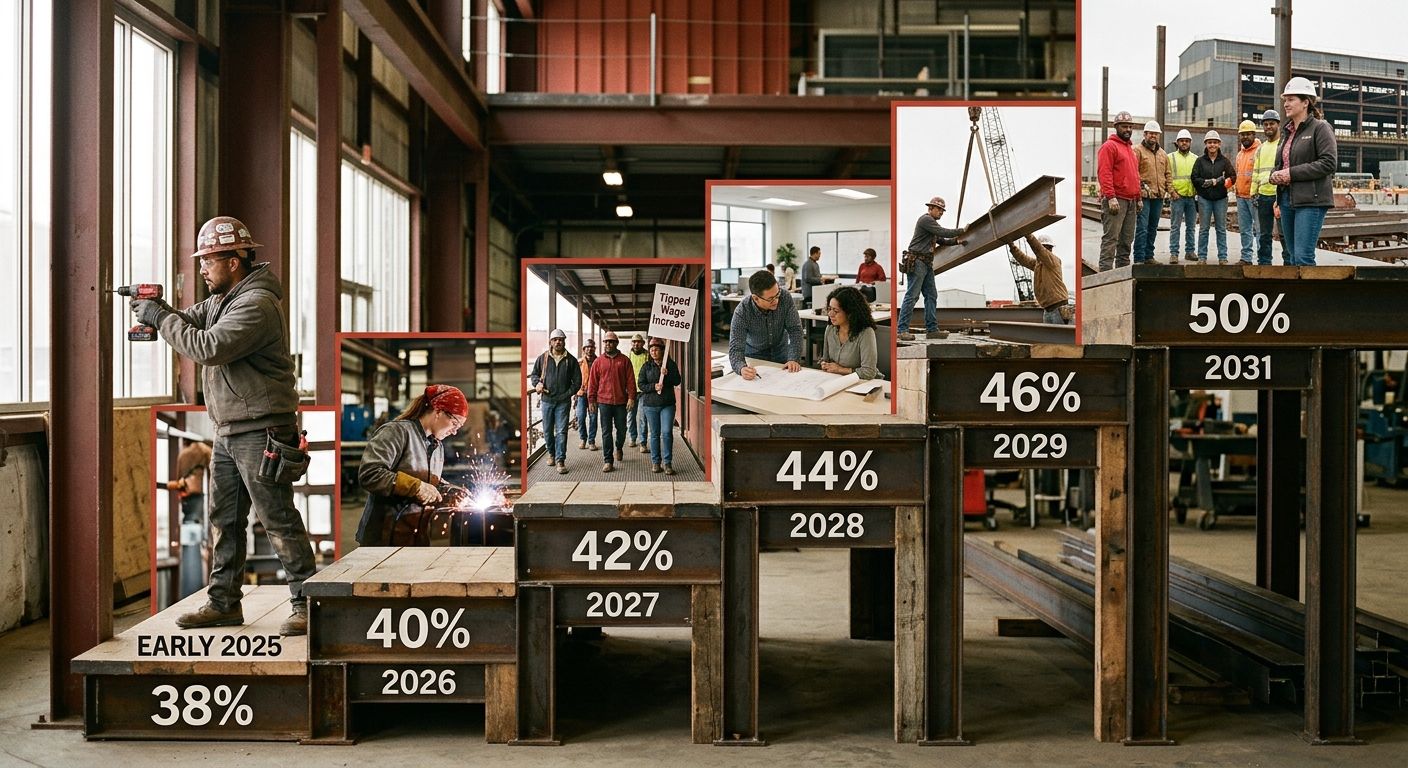
The tipped employee wage runs on its own escalator, separate from but mathematically linked to the standard minimum. In 2026, tipped workers earn a base cash wage of $5.49 per hour, set at 40% of the $13.73 standard rate. Employers cover the remaining 60% through a "tip credit," counting a worker's tips toward the minimum wage obligation.
The critical detail for workers: that 40% floor rises by 2 percentage points every year until it reaches 50% in 2031. Each January, tipped workers get a raise from two directions simultaneously. The standard minimum goes up, AND their guaranteed percentage of it increases. By 2031, tipped workers will earn at least half the standard minimum in guaranteed base pay before any tips are counted.
The Michigan Independent reported that "tipped workers' pay will also increase in the new year to $5.49 per hour, or 40% of the minimum wage, and the 85% rate for minors" will apply equally to younger workers. This dual escalator means the sub-minimum wage gap narrows each year even if no new legislation passes.
The training wage, fixed at $4.25 per hour for workers under 20 during their first 90 calendar days, sits entirely outside the escalator. It's pegged to a federal level that hasn't changed since 1996. A 19-year-old in their first three months on the job now earns less than one-third of what a standard employee earns, a gap that has widened with every standard wage increase.
The CPI Mechanism That Takes Over in 2028
The Improved Workforce Opportunity Wage Act's scheduled dollar increases end at $15.00 per hour on January 1, 2027. After that date, the law switches to a different engine: automatic annual adjustments tied to the Midwest Consumer Price Index.
This shift matters enormously for workers' purchasing power over time. A fixed-dollar minimum wage loses value every year to inflation. Michigan's rate sat at $7.40 in 2014 and crawled to $10.10 by 2023, nine years of raises that barely kept pace with rising costs. CPI indexing is designed to prevent that erosion by linking wages to actual price changes in the region.
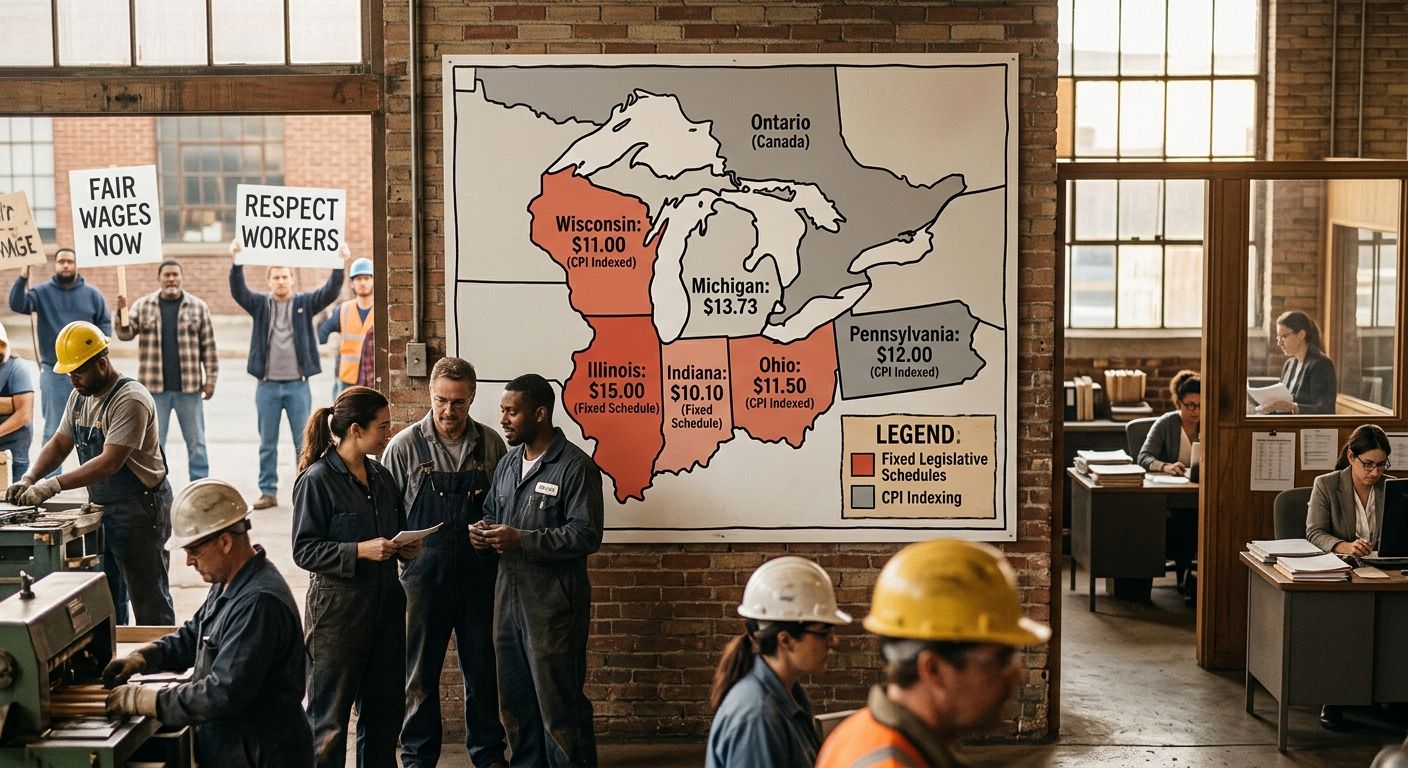
Several neighboring and peer states already use this approach. Colorado has tied its minimum wage to CPI adjustments since completing its scheduled increases, removing annual legislative battles from the equation entirely. New Jersey similarly indexes its rate to CPI after reaching its target floor. Michigan's post-2027 system will work the same way: each September, the state calculates the inflation-adjusted rate and publishes the new January 1 minimum by October 1 of the preceding year.
Michigan uses the Midwest CPI specifically rather than the national index. Midwest inflation has historically tracked close to the national average but occasionally diverges by half a percentage point or more. In years when Midwest prices rise faster than the national rate, Michigan workers receive a larger raise than a national CPI formula would deliver.
Who Gets Covered and Who Falls Through
The Improved Workforce Opportunity Wage Act applies to employers with two or more employees, a threshold low enough to capture the vast majority of Michigan businesses. But the law carves out several categories of workers, and those exclusions affect thousands of people.
Workers exempt from Michigan's state minimum wage law include certain agricultural workers on small farms, workers employed by a family member in a family business, and some seasonal recreation or amusement employees. Federal minimum wage rules still apply to many of these workers, but the federal floor of $7.25 per hour leaves them earning roughly half what the state of Michigan minimum wage guarantees to covered workers.
The interaction between state and federal law matters in every paycheck. According to Michigan's official wage and hour page, "Senate Bill 8 will incrementally increase the minimum wage to $15 per hour by 2027" under the state law, while the federal rate hasn't budged. When both laws apply, employers must pay whichever rate is higher. Since Michigan's $13.73 nearly doubles the federal $7.25, the state rate governs for almost every covered worker.
Workers in neighboring Ohio operate under a different wage structure with its own CPI formula, creating cross-border wage differentials that affect commuters and businesses in border communities along the state line. Virginia's minimum wage, which was frozen at $12.00 after a gubernatorial veto, demonstrates what happens when a state's escalator mechanism gets interrupted by political intervention, the exact outcome Michigan's bipartisan compromise was structured to prevent.
Where the Escalator Breaks Down
The Improved Workforce Opportunity Wage Act has structural limits that affect workers on the ground, and the escalator metaphor itself obscures some of them.
The training wage gap is the most glaring problem. At $4.25 per hour, a worker under 20 in their first 90 days earns 31% of the standard minimum. That percentage has shrunk with every standard wage increase because the training wage hasn't been updated since 1996. For employers inclined to cycle through young workers on 89-day rotations, the financial incentive grows larger each year. No provision of the Act addresses this widening disparity.
Enforcement is another structural weakness. Michigan's Wage and Hour Division handles complaints, but the agency's staffing has not scaled with the complexity of the new law. Tipped wage compliance requires employers to track whether each worker's tips plus base pay meet $13.73 every single pay period. Many small restaurants and service businesses lack the payroll infrastructure to perform this calculation correctly, and workers who don't know they're owed a top-up simply lose money they've earned.
The February 2025 compromise also preserved the tip credit when the court order would have eliminated it by 2029. Labor advocates, including the coalition behind the original 2018 ballot initiative, argue that the tip credit is the mechanism that enables wage theft at scale. When a server's paycheck shows $5.49 per hour and the employer claims tips cover the rest, the worker bears the burden of proving otherwise, a burden that falls hardest on workers in low-traffic shifts, workers facing customer discrimination in tipping, and workers whose employers engage in tip pooling violations.
And CPI indexing after 2027, while far better than a frozen rate, has its own blind spot. Consumer price indices measure average price changes across a broad basket of goods. Low-wage workers spend disproportionately on housing, food, and transportation, three categories where price increases have consistently outpaced the overall CPI. An index weighted toward low-wage spending patterns would produce higher annual adjustments than the Midwest CPI will deliver. The escalator keeps moving, but it doesn't move fast enough to reflect what minimum-wage workers actually pay at the grocery store and the gas pump.
Common Questions
Does the $13.73 rate apply to every employer in Michigan?
The Improved Workforce Opportunity Wage Act covers employers with two or more employees. Sole proprietorships with a single employee fall outside the state law. When both state and federal minimum wage laws apply, the employer must pay the higher rate, which is Michigan's $13.73, since the federal minimum remains $7.25 per hour.
When does Michigan's minimum wage reach $15.00?
January 1, 2027. After that date, annual adjustments shift from fixed statutory amounts to the Midwest Consumer Price Index formula. The state must publish each new rate by October 1 of the preceding year so employers have time to adjust payroll.
What if my tips plus the $5.49 base don't add up to $13.73?
Your employer is legally required to make up the difference for every pay period where your combined earnings fall short of the standard minimum. This is a per-pay-period obligation. If your employer isn't topping up your pay, file a complaint with Michigan's Wage and Hour Division through the Department of Labor and Economic Opportunity.
How does Michigan's rate compare to the federal minimum wage?
Michigan's $13.73 is 89% higher than the federal $7.25 per hour. The federal rate hasn't been updated since July 2009, over 17 years. Whenever a Michigan worker is covered by both laws, the employer pays the state rate because it's higher.
Can employers legally pay minors less than $13.73?
Yes. Workers ages 16 and 17 can be paid 85% of the standard minimum, which equals $11.67 per hour in 2026. Separately, any worker under 20 in their first 90 calendar days can be paid the federal training wage of $4.25 per hour, though this rate has become increasingly unusual in practice as the gap between it and the standard minimum has widened.
The Union Edge Staff
Frequently Asked Questions
- What is Michigan's minimum wage in 2026?
- As of January 1, 2026, Michigan's minimum wage is $13.73 per hour for standard employees, up from $12.48 in 2025. This increase was set automatically by the Improved Workforce Opportunity Wage Act without requiring new legislative action.
- When will Michigan's minimum wage reach $15 per hour?
- Michigan's minimum wage will reach $15.00 per hour on January 1, 2027. After that date, the wage will shift from fixed annual increases to automatic adjustments based on the Midwest Consumer Price Index.
- What is the tipped minimum wage in Michigan for 2026?
- Tipped employees in Michigan earn a base wage of $5.49 per hour in 2026, which is 40% of the standard minimum. Employers must make up the difference if tips plus the base wage don't reach the full $13.73 minimum wage.
- What wage can Michigan employers pay to workers under 20?
- Workers under 20 in their first 90 days can be paid the federal training wage of $4.25 per hour. For minors ages 16-17 after the training period, employers can pay 85% of the standard minimum, which is $11.67 per hour in 2026.
- How does Michigan's minimum wage compare to the federal minimum?
- Michigan's minimum wage of $13.73 is 89% higher than the federal minimum wage of $7.25 per hour. When both state and federal laws apply, employers must pay the higher Michigan rate.
- How does Michigan's minimum wage escalator work?
- The Improved Workforce Opportunity Wage Act sets automatic annual increases in Michigan's minimum wage each January without requiring new legislation. From 2026 to 2027, increases are fixed by statute; after 2027, annual adjustments are tied to the Midwest Consumer Price Index.
- What should I do if my employer isn't paying the tipped minimum wage requirement?
- If your tips plus base pay don't equal $13.73 per pay period, your employer must make up the difference. If your employer isn't topping up your pay, file a wage complaint with Michigan's Wage and Hour Division through the Department of Labor and Economic Opportunity.
- Does Michigan's minimum wage apply to all employers?
- The Improved Workforce Opportunity Wage Act applies to employers with two or more employees. Sole proprietorships with a single employee fall outside the state law, though certain agricultural workers, family business employees, and seasonal recreation workers are also excluded.
Related Articles

Minimum wage state of michigan: 2024 Guide
Michigan's minimum wage is $13.73 per hour as of January 1, 2026, governed by the Improved Workforce Opportunity Wage Act, a law that was gutted by the state legislature in 2018, restored by the Michigan Supreme Court in 2024, and then rewritten through bipartisan compromise in 2025.

Michigan Minimum Wage: 2024 Updates & Requirements
Michigan's minimum wage is $13.73 per hour, effective January 1, 2026, after the Michigan Supreme Court's July 31, 2024 ruling reinstated voter-approved wage increases that the legislature had blocked for six years. The rate reaches $15.

Minimum Wage for Michigan: 2024 Updates
Adopt-and-amend is the legislative tactic that shaped the minimum wage for Michigan for six years, and understanding how it worked, and how it collapsed, explains every dollar amount on a Michigan paycheck today.
Also in the paper