
minimum wage for new jersey
The gap between the highest and lowest minimum wage rate inside New Jersey's own borders is $9.87 per hour. Standard employees at businesses with six or more workers earn $15.92, while tipped workers receive a cash wage of just $6.05 (with a tip credit making up the difference). A third tier, $15.

New Jersey Minimum Wage in 2026: Three Rates Workers Need to Know
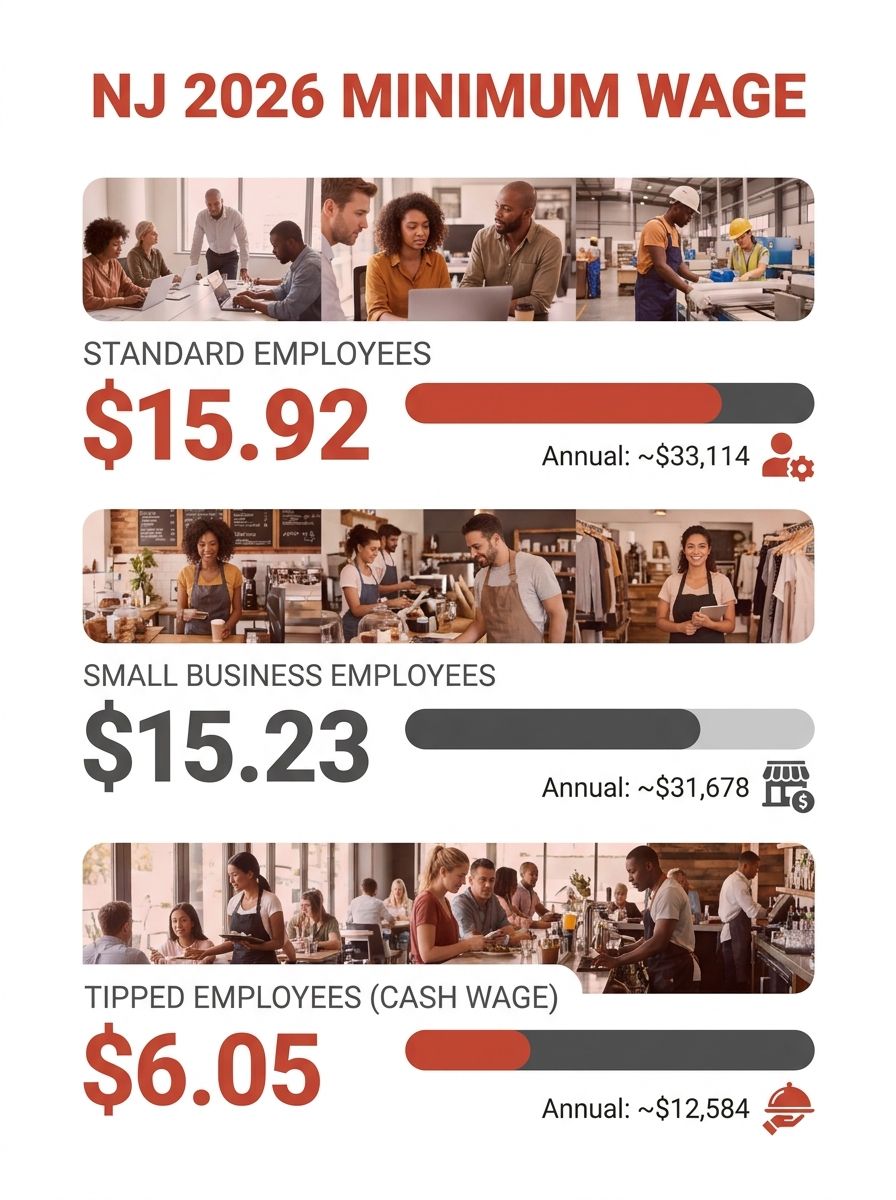
The gap between the highest and lowest minimum wage rate inside New Jersey's own borders is $9.87 per hour. Standard employees at businesses with six or more workers earn $15.92, while tipped workers receive a cash wage of just $6.05 (with a tip credit making up the difference). A third tier, $15.23, covers small-business employees. Which rate applies shapes your annual income by thousands of dollars.
The Lens for This Comparison
We're comparing New Jersey's three primary minimum wage tiers across five dimensions: hourly rate, projected annual full-time earnings (2,080 hours), scheduled future increases, employer obligations, and enforcement risks workers actually face. We've excluded training wages and certain narrow nonprofit exemptions because they affect a small slice of the workforce. Our focus is the rates that cover the vast majority of New Jersey employees, using data from the NJ Department of Labor and Workforce Development's official 2026 announcement and wage records tracked by the Federal Reserve Bank of St. Louis (FRED) from 1968 through 2026.
Standard Rate: $15.92 for Employers With Six or More Workers
The $15.92 rate covers the broadest group of New Jersey workers and functions as the state's headline minimum wage for 2026. If you work for a business with six or more employees, this is your floor. At 40 hours per week, 52 weeks per year, that translates to $33,114 in gross annual pay before taxes.
This rate arrived through a structured climb that began in 2019, when Governor Phil Murphy signed legislation raising the minimum wage from $8.85 per hour to $15.00 by January 1, 2024, through annual $1.00 increases. Once the $15.00 threshold was reached, the law shifted to inflation-indexed adjustments tied to the Consumer Price Index for Urban Wage Earners and Clerical Workers (CPI-W). That index drove a $0.13 increase in 2024 (to $15.13), a $0.36 increase in 2025 (to $15.49), and the current $0.43 bump to $15.92, reflecting a 2.81% CPI-W adjustment.
The New Jersey Department of Labor and Workforce Development confirmed in its October 2025 announcement that the standard rate increase applies automatically each January 1 under Article 1, Paragraph 23 of the State Constitution. The legislature doesn't vote on annual adjustments. The formula runs on autopilot.
That constitutional protection matters. Compared to states where legislators can stall or freeze increases (as Congress has done with the federal minimum wage, stuck at $7.25 since 2009), New Jersey workers with standard-rate coverage have a guaranteed inflation escalator. Among states with higher floors, only Washington ($16.66), California ($16.50), and Connecticut ($16.35) sit above New Jersey, according to reporting by the New Jersey Monitor.
The tradeoff: The standard rate's strength is its predictability and breadth of coverage. Its weakness is that it tracks CPI-W, which measures urban consumer prices nationally, not New Jersey's specific cost of living. A full-time worker earning $15.92 in Newark or Jersey City faces housing and transit costs that can eat 50% or more of gross pay. The rate is the best floor available in the state, but for workers in the costliest metro areas, the gap between the wage floor and actual living costs remains significant.
For workers interested in how other states handle their wage floors, we've covered Washington's inflation-indexed system and Florida's constitutional escalator in separate breakdowns.
Small Employer Rate: $15.23 for Businesses With Fewer Than Six Workers
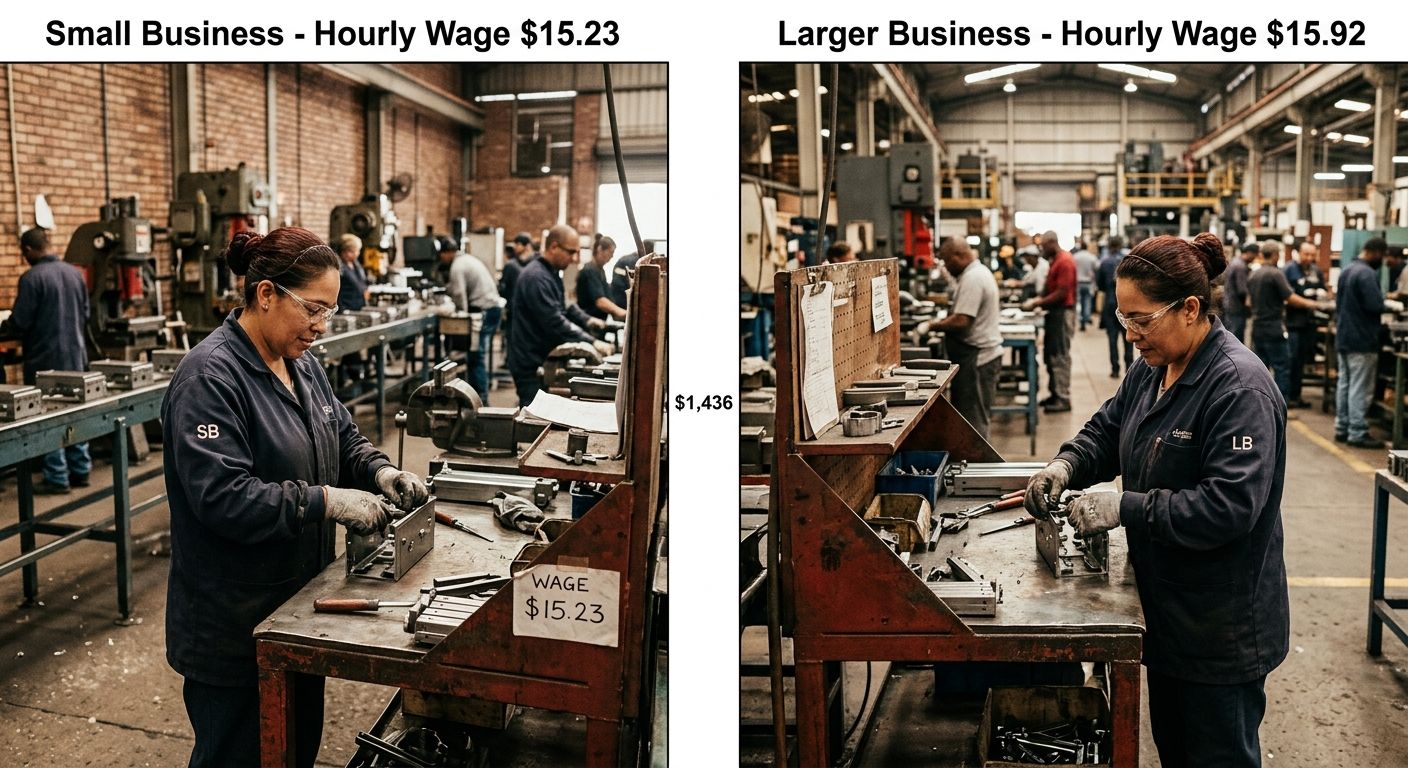
If your employer has five or fewer workers, the minimum wage for New Jersey drops to $15.23 per hour in 2026, which works out to $31,678 in annual gross pay. That's $1,436 less per year than the standard rate.
The small-employer tier exists because the 2019 legislation built in a slower phase-in for businesses the state considered less able to absorb rapid wage increases. While standard-rate employers hit $15.00 by January 2024, small employers reached $14.53 that same year. Their rate rises annually until it aligns with the standard rate in 2028. After convergence, both tiers will follow the same CPI-W adjustment formula.
The tradeoff: The small-employer rate creates a real pay gap. A worker doing identical work at a six-person landscaping crew earns $0.69 more per hour than a colleague at a five-person crew down the road. Over a full-time year, that's nearly $1,500. The gap narrows each January and disappears entirely by 2028, but for workers right now, the distinction between a five-employee and six-employee shop creates an income difference that shows up in rent payments and grocery bills. Workers at small businesses who suspect their employer is misclassifying staff count to dodge the higher rate should contact the NJ Wage and Hour Division directly.
Tipped Worker Rate: $6.05 Cash Wage With a $9.87 Tip Credit
The tipped employee minimum wage in New Jersey is $6.05 per hour in cash wages as of January 1, 2026, up from $5.62 in 2025. Employers can claim a tip credit of up to $9.87, meaning they pay less than half the standard rate out of pocket, with tips expected to fill the gap to $15.92.
This is where the minimum wage system becomes genuinely precarious for workers. The law requires that total compensation (cash wage plus tips) reaches the full $15.92 per hour. If tips fall short in any pay period, the employer must pay the difference. That obligation is clear on paper. In practice, wage theft in tipped industries is rampant across the country, and New Jersey is no exception.
The annual guaranteed income from the cash wage alone ($6.05 × 2,080 hours = $12,584) sits below the 2026 federal poverty guideline. Workers depend entirely on tips and employer compliance to reach the full minimum wage. The system places the burden of verification on the worker, who must track hours and tips meticulously, then challenge their employer if compensation falls short.
Employers must maintain accurate records of hours worked and tips received under both state law and the federal Fair Labor Standards Act. But enforcement depends on complaints. Workers who don't know their rights, who fear retaliation, or who lack documentation often absorb the loss. This is why collective bargaining agreements in the hospitality sector consistently negotiate above-minimum cash wages and transparent tip pooling. As we've detailed in our guide to the benefits of collective bargaining, a union contract can eliminate the guesswork by setting a guaranteed hourly floor that doesn't rely on customer generosity.
The tradeoff: The tipped rate is the minimum wage for New Jersey at its most fragile. Workers who earn strong tips at busy restaurants may take home well above $15.92. Workers at slow diners, seasonal tourist spots, or understaffed shifts may struggle to hit the floor. The tip credit system transfers income risk from the employer to the worker, and enforcement of the make-up-pay requirement is inconsistent. If you work a tipped position and suspect your total hourly pay regularly falls below $15.92, file a wage complaint with the NJ Department of Labor's Wage and Hour Division.
New Jersey's gig worker classification rule, finalized under an AB 5-style framework, also intersects with tipped work: workers misclassified as independent contractors lose minimum wage protections entirely.
Side-by-Side: New Jersey's 2026 Minimum Wage Tiers
Attribute | Standard (6+ Employees) | Small Employer (Fewer Than 6) | Tipped Employees | Agricultural Workers |
|---|---|---|---|---|
2026 Hourly Rate | $15.92 | $15.23 | $6.05 (cash) + $9.87 (tip credit) | $14.20 |
Annual Gross (Full-Time) | $33,114 | $31,678 | $12,584 (guaranteed cash only) | $29,536 |
Annual Adjustment Mechanism | CPI-W indexed | CPI-W indexed (converges 2028) | Tied to standard rate | Separate phase-in through 2030 |
Employer Make-Up Pay Required? | N/A | N/A | Yes, if tips + cash < $15.92 | N/A |
Key Risk for Workers | Cost-of-living gap | Miscount of employee headcount | Wage theft via unreported tip shortfalls | Exemption abuse by seasonal operations |
How Agricultural Workers Fit In
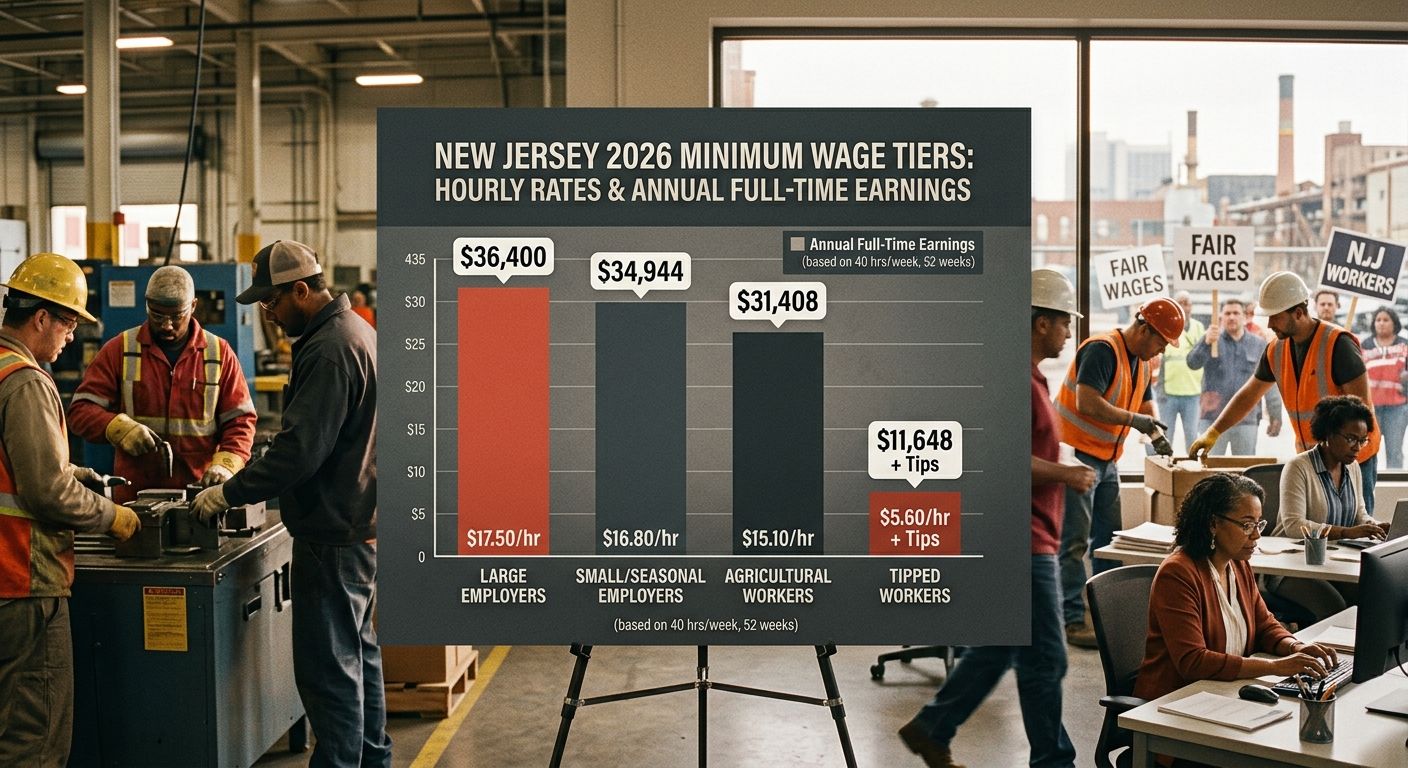
Agricultural employees in New Jersey earn $14.20 per hour in 2026, up from $13.40 in 2025. Their phase-in schedule runs through 2030, years after the small-employer rate converges with the standard rate. This slower timeline reflects political compromises during the 2019 legislation, when agricultural lobby groups argued that farm margins couldn't absorb the same pace of increases.
For farmworkers already facing seasonal schedules, physical hazards, and limited access to benefits, the lower rate compounds economic vulnerability. Seasonal farm employers hiring workers for fewer than 60 days per year can claim full exemption from the minimum wage entirely, a loophole that strips protections from some of the state's most exposed workers.
Who Should Claim Which Rate (and What to Do If It's Wrong)
There is no single "minimum wage for New Jersey." The rate that applies to you depends on your employer's size, your industry, and whether your compensation includes tips. Here's the honest breakdown of who benefits from each tier and who gets squeezed.
The standard $15.92 rate is the strongest floor available. Workers at mid-size and large employers benefit from both the highest current rate and the CPI-W escalator that protects against inflation erosion. If you're in this category and your employer is paying less, the violation is straightforward to document and report.
The small-employer $15.23 rate penalizes workers for something entirely outside their control: how many people their boss employs. The $1,436 annual gap is real money. The good news is that it closes by 2028. The bad news is that enforcement of the headcount threshold depends on accurate employee classification, and some employers game the count. If your workplace has five people on the floor but hires through staffing agencies or classifies workers as contractors, the actual employee count may be higher than your employer claims.
The tipped $6.05 cash wage is the system's weakest link. It works adequately for workers at high-volume establishments with consistent tip income. It fails for everyone else. The make-up pay requirement is the law, but collecting on it requires workers to prove the shortfall, and many lack the documentation or bargaining power to do so. Unionized tipped workers in New Jersey consistently report higher effective hourly earnings than non-union counterparts, because contract language pins down the cash wage floor and tip accounting procedures.
If you're earning below the rate that applies to your category, file a complaint with the NJ Division of Wage and Hour Compliance. The process is free, confidential, and doesn't require an attorney. You can also contact your local union hall or a worker center for help documenting your hours and pay. As workers at businesses from Springfield cannabis dispensaries to Boston Harbor casinos have demonstrated, collective action remains the most reliable tool for closing the gap between the wage floor and a living wage. The minimum wage tells you what's legal. A union contract tells you what's fair.
The Union Edge Staff
Frequently Asked Questions
- What is the minimum wage in New Jersey for 2026?
- New Jersey has three minimum wage rates for 2026: $15.92/hour for standard employees at businesses with six or more workers, $15.23/hour for small-business employees (fewer than six workers), and $6.05/hour cash wage for tipped employees (with a $9.87 tip credit). Agricultural workers earn $14.20/hour.
- How much can I earn annually at New Jersey minimum wage?
- At the standard rate of $15.92/hour working full-time (2,080 hours per year), you earn $33,114 in gross annual pay. Small-business workers earn $31,678, while tipped workers earn a guaranteed $12,584 in cash wages (not including tips).
- Will New Jersey minimum wage increase automatically?
- Yes, the standard minimum wage rate is constitutionally protected to increase automatically each January 1 based on the Consumer Price Index for Urban Wage Earners and Clerical Workers (CPI-W). The legislature does not vote on annual adjustments—they happen automatically.
- What is the tipped minimum wage in New Jersey?
- Tipped employees receive a cash wage of $6.05/hour, and employers can claim a tip credit of up to $9.87/hour. Employers must ensure total compensation (cash plus tips) reaches $15.92/hour, and must make up any shortfall.
- When will small business minimum wage match the standard rate?
- The small-employer minimum wage of $15.23/hour is scheduled to converge with the standard $15.92 rate by 2028, after which both will follow the same CPI-W adjustment formula.
- What should I do if I'm paid below New Jersey minimum wage?
- You can file a free, confidential complaint with the NJ Division of Wage and Hour Compliance without requiring an attorney. You can also contact your local union hall or a worker center for help documenting your hours and pay.
- Are seasonal workers exempt from New Jersey minimum wage?
- Yes, seasonal employers who hire workers for fewer than 60 days per year are fully exempt from New Jersey's minimum wage requirement. Nonprofit summer camps, conferences, and retreats operated by religious or nonprofit organizations are also exempt from June through September.
Related Articles

Minimum Wage New Jersey 2024: Rates & Updates
New Jersey's minimum wage for most employees reached $15.13 per hour on January 1, 2024, completing a legislated climb from $8.85 in 2019 and triggering a permanent CPI-indexed adjustment formula. The rate doesn't come from annual legislative votes anymore.

State of New Jersey Minimum Wage: 2024 Guide
The state of New Jersey minimum wage operates through a Consumer Price Index escalator that adjusts automatically every January 1. The current rate is $15.92 per hour for most workers as of January 1, 2026, and that figure will climb again next year based on inflation data from the U.S.

Minimum Wage in New York: Current Rates & Updates
Depending on where you clock in, the minimum wage in New York ranges from $16.00 to $17.00 per hour, set by a two-zone structure that completed its final scheduled $0.50 increase on January 1, 2026, and will hand future adjustments to an inflation formula in 2027.
Also in the paper