
State of New Jersey Minimum Wage: 2024 Guide
The state of New Jersey minimum wage operates through a Consumer Price Index escalator that adjusts automatically every January 1. The current rate is $15.92 per hour for most workers as of January 1, 2026, and that figure will climb again next year based on inflation data from the U.S.

State of New Jersey Minimum Wage: How the CPI Escalator Sets Every Rate
The state of New Jersey minimum wage operates through a Consumer Price Index escalator that adjusts automatically every January 1. The current rate is $15.92 per hour for most workers as of January 1, 2026, and that figure will climb again next year based on inflation data from the U.S. Bureau of Labor Statistics, without requiring a single new vote in Trenton.
The 2019 Law That Built the Escalator
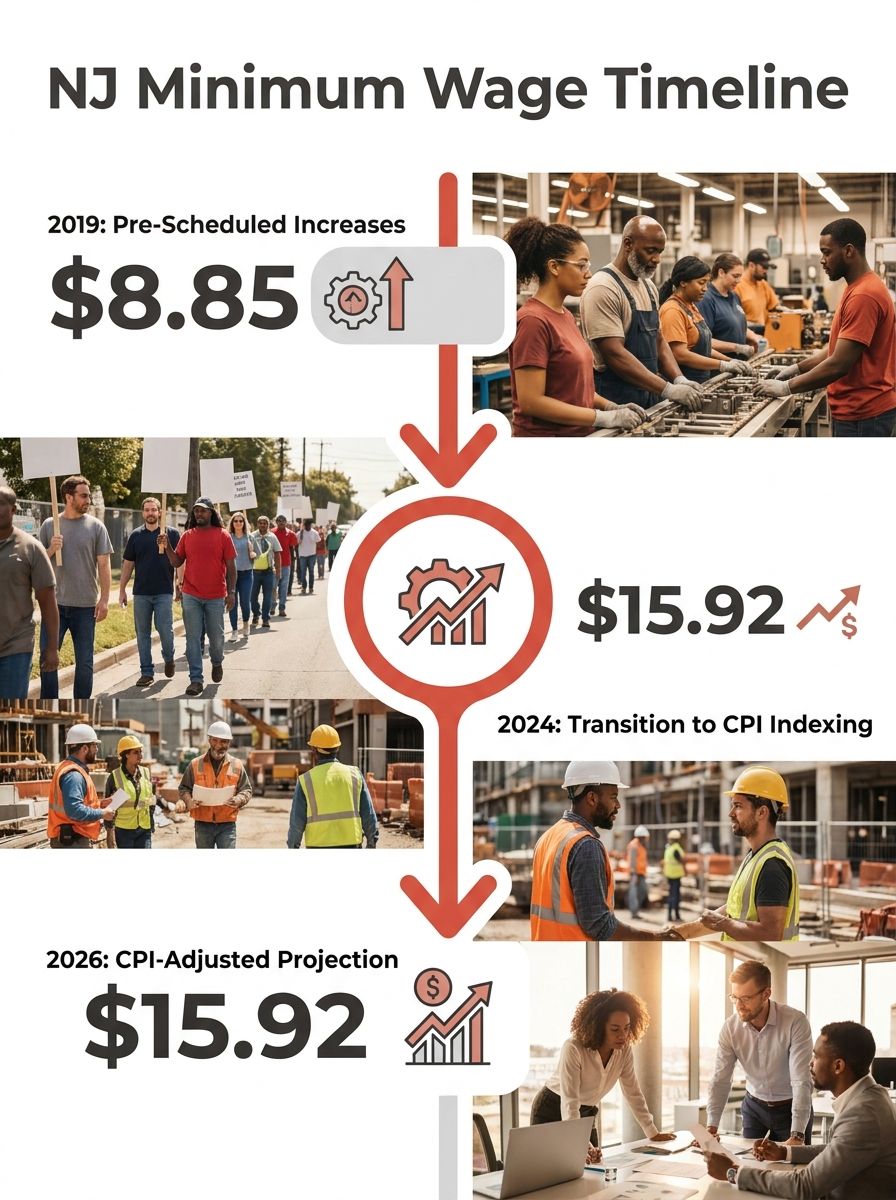
Governor Phil Murphy signed Senate Bill 15 on February 4, 2019, raising New Jersey's minimum wage from $8.85 per hour to $15.00 through a series of annual $1.00 increases. The law firm Saiber LLC documented the signing, noting that the $8.85-to-$15.00 jump represented a 69.5% increase in the wage floor over five years, one of the steepest scheduled climbs any state had attempted at the time.
The phase-in worked on a fixed schedule: $10.00 on July 1, 2019, then $11.00 on January 1, 2020, $12.00 in 2021, $13.00 in 2022, $14.00 in 2023, and $15.00 in 2024. Each step was exactly $1.00. No CPI calculation, no variability, no guesswork for payroll departments. The escalator ran on rails.
But the law contained a second, less discussed mechanism: once the wage reached $15.00, it would switch from fixed-dollar increases to CPI-indexed adjustments. That switchover happened on January 1, 2024, and it changed the fundamental character of New Jersey's wage floor from a political decision into a mathematical formula.
How the CPI Formula Calculates Each Year's Rate
The New Jersey Department of Labor uses the Consumer Price Index for All Urban Consumers (CPI-U) to calculate each year's adjustment. The formula takes the percentage change in CPI-U over the prior year, applies it to the current wage floor, and rounds to the nearest cent. There's a built-in floor: if CPI-U falls or stays flat, the minimum wage cannot decrease. It holds at the previous year's rate.
The results since the formula kicked in tell a clear story. In 2024, the CPI adjustment added $0.13, pushing the rate from $15.00 to $15.13 per hour. In 2025, the adjustment was larger at $0.36, bringing the rate to $15.49 per hour. And in 2026, the New Jersey Department of Labor announced a $0.43 increase to $15.92 per hour.
Those three numbers reveal something about the formula's behavior. The $0.13 increase in 2024 reflected the cooling inflation of that period. The $0.36 jump in 2025 and $0.43 in 2026 track with persistent price pressure on housing and food in the Northeast. The formula doesn't distinguish between "good" inflation and "bad" inflation. It follows the index wherever it goes.
Labor Commissioner Robert Asaro-Angelo has emphasized that aligning wages with the cost of living is critical for "economic fairness and security" for all New Jersey workers. That framing matters for anyone organizing around wages: the state has already conceded the principle that wages should track living costs. The argument is won. The question now is whether the CPI-U formula tracks them fast enough.
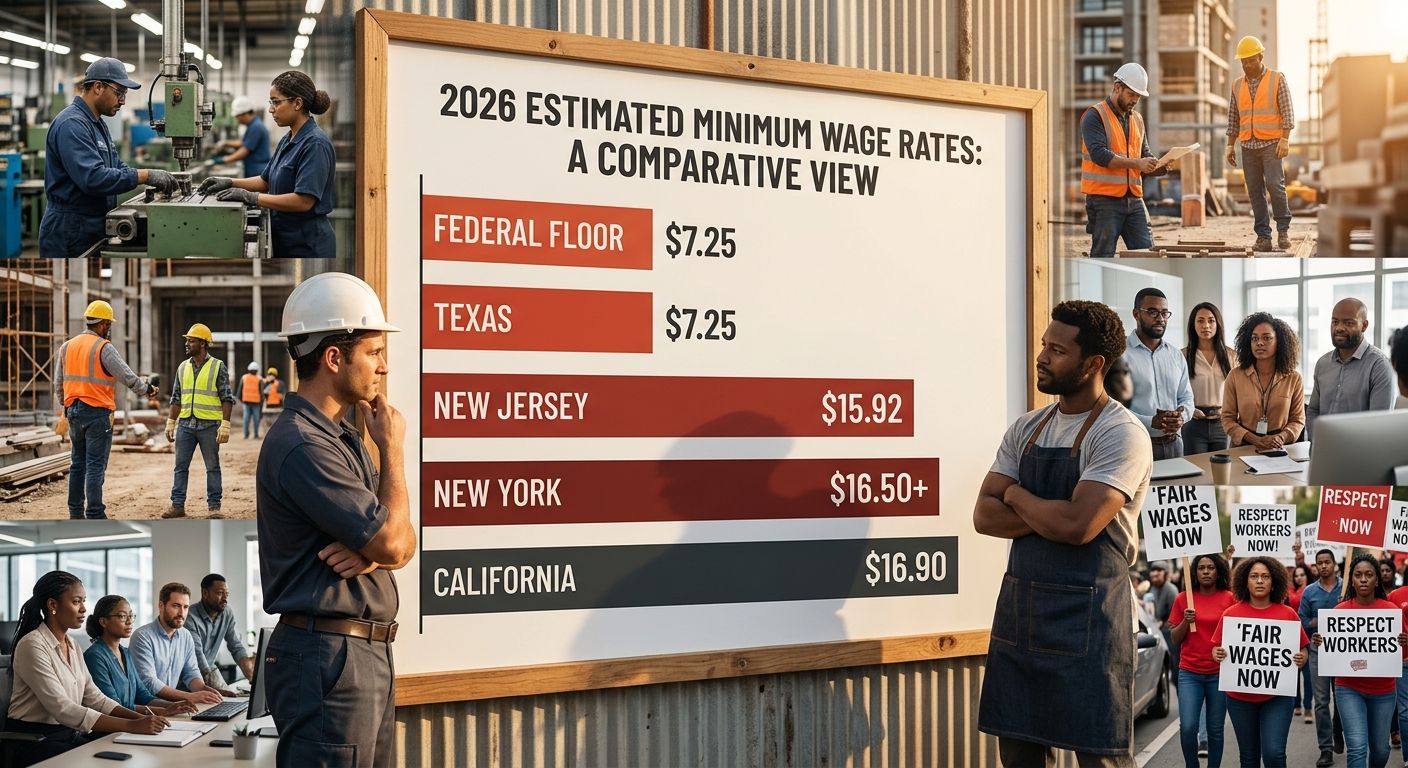
For comparison, states like Texas still sit at $7.25 per hour, the federal floor, with no adjustment mechanism at all. If you want to understand how Texas handles its minimum wage, the contrast is stark: New Jersey's $15.92 is 119.6% higher than the $7.25 rate Texas workers earn.
Four Worker Categories, Four Different Rates
The state of New Jersey minimum wage isn't a single number. Senate Bill 15 created four distinct wage tiers, each with its own schedule and rationale. The tiers exist because the law's drafters accepted the argument that certain employer types and worker categories couldn't absorb the full increase at the same pace. Whether that reasoning holds up is debatable, but the structure is the law.
Here's what each category pays as of 2026:
Worker Category | 2024 Rate | 2025 Rate | 2026 Rate | Full Parity Target |
|---|---|---|---|---|
Standard employees | $15.13/hr | $15.49/hr | $15.92/hr | Ongoing CPI adjustment |
Small employers (≤5 employees) & seasonal | $13.73/hr | $14.53/hr | $15.23/hr | 2028 |
Agricultural workers | $12.50/hr | $13.40/hr | $14.20/hr | 2030 |
Tipped employees (cash wage) | $5.26/hr | $5.62/hr | $6.05/hr | Tied to standard rate |
Long-term care direct staff | $18.13/hr | $18.49/hr | $18.92/hr | Ongoing CPI + $3 |
The gap between the standard rate and the agricultural rate is $1.72 per hour in 2026. Over a 40-hour week, 52 weeks a year, that's $3,577.60 less per year for farmworkers. The small employer and seasonal worker tier sits $0.69 below the standard rate, a gap of $1,435.20 annually for full-time workers. These aren't trivial differences. And the timeline for parity stretches years into the future: small employers won't reach the standard rate until 2028, and agricultural workers won't get there until 2030.
As Epstein Becker Green's analysis of the original law noted, the slower phase-in for small and seasonal employers was a political concession. The agricultural carve-out followed a similar logic, based on arguments about thin margins in farming. For organizers, these carve-outs are worth scrutinizing: they create two classes of workers under the same state law, and the workers in the lower tiers are disproportionately immigrants and people of color.
The Long-Term Care Premium and Healthcare Workers
"Economic fairness and security" was the phrase Labor Commissioner Asaro-Angelo used when announcing the 2025 rate increase. That language has particular weight in healthcare, where New Jersey took the unusual step of building a wage premium directly into the minimum wage law for long-term care direct staff.
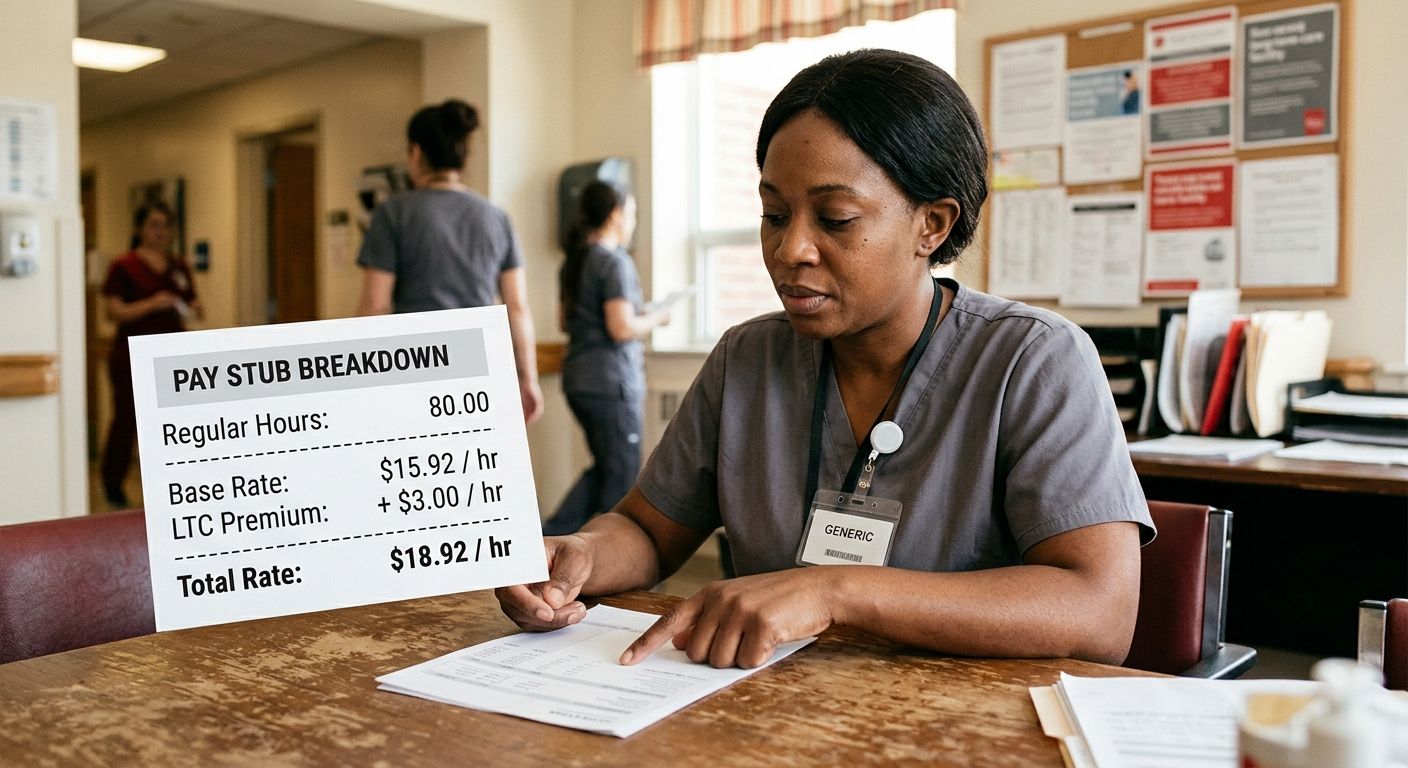
The premium adds $3.00 per hour on top of the standard minimum wage. In 2025, that meant $18.49 per hour. In 2026, it's $18.92 per hour. The premium applies to certified nursing assistants, home health aides, and other direct care workers in long-term care facilities. It doesn't cover all healthcare workers, and it doesn't cover hospital staff working outside long-term care settings. But for the workers it does cover, it represents a 23.2% premium over what a retail or food service worker earns at the standard minimum.
This matters because long-term care has been hemorrhaging workers for years. Low wages have been the single biggest driver of turnover in nursing homes and assisted living facilities across the state. The $3.00 premium was designed to slow the bleeding. Whether $18.92 is enough to retain workers in a field that demands physical labor, emotional resilience, and clinical skill is a separate question. Similar dynamics play out in California's wage structure, where healthcare sub-minimums have been a central fight.
New Jersey's approach of embedding the premium in the minimum wage law, rather than funding it through separate appropriations, means it's protected by the same CPI escalator. When the standard rate goes up, the long-term care rate goes up automatically. That's a structural win for healthcare workers that many other states haven't replicated.
Tipped Employees and the Tip Credit Gap
The tipped employee cash wage in New Jersey is $6.05 per hour as of January 1, 2026. Employers can claim a maximum tip credit of $9.87, which means they're betting that tips will cover the difference between $6.05 and the $15.92 standard rate. If a tipped worker's hourly earnings (cash wage plus tips) don't reach $15.92, the employer is required by law to pay the difference.
That obligation exists on paper. Enforcing it is another matter entirely. Tipped workers frequently report that employers fail to make up the shortfall, especially during slow shifts. The burden of tracking and proving the gap falls on the worker, who has to document every shift's tips against the minimum threshold. Under the New Jersey Unpaid Wage Claims Act, workers have a six-year statute of limitations to file claims for unpaid wages, which provides a longer window than many states offer. But filing a wage claim requires knowing your rights, having documentation, and being willing to confront your employer.
New York's tipped wage structure follows a comparable pattern, though the base cash wages differ by region. The core problem is identical: tip credits create a system where the employer's legal obligation to make workers whole depends on workers having the information and use to enforce it. Unions can play a critical role here by tracking tip credit compliance systematically and filing collective claims when patterns of underpayment emerge.
Where the Model Breaks
The CPI escalator has three significant blind spots that organizers, workers, and policymakers should understand.
Geographic cost variation. New Jersey's cost of living varies enormously between, say, Hudson County (median rent above $2,100/month) and Cumberland County (median rent around $1,100/month). The CPI-U formula uses a national or regional index, not a county-level one. A worker in Newark faces rent and transit costs that a $15.92 hourly wage can barely touch. A worker in rural South Jersey faces a lower cost of living but also fewer available hours. The single statewide rate can't account for these differences. New York addressed this with a tiered geographic structure where New York City, Westchester County, and Long Island carry a $16.00 base while the rest of the state sits lower. New Jersey has no equivalent.
The parity delay for lower tiers. Agricultural workers won't reach the standard rate until 2030. That's an 11-year lag from when the law was signed in 2019. Small and seasonal employer workers face a 9-year lag until 2028. During those years, every CPI increase that raises the standard rate also widens the dollar gap between tiers. The law promises eventual parity, but the path there is long, and workers in those categories lose real purchasing power every year they wait.
Wage compression above the floor. When the minimum wage rises to $15.92, workers who previously earned $16.00 or $17.00 per hour now sit barely above the legal minimum. Their experience, seniority, and skills aren't reflected in the pay differential anymore. Employers are legally required to raise wages only to the new floor, not to maintain pay gaps above it. This compression erodes morale and creates organizing opportunities, but it also means that the minimum wage increase, by itself, doesn't solve the broader problem of low wages in industries like healthcare, food service, and retail. Workers earning $18.00 in a non-long-term-care healthcare role see their premium over minimum shrink from $3.00 to $2.08 without any change in their actual paycheck.
States like Michigan have faced identical compression dynamics as their own wage floors have risen.
Common Questions
Does the New Jersey minimum wage go up every year automatically?
Yes. Since reaching the $15.00 target on January 1, 2024, the state of New Jersey minimum wage adjusts automatically each January 1 based on the Consumer Price Index for All Urban Consumers (CPI-U). The rate cannot decrease; if CPI-U falls, the wage holds at the previous year's level. The 2026 rate of $15.92 reflects a $0.43 CPI-driven increase over 2025's $15.49.
Do all New Jersey workers earn the same minimum wage?
No. The law creates four tiers. Standard employees earn $15.92 per hour in 2026. Small employers (five or fewer employees) and seasonal employers pay $15.23. Agricultural workers on hourly or piece-rate pay earn $14.20. Tipped employees receive a cash wage of $6.05 with a $9.87 tip credit. Long-term care direct staff earn $18.92, a $3.00 premium above the standard rate.
What happens if my tips don't bring me up to the full minimum wage?
Your employer is legally required to pay the difference. If your cash wage of $6.05 plus tips doesn't equal at least $15.92 per hour in any given pay period, the employer must make up the shortfall. Under the New Jersey Unpaid Wage Claims Act, you have six years to file a claim for unpaid wages. Document your tips and hours on every shift.
How does New Jersey's minimum wage compare to neighboring states?
New Jersey's $15.92 sits below New York City, Westchester County, and Long Island (where the base exceeds $16.00) but above Pennsylvania's $7.25, which mirrors the federal floor. The state's CPI escalator means the gap with higher-cost neighbors like New York narrows or widens each year depending on each state's adjustment formula.
Does the CPI escalator apply to the long-term care premium too?
Yes. The $3.00 premium rides on top of the standard rate, so when the CPI pushes the standard rate up, the long-term care rate rises in lockstep. The 2026 long-term care rate of $18.92 reflects the same $0.43 CPI increase applied to the 2025 rate of $18.49.
The Union Edge Staff
Frequently Asked Questions
- What is the current New Jersey minimum wage in 2026?
- The New Jersey minimum wage is $15.92 per hour as of January 1, 2026, for standard employees. This rate adjusts automatically each January 1 based on the Consumer Price Index for All Urban Consumers (CPI-U), and cannot decrease if inflation falls.
- Does New Jersey minimum wage increase automatically every year?
- Yes, since January 1, 2024, New Jersey's minimum wage adjusts automatically each year based on CPI-U data without requiring legislative action. The adjustment happens on January 1 each year, and the wage floor cannot decrease even if inflation falls.
- How much do tipped employees earn in New Jersey?
- Tipped employees earn a cash wage of $6.05 per hour as of 2026, with employers allowed a maximum tip credit of $9.87. If tips don't bring the total to $15.92 per hour, the employer must make up the difference, though workers have six years to file claims for unpaid wages.
- What is the minimum wage for long-term care workers in New Jersey?
- Long-term care direct care staff earn $18.92 per hour as of 2026, which includes a $3.00 premium on top of the standard minimum wage rate. This premium applies to certified nursing assistants, home health aides, and other direct care workers in nursing homes and assisted living facilities.
- Are all workers in New Jersey covered by the same minimum wage?
- No, New Jersey has four different minimum wage tiers. Standard employees earn $15.92/hour in 2026, small employers (≤5 employees) and seasonal workers earn $15.23/hour, agricultural workers earn $14.20/hour, and tipped employees earn $6.05/hour cash wage. Long-term care staff receive a $3.00 premium on top of the standard rate.
- When will agricultural workers in New Jersey reach the standard minimum wage?
- Agricultural workers in New Jersey won't reach full parity with the standard minimum wage until 2030. As of 2026, they earn $14.20 per hour compared to the standard rate of $15.92, a difference of $1.72 per hour.
- How does New Jersey's minimum wage compare to other states?
- New Jersey's $15.92 minimum wage is significantly higher than states like Texas and Pennsylvania, which maintain the federal minimum of $7.25 per hour (119.6% higher than Texas). It is lower than New York City, Westchester County, and Long Island, where rates exceed $16.00 per hour.
- What happens if my employer doesn't pay the difference on tipped wages?
- Under the New Jersey Unpaid Wage Claims Act, you can file a wage claim for unpaid wages within six years. You must document your tips and hours to prove the shortfall, and your employer is legally required to make up any difference between your cash wage plus tips and the full $15.92 minimum wage.
Related Articles

Minimum Wage New Jersey 2024: Rates & Updates
New Jersey's minimum wage for most employees reached $15.13 per hour on January 1, 2024, completing a legislated climb from $8.85 in 2019 and triggering a permanent CPI-indexed adjustment formula. The rate doesn't come from annual legislative votes anymore.

minimum wage for new jersey
The gap between the highest and lowest minimum wage rate inside New Jersey's own borders is $9.87 per hour. Standard employees at businesses with six or more workers earn $15.92, while tipped workers receive a cash wage of just $6.05 (with a tip credit making up the difference). A third tier, $15.

Minimum Wage New York State 2024: Rates & Changes
New York State's minimum wage operates through a geographic tier system that splits the state into two wage zones, schedules $0.50 annual increases through 2026, and then hands rate-setting to an inflation index in 2027.
Also in the paper