
Minimum Wage USA Florida: 2024 Guide
The Florida Constitution, not the state legislature, controls the minimum wage for roughly 10 million workers statewide. That constitutional lock is the defining feature of Florida's wage law: the current rate is $14.00 per hour, rising to $15.

Minimum Wage in Florida: How the Constitutional Escalator Actually Works
The Florida Constitution, not the state legislature, controls the minimum wage for roughly 10 million workers statewide. That constitutional lock is the defining feature of Florida's wage law: the current rate is $14.00 per hour, rising to $15.00 on September 30, 2026, and no elected official can block either increase.
What Amendment 2 Changed About Florida's Wage Floor
Article X, Section 24 of the Florida Constitution, as amended by Amendment 2 on November 3, 2020, defines the state's minimum wage and its adjustment mechanism. Voters approved the amendment with 60.82% support, clearing the 60% supermajority required for constitutional ballot measures in Florida.
Before Amendment 2, Florida's minimum wage was adjusted annually based on the Consumer Price Index, a formula that produced small, unpredictable increases. The 2020 amendment replaced that system with a fixed $1.00-per-year escalator, starting from $10.00 in September 2021 and climbing to $15.00 by September 2026. The constitutional language is self-executing: it requires no legislative action, no gubernatorial signature, and no regulatory rulemaking.
This distinction matters for workers. Legislative wage floors can be frozen, reduced, or loaded with exemptions through ordinary committee votes. A constitutional wage floor requires another ballot initiative to change, a process that costs millions of dollars and requires hundreds of thousands of voter signatures. The Florida Department of Commerce administers the law and publishes updated rate posters annually.
For workers trying to understand how Florida's minimum wage compares to New York City's recent wage increases, the constitutional mechanism is the critical difference. New York's rate is set by statute and adjusted by a wage board; Florida's is constitutionally mandated and politically insulated from rollback.
The Year-by-Year Escalator Schedule
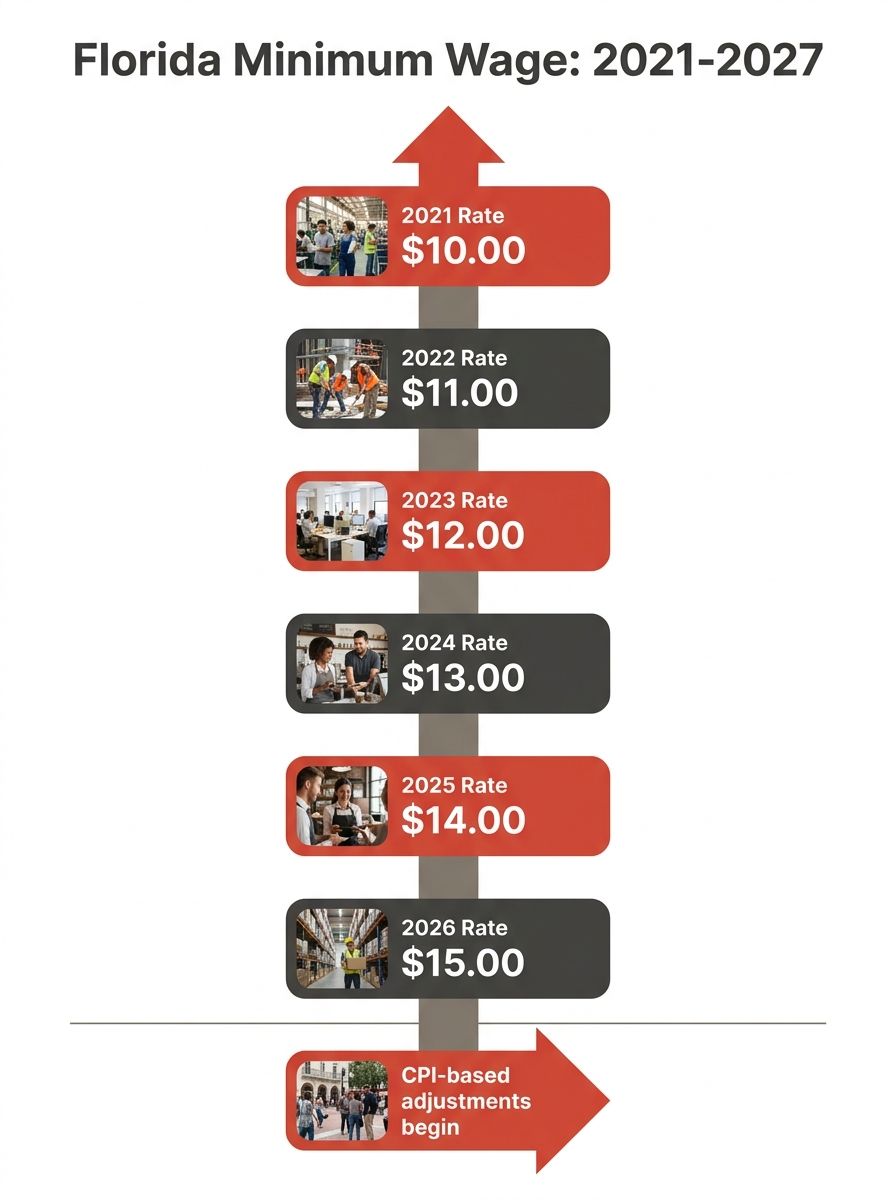
Each increase takes effect at midnight on September 30, not January 1, which catches some employers off guard. Here's the full schedule from Amendment 2's enactment through its final fixed increase:
Effective Date | Standard Rate | Tipped Employee Rate | Tip Credit |
|---|---|---|---|
September 30, 2021 | $10.00 | $6.98 | $3.02 |
September 30, 2022 | $11.00 | $7.98 | $3.02 |
September 30, 2023 | $12.00 | $8.98 | $3.02 |
September 30, 2024 | $13.00 | $9.98 | $3.02 |
September 30, 2025 | $14.00 | $10.98 | $3.02 |
September 30, 2026 | $15.00 | $11.98 | $3.02 |
The tip credit has remained fixed at $3.02 per hour throughout the entire escalator. That number comes directly from the Florida Department of Commerce's official wage notice, and it doesn't adjust independently. The tipped wage rises dollar-for-dollar alongside the standard rate.
One practical consequence: employers who updated payroll for the September 30, 2024 increase to $13.00 and the September 30, 2025 increase to $14.00 need to prepare for the final scheduled jump to $15.00 in less than three months. After that, the annual adjustment date stays September 30 but the increase amount becomes variable.
For a deeper breakdown of specific rate changes and their impact on Florida workers and employers, the September 30 date has become a de facto annual wage review for millions of hourly employees across the state.
How Tipped Wages Function Under This System
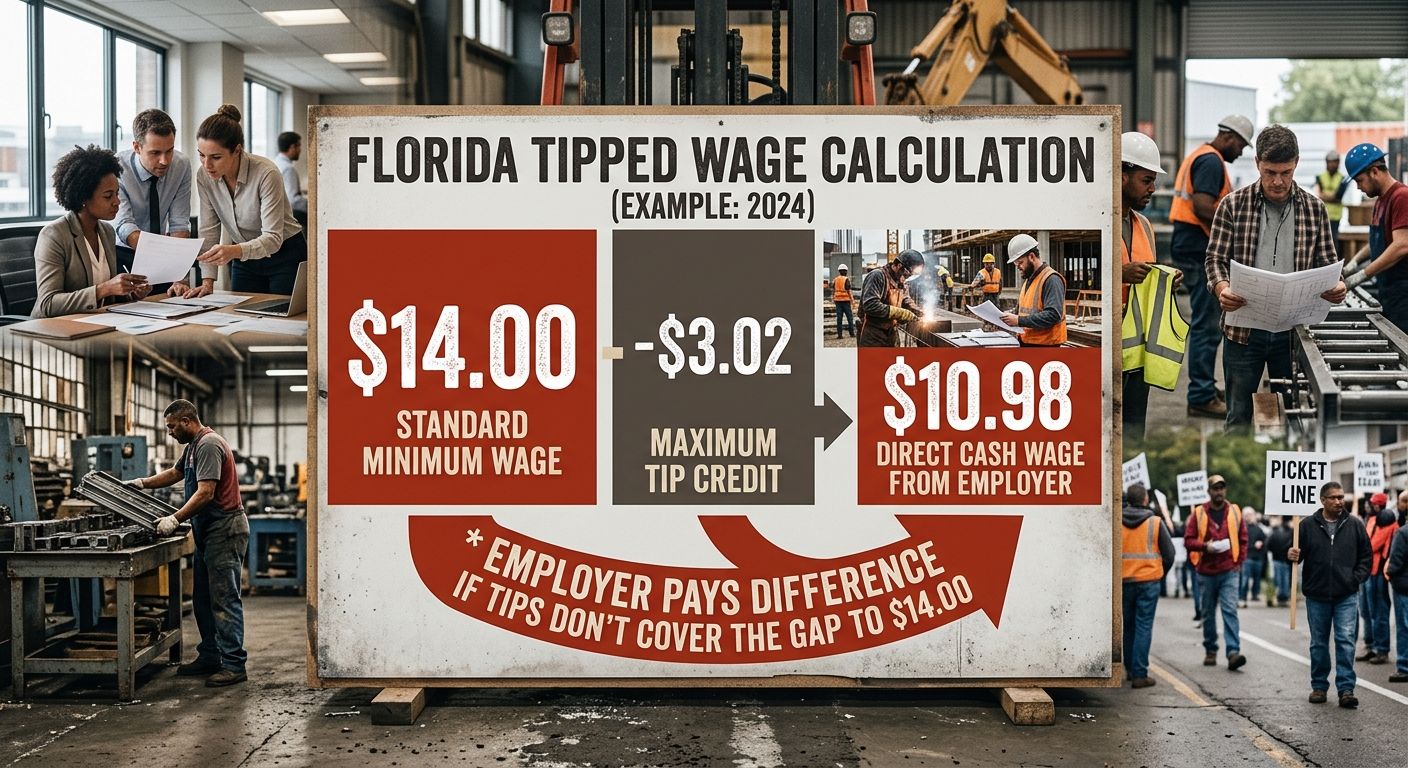
The tipped minimum wage in Florida operates through a fixed tip credit of $3.02 per hour, which employers deduct from the standard rate. As of September 30, 2025, tipped workers receive a direct cash wage of $10.98 per hour: the $14.00 standard rate minus the $3.02 credit.
Three conditions must be met for an employer to legally claim the tip credit. First, the employer must inform the employee, before the tip credit is applied, of the direct cash wage amount, the tip credit amount, and the employee's right to retain all tips. Second, the employee must actually receive tips. Third, the employee's total compensation (direct wage plus tips) must equal or exceed the full minimum wage for every hour worked.
If an employee's tips fall short during any pay period, the employer must make up the difference. This "tip shortfall" obligation is absolute under Florida law, and violations constitute wage theft under both state and federal standards.
The federal minimum wage, still frozen at $7.25 per hour since 2009, applies as a floor in states without their own minimum wage law. Florida's rate supersedes the federal rate because state law requires a higher amount, a principle codified in the Fair Labor Standards Act, which mandates that workers receive whichever rate is higher.
The CPI Switch After $15.00
On September 30, 2026, Florida's minimum wage reaches $15.00 per hour, the final step on Amendment 2's fixed escalator. Beginning in 2027, the annual adjustment shifts to the Consumer Price Index for Urban Wage Earners and Clerical Workers (CPI-W) for the South region, which the Florida Department of Commerce uses to calculate each year's increase.
This is the same indexing formula Florida used before Amendment 2, and it produces smaller, inflation-tracking adjustments rather than the $1.00 annual jumps workers have experienced since 2021. Between 2005 and 2020, Florida's CPI-based adjustments ranged from $0.00 in years of low or negative inflation to $0.39 at the high end. If inflation runs at roughly 3%, a CPI-based increase on a $15.00 base would yield approximately $0.45, less than half the $1.00 increases workers have received during the Amendment 2 escalator.
The Department of Commerce must announce the new rate by September 1 each year, giving employers 30 days to update payroll before the September 30 effective date.
One structural protection remains: the CPI formula cannot produce a wage decrease. If inflation turns negative, the minimum wage stays flat. But the rate also won't climb in meaningful increments without another constitutional amendment or significant inflationary pressure. According to Florida Plan Finder's employer guide, the September 30, 2026 increase from $14.00 to $15.00 will bring the tipped employee rate to $11.98 per hour, with CPI-linked adjustments beginning the following year.
The Gap Between the Minimum and a Living Wage
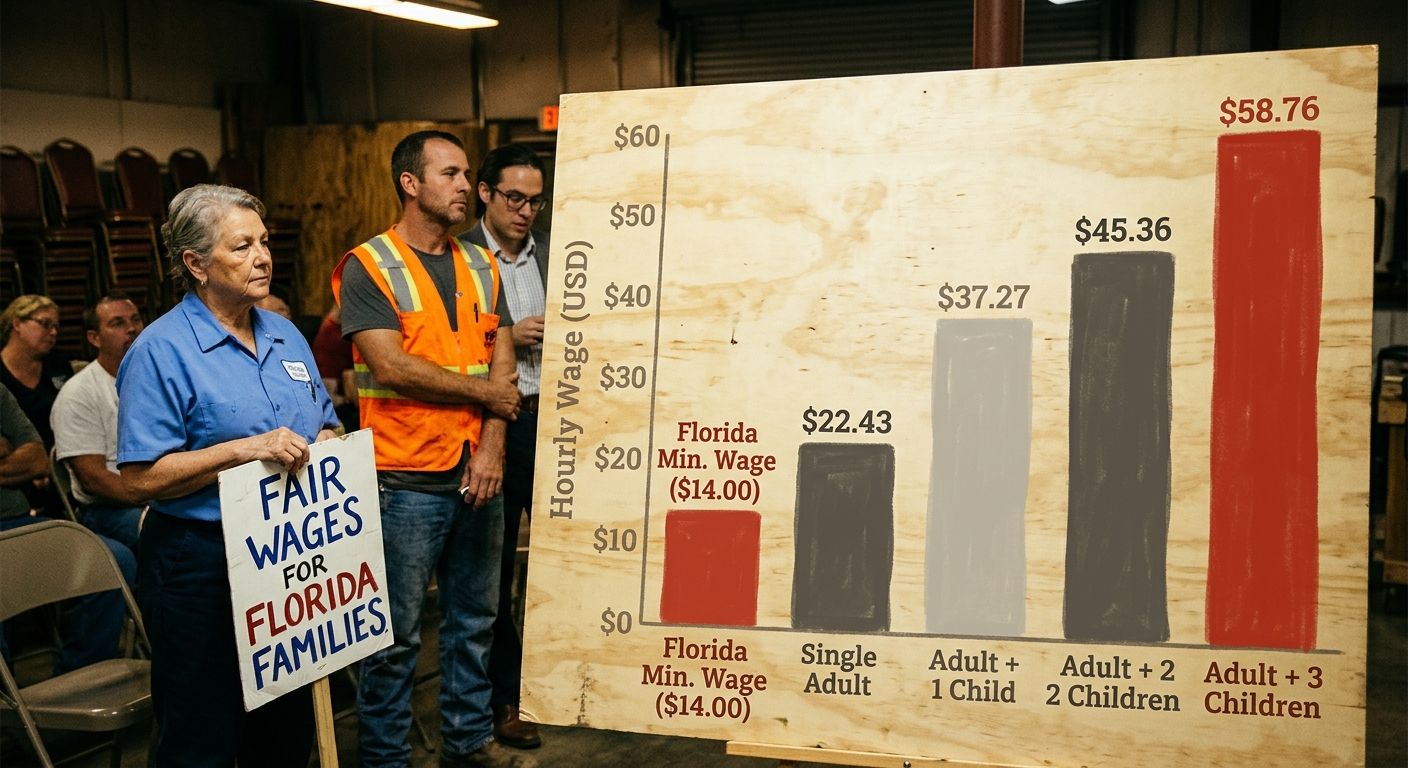
MIT's Living Wage Calculator, updated as of February 2026, puts the living wage for a single adult with no children in Florida at $22.43 per hour. For an adult with one child, the figure jumps to $37.27. For an adult with two children, it reaches $45.36. For an adult with three children, $58.76.
Against those numbers, the current $14.00 minimum wage covers 62.4% of what a single childless adult needs to survive. For a single parent with one child, it covers 37.6%. The $15.00 rate arriving in September 2026 narrows those gaps slightly, to 66.9% and 40.2% respectively, but the structural deficit remains enormous.
These living wage calculations, as reported by the Tallahassee Democrat, account for housing, food, transportation, childcare, healthcare, and taxes at regional market rates. They represent survival-level costs, not comfortable middle-class budgets.
This gap explains why collective bargaining remains essential even in states with relatively high minimum wages. Workers who organize for union contracts routinely negotiate wages well above statutory minimums, a point illustrated by examples of collective bargaining victories across industries where the legal floor proved inadequate.
The Florida minimum wage debate also sits in a federal context. More than 30 states now require wages above the federal $7.25 floor, but Congress hasn't raised the federal rate since July 2009. For Florida workers, Amendment 2's escalator delivered a roughly 75% wage increase (from $8.56 in 2020 to the coming $15.00) over six years. The federal rate delivered zero during that same period, and zero for the 11 years before it.
Where the Model Breaks
Amendment 2's escalator has clear strengths: it's constitutionally protected, predictable, and automatic. But the mechanism has real limits that affect workers on the ground.
No local control. Florida's state preemption law bars cities and counties from setting their own higher minimum wages. Miami-Dade County, where housing costs routinely exceed statewide averages by 30% to 40%, pays the same $14.00 minimum as rural counties in the Panhandle. Workers in high-cost metro areas absorb a disproportionate hit from this uniform statewide rate.
No sector adjustments. The rate applies uniformly across industries. A hotel housekeeper in Orlando and a warehouse worker in Jacksonville earn the same floor, despite vastly different working conditions, physical demands, and local labor markets. Collective bargaining is the primary tool workers have to differentiate wages by occupation and risk, but Florida's right-to-work statute weakens union density across the state. Understanding how employers resist organizing efforts helps workers navigate this environment.
The CPI ceiling after 2026. Once the fixed escalator ends, real wage growth depends entirely on inflation trends. If inflation drops below 2%, annual minimum wage increases will be measured in dimes. Workers who saw $1.00 annual raises for six straight years will experience a sharp deceleration that erodes the purchasing power gains they accumulated.
Small business displacement. A February 2026 opinion piece in the Sun Sentinel argued that the amendment's outcome has been "more big brands and automation and less small businesses that need time to build product awareness but lack the war chest necessary for business development." Whether you agree with that framing or not, the consolidation pressure on small employers is a documented consequence of uniform rate increases applied without size-based phase-ins.
Enforcement gaps. The Florida Department of Commerce does not maintain a dedicated wage-theft enforcement division comparable to California's Labor Commissioner or New York's Department of Labor. Workers who experience minimum wage violations must file complaints through a system that relies heavily on individual initiative, creating barriers for workers who fear retaliation or lack English proficiency. A $14.00 wage floor means nothing if the employer pays $10.00 and the worker has no accessible path to enforcement.
Common Questions
Does Florida's minimum wage apply to all workers?
The $14.00 rate covers nearly all employees in Florida, including part-time, temporary, and seasonal workers. The primary exception is workers under 18 in certain training positions, who may be paid a sub-minimum wage for a limited period. Independent contractors are not covered, though many workers classified as independent contractors are legally employees under federal and state misclassification tests.
What happens if my employer doesn't pay the minimum wage?
You can file a complaint with the Florida Department of Commerce or pursue a private civil action. Under Florida law, successful claimants can recover unpaid wages plus an equal amount in liquidated damages, plus attorney's fees. The statute of limitations is five years for minimum wage claims under the Florida Constitution, substantially longer than the two-to-three-year window under the federal Fair Labor Standards Act.
Is the $15.00 rate in September 2026 the final increase?
It's the final fixed $1.00 increase. After September 30, 2026, annual adjustments continue every September 30 but are calculated using the Consumer Price Index rather than the fixed dollar amount. The minimum wage will keep rising in most years, but increases will be smaller and variable depending on inflation.
How does Florida's minimum wage compare to the federal rate?
Florida's current $14.00 rate is 93% higher than the federal minimum of $7.25 per hour. When the federal and state rates differ, employers must pay whichever is higher. Since Florida's rate has exceeded the federal floor since 2005, the federal minimum wage is effectively irrelevant for workers in the state.
Can the Florida legislature lower or freeze the minimum wage?
No. Amendment 2 is embedded in Article X, Section 24 of the Florida Constitution. Changing it requires a new constitutional amendment, which must be placed on the ballot either by citizen petition (requiring signatures from 8% of voters in the most recent presidential election, collected across at least half the state's congressional districts) or by a three-fifths vote of both legislative chambers. The amendment must then pass with 60% voter approval. That's a deliberately high bar, and it's the reason the escalator has proceeded without interference since 2021.
The Union Edge Staff
Frequently Asked Questions
- What is Florida's minimum wage in 2024?
- Florida's minimum wage is $13.00 per hour as of September 30, 2024. The rate increases by $1.00 annually until it reaches $15.00 on September 30, 2026, after which adjustments shift to the Consumer Price Index.
- When does Florida's minimum wage increase?
- Florida's minimum wage increases every September 30, not January 1. The increases occur automatically at midnight on that date and require no legislative action or employer notification.
- What is the tipped minimum wage in Florida?
- Tipped employees in Florida receive a direct cash wage of $10.98 per hour as of September 30, 2025, with employers able to claim a $3.02 tip credit. Employers must ensure total compensation from wages and tips meets the full minimum wage of $14.00 per hour.
- Can Florida's legislature lower the minimum wage?
- No. Florida's minimum wage is constitutionally mandated through Amendment 2 and cannot be lowered or frozen by the legislature. Changing it requires a new constitutional amendment with signatures from 8% of voters collected across at least half the state's congressional districts, plus 60% voter approval.
- What happens after Florida's minimum wage reaches $15.00 in 2026?
- After September 30, 2026, the fixed $1.00 annual increases end and annual adjustments switch to the Consumer Price Index for the South region. Annual increases will continue every September 30 but will be smaller and variable based on inflation rates.
- How much will the minimum wage be in Florida in September 2026?
- Florida's minimum wage will be $15.00 per hour starting September 30, 2026. This is the final step in Amendment 2's fixed escalator before the adjustment mechanism shifts to the Consumer Price Index.
- What can I do if my employer doesn't pay Florida's minimum wage?
- You can file a complaint with the Florida Department of Commerce or pursue a private civil action. Successful claimants can recover unpaid wages plus an equal amount in liquidated damages and attorney's fees, with a five-year statute of limitations for minimum wage claims.
Related Articles

US Minimum Wage Florida: 2024 Rates & Updates
Amendment 2, the constitutional provision Florida voters approved on November 3, 2020, locked the state's minimum wage into a fixed $1-per-year escalator that no governor or legislature can repeal.

What Is the State of Florida Minimum Wage
Amendment 2, ratified by Florida voters in November 2020, embedded a minimum wage escalator directly into Article X of the state constitution, removing the rate from legislative control entirely. The current floor is $14.00 per hour for non-tipped workers and $10.

Minimum Wage in Florida USA: Current Rates 2024
Florida's minimum wage is a constitutionally mandated rate that increases automatically each September 30 without any legislative vote. The current rate is $14.00 per hour, effective since September 30, 2025, and the constitutional escalator driving these raises keeps the floor $6.
Also in the paper