
Oregon Minimum Wage 2024: Rates & Updates
Oregon divides its territory into three wage zones (Portland metro, standard counties, and non-urban counties) and ties each zone's minimum wage to the Consumer Price Index, recalculating every July 1. The 2024 adjustment raised all three tiers by 50 cents, landing at $15.95, $14.70, and $13.

Oregon Minimum Wage 2024: Rates, Tiers, and How the Annual Adjustment Works
Oregon divides its territory into three wage zones (Portland metro, standard counties, and non-urban counties) and ties each zone's minimum wage to the Consumer Price Index, recalculating every July 1. The 2024 adjustment raised all three tiers by 50 cents, landing at $15.95, $14.70, and $13.70 per hour respectively, based on a 3.5% CPI increase measured between March 2023 and March 2024.
How Oregon Defines and Divides Its Minimum Wage
Oregon's minimum wage is governed by state statute and administered by the Bureau of Labor and Industries (BOLI). The state established its three-tier system through Senate Bill 1532 in 2016, which created separate wage floors for different regions to reflect varying costs of living. Before SB 1532, Oregon had a single statewide rate. The law phased in scheduled annual increases through July 1, 2022, and then shifted to an inflation-indexed model tied to the CPI.
This indexed approach distinguishes Oregon from states like Texas, which still relies on the federal minimum of $7.25 per hour, and from states like Ohio, whose constitutional amendment indexes a single statewide rate. Oregon's system creates three distinct legal obligations depending on where work is physically performed, which means an employer operating in multiple regions can owe different wages to different workers on the same payroll.
The federal minimum wage of $7.25 per hour, unchanged since 2009, serves as a floor that the minimum wage in Oregon exceeds by $6.45 to $8.70 depending on region. Workers in Oregon are entitled to the higher state rate under federal preemption rules.
The CPI Calculation Behind the 2024 Increase
BOLI is required to calculate the new standard minimum wage rate by April 30 of each year, using the percentage change in the CPI from the previous March-to-March period. For 2024, the CPI rose 3.5% between March 2023 and March 2024. The Nonprofit Association of Oregon reported the math directly: $14.20 × 0.035 = $0.497, rounded to the nearest five cents, producing a $0.50 increase to the standard county rate.
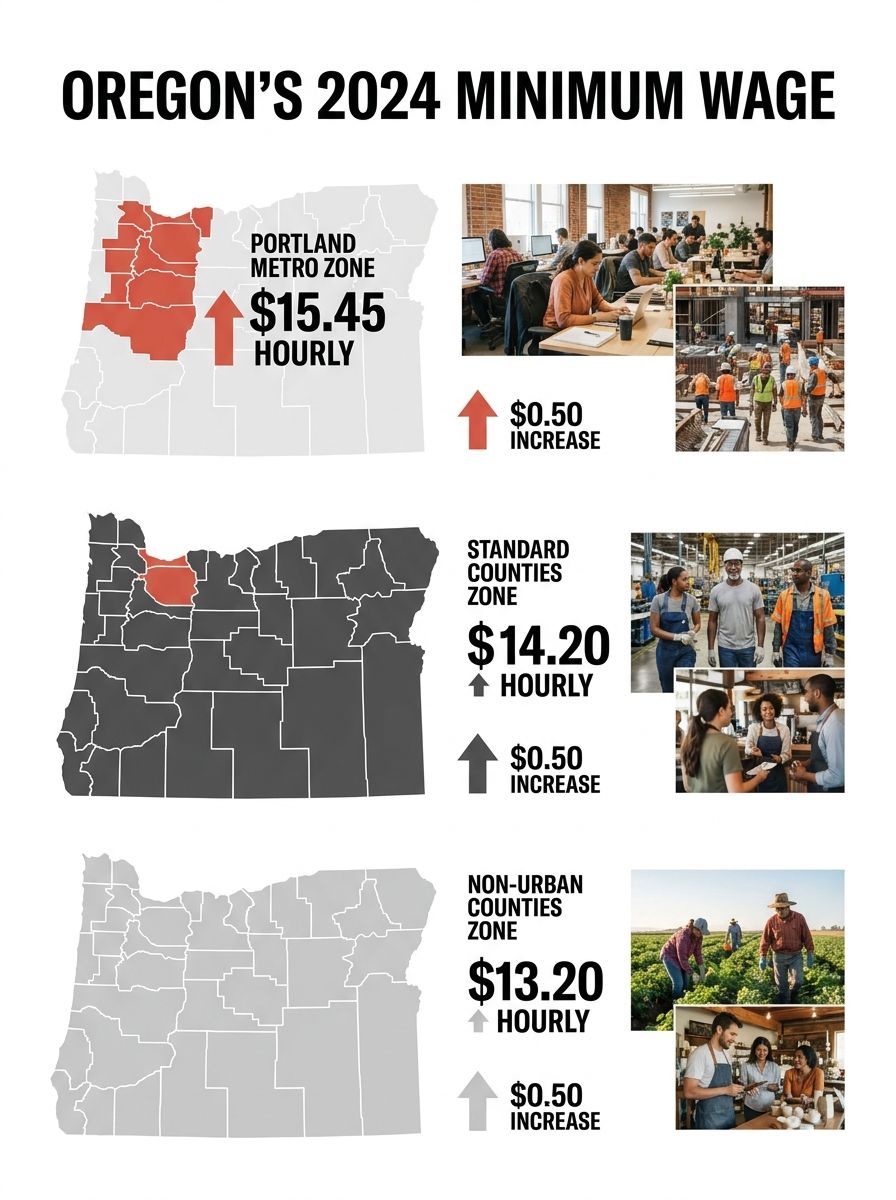
That 50-cent increase then applies uniformly across all three tiers. The Portland metro premium ($1.25 above standard) and the non-urban discount ($1.00 below standard) remain fixed dollar amounts set by SB 1532. So when the standard rate moved from $14.20 to $14.70, Portland metro moved from $15.45 to $15.95, and non-urban moved from $13.20 to $13.70.
Region | Pre-July 2024 Rate | July 1, 2024 Rate | Increase |
|---|---|---|---|
Portland Metro | $15.45/hr | $15.95/hr | +$0.50 |
Standard Counties | $14.20/hr | $14.70/hr | +$0.50 |
Non-Urban Counties | $13.20/hr | $13.70/hr | +$0.50 |
Oregon's rates go into effect on July 1 each year, which distinguishes the state from places like Washington, where annual adjustments take effect January 1. This mid-year timing matters for payroll compliance. Employers who budget on a calendar-year basis can miss the change entirely, exposing themselves to back-pay claims for the second half of the fiscal year.
Geographic Boundaries for Each Tier
The Portland metro tier covers employers inside the urban growth boundary of the Portland metropolitan area. Counties included: Multnomah, Washington, and Clackamas, along with parts of other counties within the metro urban growth boundary. The standard tier covers the majority of Oregon's remaining populated counties, including Lane (Eugene), Marion (Salem), Deschutes (Bend), and Jackson (Medford). The non-urban tier covers 18 counties the state designates as rural: Baker, Coos, Crook, Curry, Douglas, Gilliam, Grant, Harney, Jefferson, Klamath, Lake, Malheur, Morrow, Sherman, Umatilla, Union, Wallowa, and Wheeler.
For workers who perform duties across multiple zones in a single pay period, employers face a compliance choice: pay the highest applicable tier rate for all hours, or track hours by region and pay the corresponding rate for each set of hours. BOLI has not mandated which approach employers must use, but tracking errors create wage theft risk. An employee who works three days in Portland metro and two days in a standard county during the same week is owed $15.95 for the Portland hours, and $14.70 for the standard county hours, unless the employer elects to pay $15.95 across the board.
No Tip Credit and No Youth Subminimum
Oregon is one of seven states that prohibit tip credits entirely. Employers must pay the full Oregon minimum wage regardless of whether the employee receives tips. A tipped restaurant worker in Portland earns at least $15.95 per hour before any tips are counted. This stands in sharp contrast to the federal tipped minimum of $2.13 per hour, which applies in states that haven't passed their own tip credit prohibitions.
The state also doesn't allow a subminimum wage for youth workers, seasonal employees, or part-time staff. Every worker performing labor in Oregon receives the same regional minimum wage floor regardless of age, hours worked, or employment classification. There are restrictions on the hours and types of work minors can perform, but the hourly rate is identical to what an adult worker earns in the same zone.

Low Wages, Long Hours, and Safety on the Job
The connection between the minimum wage for Oregon and workplace safety runs through fatigue, fear, and economic pressure. Workers earning near the wage floor are concentrated in industries with elevated injury rates: food service, agriculture, warehousing, and retail. BOLI enforces both wage and workplace standards, but the agencies' enforcement capacities are separate, and workers who are already financially strained are less likely to file safety complaints when they fear losing hours or employment.
Oregon's tiered system attempts to account for regional cost-of-living variation, and this matters for safety because the non-urban tier's $13.70 rate applies in agricultural counties like Malheur, Umatilla, and Jefferson. These are areas with significant farmworker populations performing physically demanding and hazardous work. When a wage floor doesn't cover basic expenses, workers take on overtime or second jobs, and fatigue is a documented contributor to workplace injuries. Oregon OSHA data consistently shows that agriculture, construction, and food processing account for disproportionate shares of workplace injuries and fatalities, and these are sectors that employ large numbers of minimum-wage and near-minimum-wage workers.
The Oregon minimum wage also intersects with workplace safety through overtime patterns. Workers whose base pay sits at $13.70 or $14.70 per hour need more hours to cover rent, transportation, and food, and the resulting fatigue from 50- or 60-hour weeks increases accident risk. A wage floor that keeps pace with inflation doesn't eliminate this dynamic, but it reduces the severity of the gap between earnings and living costs that pushes workers into dangerous amounts of overtime.

Where the Tiered Model Breaks Down
Oregon's three-tier system assumes that cost of living correlates neatly with the Portland metro / standard / non-urban classification. The gaps are growing in ways that undermine that assumption. Bend, classified as a standard county (Deschutes), has housing costs that rival parts of the Portland metro, yet its minimum wage sits $1.25 per hour lower. Workers in Bend earning $14.70 face rental markets where median one-bedroom apartments regularly exceed $1,400 per month.
The fixed differentials between tiers present another weakness. The Portland metro premium is locked at $1.25 above the standard rate, and the non-urban discount is locked at $1.00 below. These gaps were set by SB 1532 in 2016 and don't adjust with inflation or with changes in the relative cost of living between regions. If Portland metro housing costs grow faster than non-urban housing costs, the premium becomes less meaningful over time, and there's no statutory mechanism to recalibrate.
Multi-location employers also face administrative friction. Businesses operating restaurants or retail locations in both Portland and Salem must track which hours were worked where, or pay all workers at the highest tier. Small employers with limited payroll infrastructure often default to the higher rate to avoid compliance risk, which raises their labor costs beyond what the law strictly requires.
And the CPI-indexing mechanism itself is backward-looking. The 3.5% CPI increase used for the 2024 adjustment reflects price changes from March 2023 to March 2024. Workers experience those higher prices in real time; the wage adjustment arrives months later, on July 1. During periods of rapid inflation, the wage floor lags behind the cost of living it's designed to track. States with similar indexing mechanisms, including California's statewide rate, face the same structural delay, though Oregon's mid-year effective date adds an extra six months of lag compared to states that adjust on January 1.
Common Questions
Does minimum wage in Oregon apply to salaried employees?
Oregon's minimum wage is expressed as an hourly rate. Salaried employees classified as non-exempt under state and federal law must still earn at least the applicable minimum wage for all hours worked. Exempt employees meeting both salary and duties tests under Oregon and federal law are not covered by the hourly minimum.
Can Oregon employers pay less than minimum wage to workers under 18?
No. Oregon does not allow a youth subminimum wage. Workers under 18 receive the same regional minimum wage as adult workers. There are restrictions on hours and types of work minors can perform, but the hourly rate is identical.
When do Oregon's minimum wage rates change each year?
Rates change on July 1 each year. BOLI calculates the new rates by April 30 using the March-to-March CPI change. This mid-year schedule differs from many states that adjust on January 1.
What happens if an employee works in two different wage zones during the same week?
The employer can either pay the highest applicable tier rate for all hours worked that week, or track hours by zone and pay the corresponding rate for each set of hours. Oregon law requires that workers receive at least the minimum wage for the zone where work is physically performed.
How does Oregon's minimum wage compare to neighboring states?
Washington's statewide minimum wage was $16.28 per hour for 2024, higher than any of Oregon's three tiers. Idaho follows the federal minimum of $7.25 per hour. California's statewide minimum was $16.00 per hour for 2024, putting Oregon's Portland metro rate roughly in line with California's base. The contrast with Idaho is particularly stark for workers in Ontario, Oregon (Malheur County), who earn at least $13.70 per hour while workers just across the Snake River in Idaho may earn $7.25 for comparable work.
The Union Edge Staff
Frequently Asked Questions
- What is the Oregon minimum wage for 2024?
- Oregon has three regional minimum wage tiers as of July 1, 2024: $15.95 per hour in Portland metro areas, $14.70 per hour in standard counties, and $13.70 per hour in non-urban counties.
- Does Oregon allow tip credits for restaurant workers?
- No, Oregon prohibits tip credits entirely. Employers must pay the full regional minimum wage regardless of whether employees receive tips, so a tipped restaurant worker in Portland earns at least $15.95 per hour before tips.
- Can Oregon employers pay teenagers a lower minimum wage?
- No, Oregon does not allow a youth subminimum wage. Workers under 18 receive the same regional minimum wage as adult workers, though there are restrictions on the hours and types of work minors can perform.
- When do Oregon minimum wage rates take effect each year?
- Oregon's minimum wage rates take effect on July 1 each year, based on calculations completed by April 30 using the Consumer Price Index change from March to March of the prior year.
- How does the CPI adjustment work for Oregon's minimum wage?
- BOLI calculates the new standard rate by applying the year-over-year CPI percentage change to the current rate, rounding to the nearest five cents. The same dollar increase is then applied uniformly to all three geographic tiers.
- Which counties are classified as non-urban in Oregon's minimum wage system?
- Oregon designates 18 counties as non-urban for minimum wage purposes: Baker, Coos, Crook, Curry, Douglas, Gilliam, Grant, Harney, Jefferson, Klamath, Lake, Malheur, Morrow, Sherman, Umatilla, Union, Wallowa, and Wheeler.
- What should I do if I encounter unsafe working conditions at my Oregon job?
- You have the right to file a confidential complaint with Oregon OSHA, and retaliation for safety complaints is illegal under Oregon law regardless of employment status or immigration status.
- How does Oregon's minimum wage compare to Washington and California?
- Washington's statewide minimum wage was $16.28 per hour in 2024, higher than any Oregon tier. California's was $16.00 per hour in 2024, putting it roughly in line with Oregon's Portland metro rate of $15.95.
Related Articles

Minimum Wage State of Oregon: 2024 Rates
Oregon's minimum wage is set by a CPI-indexed formula that automatically adjusts three separate geographic rates every July 1, making it one of the few state wage systems that tracks inflation without requiring annual legislative action. As of July 1, 2024, those rates stand at $15.

Minimum Wage Ohio: 2024 Rates & Legal Guide
Article II, Section 34a of the Ohio Constitution contains the formula that sets Ohio's minimum wage every January 1, removing the state legislature from the process entirely. The rate adjusts automatically based on the Consumer Price Index, which pushed the minimum wage in Ohio from $10.

State of Colorado Minimum Wage 2024: Rates & Changes
Colorado's state minimum wage rose to $14.42 per hour on January 1, 2024, set automatically by a Consumer Price Index formula that removes the state legislature from annual rate decisions entirely.
Also in the paper