
Washington State Minimum Wage: 2024 Rates & Laws
Washington state doesn't have one minimum wage. It has at least seven. The statewide floor sat at $16.28 per hour for 2024 (rising to $17.

Washington State Minimum Wage: 2024 Rates & Laws
Washington state doesn't have one minimum wage. It has at least seven. The statewide floor sat at $16.28 per hour for 2024 (rising to $17.13 in 2026), but six cities enforce their own higher rates, creating a layered system where a worker's legal pay minimum depends entirely on which municipal boundary contains their workplace.
What the State Minimum Wage Covers and Where It Comes From
Washington's minimum wage applies to most employees aged sixteen and older for every hour worked in the state. The Washington Department of Labor & Industries (L&I) administers the rate and publishes updates each fall. The legal foundation traces back to Initiative 1433, which voters approved in November 2016. That initiative did two things: it raised the wage floor in scheduled steps through 2020, and it locked in a permanent annual adjustment mechanism tied to inflation data.
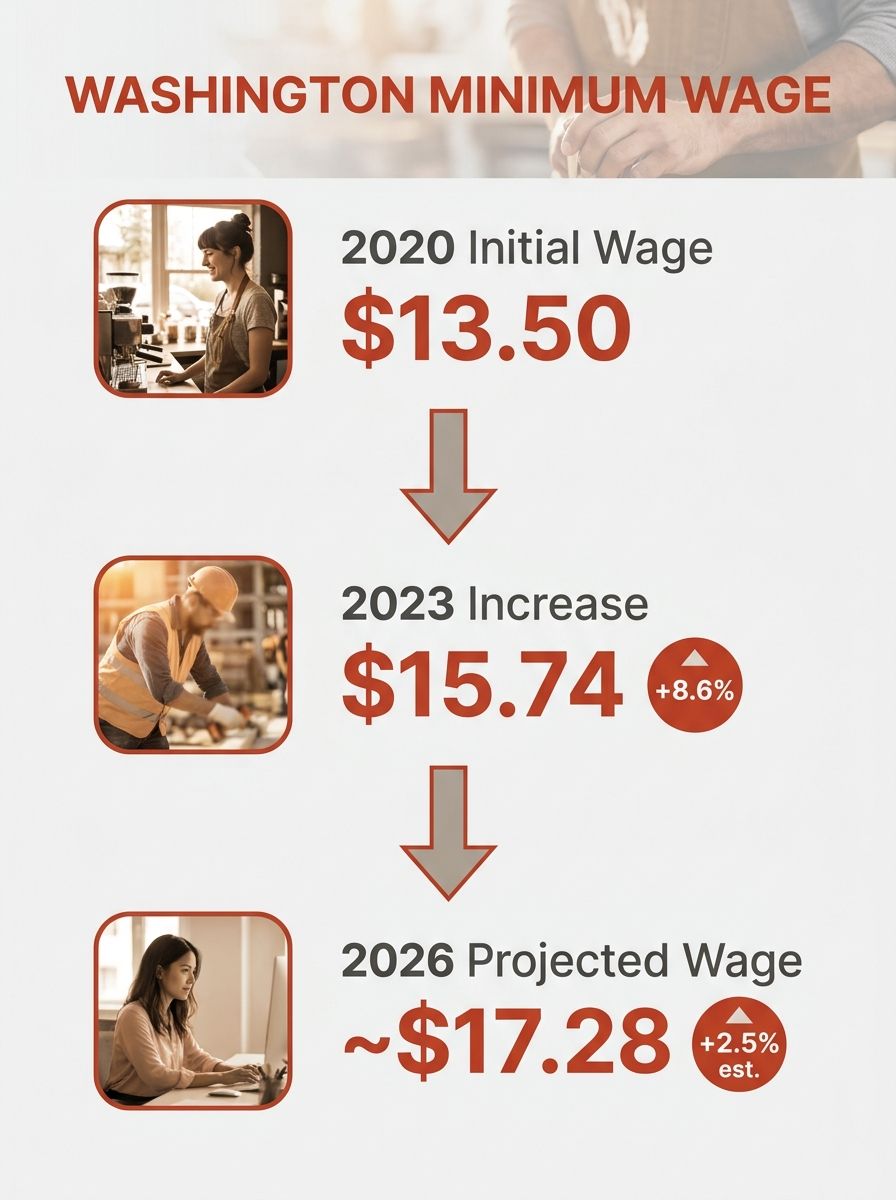
The 2024 rate of $16.28 per hour represented a 3.4% increase over the 2023 rate of $15.74, according to Ogletree Deakins' analysis. L&I announced the figure in September 2023, and it took effect January 1, 2024. This makes Washington's minimum wage for the state one of the highest base floors in the country, well above the federal minimum of $7.25 and more than double what workers earn in states like Texas that default to the federal floor.
The mechanism that produces this number is automatic. No legislative vote is required. No governor's signature. The rate moves on its own, which is the single most important structural feature of Washington's wage law and the one most commonly misunderstood by employers who treat each year's announcement as a policy decision rather than a mathematical output.
The CPI-W Escalator: Inflation Indexing Without Legislative Action
The adjustment mechanism works like this: L&I uses the federal Consumer Price Index for Urban Wage Earners and Clerical Workers (CPI-W) to calculate whether the minimum wage needs to increase. If the CPI-W rose from the prior year, L&I raises the minimum wage in Washington state by the same percentage, rounded to the nearest cent. If the CPI-W fell or stayed flat, the wage stays the same. It never decreases.
The Bureau of Labor Statistics publishes the CPI-W data that feeds the formula. L&I typically announces the new rate by late September, giving employers roughly three months to update payroll systems before the January 1 effective date. The 2024 adjustment of 3.4% reflected the CPI-W change measured over the preceding twelve-month period. The 2026 adjustment was smaller at 2.8%, producing the current $17.13 rate, because consumer price growth moderated.
This indexing approach differs from what you'll find in Ohio's CPI-linked system, which uses a slightly different inflation measure and constitutional framework. Washington's version is statutory rather than constitutional, meaning the legislature could theoretically modify it, though doing so would be politically difficult given the initiative's origin as a voter-approved measure.
The practical consequence for workers is significant: the purchasing power of the state minimum wage in Washington doesn't erode between political cycles. In states without automatic indexing, wage floors can sit unchanged for a decade or more while prices climb around them. Washington's floor has increased every year since the mechanism kicked in.
City-Level Rates That Stack on Top of the State Floor
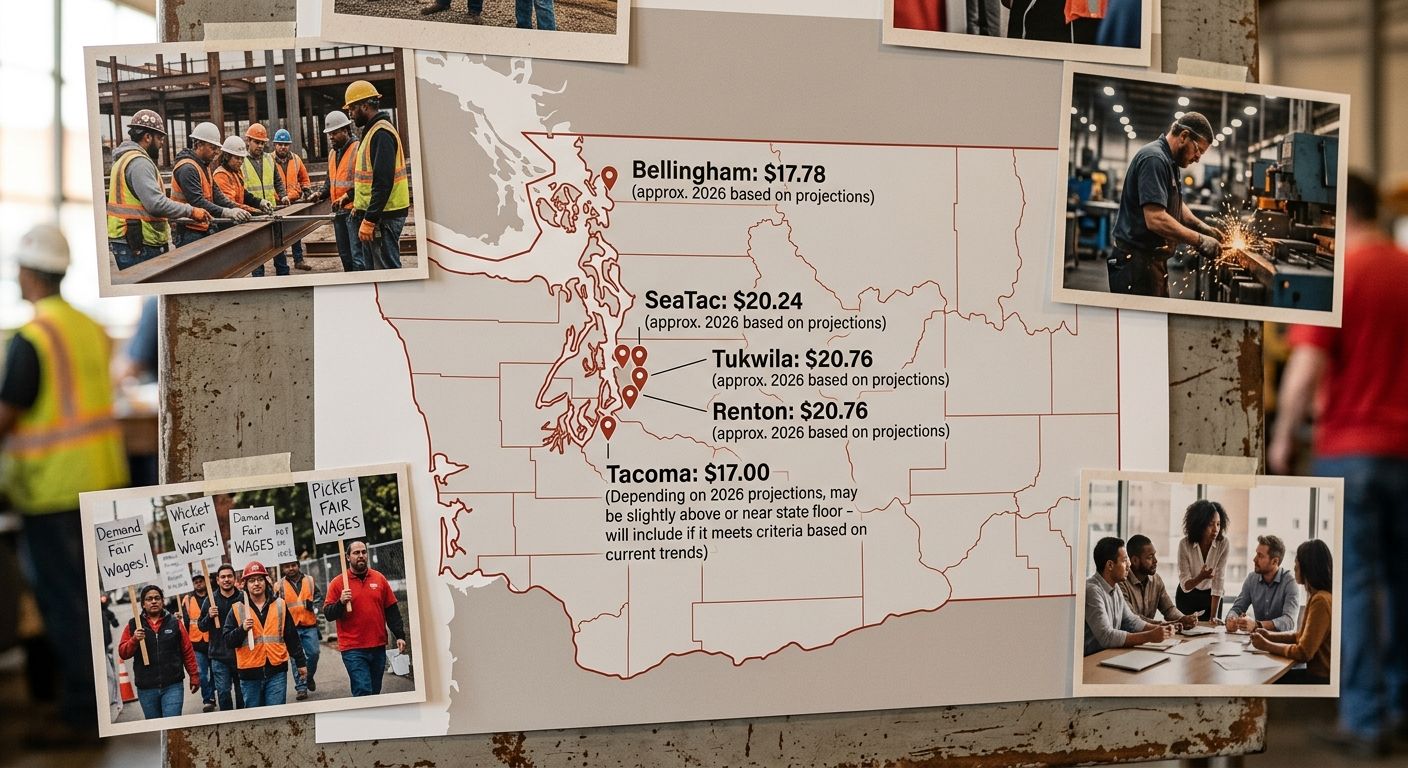
The statewide rate is the baseline. Six cities enforce local minimum wage ordinances that require higher pay within their municipal limits: Seattle, SeaTac, Tukwila, Renton, Bellingham, and Burien. Each city's structure differs in how it defines employer size, whether it phases rates by revenue, and when annual adjustments take effect.
Seattle's minimum wage ordinance eliminated its tiered structure and now requires $21.30 per hour for all employers regardless of size, effective January 1, 2025. Before that consolidation, Seattle split employers into "Schedule 1" (500+ employees worldwide) and "Schedule 2" (fewer than 500), with different rates and tip/benefit credit rules for the smaller tier.
Tukwila holds the highest local rate in the state at $21.65 per hour for large employers. Renton requires $21.57 per hour for employers with 15 or more employees worldwide or over $2 million in annual gross revenue, effective July 1, 2026, according to Miller Nash LLP's compliance analysis. Employers in Renton with fewer than 15 employees and less than $2 million in gross revenue pay only the state minimum.
This patchwork creates real compliance risk. A restaurant chain with locations in both Bellingham and unincorporated King County faces two different legal minimums for identical work. A worker transferred between branches mid-pay-period could trigger a rate change for hours worked at the new location. The obligation follows the geography of the work, not the employer's headquarters address.
Jurisdiction | 2024 Rate | 2026 Rate | Adjustment Date |
|---|---|---|---|
Washington State | $16.28 | $17.13 | January 1 |
Seattle | ~$19.97 (varies by tier) | $21.30 (all employers) | January 1 |
Tukwila (large employers) | Varies | $21.65 | January 1 |
Renton (15+ employees / $2M+ revenue) | Varies | $21.57 | July 1 |
SeaTac (hospitality/transportation) | Higher than state | Higher than state | January 1 |
Workers Who Fall Outside the Standard Rate
Washington's minimum wage law covers most workers, but specific carve-outs exist. The narrowness of these exceptions is itself a defining feature of the state's approach compared to states with broader tip credit or agricultural exemptions.
The most important exception: Washington does not allow tip credits. An employer cannot pay a reduced base wage and count tips toward the minimum. If you work as a server in Seattle, your employer owes you $21.30 per hour before a single tip is counted. This stands in direct contrast to the federal system, which permits a tipped minimum as low as $2.13 per hour, and to most states that allow some form of tip offset. For tipped workers, the minimum wage in Washington state functions as a true floor with no trapdoors.
Minors aged 14 and 15 may be paid 85% of the state minimum wage. In 2026, that translates to $14.56 per hour. Workers aged 16 and older receive the full rate regardless of age. Agricultural workers, who were historically excluded from minimum wage protections in many states, are covered under Washington law.
Certain categories of workers remain outside the law's reach, including bona fide executives, administrators, and professionals who meet the salary and duties tests for overtime exemption. Student workers in specific educational programs and individuals in certain vocational rehabilitation settings may also fall outside standard coverage. But the list is short compared to states like California, which layers additional industry-specific minimums on top of its general floor.
The Overtime Threshold That Rises in Lockstep
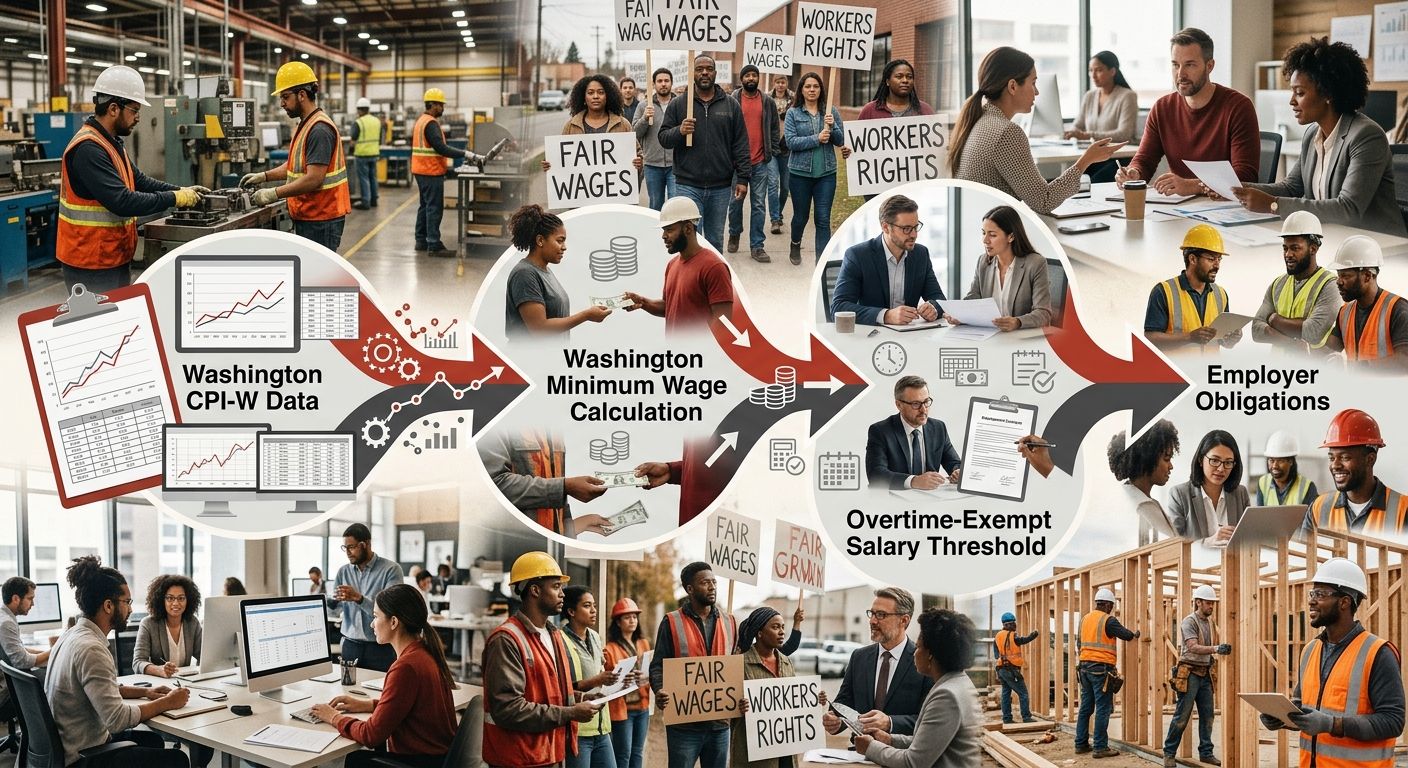
Washington ties its overtime-exempt salary threshold directly to the state minimum wage, which means the exempt threshold climbs automatically alongside the hourly floor. For 2026, the overtime-exempt salary threshold is $80,168.40 per year. An employee earning less than that amount cannot be classified as exempt from overtime, regardless of job title or duties.
This connection matters because it prevents a common employer workaround: paying a worker a modest salary, classifying them as "exempt," and then requiring 50 or 60 hours per week without overtime pay. As the minimum wage rises, the salary floor for exemption rises proportionally, pulling more workers back into overtime eligibility.
The 2024 threshold was lower, reflecting the $16.28 base rate, but the formula is consistent: the state multiplies the minimum wage by a set factor (which has been phasing in over several years) to produce the annual salary threshold. Employers who set salaries near the exemption line in January often find their exempt employees reclassified by the following January when the threshold bumps upward.
Where This Mechanism Falls Short
The CPI-W escalator solves the political gridlock problem. It doesn't solve the cost-of-living problem. The statewide rate of $17.13 per hour translates to roughly $35,630 per year for a full-time worker. In King County, where median rent for a one-bedroom apartment exceeds $1,800 per month, that annual figure covers rent and little else. The mechanism preserves purchasing power relative to inflation, but it can't close a gap that existed when the base rate was first set.
The city-level patchwork, while it pushes rates higher in expensive metro areas, creates its own distortions. Businesses just outside city limits face lower labor costs than competitors inside the boundary, creating incentives to relocate short distances. Workers commuting across municipal lines may earn different rates at different job sites during the same week. And cities without local ordinances, including many mid-size communities in eastern Washington where housing costs have also risen sharply, are stuck at the state floor with no local mechanism to adjust.
The CPI-W itself has known limitations as a cost-of-living proxy. It measures price changes for a specific basket of goods weighted toward urban wage earners and clerical workers, which doesn't perfectly track the spending patterns of minimum-wage households. Housing costs, childcare, and healthcare, the categories that consume the largest share of low-wage budgets, are represented in the index but may be underweighted relative to their actual impact.
And the escalator only prevents erosion. It doesn't produce catch-up gains. If the minimum wage was inadequate when the indexing began, annual CPI adjustments maintain that inadequacy in inflation-adjusted terms. Any real increase in the purchasing power of the minimum wage still requires legislative or ballot action, the same political process the escalator was designed to bypass.
The comparison to New York's approach is instructive: New York used scheduled legislative increases to push its floor higher in distinct steps, accepting the political friction in exchange for larger real gains. Washington chose the smoother, automated path and got predictability at the cost of ambition.
Common Questions
Does the minimum wage in Washington state apply to all workers?
It applies to most employees aged 16 and older for every hour worked. Minors aged 14-15 can be paid 85% of the state rate ($14.56 per hour in 2026). Certain exempt professionals, executives, and administrators who meet both salary and duties tests are excluded. Agricultural workers are covered, unlike in many other states.
Can employers in Washington use tips to offset the minimum wage?
No. Washington prohibits tip credits entirely. Employers must pay the full applicable minimum wage before tips. A tipped worker in Seattle receives $21.30 per hour from their employer, and all tips are additional income on top of that amount.
Which cities in Washington have minimum wages higher than the state rate?
Six cities enforce local minimums above the state floor: Seattle, SeaTac, Tukwila, Renton, Bellingham, and Burien. Rates vary by employer size, revenue, and industry. Tukwila's rate for large employers ($21.65 in 2026) is the highest in the state. The Washington State University HR page maintains a current summary.
How is the annual adjustment calculated?
L&I uses the Consumer Price Index for Urban Wage Earners and Clerical Workers (CPI-W), published by the federal Bureau of Labor Statistics. If the CPI-W increased over the prior year, the minimum wage rises by the same percentage, rounded to the nearest cent. The rate never decreases.
What was the Washington state minimum wage in 2024 compared to 2026?
The statewide rate was $16.28 per hour in 2024 (a 3.4% increase over 2023). It rose to $16.66 in 2025 and $17.13 in 2026 (a 2.8% increase). For a deeper look at the state's wage history and related provisions, our guide to Washington minimum wage rates covers additional detail.
The Union Edge Staff
Frequently Asked Questions
- What is the Washington state minimum wage for 2024?
- The Washington state minimum wage for 2024 is $16.28 per hour, which represents a 3.4% increase over the 2023 rate of $15.74. However, six cities (Seattle, Tukwila, Renton, Bellingham, Burien, and SeaTac) enforce higher local rates within their municipal boundaries.
- Does Washington state allow tip credits?
- No, Washington state prohibits tip credits entirely. Employers must pay the full applicable minimum wage before tips are counted, so a server in Seattle earns the full $21.30 per hour from their employer before any tips are added.
- How does Washington's minimum wage automatically adjust each year?
- Washington's minimum wage adjusts automatically every January 1 based on the Consumer Price Index for Urban Wage Earners and Clerical Workers (CPI-W). If the CPI-W increased over the prior year, the minimum wage rises by the same percentage rounded to the nearest cent, and the rate never decreases.
- What is the highest minimum wage in Washington state?
- Tukwila has the highest local minimum wage in Washington state at $21.65 per hour for large employers as of 2026, followed by Renton at $21.57 per hour for employers with 15 or more employees or over $2 million in annual revenue.
- Can minors in Washington be paid less than the state minimum wage?
- Yes, minors aged 14 and 15 may be paid 85% of the state minimum wage, which translates to $14.56 per hour in 2026. Workers aged 16 and older receive the full minimum wage rate regardless of age.
- What is the overtime-exempt salary threshold in Washington for 2026?
- The overtime-exempt salary threshold in Washington for 2026 is $80,168.40 per year. An employee earning less than this amount cannot be classified as exempt from overtime, regardless of job title, and this threshold automatically increases each year in lockstep with the minimum wage.
- Are agricultural workers covered by Washington's minimum wage law?
- Yes, agricultural workers are covered under Washington's minimum wage law, which is a defining feature compared to many other states that historically excluded agricultural workers from minimum wage protections.
Related Articles

state of washington minimum wage: 2024 Guide
Initiative 1433, which Washington voters approved in November 2016, built an automatic escalator into state law: the minimum wage rises every January 1 by the percentage change in the Consumer Price Index for Urban Wage Earners and Clerical Workers (CPI-W), producing a 2024 rate of $16.

Minimum Wage of Washington: 2024 Update
Washington's minimum wage is set by an automatic annual formula tied to the Consumer Price Index for Urban Wage Earners and Clerical Workers (CPI-W), making it one of the few state wage floors in the country that rises without requiring new legislation each cycle. The 2024 rate of $16.

Minimum Wage Washington: 2024 Rates & Changes
Washington's minimum wage is an inflation-indexed floor set by state law, adjusted each September based on the Consumer Price Index for Urban Wage Earners and Clerical Workers (CPI-W), and effective every January 1 without a legislative vote. The 2024 statewide rate reached $16.28 per hour, a 3.
Also in the paper