
Ohio's Minimum Wage 2024: Rates & Updates
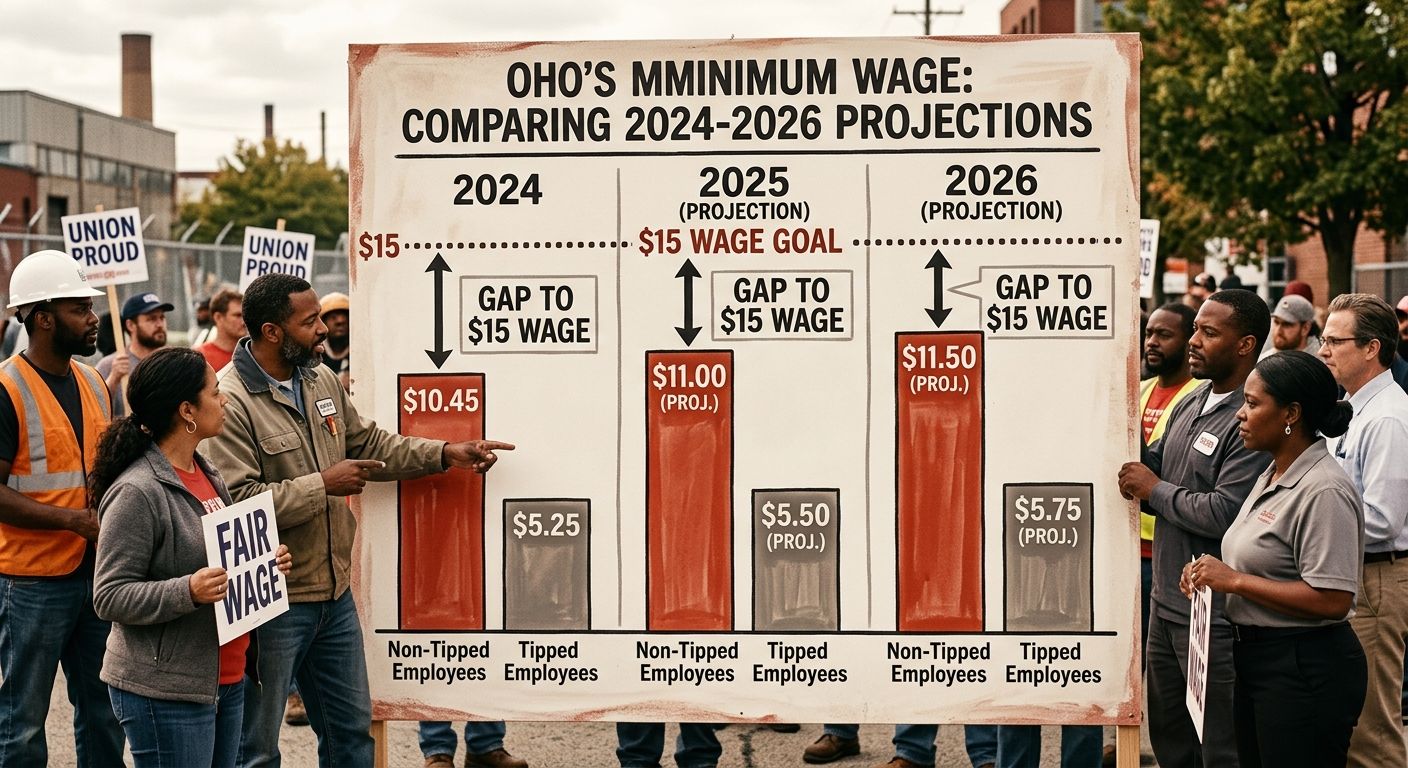
Article II, Section 34a of the Ohio Constitution locks in an automatic minimum wage adjustment every January 1, indexed to the Consumer Price Index. The 2024 Ohio minimum wage was $10.45 per hour for non-tipped employees and $5.25 for tipped employees, and those rates have since risen to $11.

Ohio's Minimum Wage: How the Constitutional Escalator Sets Your Pay
Article II, Section 34a of the Ohio Constitution locks in an automatic minimum wage adjustment every January 1, indexed to the Consumer Price Index. The 2024 Ohio minimum wage was $10.45 per hour for non-tipped employees and $5.25 for tipped employees, and those rates have since risen to $11.00 and $5.50 respectively as of January 2026.
What the Ohio Constitution Actually Requires
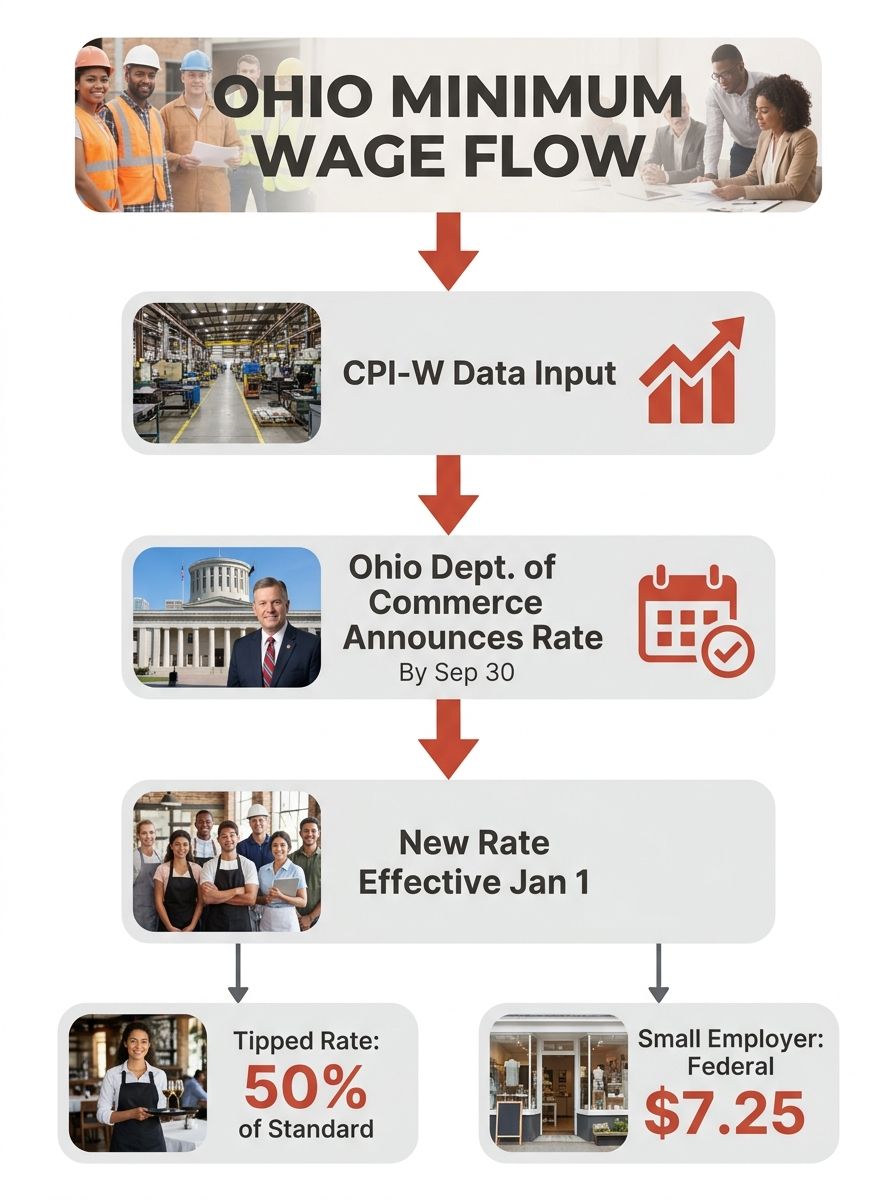
Ohio voters approved a constitutional amendment in November 2006 that embedded the minimum wage directly into the state's founding document. Unlike states where the legislature sets the wage floor through ordinary statute, Ohio's system runs on autopilot. The Ohio Department of Commerce announces new rates by September 30 each year, and those rates take effect January 1 with zero legislative debate required.
The amendment established two foundational rules. First, Ohio's minimum wage must always equal or exceed the federal minimum wage of $7.25 per hour set by the Fair Labor Standards Act. Second, the rate adjusts annually based on the percentage change in the Consumer Price Index for Urban Wage Earners and Clerical Workers (CPI-W). If CPI-W goes up 3%, the minimum wage goes up approximately 3%. If CPI-W drops, the wage stays flat, it never decreases.
This structure matters for workers because it removes a common bottleneck in wage policy. States like Texas, which still sit at the $7.25 federal floor, require active legislation to raise their wage. Ohio eliminated that chokepoint two decades ago.
How the CPI-W Escalator Calculates Each Year's Increase
The Ohio Department of Commerce uses CPI-W data published by the Bureau of Labor Statistics to calculate each year's adjustment. The percentage change in CPI-W over the prior year gets applied to the current minimum wage, and the resulting figure is rounded to the nearest five cents.
Here's what that looks like in practice. The 2024 Ohio minimum wage rose from $10.10 to $10.45, a $0.35 increase reflecting roughly 3.5% inflation. The 2025 rate climbed from $10.45 to $10.70, a $0.25 increase. And the 2026 rate moved from $10.70 to $11.00, a $0.30 increase that the Ohio Township Association confirmed represents a 2.8% adjustment from the previous year.
The ratchet only moves in one direction. If CPI-W records deflation in a given year, the minimum wage freezes at its current rate. Ohio workers never face a pay cut under this system, though they can experience a year of zero increase during deflationary periods.
This automatic escalator design is shared by several other states. New Jersey runs a similar CPI-based adjustment that has pushed its rate considerably higher, reaching $15.49 in 2025 and $15.92 in 2026. The gap between Ohio's $11.00 and New Jersey's $15.92 illustrates a critical point: the escalator preserves purchasing power against inflation, but it doesn't close the original gap between a low starting rate and a living wage.
The Rate Timeline: 2024 Through 2026
The minimum wage in Ohio has moved through three annual adjustments since the beginning of 2024. Each column in the table below shows the rate by worker category and year.
Category | Jan. 1, 2024 | Jan. 1, 2025 | Jan. 1, 2026 |
|---|---|---|---|
Non-tipped employees | $10.45/hr | $10.70/hr | $11.00/hr |
Tipped employees | $5.25/hr | $5.35/hr | $5.50/hr |
Small employer threshold | $385,000 gross receipts | , | $405,000 gross receipts |
Small employer rate | $7.25/hr (federal) | $7.25/hr (federal) | $7.25/hr (federal) |
Full-time annual gross (non-tipped, 2,080 hrs) | $21,736 | $22,256 | $22,880 |
The annual gross for a full-time minimum wage worker at the 2024 rate of $10.45 came out to $21,736 before taxes. At the 2026 rate of $11.00, that figure rises to $22,880. The federal poverty threshold for a family of three was $25,820 in 2024, meaning a full-time Ohio minimum wage worker earning $21,736 fell roughly $4,084 below that line. Even at the 2026 rate, the gap remains.
Advocacy groups have pointed out that at current inflation rates, Ohio's minimum wage won't reach $15.00 per hour until approximately 2034 for non-tipped workers. For tipped workers, that same $15.00 threshold won't arrive until roughly 2064.
Tipped Employees and the Tip Credit Mechanism
Ohio law allows employers to pay tipped employees a base cash wage of exactly half the standard minimum wage, provided that tips bring total compensation up to at least the full minimum wage for every hour worked. In 2024, that meant a base wage of $5.25 per hour. In 2026, it's $5.50 per hour.
The employer's obligation doesn't end with cutting the lower check. If a tipped employee's combined hourly earnings (cash wage plus tips) fall below the full minimum wage of $11.00 in any given pay period, the employer must cover the difference. This is the "tip credit" system, the employer takes a credit against tips, but that credit evaporates whenever tips are insufficient.
The federal tip credit system is far more aggressive. Under the FLSA, tipped employees can be paid a cash wage as low as $2.13 per hour, with a maximum tip credit of $5.12 against the $7.25 federal minimum. Ohio's $5.50 base wage is $3.37 higher than the federal tipped floor, a meaningful difference for restaurant workers, bartenders, and delivery staff.
The Gross Receipts Threshold: When Federal Rates Apply Instead
Ohio's minimum wage has a carve-out for small businesses. The state rate of $11.00 per hour (as of 2026) applies only to employers with annual gross receipts exceeding $405,000. Businesses grossing below that threshold pay the federal minimum wage of $7.25 per hour instead.
In 2024, the threshold was $385,000. By 2026, it rose to $405,000, an increase that tracks inflation in the same way the wage itself does. The threshold adjustment means that the pool of employers covered by the higher state rate expands slowly over time, but the gap between the two rates remains stark: a worker at a small business earning $7.25 makes $3.75 less per hour than their counterpart at a larger employer doing identical work.
This two-tier system doesn't exist in every state. Michigan, for example, applies its minimum wage uniformly regardless of employer size. Ohio's gross receipts carve-out creates a situation where a worker at a small diner and a worker at a chain restaurant in the same town, doing the same job, can legally earn very different hourly wages.
Ohio law also exempts several categories of workers entirely from the state minimum wage, deferring instead to federal FLSA definitions. These include certain agricultural workers, seasonal amusement park employees, and workers employed by immediate family members.

Where the Escalator Falls Short
The CPI-W mechanism does what it was designed to do: prevent the minimum wage from eroding against inflation. But preventing erosion and building toward a living wage are two different objectives, and Ohio's escalator only accomplishes the first.
Three structural limitations define where the model breaks down.
The starting point problem. Ohio's 2006 amendment set the initial rate at $6.85 per hour. Every CPI-W adjustment since then has been a percentage increase on that base. Compounding from a low starting point means the dollar-value gains each year are small in absolute terms, $0.25 to $0.35 per year in recent cycles. States like New Jersey that legislated higher starting points before attaching a CPI escalator now sit $4 to $5 ahead of Ohio despite using the same indexing mechanism.
The tipped wage multiplier. Because Ohio's tipped wage is pegged at 50% of the standard rate, the gap between tipped and non-tipped workers grows in absolute dollars as the standard rate climbs. In 2024, the gap was $5.20 per hour. In 2026, it's $5.50. The tipped wage mechanism assumes that tips reliably close the gap, but enforcement of the make-up-the-difference rule is inconsistent, and many tipped workers don't know the rule exists.
No regional adjustment. Ohio's economy spans Cleveland, Columbus, and Cincinnati metro areas where cost of living is substantially higher than rural Appalachian counties. The single statewide rate doesn't account for that variation. A $11.00 wage stretches further in rural Vinton County than it does in Franklin County, where median rents have risen sharply. Unlike states where cities can set their own higher minimums, Ohio's constitutional framework creates a single rate with no local override mechanism.
Common Questions
Does Ohio's minimum wage apply to all workers?
No. Ohio's state minimum wage of $11.00 per hour (as of January 2026) applies to employees of businesses with annual gross receipts exceeding $405,000. Workers at businesses below that threshold are covered by the federal minimum wage of $7.25 per hour. Certain categories, including some agricultural workers, seasonal amusement park employees, and family-employed workers, are exempt under both state and federal law.
How does Ohio's tipped minimum wage work?
Employers can pay tipped employees $5.50 per hour (as of 2026), exactly half the standard $11.00 rate. If a tipped worker's combined earnings from the base wage and tips don't reach $11.00 per hour in a given pay period, the employer is legally obligated to cover the shortfall. The federal tipped floor is much lower at $2.13 per hour, making Ohio's tipped rate one of the higher state-level floors.
Can Ohio's minimum wage ever go down?
No. The constitutional amendment specifies that if the CPI-W index declines in a given year, the minimum wage stays at its current rate. It never decreases. During deflationary years, workers keep their existing rate while the escalator pauses.
When are new Ohio minimum wage rates announced?
The Ohio Department of Commerce announces the next year's rate by September 30 each year. The new rate takes effect January 1. Employers are required to update workplace posters and payroll systems before that date.
How does Ohio's minimum wage compare to neighboring states?
Ohio's $11.00 rate is higher than the $7.25 federal floor that still applies in states without their own minimum wage laws, but it trails several neighbors. Michigan's minimum wage sits above Ohio's rate following a series of recent increases. Pennsylvania remains at the $7.25 federal minimum for most workers. West Virginia's rate is $8.75. The variation across bordering states means that workers in Ohio border towns sometimes face different pay floors for identical work depending on which side of a state line they're employed.
The Union Edge Staff
Frequently Asked Questions
- What is Ohio's minimum wage in 2024 and 2026?
- Ohio's minimum wage for non-tipped employees was $10.45 per hour on January 1, 2024, and rose to $11.00 per hour as of January 1, 2026. For tipped employees, the rates were $5.25 per hour in 2024 and $5.50 per hour in 2026.
- How does Ohio's minimum wage increase each year?
- Ohio's minimum wage automatically adjusts every January 1 based on the Consumer Price Index for Urban Wage Earners and Clerical Workers (CPI-W). The Ohio Department of Commerce announces the new rate by September 30 each year, and the percentage change in CPI-W is applied to the current minimum wage, rounded to the nearest five cents.
- Can Ohio's minimum wage go down?
- No, Ohio's minimum wage can never decrease. If the CPI-W index declines in a given year, the minimum wage stays at its current rate. During deflationary periods, workers keep their existing rate while the escalator pauses.
- What is Ohio's tipped minimum wage and how does it work?
- Ohio allows employers to pay tipped employees a base wage of $5.50 per hour (as of 2026), which is exactly half the standard minimum wage. If the tipped employee's combined earnings from the base wage and tips don't reach the full $11.00 minimum wage in a given pay period, the employer must make up the difference.
- Does Ohio's minimum wage apply to all businesses?
- No, Ohio's state minimum wage of $11.00 per hour (as of 2026) applies only to employers with annual gross receipts exceeding $405,000. Businesses with lower gross receipts must pay the federal minimum wage of $7.25 per hour instead.
- When will Ohio's minimum wage reach $15 per hour?
- Based on current inflation rates, advocacy groups project that Ohio's minimum wage won't reach $15.00 per hour until approximately 2034 for non-tipped workers, and not until roughly 2064 for tipped employees.
- How does Ohio's minimum wage compare to the federal minimum wage?
- Ohio's minimum wage of $11.00 per hour is significantly higher than the federal minimum wage of $7.25 per hour. However, Ohio's tipped minimum wage of $5.50 per hour is much higher than the federal tipped minimum wage of $2.13 per hour.
Related Articles

Minimum Wage Ohio: 2024 Rates & Legal Guide
Article II, Section 34a of the Ohio Constitution contains the formula that sets Ohio's minimum wage every January 1, removing the state legislature from the process entirely. The rate adjusts automatically based on the Consumer Price Index, which pushed the minimum wage in Ohio from $10.

State of Ohio Minimum Wage: Current Rates & 2024
Constitutional Amendment II-34a, passed by Ohio voters in 2006, removed the state legislature from the annual minimum wage decision entirely.

Michigan Minimum Wage: Current Rates & Updates
The Improved Workforce Opportunity Wage Act controls the state of Michigan minimum wage through a fixed annual escalator that raises the floor each January without requiring new legislative votes. As of January 1, 2026, that escalator pushed the standard rate to $13.
Also in the paper