
The Salting Strategy Exposed: How Unions Plant Organizers and What Employers Should Know About Detection
Salting puts trained union organizers on a company's payroll by having them apply for real jobs at non-union workplaces. The NLRA has protected this organizing strategy since 1935.

The Salting Strategy Exposed: How Unions Plant Organizers and What Workers Need to Know
Salting puts trained union organizers on a company's payroll by having them apply for real jobs at non-union workplaces. The NLRA has protected this organizing strategy since 1935. But GC Memorandum 25-08, issued by the NLRB's Acting General Counsel on July 24, 2025, raised the burden of proof for organizers and handed employers new tools to challenge them.
Federal law protects the right to seek a job at a company with the specific goal of building union support from inside. That protection is 91 years old. The ground beneath it shifted in July 2025 when Acting General Counsel William Cowen issued GC Memorandum 25-08. The memo rewrites how the NLRB investigates salting complaints. It creates new hurdles for organizers and new defenses for employers. Here are seven rules every organizer, union member, and worker should understand.
Know that salting is a federally protected right under the NLRA
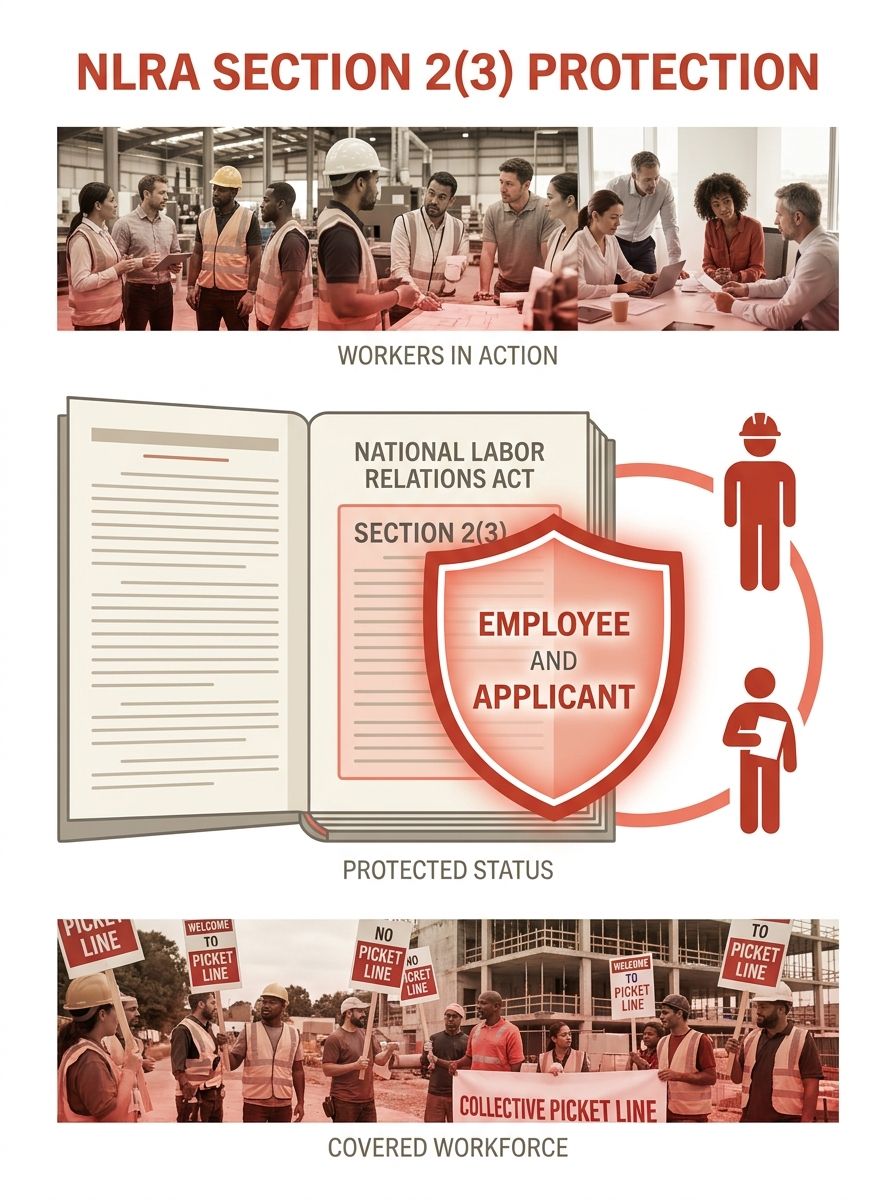
Section 2(3) of the National Labor Relations Act protects all job applicants from discrimination based on union activity or sympathy. This includes people who apply with the open intent to organize coworkers. Courts have upheld this status repeatedly over 9 decades.
As Fisher Phillips noted in their analysis of the 2025 guidance, "salting is a legitimate organizing activity, and 'salts' are protected from discrimination and retaliation under federal labor law." An employer who refuses to hire someone because of union ties commits an unfair labor practice under Sections 8(a)(1) and 8(a)(3) of the NLRA.
Why frame this as a civil rights issue? Because the right to organize is a labor right, and labor rights are civil rights. An employer who reads your resume, sees that you worked at a unionized hotel, and tosses your application is engaging in viewpoint discrimination. The NLRA prohibits exactly this. A salt who identifies prior union affiliation on a job application, or who states an intent to organize, is exercising a right the federal government has protected since the Wagner Act became law in 1935.
Understand why unions send organizers inside in the first place
Under current U.S. labor law, unions may be prohibited from talking with workers in the workplace. Outside organizers often cannot set foot on company property. Employers control the physical space. They run captive audience meetings. They hire consultants to deliver anti-union messaging on the clock. Workers hear one side of the story for 8 to 12 hours a day.
Salting exists because this legal playing field is tilted. When an organizer takes a real job at a target company, they gain the same rights as every other employee: talking with coworkers during breaks, sharing literature in non-work areas, and advocating for collective bargaining. The tactic has deep roots in construction, hospitality, and retail, where high turnover makes outside organizing difficult. The IBEW developed its COMET (Construction Organizing Membership Education Training) program specifically to prepare members for union salting tactics.
James Walsh spent 2 years as an undercover organizer for UNITE HERE, applying for jobs at non-union hotels and restaurants. He described the work in The Atlantic as a daily balancing act between doing real work and building trust for organizing conversations. The tactic has spread well beyond the trades. Jaz Brisack, a Rhodes Scholar, became a barista at a Starbucks in Buffalo, New York. She helped launch one of the most visible organizing campaigns in recent memory. As Duane Morris noted, for organizers like Brisack, "unionization is a cause, not a way to make a living through union dues."
Choosing which organizing model to follow during a salting campaign shapes the entire effort. Salts who prioritize one-on-one relationship building over top-down messaging consistently produce stronger results.
Learn what GC Memorandum 25-08 actually changed
The July 24, 2025 guidance from Acting General Counsel William Cowen directs NLRB regional offices to investigate salting complaints with new scrutiny. The biggest change: investigators must now "deeply probe" whether a job applicant had a genuine interest in the job they sought.
Before this memo, the NLRB's 2007 decision in Toering Electric Company had already begun narrowing NLRA protections. That case held that an applicant who showed no genuine interest in employment might fall outside the Act's definition of "employee." But the standard was applied loosely. The new guidance makes it a formal investigative requirement.
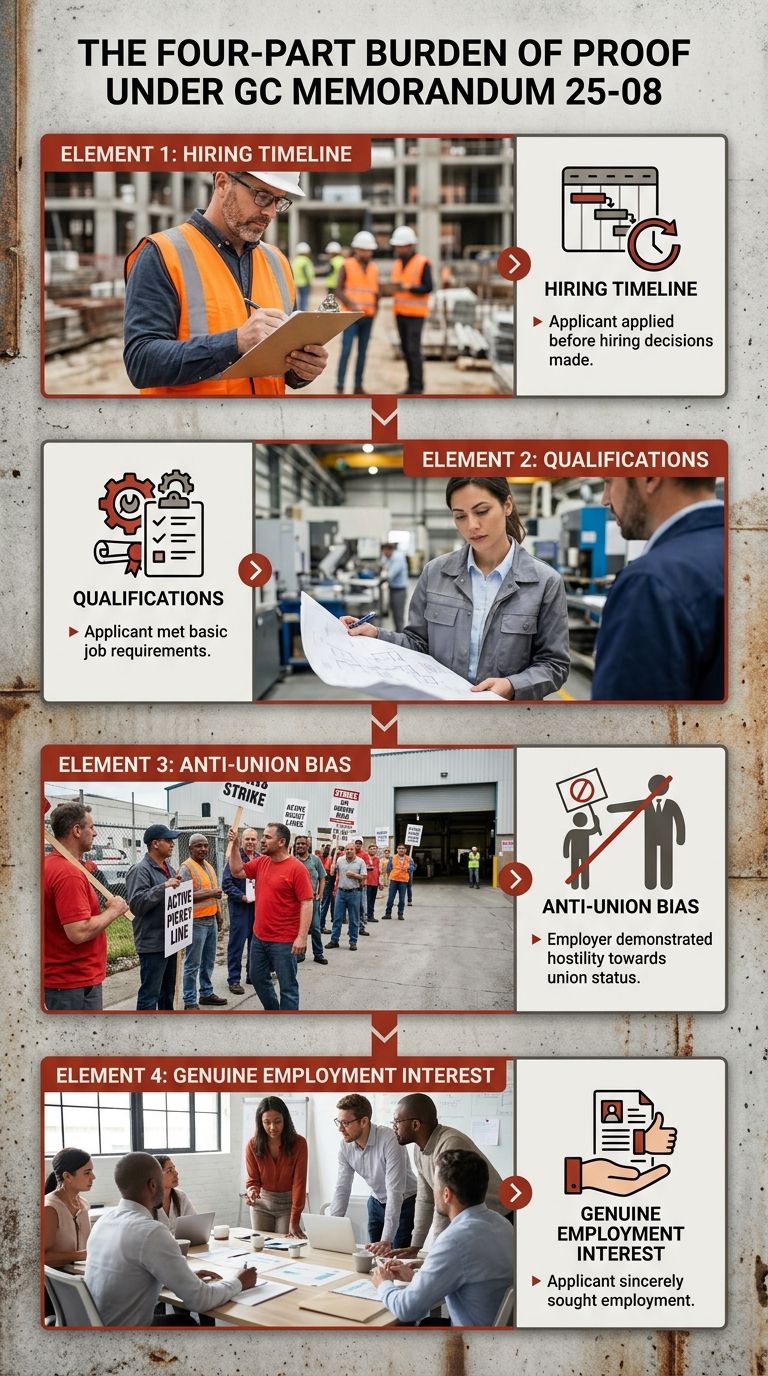
When a union files an unfair labor practice charge alleging that an employer refused to hire a salt, the General Counsel must now prove 4 elements:
The applicant applied when the employer was actively hiring or planning to hire
The applicant was qualified, or the employer applied hiring standards inconsistently
The employer rejected the applicant because of anti-union bias
The applicant had a genuine interest in the job
That fourth element is new as an explicit requirement. Investigators look for "red flags" in applications: listing "filing charges" as a hobby, submitting resumes that emphasize organizing over job skills, or sending mass applications without individual authorization. Employers can rebut a salt's claimed sincerity by showing disruptive behavior, refusal of similar jobs, or incomplete applications.
The memo also limits backpay. Under the Oil Capitol Sheet Metal, Inc. framework, the General Counsel must provide evidence of how long a salt would have stayed on the job. Backpay no longer runs indefinitely by default. For organizers, the practical impact is clear: every salting campaign now demands better documentation from day one.
Document everything from the moment you submit an application
This rule applies whether you're a trained salt or a worker who happens to have union experience on your resume. If an employer denies you a job and you suspect anti-union bias, your case will live or die on records.
Keep copies of every application. Save confirmation emails. Screenshot job postings that prove the employer was hiring. If anyone asks about union affiliation during an interview, write down the exact question, who asked it, and the time within 24 hours. Under the new guidance, NLRB investigators will examine whether your application was complete, professional, and tailored to the position.
Spilman Thomas & Battle's analysis confirmed that a salt may identify prior union affiliation on an application or state an intent to organize and still receive NLRA protections. Being open about your beliefs does not forfeit your rights. But the application itself must reflect a real desire to do the work.
For unions running salting campaigns, the documentation standard should be higher than ever. Secure digital record-keeping of application materials, interview notes, and correspondence protects organizers and strengthens any future unfair labor practice charge. Retain everything for at least 12 months. The statute of limitations for filing a ULP charge is 6 months, but litigation can stretch well beyond that window.
Train for the work itself, not a performance
Salting campaigns collapse when organizers treat the job as a cover story instead of a real position. The most effective salts are workers first. They show up on time, do the job well, build genuine relationships, and earn trust through shared daily experience. The organizing grows from those relationships naturally.
UNITE HERE's mentorship programs and the IBEW's COMET training both stress this point. Salts learn one-on-one organizing techniques, their legal rights under the NLRA, and strategies for building internal support. But the foundation is always competence at the job. An organizer who can't bus tables, wire a junction box, or run a register won't earn the respect needed to start real conversations about converting workplace complaints into a campaign.
Under the July 2025 guidance, this approach serves a legal purpose too. An organizer who performs well, shows up reliably, and treats the job seriously builds a strong record of genuine employment interest. An organizer who does the bare minimum, provokes management in the first week, or openly disrupts operations hands the employer the evidence they need to challenge NLRA protections.
Trust is the currency of every organizing strategy. That trust comes from being a reliable coworker, not from delivering speeches about solidarity on your first shift.

Recognize employer "detection" for what it is
Employer-side law firms publish detailed guides on how to spot undercover organizers during the hiring process. They recommend screening for "red flags" like union keywords on resumes, overqualification, and unusual interest in workplace policies. Some advise rejecting applicants whose work history shows multiple short stints at organized workplaces.
Think about what that means. An employer reads your resume, sees that you once belonged to a union local, and decides you're too risky. That is viewpoint-based exclusion. It violates Section 8(a)(3) of the NLRA. And it mirrors a long, documented history of workplace infiltration by employers themselves, from the Pinkerton agents hired to "sow disinformation, disrupt meetings, and expose weaknesses" in labor organizations to the Remington Rand corporation's formalized union-busting playbook in 1936.
Modern detection tactics are more polished. The impulse behind them is identical. Anti-union consultants sometimes flood a prospective bargaining unit with new hires who are pressured to vote against representation. That practice, importing workers to dilute pro-union sentiment, is the actual mirror image of salting. The employer builds a workforce designed to suppress organizing.
Framing union salting tactics as "workplace infiltration" serves an employer narrative that casts organizers as invaders rather than workers exercising protected rights. The framing itself is a union-busting tool. Call salting what the law says it is: protected organizing activity. Workers interested in understanding how authorization cards fit into this process should study the legal checkpoints that determine a campaign's trajectory.
Never forget that rights on paper require enforcement in practice
The NLRA gives workers the right to organize. It gives salts the right to apply for jobs and build support from within. GC Memorandum 25-08 hasn't eliminated those rights. But it has made enforcing them harder by adding investigative requirements that favor employers.
Winning an unfair labor practice case after being denied a job can take months. During that time, an organizer who was rejected still needs income. Backpay, even when awarded, arrives after a process that can stretch across 1 to 2 years of litigation. The rights are real. The enforcement gap is real too.
Salts who document every step, apply with genuine care, and perform their jobs with discipline put themselves in the strongest position. Unions that invest in legal training, secure communication channels, and mentorship for organizers protect their people and their campaigns. Employers who build hiring systems to screen out workers with union sympathies should know that those systems create legal liability under the NLRA. And workers at every level should understand that the right to organize at work is older than Social Security, older than the minimum wage, and backed by 91 years of federal law.
When These Rules Break Down
These principles assume a functioning NLRB and consistent enforcement. Neither is guaranteed. The agency's priorities shift with each new General Counsel and each presidential administration. GC Memorandum 25-08 could be rescinded, rewritten, or replaced within a year.
Salting also carries personal costs no rulebook can eliminate. Organizers who take jobs at hostile companies face surveillance, retaliation, and daily stress. Legal protections exist, but exercising them requires time, money, and stamina.
And the strategy doesn't work everywhere. In small workplaces where employees know each other well, a new hire with organizing intent will stand out fast. Salting works best in industries with high turnover, large workforces, and frequent hiring cycles. Construction, hospitality, retail, and food service remain the most common targets because those conditions exist in abundance.
The deeper truth is that salting exists because American labor law makes standard organizing so difficult. If workers could freely discuss unionization without employer interference, if outside organizers had meaningful workplace access, the pressure to send trained organizers undercover would drop. Salting is a response to a system that forces workers to fight for rights they already hold on paper. Understanding that system, documenting your experience within it, and approaching the work with discipline and genuine solidarity is how those rights get turned into something real.
The Union Edge Staff
Related Articles

The Salting Strategy Playbook: How Pro-Union Workers Organize From Inside High-Resistance Workplaces
Three distinct salting tactics dominate internal union organizing in high-resistance workplaces: professional salts paid by unions, covert activist salts driven by ideology, and hybrid organizers trained at schools like the Inside Organizer School.

From Salting to Sustained Campaigns: How Unions Plant Organizers and Build Lasting Workplace Power
Salting, the practice of trained union organizers taking jobs at non-union workplaces to build support from the inside, drove the first successful Starbucks organizing campaign in decades.

When Employers Fight Back: Recognizing and Countering Union-Busting Tactics During Your Organizing Campaign
U.S. employers are charged with violating federal law in 41.5% of all union election campaigns, according to a study from the Economic Policy Institute. The violations follow a predictable script.
Also in the paper