
state of pennsylvania minimum wage: Current Rates
Pennsylvania's minimum wage is $7.25 per hour, the lowest rate any state can legally enforce because it mirrors the federal floor set by the Fair Labor Standards Act.

State of Pennsylvania Minimum Wage: How the Wage Floor Actually Works
Pennsylvania's minimum wage is $7.25 per hour, the lowest rate any state can legally enforce because it mirrors the federal floor set by the Fair Labor Standards Act. That rate took effect on July 24, 2009, and has not changed in over 17 years, making Pennsylvania one of 20 states still pinned to the federal minimum while the real purchasing power of that wage has dropped roughly 30%.
What the Pennsylvania Minimum Wage Act Requires
The Pennsylvania Minimum Wage Act (Act 5 of 1968, amended by Act 2006-112) establishes the state's own wage floor independent of federal law. When the state rate falls at or below the federal rate, the federal number controls. That's exactly what happened in 2009: the FLSA's final scheduled increase brought the federal minimum to $7.25 per hour, and Pennsylvania's rate, which had already been raised to $7.25 under Act 2006-112, locked in at the same number. Since then, neither the federal government nor the state legislature has raised the floor. The result is a wage rate frozen in an economy that has moved on without it.
The Act applies to most Pennsylvania employers with two or more employees. Exempt categories include agricultural workers, domestic workers employed on a casual basis, newspaper delivery workers, and certain seasonal amusement or recreational establishment employees. If you work for any employer covered by both state and federal law, you're entitled to whichever minimum is higher. Right now, those two numbers are identical.
The Tipped Wage Sub-Minimum and How Tip Credit Functions
Tipped workers in Pennsylvania face an entirely different pay structure. Their base cash wage is $2.83 per hour, slightly above the federal tipped minimum of $2.13. The gap between $2.83 and the full $7.25 minimum is called the "tip credit," and it allows employers to count a worker's tips toward meeting the minimum wage obligation.
Here's where the mechanism gets important for workers' rights. Under both the Pennsylvania Minimum Wage Act and the FLSA, if a tipped employee's combined hourly earnings (base wage plus tips) fall below $7.25 in any pay period, the employer must make up the difference. The Pennsylvania Department of Labor and Industry states this obligation explicitly: the employer must supplement wages so total hourly compensation reaches at least $7.25.
A "tipped employee" under Pennsylvania law is someone who customarily and regularly receives more than $30 per month in tips. That definition pulls in servers, bartenders, valets, and many hotel workers. It does not include fast-food workers, retail employees, or anyone whose tips are occasional rather than routine.
The enforcement problem is significant. Workers who don't track their tips carefully, or whose employers don't maintain accurate records, often fall through the gap. The make-up pay obligation exists on paper, but proving a violation requires documentation that many low-wage workers don't have.
The 80/20 Rule and Dual-Duty Work
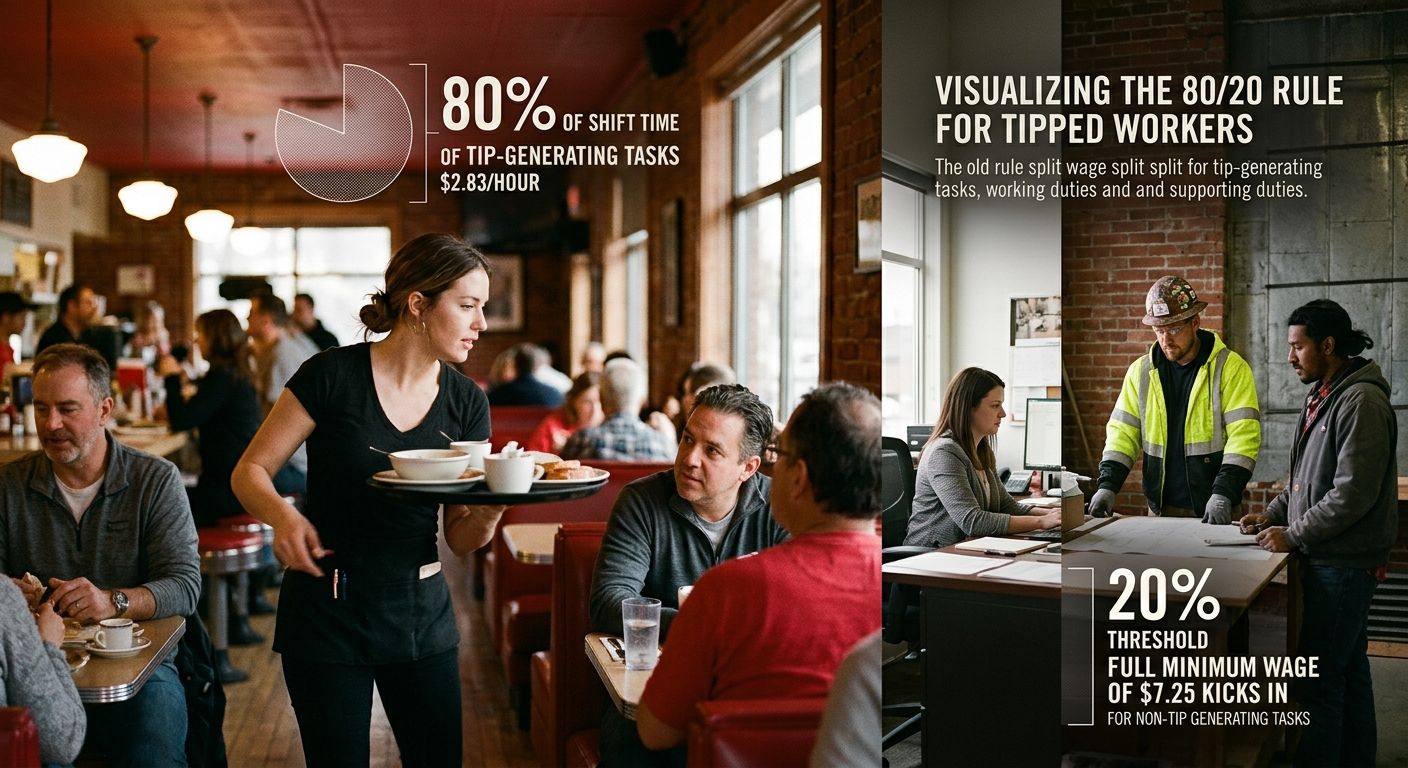
Pennsylvania follows the federal "80/20" standard for tipped employees, and understanding this rule matters for anyone whose shift involves tasks that don't generate tips. Under this framework, tipped employees must spend at least 80% of their work time on tip-generating activities. If a server spends more than 20% of a shift rolling silverware, cleaning, restocking, or performing other side work, the employer must pay the full $7.25 minimum for those non-tipped hours rather than the $2.83 sub-minimum.
This rule has been a persistent source of wage theft claims across the restaurant industry nationally. The practical challenge is straightforward: most employers don't track side-work time with any precision, and most tipped workers don't have the use to demand that tracking in real time.
Overtime Protections Built on Top of the Floor
Pennsylvania's overtime rules layer on top of the minimum wage floor. Covered employees earn 1.5 times their regular rate for every hour worked beyond 40 in a single workweek. For a worker earning exactly $7.25/hour, that means $10.88/hour for each overtime hour. The overtime obligation applies regardless of whether the employee is paid hourly, by piece rate, or on a salary basis, unless the worker qualifies for an exemption under the state or federal "white collar" tests.
The salary threshold for exempt status is $684 per week ($35,568 annually). Workers earning below that threshold are entitled to overtime pay even if their employer classifies them as salaried. Misclassification of non-exempt workers as exempt remains one of the most common wage violations in the state, and it hits workers in food service, retail management, and home health care particularly hard. For context on how the federal minimum wage interacts with state-level overtime rules, the key principle is that the higher standard always applies.
Why the Rate Has Been Frozen for 17 Years
The state of Pennsylvania minimum wage has remained at $7.25/hour through a specific legislative failure, not through deliberate policy design. The Republican-controlled Pennsylvania Senate has refused to bring minimum wage increases to a floor vote for over a decade, even as the Democratic-controlled House has passed multiple increase bills.
The most recent effort is HB 2189, which the Pennsylvania House passed in March 2026. The bill proposes phased increases: $9 in 2026, $10 in 2027, and $11 beginning January 1, 2028. Governor Josh Shapiro has publicly called on the Senate to act, pointing to the 30% erosion of purchasing power since 2009. The bill sits in the Senate with no committee hearing scheduled.
This pattern is familiar to anyone who tracks how states like Maryland have moved to $15/hour while others remain stuck at the federal floor. The mechanism of failure is consistent: a state legislature split between parties, with the chamber blocking increases facing no direct electoral consequence for inaction. States where voters can bypass the legislature through ballot initiatives, like Michigan, have generally raised their floors. Pennsylvania has no statewide citizen initiative process.
Meanwhile, the market has moved. According to 2025 data from the Pennsylvania Department of Labor and Industry, only 42,900 workers in the state earn the minimum wage or less, a 42% decline since 2020 and less than 1% of the total workforce. But approximately 553,700 Pennsylvania workers still earn less than $15/hour. The minimum wage isn't just a line on a chart; it serves as an anchor that depresses wages for everyone clustered near it, even those earning a dollar or two above the floor.
Where the Mechanism Breaks
Pennsylvania's minimum wage structure has several failure points that disproportionately affect the workers it's supposed to protect.
No local override. Unlike states such as California or New York, Pennsylvania does not allow cities or counties to set their own minimum wages. Philadelphia, with a cost of living dramatically higher than rural Pennsylvania, is locked to the same $7.25 floor. The city passed a $15/hour minimum for city employees and contractors, but that order doesn't extend to private employers. This preemption means the state's most expensive labor markets have no tool to address local wage adequacy.
No automatic indexing. The state of Pennsylvania minimum wage has no built-in adjustment for inflation. Every increase requires a new act of the legislature, which means the real value of the wage erodes continuously between increases. States like Washington and Oregon have tied their minimums to the Consumer Price Index, creating automatic annual adjustments. Pennsylvania's structure guarantees that the floor loses value every single year it isn't raised through legislation.
Enforcement gaps for tipped workers. The make-up pay obligation and the 80/20 rule both depend on employer record-keeping and worker awareness. The Pennsylvania Department of Labor and Industry can investigate complaints, but staffing for wage investigations has not kept pace with the complexity of tip-credit compliance. Workers who don't know they're owed make-up pay never file a complaint. The tools tracking employer spending on labor compliance avoidance give some indication of how much resources flow toward circumventing worker protections compared to how little flows toward enforcing them.
Exempt worker classification abuse. The $684/week salary threshold for overtime exemption creates a gray zone where employers classify workers as exempt managers to avoid overtime obligations, even when those workers spend most of their hours performing non-managerial duties. This is a structural weakness in any minimum-wage-plus-overtime system, and it's especially acute when the base minimum is low enough that pushing someone to $684/week feels like a significant raise.
Common Questions
Does the state of Pennsylvania minimum wage apply to all workers?
The Pennsylvania Minimum Wage Act covers most employers with two or more employees, but it exempts agricultural workers, certain domestic workers, newspaper delivery workers, and seasonal amusement employees. Workers covered by both state and federal law are entitled to whichever minimum is higher. Because Pennsylvania's rate and the federal rate are both $7.25, the practical distinction rarely matters for covered workers.
Can Philadelphia or Pittsburgh set a higher minimum wage?
No. Pennsylvania preempts local wage ordinances. Cities and counties cannot establish minimum wages higher than the state rate for private-sector employers. Philadelphia has set a $15/hour minimum for city employees and contractors, but that applies only to government-funded positions, not the broader private workforce.
What happens if my tips don't bring me up to $7.25/hour?
Your employer is legally required to make up the difference. Under both the Pennsylvania Minimum Wage Act and the FLSA, if your combined cash wage ($2.83/hour) plus tips falls below $7.25 for a pay period, the employer must pay you additional wages to reach the $7.25 floor. If your employer isn't doing this, you can file a complaint with the Pennsylvania Department of Labor and Industry.
How does Pennsylvania's minimum wage compare to neighboring states?
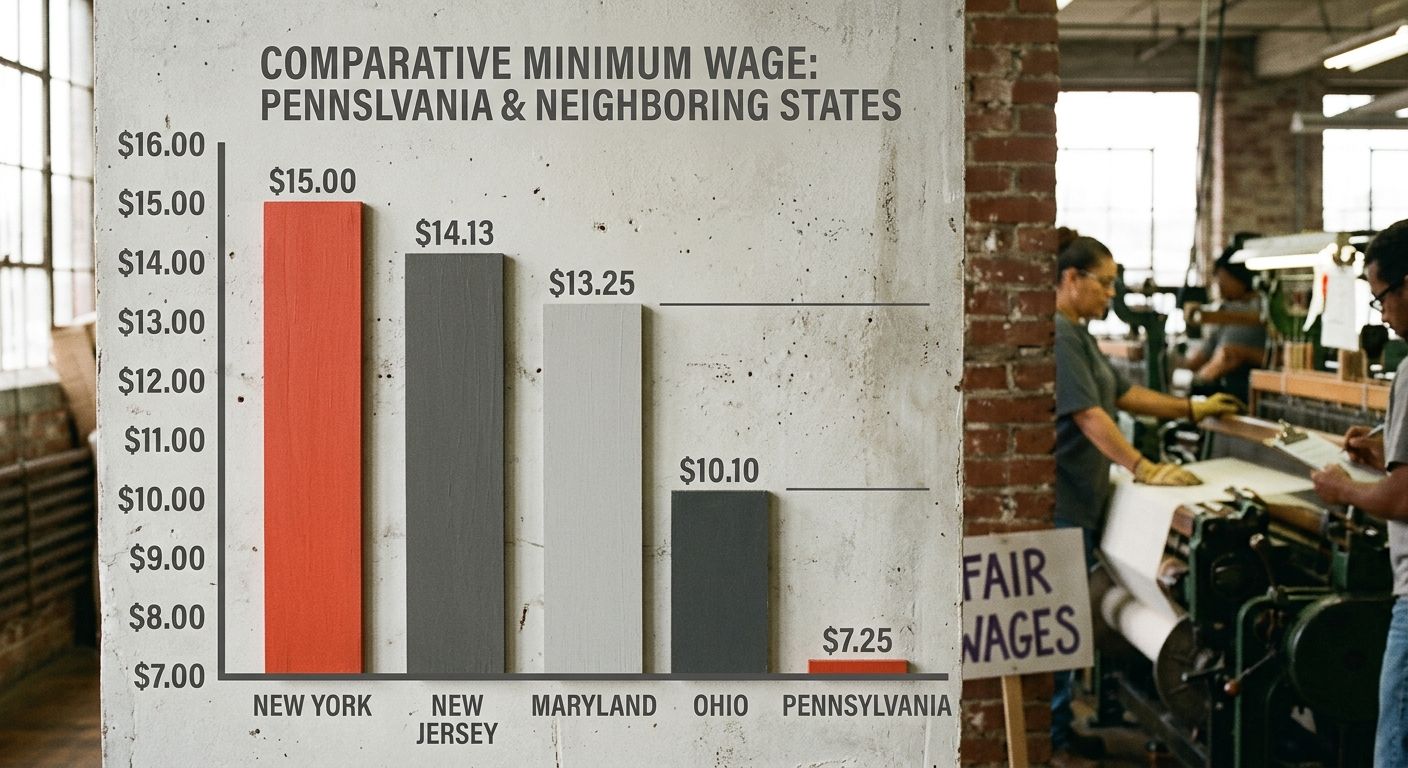
Pennsylvania's $7.25/hour rate is the lowest among its neighbors. New Jersey's minimum wage is $15.49/hour, New York's ranges from $15 to $16.50 depending on region, Maryland's is $15/hour, and Ohio's is $10.70/hour. West Virginia, at $8.75, is the closest neighbor above Pennsylvania's rate. The contrast is stark: a full-time worker crossing the border from Pennsylvania to New Jersey earns roughly $17,100 more per year for the same 40-hour week.
Is there any pending legislation to raise the rate?
HB 2189 passed the Pennsylvania House in March 2026 with proposed phased increases to $9, $10, and then $11 by 2028. The bill is stalled in the Republican-controlled Senate. The growing movement for union membership and collective bargaining power offers workers an alternative path to higher wages even without legislative action, but it can't substitute for a higher statutory floor that covers all workers regardless of union status.
The Union Edge Staff
Frequently Asked Questions
- What is the current minimum wage in Pennsylvania?
- Pennsylvania's minimum wage is $7.25 per hour, which has been in effect since July 24, 2009, and mirrors the federal minimum wage set by the Fair Labor Standards Act.
- What is the tipped minimum wage in Pennsylvania?
- Tipped workers in Pennsylvania earn a base cash wage of $2.83 per hour, and employers must make up the difference if tips don't bring total hourly earnings to at least $7.25.
- Can Philadelphia set its own higher minimum wage?
- No, Pennsylvania preempts local wage ordinances, so Philadelphia cannot establish a minimum wage higher than the state rate for private-sector employers, though the city has set a $15/hour minimum for city employees and contractors only.
- What is the 80/20 rule for tipped employees in Pennsylvania?
- Tipped employees must spend at least 80% of their work time on tip-generating activities; if they spend more than 20% on non-tipped tasks like cleaning or prep work, employers must pay the full $7.25/hour for those hours instead of the $2.83 sub-minimum.
- How much overtime pay do Pennsylvania workers earn?
- Covered employees earn 1.5 times their regular rate for every hour worked beyond 40 in a single workweek; for a worker earning $7.25/hour, that equals $10.88/hour for overtime.
- How does Pennsylvania's minimum wage compare to neighboring states?
- Pennsylvania's $7.25/hour is the lowest among its neighbors: New Jersey is $15.49/hour, New York ranges from $15-$16.50, Maryland is $15/hour, Ohio is $10.70/hour, and West Virginia is $8.75/hour.
- What pending legislation exists to raise Pennsylvania's minimum wage?
- HB 2189 passed the Pennsylvania House in March 2026 proposing phased increases to $9 in 2026, $10 in 2027, and $11 by January 1, 2028, but the bill is stalled in the Republican-controlled Senate with no committee hearing scheduled.
- What is the salary threshold for overtime exemption in Pennsylvania?
- Workers earning below $684 per week ($35,568 annually) are entitled to overtime pay even if their employer classifies them as salaried, as this is the salary threshold for exempt status.
Related Articles

Minimum Wage for Pennsylvania: Complete 2024 Guide
Since July 24, 2009, Pennsylvania has not raised its minimum wage by a single cent. The rate sits at $7.25 per hour, locked to the federal floor, while inflation has eroded its real purchasing power to approximately $6.87 in 2009 dollars.

Minimum Wage New Jersey 2024: Rates & Updates
New Jersey's minimum wage for most employees reached $15.13 per hour on January 1, 2024, completing a legislated climb from $8.85 in 2019 and triggering a permanent CPI-indexed adjustment formula. The rate doesn't come from annual legislative votes anymore.

Federal Minimum Wage: What You Need to Know
The federal minimum wage is $7.25 per hour, set by the Fair Labor Standards Act (FLSA) and enforced by the U.S. Department of Labor's Wage and Hour Division. That rate has been frozen since July 24, 2009, making it the longest period without an increase since the FLSA became law in 1938.
Also in the paper