
US Minimum Wage in Texas: 2024 Guide
The US minimum wage in Texas is $7.25 per hour, identical to the federal floor set under the Fair Labor Standards Act, and unchanged since July 24, 2009.

US Minimum Wage in Texas: How $7.25 Actually Works
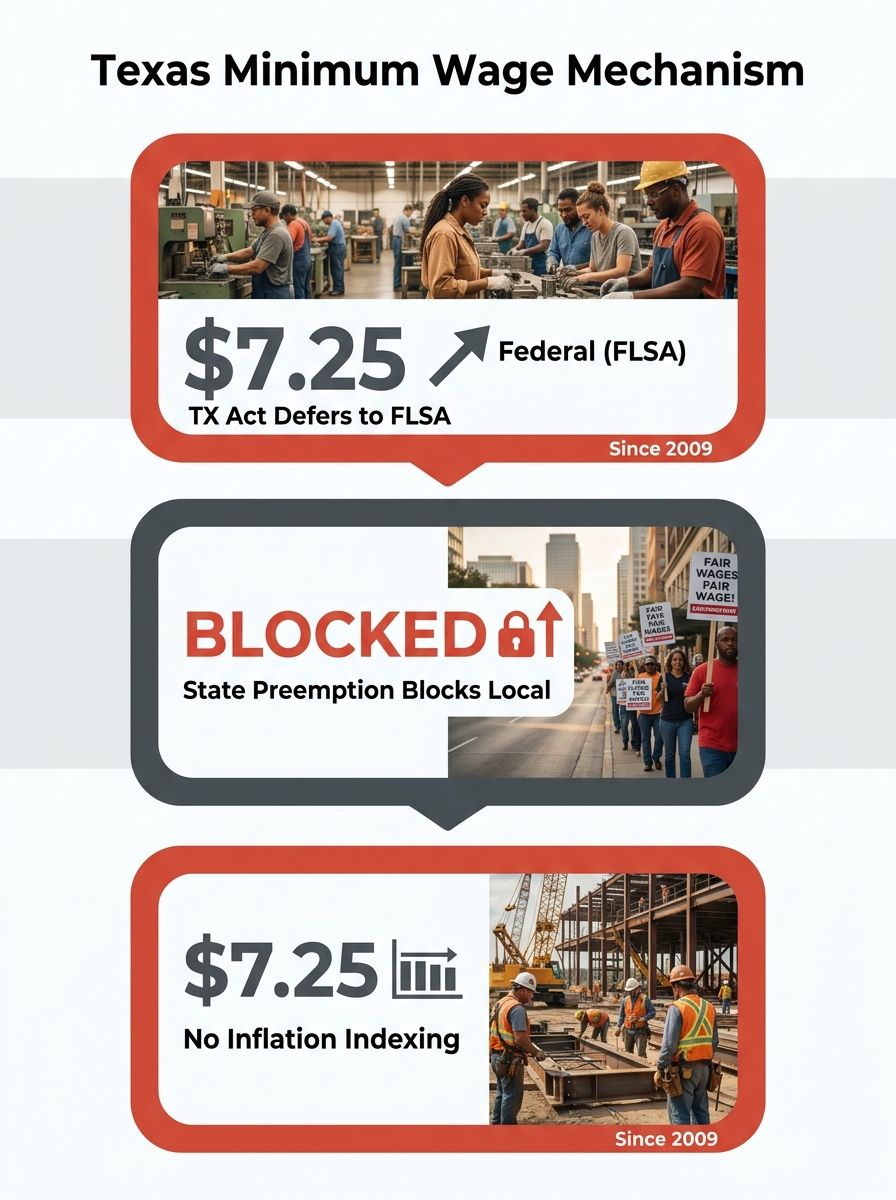
The US minimum wage in Texas is $7.25 per hour, identical to the federal floor set under the Fair Labor Standards Act, and unchanged since July 24, 2009. Three interlocking legal layers keep it frozen: a state statute that mirrors federal rates, a preemption doctrine that blocks local increases for private employers, and zero inflation indexing.
How the Texas Minimum Wage Act Defers to the Federal Rate
The Texas Minimum Wage Act does not establish an independent wage floor above the federal standard. The primary exemption from the state act is for any person already covered by the federal Fair Labor Standards Act. Since the FLSA covers the vast majority of Texas employers with annual gross sales above $500,000 or who engage in interstate commerce, most workers fall under federal jurisdiction. The state rate of $7.25 per hour functions as a default for the narrow set of employees the FLSA doesn't reach.
This means Texas doesn't have a two-tier system where state law adds protections on top of federal law, the way California's wage structure does. The state simply adopts the federal number. According to U.S. Department of Labor data, Texas is among roughly 18 states that have never raised their wage floor above the FLSA minimum. The $7.25 rate, set nationally in July 2009, has now held steady for 17 years. In purchasing-power terms, the Bureau of Labor Statistics CPI calculator shows that $7.25 in 2009 would need to be roughly $10.50 today to match inflation, meaning the real value of the Texas minimum wage has fallen by about 31%.
The $2.13 Tipped Wage and Tip Credit Arithmetic
Tipped workers in Texas receive a minimum cash wage of $2.13 per hour, with employers claiming a "tip credit" of $5.12 per hour to bridge the gap to $7.25. Texas defines a tipped employee as someone earning more than $20 per month in tips, while the federal threshold is $30 per month, according to OnPay's state wage analysis. That $10 difference in the definition means a slightly wider pool of Texas workers qualifies as "tipped" under state law compared to federal standards.
The arithmetic is straightforward in theory: if a server earns $2.13 in cash wages and $8.00 in tips during a given hour, total compensation is $10.13, which exceeds $7.25. The employer owes nothing additional. But if tips fall short on a slow shift and total hourly earnings drop below $7.25, the employer must pay the difference. In practice, the Department of Labor's Wage and Hour Division has found consistent compliance failures on this "make-up pay" obligation.
For context, compare this to states with no tip credit at all. California requires the full state minimum wage of $16.50 per hour before tips, as we've covered in our guide to California's wage rules. The difference between $2.13 and $16.50 as a guaranteed cash wage is $14.37 per hour, which over a 2,080-hour work year amounts to roughly $29,890 in guaranteed annual pay that a Texas tipped worker simply does not receive.
Why Texas Cities Can't Set Higher Private-Sector Wages
State preemption is the third layer of the mechanism. Texas law blocks municipalities from imposing minimum wage ordinances on private employers within city limits. Austin, Houston, Dallas, and San Antonio have all explored or discussed higher local floors, but none can legally mandate them for the private sector. This preemption structure puts Texas in the same camp as roughly 25 other states that restrict local wage-setting authority.
Cities have found workarounds for their own payrolls. Austin's living wage for city-contracted work was set at $22.05 per hour for the 2025–26 fiscal year, a rate three times the statewide minimum. Houston and San Antonio have established similar policies for municipal employees. But these carve-outs cover a small fraction of the workforce. A hospital janitor employed by the city of Austin earns at least $22.05; a hospital janitor at a private facility across the street may legally be paid $7.25.
This gap has material consequences for healthcare staffing. When public-sector wages outpace private-sector floors by a factor of three, workers migrate toward government jobs, leaving private healthcare employers in rural and underserved areas competing for the same labor pool with far less to offer.

Healthcare Workers Caught at the Floor
The $7.25 minimum wage has specific consequences for Texas's healthcare labor pipeline. Home health aides, certified nursing assistants, dietary aides in nursing facilities, and patient transport workers in small clinics frequently earn wages at or near the federal floor. The Bureau of Labor Statistics reports a median hourly wage for home health aides in Texas of approximately $11.00, but entry-level positions in rural counties often start at $8.00 to $9.00.
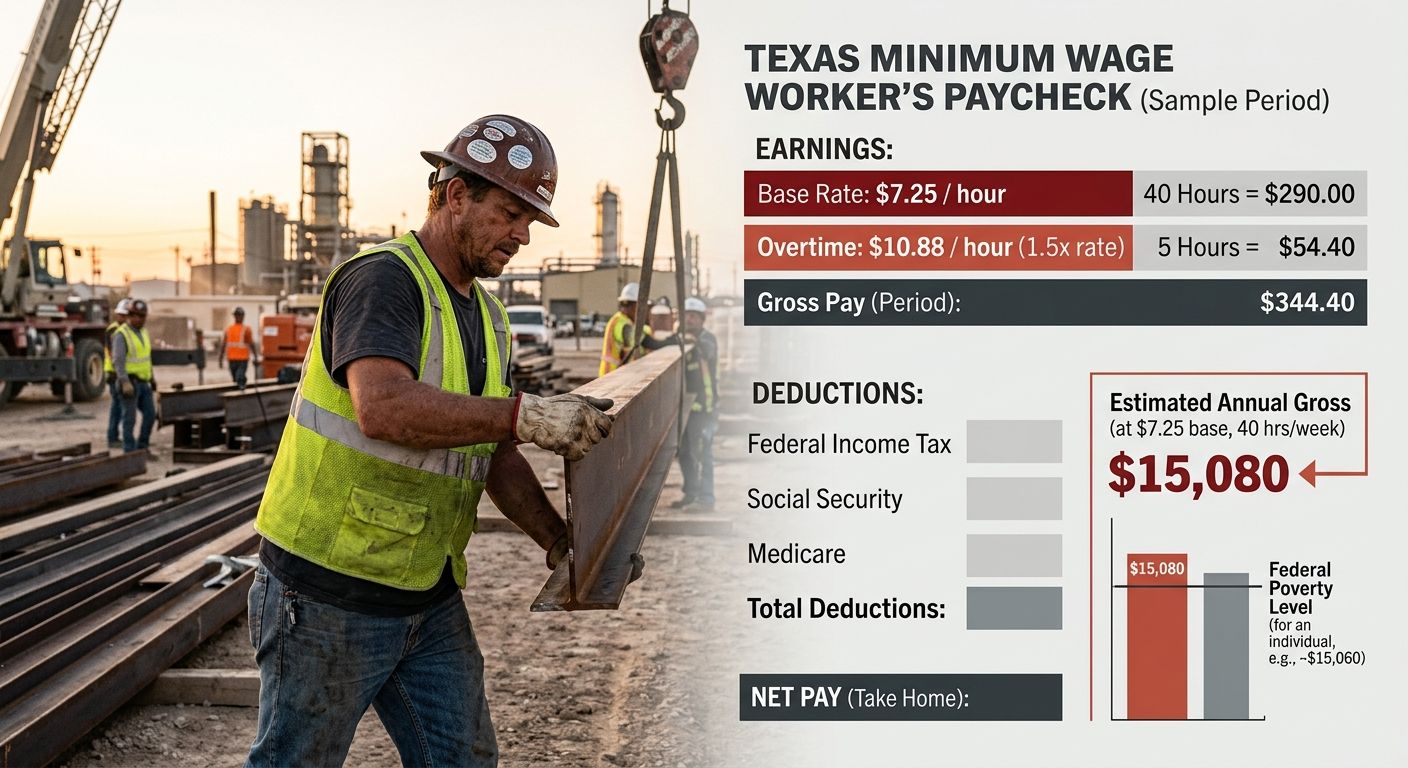
Texas has roughly 29 million residents and consistently ranks among the states with the highest rate of uninsured adults, at approximately 18% according to Census Bureau American Community Survey data. The connection between low wages and insurance coverage is direct: workers earning $7.25 per hour gross $15,080 per year at full-time hours. That's below the federal poverty line of $15,060 for a single individual (2024 guidelines), and well below any reasonable threshold for affording private health insurance without subsidies. Many healthcare support workers in Texas are themselves uninsured while providing care to others.
When Ohio raised its minimum wage through a constitutional amendment indexed to inflation, healthcare employers in that state saw measurable improvements in retention among certified nursing assistants. Texas has no equivalent mechanism. The Texas Workforce Commission does not index the state wage to the Consumer Price Index, and no pending legislation mandates such a change.
State | Minimum Wage | Indexed to Inflation | Tipped Cash Wage | Tip Credit |
|---|---|---|---|---|
Texas | $7.25 | No | $2.13 | $5.12 |
Florida | $13.00 | Yes | $9.98 | $3.02 |
Ohio | $10.45 | Yes | $5.25 | $5.20 |
California | $16.50 | Yes | $16.50 | None |
New York | $15.00+ | Yes | $10.65 | $4.35 |
This table illustrates why Texas healthcare employers face a structural recruiting disadvantage. Every bordering state or comparable large-state economy offers a higher guaranteed floor, and most index that floor to inflation so the gap widens every January.
Overtime, Pay Frequency, and Compliance Gaps
Non-exempt Texas employees must receive 1.5 times their regular rate for hours exceeding 40 in a workweek. At the $7.25 minimum, the overtime rate is $10.88 per hour. Texas has no daily overtime requirement, meaning a worker can be scheduled for a 12-hour shift without overtime pay as long as weekly hours stay at or below 40.
The Texas Payday Law requires non-exempt employees to be paid at least twice per month, with semi-monthly periods as equal in length as practicable. Exempt employees must be paid at least once per month. As of May 2026, the federal salary threshold for exempt classification remains $684 per week ($35,568 annually), and misclassifying hourly healthcare workers as exempt salaried employees is among the most common wage violations in the state.
The Commissioner of Agriculture also sets separate "piece rates" for agricultural workers picking or harvesting plants and crops, based on how much an average worker can produce in a given time period. This carve-out operates entirely outside the hourly wage framework and affects a significant segment of Texas's rural workforce.
Where the Model Breaks
The Texas minimum wage mechanism assumes the federal floor will rise periodically, keeping state wages current without state legislative action. That assumption broke in 2009 and hasn't recovered. Congress has not passed a federal minimum wage increase in 17 years, the longest gap since the FLSA's enactment in 1938. The previous record was a 10-year gap between 1997 and 2007.
The preemption layer also produces a paradox: Texas touts local governance and limited state interference, yet the preemption doctrine prevents cities from exercising local governance on wages. Austin's city council can set a $22.05 wage for its own contracts but cannot require a private nursing home within city limits to pay above $7.25. The mechanism protects a statewide floor, but in practice it functions as a statewide ceiling.
Youth workers face an additional wrinkle. Workers under 20 can be paid $4.25 per hour during their first 90 consecutive calendar days of employment. For young healthcare workers entering as dietary aides or patient transport staff, the first three months of employment can mean gross pay of roughly $680 per month at 40 hours per week, before taxes.
And the piece-rate exemption for agricultural workers creates a population of Texas workers who fall entirely outside hourly wage protections. The Texas Workforce Commission publishes piece rate schedules that tie pay to volume of harvest rather than hours worked, a structure that labor advocates have challenged as incompatible with wage adequacy.
Common Questions
Does Texas have a state minimum wage separate from the federal rate?
Technically, yes. The Texas Minimum Wage Act sets a state floor at $7.25 per hour. But the act exempts anyone covered by the FLSA, which includes the vast majority of Texas workers. The state rate functions as a backup for workers the federal law doesn't cover, not as an independent or higher standard.
Can Texas cities like Houston or Austin set their own minimum wage?
Only for municipal employees and city contractors. State preemption law prevents Texas cities from mandating a minimum wage above $7.25 for private-sector employers. Austin pays city-contracted workers $22.05 per hour, but private businesses in Austin can legally pay $7.25.
What happens if a tipped worker's total pay falls below $7.25 per hour?
The employer must pay the difference. If a tipped employee earns $2.13 in cash wages and tips bring total hourly earnings to only $6.00, the employer owes an additional $1.25 per hour for that pay period. Failure to do so violates both state and federal law. Workers who experience this shortfall can file a wage claim with the Texas Workforce Commission.
How does the Texas minimum wage affect healthcare staffing?
Texas healthcare employers, particularly nursing homes and home health agencies, compete for workers against states that pay $10 to $16+ per hour as a legal minimum. The $7.25 floor contributes to high turnover among certified nursing assistants and home health aides. Facilities in Florida, which raised its floor to $13.00 through a voter-approved constitutional amendment, report lower vacancy rates in comparable roles.
Is there pending legislation to raise the Texas minimum wage?
No legislation with realistic prospects of passage has advanced through the Texas legislature. While several bills have been introduced in past sessions proposing rates of $10 to $15 per hour, none has received a committee vote in either chamber. The FRED economic data series tracking the Texas minimum wage rate shows a flat line from 2009 through 2026.
The Union Edge Staff
Frequently Asked Questions
- What is the minimum wage in Texas in 2024?
- The minimum wage in Texas is $7.25 per hour, which matches the federal minimum wage set under the Fair Labor Standards Act and has remained unchanged since July 24, 2009.
- Can Texas cities like Austin or Houston set their own minimum wage?
- No, state preemption law prevents Texas cities from mandating a minimum wage above $7.25 for private-sector employers. Cities can only set higher wages for their own municipal employees and contractors—for example, Austin pays city-contracted workers $22.05 per hour.
- What is the tipped minimum wage in Texas?
- Tipped employees in Texas receive a minimum cash wage of $2.13 per hour, with employers claiming a tip credit of $5.12 per hour to reach the $7.25 minimum. If tips don't bring total earnings to $7.25, the employer must pay the difference.
- How much has the Texas minimum wage lost in value due to inflation?
- The $7.25 minimum wage set in 2009 would need to be approximately $10.50 today to match inflation, meaning the real value of the Texas minimum wage has fallen by about 31% over 17 years.
- What is the overtime rate for Texas minimum wage workers?
- Non-exempt Texas employees earning minimum wage receive 1.5 times their regular rate for hours exceeding 40 in a workweek, which equals $10.88 per hour. Texas has no daily overtime requirement, so workers can work 12-hour shifts without overtime pay as long as weekly hours stay at or below 40.
- How does Texas minimum wage affect healthcare worker recruitment?
- Texas healthcare employers compete for workers against neighboring states offering $10 to $16+ per hour as minimum wage, contributing to high turnover among certified nursing assistants and home health aides. The $7.25 floor gives private healthcare facilities a significant disadvantage compared to higher-paying public-sector positions.
- What is the minimum wage for workers under 20 in Texas?
- Workers under 20 can be paid $4.25 per hour during their first 90 consecutive calendar days of employment, which amounts to roughly $680 per month at 40 hours per week before taxes.
- Is there pending legislation to raise the Texas minimum wage?
- No legislation with realistic prospects of passage has advanced through the Texas legislature. While bills proposing rates of $10 to $15 per hour have been introduced in past sessions, none has received a committee vote in either chamber.
Related Articles

Minimum Texas Wage: What You Need to Know
Unlike 30 states that set independent minimum wage floors above the federal rate, Texas adopted the federal number by reference and then built a legal architecture that prevents any city or county from going higher. The result: the minimum wage in Texas has been $7.

Minimum Wage Texas: Current Laws & Rates
Chapter 62 of the Texas Labor Code contains no independent wage figure. It copies the federal minimum wage by reference, which means the texas minimum wage has been $7.25 per hour since July 24, 2009, and won't change unless Congress acts.

What Is Minimum Wage in Texas: 2024 Guide
Texas does not set its own minimum wage dollar amount. The state's minimum wage law, administered by the Texas Workforce Commission, defers entirely to the federal Fair Labor Standards Act, which means workers in Texas earn a floor of $7.25 per hour, a rate unchanged since July 24, 2009.
Also in the paper