
State of Ohio Minimum Wage: Current Rates & 2024
Constitutional Amendment II-34a, passed by Ohio voters in 2006, removed the state legislature from the annual minimum wage decision entirely.

State of Ohio Minimum Wage: Current Rates, 2024 Baseline, and How the Annual Adjustment Works
Constitutional Amendment II-34a, passed by Ohio voters in 2006, removed the state legislature from the annual minimum wage decision entirely. The state of Ohio minimum wage adjusts automatically every January 1 based on inflation, which means Ohio workers don't wait on statehouse debates to see a raise. The 2024 rate was $10.45 per hour for non-tipped employees; the current 2026 rate is $11.00. But the mechanism driving those numbers contains structural gaps that keep wages far below what workers actually need.
What Article II, Section 34a Requires
Ohio's minimum wage mechanism is embedded in the state constitution, which makes it harder to repeal than an ordinary statute and removes it from the standard legislative process. Voters approved Amendment II-34a in November 2006 with roughly 56% of the vote. The amendment did three things: it set an initial minimum wage above the federal floor, it required annual recalculation based on inflation, and it prohibited local governments from setting their own wage floors.
That last detail matters. Unlike California, where dozens of cities and counties have enacted their own minimums on top of the state floor, Ohio law preempts all local variation. Cleveland, Columbus, and Cincinnati cannot pass their own wage ordinances. The state rate is the only rate. For workers in high-cost metro areas, this creates a real problem: the same $11.00 per hour applies whether you're renting in rural Scioto County or downtown Franklin County, where living costs run significantly higher.
The Ohio Department of Commerce administers the annual adjustment and publishes the new rate each September 30, effective the following January 1.
The Gross Receipts Threshold Creates Two Wage Floors
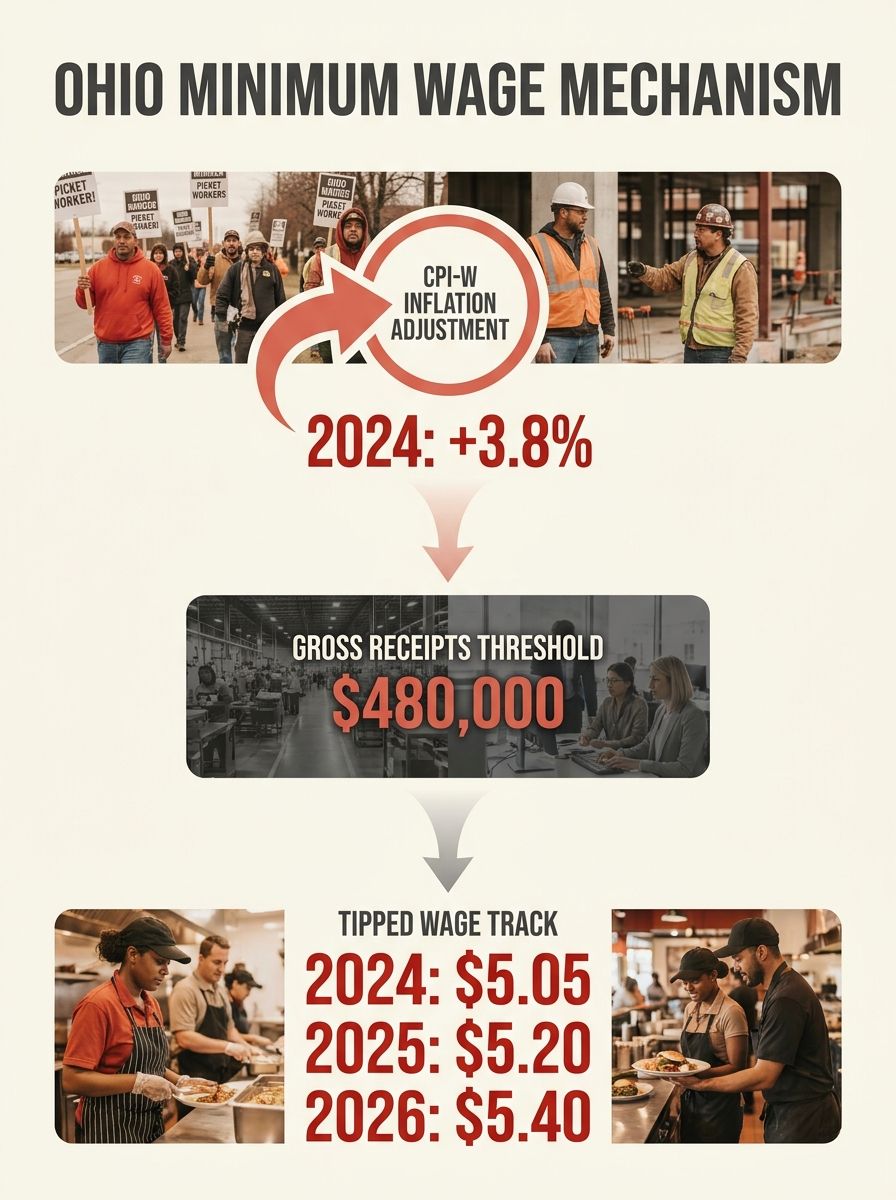
Here's where Ohio's system gets unusual. The state minimum wage applies only to employers whose annual gross receipts exceed a specific dollar threshold, and that threshold itself adjusts with inflation each year. Employers below the threshold are required to pay the federal minimum wage of $7.25 per hour instead.
The thresholds have climbed alongside the wage rate:
Year | Non-Tipped Rate | Tipped Rate | Gross Receipts Threshold |
|---|---|---|---|
2023 | $10.10/hr | $5.05/hr | $372,000 |
2024 | $10.45/hr | $5.25/hr | $385,000 |
2025 | $10.70/hr | $5.25/hr | $394,000 |
2026 | $11.00/hr | $5.50/hr | $405,000 |
For 2024, the Ohio Department of Commerce set the threshold at $385,000. As of January 1, 2026, it's risen to $405,000 in annual gross receipts. Employers who fall below that line can legally pay their workers $7.25 per hour, which is the same federal rate that hasn't budged since 2009.
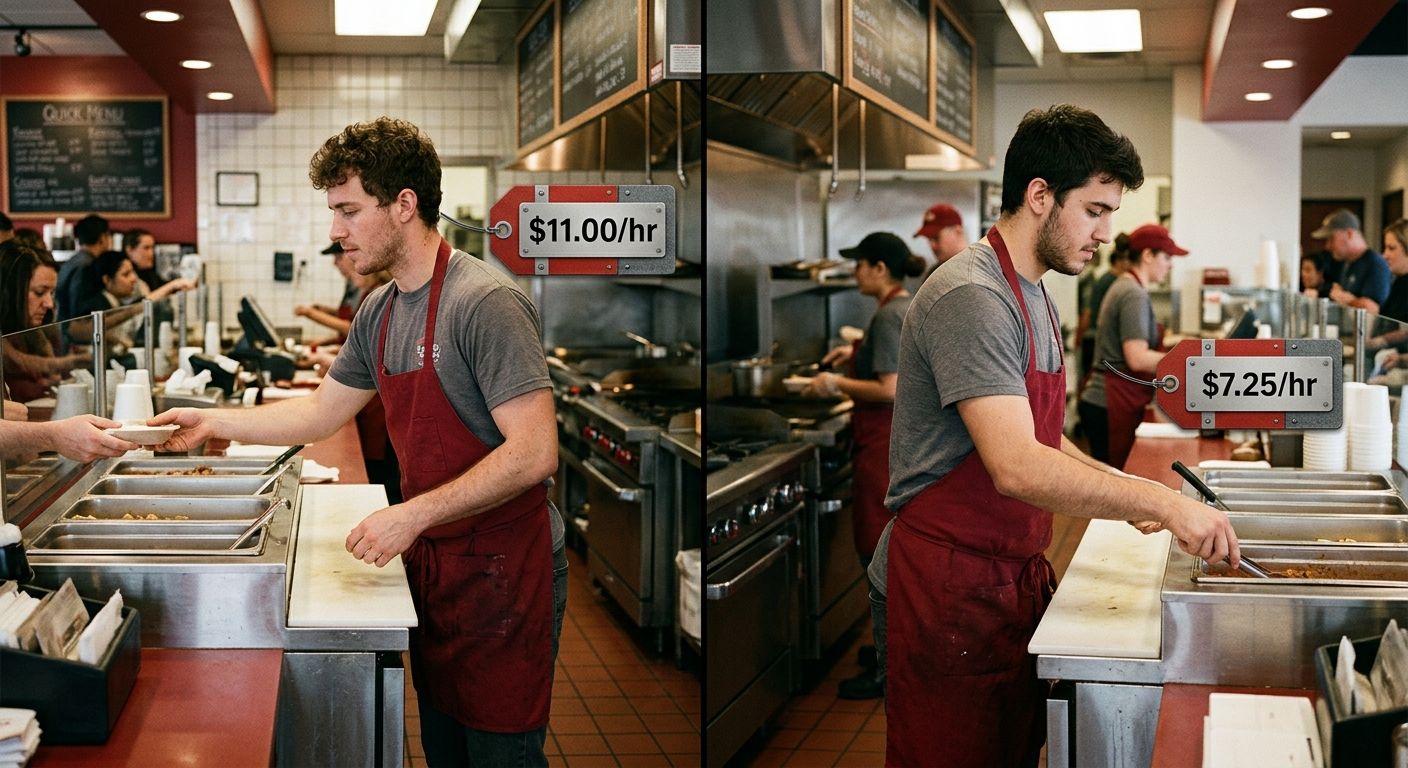
This dual-tier system means Ohio functionally operates two different minimum wages depending on the size of the business. A dishwasher at a small-town restaurant grossing $350,000 a year can earn $3.75 less per hour than a dishwasher at a chain location down the road. The work is identical. The pay gap is structural.
Workers aged 14 and 15 are also excluded from the state rate regardless of employer size. They're paid the federal $7.25.
How the CPI-W Adjustment Calculates the Annual Rate
The Consumer Price Index for Urban Wage Earners and Clerical Workers, known as CPI-W, is a federal inflation measure published by the Bureau of Labor Statistics. Ohio's constitution ties the minimum wage to this index. Each year, the Department of Commerce takes the percentage change in CPI-W and applies it to the current rate, rounding to the nearest five cents.
The adjustment is always upward or flat. Ohio's constitutional language specifies that the minimum wage cannot decrease from one year to the next, even if CPI-W declines. During periods of deflation, the rate holds steady.
From 2024 to 2025, the state of Ohio minimum wage rose $0.25, from $10.45 to $10.70 per hour. From 2025 to 2026, it rose another $0.30, reaching $11.00. According to Federal Reserve data tracked by FRED, Ohio's rate hit a record high of $11.00 in January 2026, up from a record low of $1.25 per hour in 1969.
The CPI-W mechanism produces steady, incremental raises. It avoids the political standoffs that freeze wages for years in states where legislatures control the rate. But it also means the increases are small, typically between $0.20 and $0.40 per year. At a 2% annual inflation rate, Ohio's minimum wage wouldn't reach $15.00 per hour until approximately 2034. For comparison, California's statewide floor already sits at $16.00, and Florida's amendment-driven schedule reached $13.00 in 2024 on its way to $15.00 by 2026.
Tipped Workers and the Sub-Minimum Wage
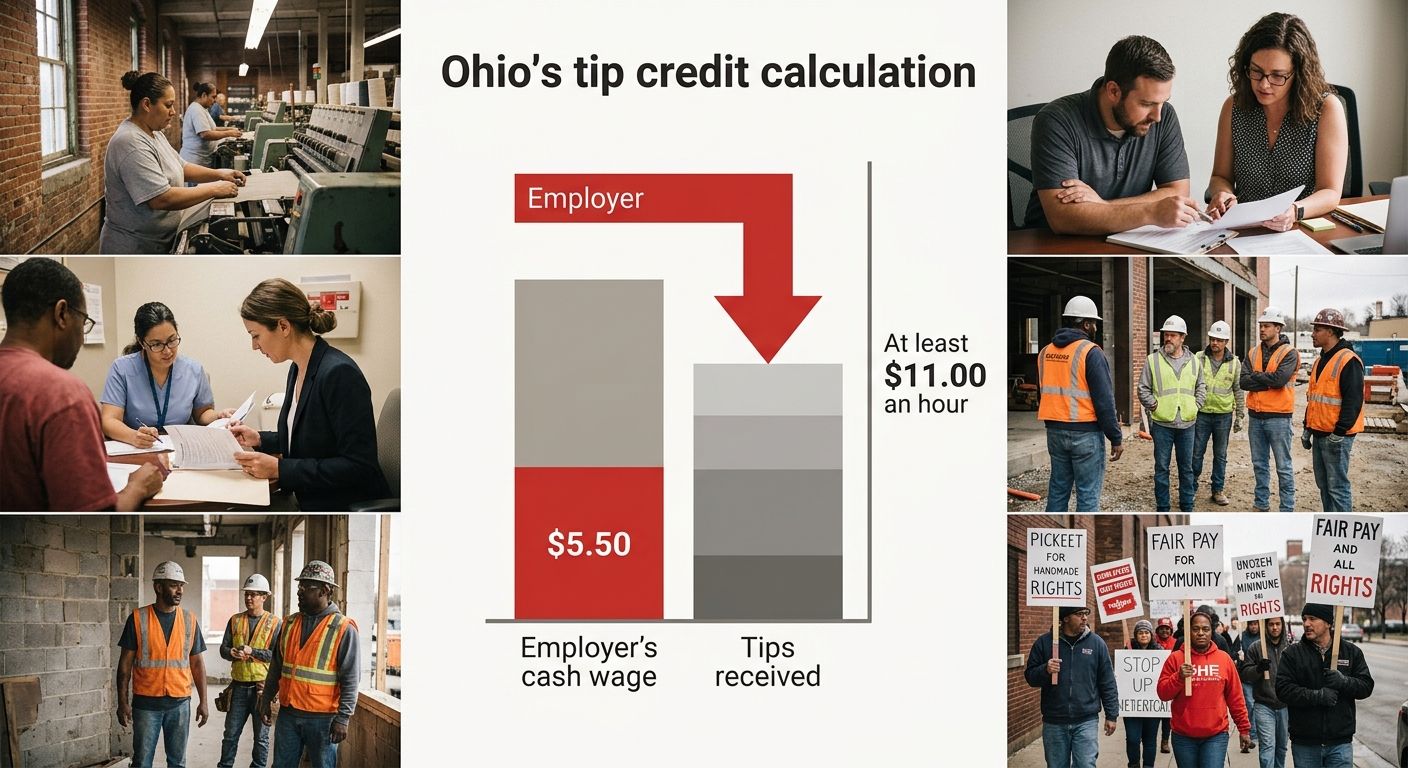
Ohio permits employers to pay tipped employees a reduced hourly rate, provided that tips bring total compensation to at least the full state minimum wage. As of 2026, the tipped minimum wage is $5.50 per hour, exactly half the standard rate. In 2024, it was $5.25.
If an employee's tips in a given pay period don't bring their effective hourly wage up to $11.00, the employer is legally required to make up the difference. This is called the "tip credit" obligation, and violating it constitutes wage theft under Ohio law.
The enforcement gap, however, is wide. Tipped workers frequently report that employers fail to track tip income accurately or refuse to cover shortfalls. The burden of proving a tip credit violation typically falls on the worker, who may not have access to their own payroll records.
Ohio House Bill 34, introduced in the state legislature, would eliminate the tipped employee minimum wage entirely and require all employees to be paid the full state rate. The bill would also raise the minimum wage to $15.00 per hour. As of mid-2026, the bill has not advanced to a floor vote. Congressional Democrats have pushed a similar concept at the federal level with a proposed $25 minimum wage bill that would eliminate the restaurant tip credit nationwide, though that legislation also faces long odds.
The Gap Between the Wage Floor and a Living Wage
Ohio's minimum wage mechanism functions as designed. It prevents wage stagnation by pegging increases to measured inflation. But the mechanism was built on top of a starting rate that was already below what workers needed, and inflation indexing can only preserve purchasing power relative to that baseline. It can't close a gap that existed from the start.
A full-time worker earning $11.00 per hour in 2026 makes approximately $22,880 per year before taxes. That figure lands $4,440 below the federal poverty level for a family of three. Even for a single adult with no dependents, $22,880 leaves little margin in any Ohio metro area after rent, transportation, and food.
The affordability math gets worse in Ohio's higher-cost counties. Research on living costs indicates that in Delaware County, one of the most expensive in the state, a minimum wage worker would need to work nearly two and a half years' worth of hours to cover a single year of expenses. And the tipped sub-minimum of $5.50 per hour produces annual base earnings of just $11,440 before tips, a figure that wouldn't cover rent alone in most Ohio cities.
Ohio's nurses have already documented how low wages and difficult conditions contribute to workplace violence and understaffing across the state's healthcare facilities. The same economic pressures ripple through every sector that relies on minimum-wage labor: food service, retail, warehousing, and home care.
Where the Model Breaks
Ohio's CPI-W indexing mechanism works well for one purpose: preventing the wage floor from eroding against inflation. It breaks down in three specific ways.
It can't correct an inadequate starting point. The 2006 amendment set the initial rate at $6.85. Every subsequent increase has been a percentage adjustment on that base. If the original rate was too low for workers to live on, annual CPI adjustments maintain that inadequacy in real terms rather than fixing it. Only legislative action or a new ballot initiative can reset the base.
The gross receipts threshold creates a legal path to poverty wages. Any employer below the threshold, which is $405,000 in 2026, can pay $7.25 per hour. That's a rate set by Congress in 2009, now 17 years without adjustment. The threshold rises with inflation, but the federal rate underneath it doesn't, meaning the gap between the two tiers widens every year.
State preemption blocks local solutions. Cities like Columbus and Cleveland, where costs of living are highest, cannot pass their own wage ordinances. The constitutional amendment that guaranteed annual increases also locked out the local governments best positioned to respond to regional cost variation. Workers in expensive metro areas are stuck with the same flat statewide rate as workers in the state's cheapest counties, with no mechanism for local adjustment.
These aren't flaws in the CPI-W math. They're structural limits on what an inflation-indexed wage floor can accomplish when the political system won't address the underlying rate or the rules that surround it.
Common Questions
Does the state of Ohio minimum wage apply to all employers?
No. The state rate of $11.00 per hour (as of 2026) applies only to employers with annual gross receipts exceeding $405,000. Employers below that threshold must pay at least the federal minimum wage of $7.25 per hour. Workers aged 14 and 15 are also paid the federal rate regardless of employer size.
How often does Ohio's minimum wage change?
Every January 1. The Ohio Department of Commerce announces the new rate each September 30, based on changes in the CPI-W inflation index. The rate can increase or stay the same but cannot decrease under the state constitution.
What was Ohio's minimum wage in 2024?
The 2024 rate was $10.45 per hour for non-tipped employees and $5.25 per hour for tipped employees, with a gross receipts threshold of $385,000.
Can Ohio cities set their own minimum wages?
No. Article II, Section 34a of the Ohio Constitution preempts local minimum wage ordinances. The statewide rate is the only enforceable minimum wage in Ohio, regardless of local cost-of-living differences.
What happens if a tipped worker's total pay falls below the minimum wage?
The employer must pay the difference. Ohio law requires that tipped employees' base pay ($5.50/hr in 2026) plus tips equal at least the full state minimum wage ($11.00/hr). Employers who fail to cover shortfalls face back-wage liability for up to three years, plus liquidated damages and attorney fees.
The Union Edge Staff
Frequently Asked Questions
- What is the current Ohio minimum wage for 2026?
- As of January 1, 2026, Ohio's minimum wage is $11.00 per hour for non-tipped employees. The tipped minimum wage is $5.50 per hour, and employers with annual gross receipts below $405,000 must pay the federal minimum of $7.25 per hour.
- How does Ohio's minimum wage adjust each year?
- Ohio's minimum wage automatically adjusts every January 1 based on the Consumer Price Index for Urban Wage Earners and Clerical Workers (CPI-W). The Ohio Department of Commerce announces the new rate each September 30, and increases are rounded to the nearest five cents.
- Can employers in Ohio pay less than minimum wage?
- Yes, employers with annual gross receipts below $405,000 can legally pay the federal minimum wage of $7.25 per hour instead of the state rate. Additionally, workers aged 14 and 15 are paid the federal rate regardless of employer size.
- Can Ohio cities like Columbus or Cleveland set their own minimum wages?
- No. The Ohio Constitution preempts all local minimum wage ordinances, so cities and counties cannot pass their own wage floors. The statewide rate is the only enforceable minimum wage in Ohio.
- What must employers do if a tipped worker's pay falls below minimum wage?
- Employers must pay the difference to bring the tipped employee's base pay plus tips to at least the full state minimum wage ($11.00 per hour in 2026). Violations constitute wage theft and carry back-wage liability for up to three years, plus liquidated damages and attorney fees.
- When will Ohio's minimum wage reach $15 per hour?
- At current inflation trajectories of approximately 2% annually, Ohio's minimum wage won't reach $15.00 per hour until approximately 2034. The tipped minimum wage won't reach $15 until around 2064.
- What was the Ohio minimum wage in 2024?
- In 2024, Ohio's minimum wage was $10.45 per hour for non-tipped employees and $5.25 per hour for tipped employees, with a gross receipts threshold of $385,000.
Related Articles

Minimum Wage Ohio: 2024 Rates & Legal Guide
Article II, Section 34a of the Ohio Constitution contains the formula that sets Ohio's minimum wage every January 1, removing the state legislature from the process entirely. The rate adjusts automatically based on the Consumer Price Index, which pushed the minimum wage in Ohio from $10.

Ohio's Minimum Wage 2024: Rates & Updates
Article II, Section 34a of the Ohio Constitution locks in an automatic minimum wage adjustment every January 1, indexed to the Consumer Price Index. The 2024 Ohio minimum wage was $10.45 per hour for non-tipped employees and $5.25 for tipped employees, and those rates have since risen to $11.

State of Colorado Minimum Wage 2024: Rates & Changes
Colorado's state minimum wage rose to $14.42 per hour on January 1, 2024, set automatically by a Consumer Price Index formula that removes the state legislature from annual rate decisions entirely.
Also in the paper