
What is the Minimum Wage in Florida
Unlike most state wage floors, which legislatures can freeze or repeal at will, Florida's minimum wage is locked into the state constitution. The current rate is $14.00 per hour, climbing to $15.

What Is the Minimum Wage in Florida? The Constitutional Mechanism Behind the Rate
Unlike most state wage floors, which legislatures can freeze or repeal at will, Florida's minimum wage is locked into the state constitution. The current rate is $14.00 per hour, climbing to $15.00 on September 30, 2026, the final step of Amendment 2, which Florida voters approved in November 2020 with 60.82% support.
How Amendment 2 Rewrote Florida's Wage Floor
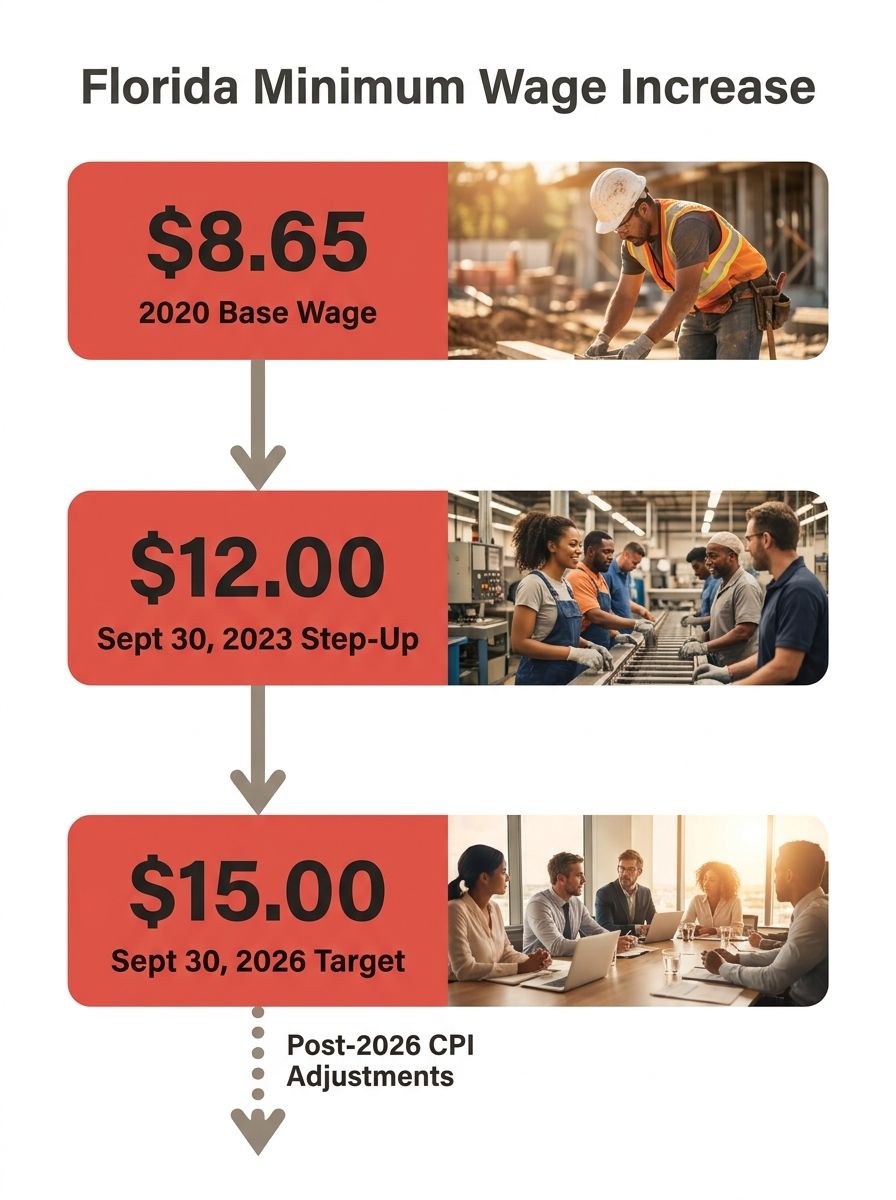
Florida's minimum wage sat at $5.15 per hour from 2000 through 2004, matching the federal rate, according to the Florida Department of Commerce's wage history records. A 2004 ballot initiative created the first constitutional minimum wage provision, and for years afterward, the rate inched upward in small CPI-linked increments. By 2020, the wage had reached $8.65 per hour, a number that left a full-time worker earning roughly $18,000 annually before taxes.
The state legislature showed no interest in raising it. So Florida's workers and organizers went around them.
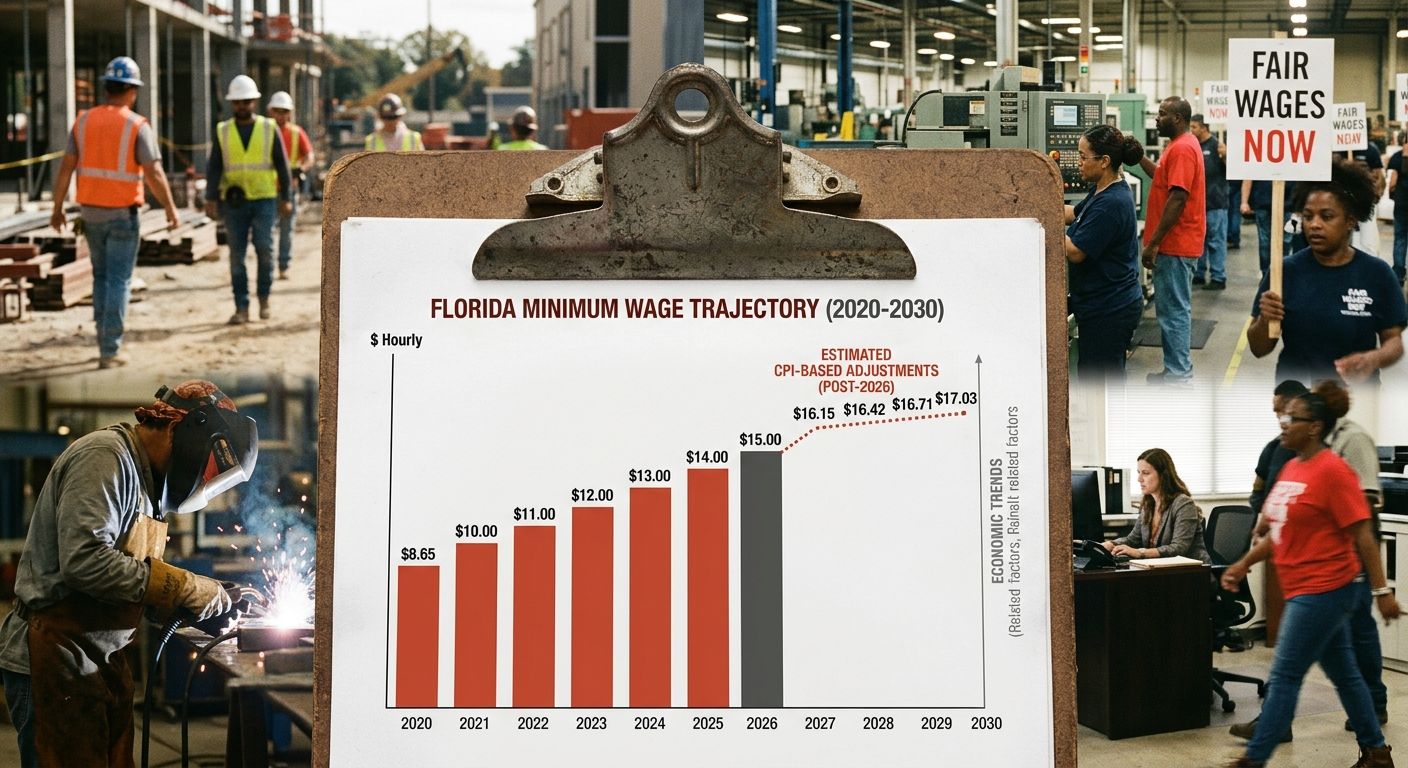
Amendment 2 appeared on the November 2020 ballot as a constitutional amendment requiring 60% approval. It passed with 60.82%, carrying the measure by roughly 2.5 million votes. The amendment's language was specific and binding: $1.00 annual increases on September 30 of each year, starting at $10.00 in 2021 and ending at $15.00 in 2026. No legislative review. No gubernatorial veto. The schedule was etched into Article X, Section 24 of the Florida Constitution.
This structure matters for anyone asking what is the minimum wage in Florida, because the answer isn't set by a bill that can be quietly amended in committee. It's set by the same document that establishes the state's court system and bill of rights.
The Current Rate and the Final Scheduled Increase
So what is Florida's minimum wage right now? As of September 30, 2025, non-tipped employees earn $14.00 per hour. That rate applies to every covered worker in the state, with no regional variation. Florida doesn't use the tiered geographic zones that Oregon employs for its wage calculations.
On September 30, 2026, about six weeks from now, the rate steps up to $15.00 per hour. This is the final fixed increase under Amendment 2.
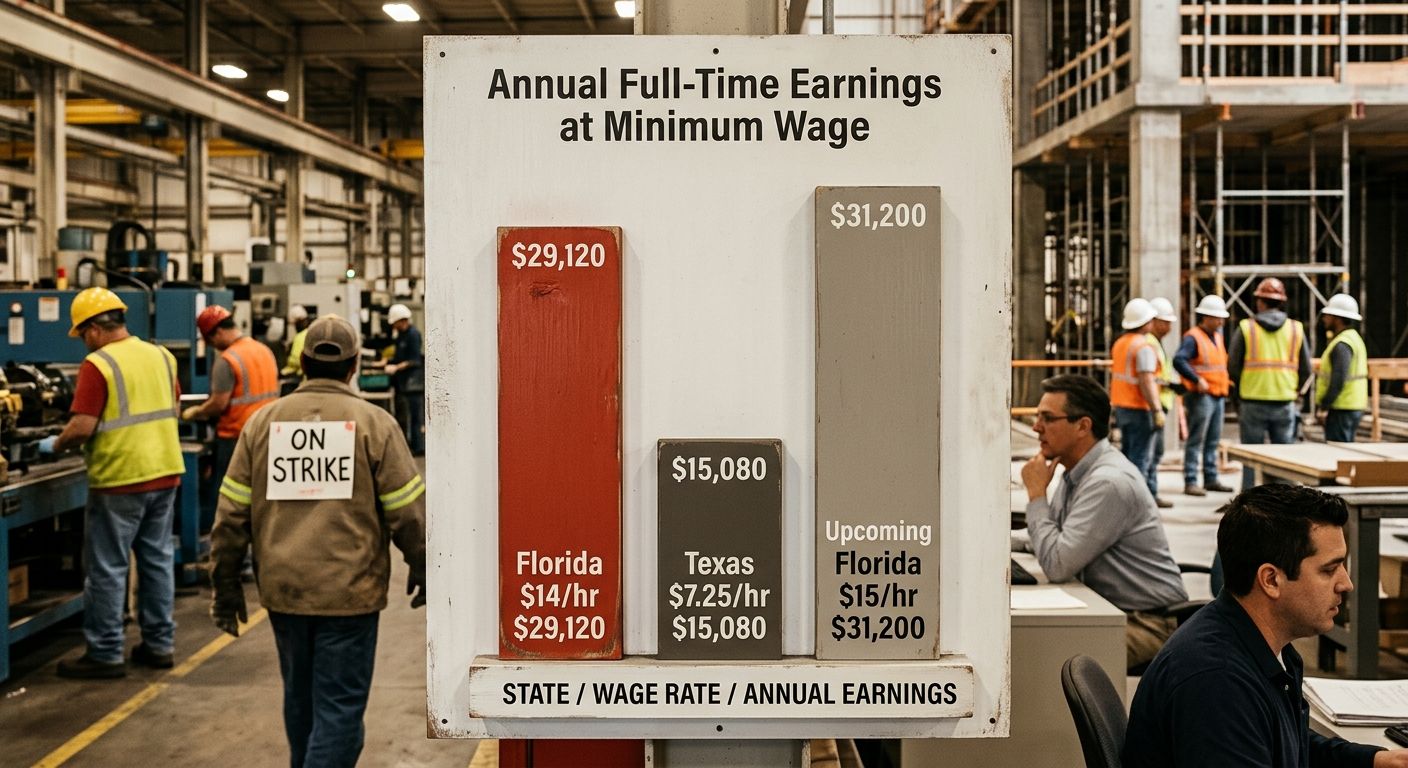
The gap between Florida's rate and the federal minimum wage tells its own story. The U.S. Department of Labor's state wage table lists the federal floor at $7.25 per hour, unchanged since July 2009. Florida's current $14.00 rate is 93% higher. When the $15.00 rate kicks in, a full-time Florida worker will earn $31,200 annually at 40 hours per week, compared to $15,080 at the federal rate. The difference is $16,120 per year.
For workers covered by both state and federal law, the rule is simple: employers pay whichever rate is higher. In Florida, that's the state rate by a wide margin.
Florida (current) | Florida (Sept 30, 2026) | Federal | |
|---|---|---|---|
Standard hourly rate | $14.00 | $15.00 | $7.25 |
Annual full-time (40 hrs/wk) | $29,120 | $31,200 | $15,080 |
Tipped hourly rate | $10.98 | $11.98 | $2.13 |
Tip credit | $3.02 | $3.02 | $5.12 |
Compare this to states still stuck at the federal floor. Texas pays $7.25 per hour with no state-level increase on the horizon, meaning a Florida worker earning the minimum makes $14,040 more per year than a Texas counterpart doing the same job.
How the Tipped Minimum Wage Mechanism Works
Understanding what is minimum wage in Florida requires a separate look at tipped employees, because they operate under a different pay structure with real enforcement consequences.
The tipped minimum wage in Florida is $10.98 per hour as of September 30, 2025. It rises to $11.98 per hour on September 30, 2026. The gap between the tipped rate and the standard rate is always $3.02, a fixed tip credit that Amendment 2 carried forward from prior Florida law.
Here's how the tip credit works mechanically. An employer pays the tipped employee $10.98 per hour in direct cash wages. The employer then claims a $3.02 per hour credit, assuming tips bring the worker's total compensation to at least $14.00 per hour. If tips fall short in any pay period, the employer is legally required to make up the difference.
That "make up the difference" obligation is where enforcement breaks down in practice. The Florida Department of Commerce doesn't have a standalone wage enforcement division with independent investigative authority the way some states do. Workers who are shorted often need to file complaints with the federal Wage and Hour Division or pursue private legal action. For workers in the restaurant and hospitality industries, who represent a huge share of Florida's tipped workforce, the burden of tracking and proving tip shortfalls falls heavily on the employee.
The federal tipped minimum wage, for comparison, is $2.13 per hour with a $5.12 tip credit. Florida's $10.98 tipped rate is more than five times the federal floor, offering meaningfully stronger baseline protection for tipped workers. But the gap between $10.98 and $14.00 still creates a structural incentive for employers to shift labor costs onto customer tips rather than paying full wages directly.
What Happens After $15, the CPI Adjustment Phase
Amendment 2's fixed $1.00 annual increases end on September 30, 2026. After that, Florida's minimum wage adjusts annually based on the Consumer Price Index, reverting to the same inflation-tracking mechanism the state used between 2005 and 2020.
The CPI adjustment works like this: the Florida Department of Commerce calculates the percentage change in the Consumer Price Index for Urban Wage Earners and Clerical Workers (CPI-W) for the 12-month period ending on the prior September 1. That percentage is applied to the current minimum wage, and the new rate takes effect on September 30. If the CPI-W is flat or negative, the minimum wage stays at the current level; it never decreases.
This creates a floor but not a ceiling. During periods of high inflation, the CPI adjustment can produce meaningful raises. During low-inflation years, the wage barely moves. Between 2005 and 2020, when this same mechanism governed Florida's rate, annual CPI adjustments ranged from $0.00 in some years to roughly $0.20–$0.40 in others. The pace was far slower than the $1.00 fixed increases that Amendment 2 mandated.
Workers and organizers who pushed for Amendment 2 understood this tradeoff. The fixed-increase schedule was designed to bring the wage to a specific target quickly. The CPI mechanism is designed to maintain purchasing power, not build it. For workers who find $15.00 per hour insufficient in high-cost metro areas like Miami and Orlando, the post-2026 mechanism offers incremental protection against inflation, and that's about it.
Where the Mechanism Breaks
Florida's constitutional minimum wage has structural limits that its clean schedule can obscure. Three deserve attention.
No local control. Florida's state preemption law prohibits cities and counties from setting their own minimum wage rates. Miami-Dade County, where the cost of living runs roughly 22% above the national average, pays the same $14.00 minimum as rural Hendry County. Workers in high-cost metros absorb that gap directly. States like Oregon address this with regional wage tiers; Florida's constitution doesn't permit it.
Legislative attempts to carve out exemptions. In early 2026, Florida House Bill 221 proposed a training wage exemption that would have allowed employers to pay workers under 21 years old a sub-minimum rate during an initial training period. The bill drew sharp opposition from labor groups who argued it would create a two-tier workforce and incentivize cycling through young workers to avoid full pay obligations. As of August 2026, no training wage exemption has been enacted. But the attempt signals ongoing legislative interest in weakening the amendment's protections without the political cost of repealing a voter-approved constitutional provision outright.
Weak state-level enforcement infrastructure. Florida has no state department of labor in the traditional sense. The Florida Department of Commerce handles wage postings and announcements but doesn't conduct the kind of proactive wage-theft investigations that states like New York run through their Department of Labor. Workers who experience minimum wage violations in Florida typically rely on the federal Wage and Hour Division or private attorneys. For low-wage workers already stretched thin, the cost and complexity of filing a complaint can be prohibitive. The constitutional right to $14.00 per hour means less when the enforcement mechanism depends almost entirely on individual workers bringing their own claims.
Coverage gaps. Florida's minimum wage law excludes certain categories of workers, including some agricultural employees and workers at very small businesses not covered by the Fair Labor Standards Act. The U.S. Department of Labor notes that workers not subject to the FLSA may fall outside state coverage depending on their employer's size and industry classification. These exclusions affect a small but real segment of the workforce.
Common Questions
Does Florida's minimum wage apply to all workers?
No. Certain categories of workers, including some agricultural employees, domestic workers in private homes, and employees at businesses not covered by the Fair Labor Standards Act, may fall outside the state minimum wage requirement. Employers covered by the FLSA must pay at least the federal minimum of $7.25 per hour, but Florida's $14.00 rate supersedes that for covered workers. Workers unsure of their coverage status should check with the federal Wage and Hour Division.
What is Florida minimum wage for tipped employees?
The tipped minimum wage is $10.98 per hour through September 29, 2026, rising to $11.98 on September 30, 2026. Employers claim a $3.02 per hour tip credit but must make up any shortfall if a worker's tips plus direct wages don't reach the full minimum wage in a given pay period. We covered the broader context of Florida's current minimum wage structure in an earlier breakdown.
Will Florida's minimum wage keep going up after $15?
Yes, but through a different mechanism. After the $15.00 rate takes effect on September 30, 2026, future adjustments will track the Consumer Price Index for Urban Wage Earners and Clerical Workers (CPI-W). Annual increases will reflect inflation rather than the fixed $1.00 steps of the 2021–2026 schedule. The rate can never decrease, even if the CPI-W falls.
Can Florida cities set a higher local minimum wage?
No. Florida's state preemption law bars cities and counties from establishing minimum wage rates above the state level. Every jurisdiction in Florida pays the same rate regardless of local cost of living. This contrasts with states that allow or mandate local wage variation.
How does Florida's rate compare to other large states?
Florida's $14.00 rate (and upcoming $15.00) sits well above Texas at $7.25 and above Ohio's current rate. It trails California, which maintains one of the highest state minimum wages in the country, as detailed in our California minimum wage overview. Among Sun Belt states, Florida's voter-imposed schedule has produced one of the most aggressive wage escalations of the past five years.
The Union Edge Staff
Frequently Asked Questions
- What is the current minimum wage in Florida?
- As of September 30, 2025, Florida's minimum wage is $14.00 per hour for non-tipped employees. This rate will increase to $15.00 per hour on September 30, 2026, which is the final step of Amendment 2 approved by Florida voters in November 2020.
- When will Florida's minimum wage reach $15 per hour?
- Florida's minimum wage will reach $15.00 per hour on September 30, 2026. This is the final fixed increase mandated by Amendment 2, after which future increases will be based on Consumer Price Index adjustments.
- What is the tipped minimum wage in Florida?
- The tipped minimum wage in Florida is $10.98 per hour as of September 30, 2025, rising to $11.98 per hour on September 30, 2026. Employers can claim a fixed $3.02 tip credit but must make up the difference if tips and direct wages don't reach the full minimum wage in any pay period.
- How much more does Florida pay than the federal minimum wage?
- Florida's current minimum wage of $14.00 per hour is 93% higher than the federal minimum wage of $7.25 per hour, which has been frozen since 2009. A full-time Florida worker earning minimum wage makes $31,200 annually compared to $15,080 at the federal rate.
- Can Florida cities set their own minimum wage higher than the state rate?
- No. Florida's state preemption law prohibits cities and counties from setting their own minimum wage rates above the state level. All jurisdictions in Florida, from Miami-Dade County to rural areas, must pay the same state minimum wage.
- How will Florida's minimum wage increase after it reaches $15?
- After September 30, 2026, Florida's minimum wage will adjust annually based on the Consumer Price Index for Urban Wage Earners and Clerical Workers (CPI-W). The rate will never decrease, but increases will reflect inflation rather than the fixed $1.00 annual steps used through 2026.
- Why is Florida's minimum wage locked into the state constitution?
- Florida voters approved Amendment 2 in November 2020 with 60.82% support, making the minimum wage a constitutional requirement that cannot be easily changed by the legislature. This constitutional mechanism ensures the wage follows a specific schedule without legislative review or gubernatorial veto.
- Do all Florida workers get the state minimum wage?
- No. Certain categories of workers, including some agricultural employees, domestic workers in private homes, and employees at businesses not covered by the Fair Labor Standards Act, may fall outside the state minimum wage requirement. Workers unsure of their coverage should check with the federal Wage and Hour Division.
Related Articles

What Is the State of Florida Minimum Wage
Amendment 2, ratified by Florida voters in November 2020, embedded a minimum wage escalator directly into Article X of the state constitution, removing the rate from legislative control entirely. The current floor is $14.00 per hour for non-tipped workers and $10.

Minimum Wage in Florida: 2024 Rate Changes
Before 2004, Florida had no state minimum wage at all. Voters fixed that twice through constitutional amendments, the second of which created a fixed $1.00-per-year escalator that brought the minimum wage in Florida to $13.00 per hour on September 30, 2024, with a $15.

Minimum Wage at Florida: 2024 Guide & Updates
Amendment 2 to Florida's constitution, approved by voters on November 3, 2020, hardwired a $1.00-per-year minimum wage escalator into state law that bypasses the legislature entirely. That mechanism set the minimum wage in Florida at $13.
Also in the paper