
What Is the State of Texas Minimum Wage
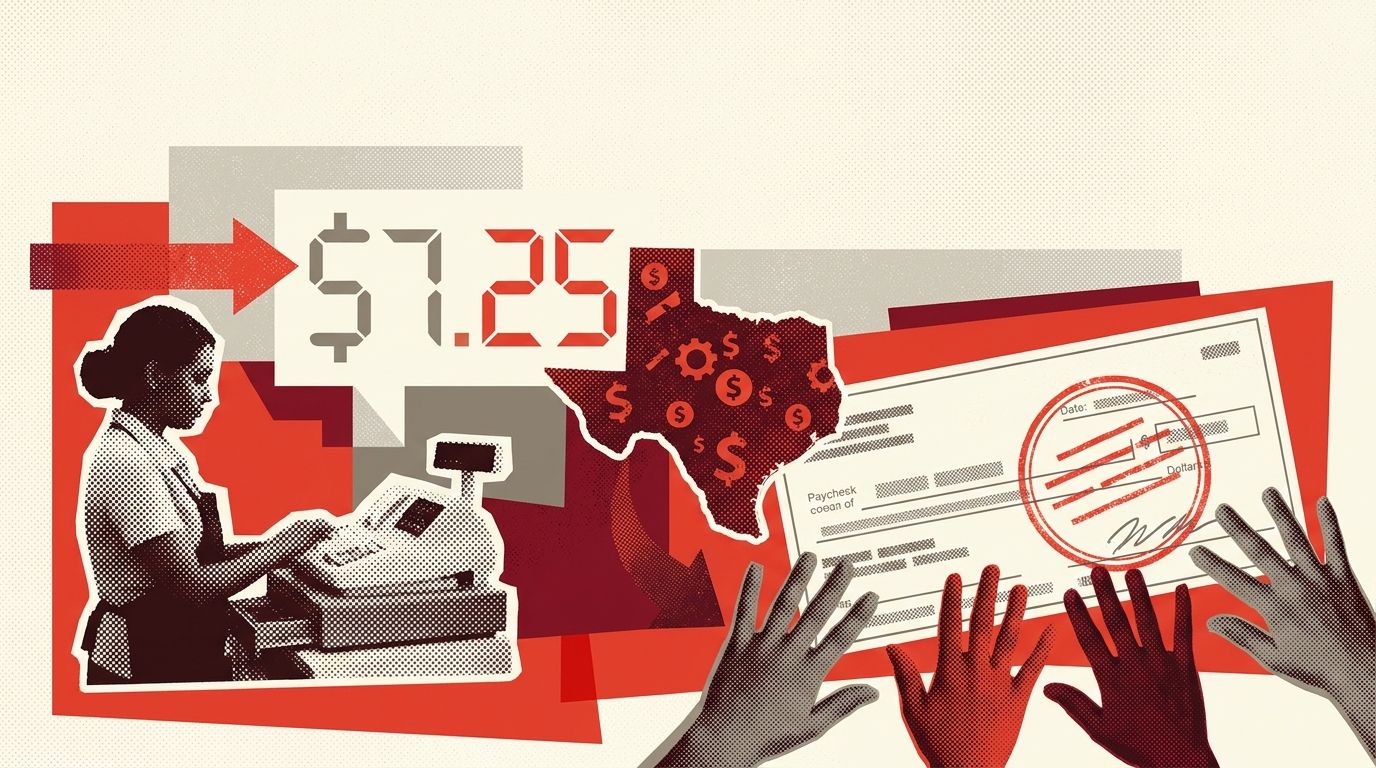
The Texas Minimum Wage Act contains no dollar amount. The statute adopts the federal minimum wage rate by reference, making the state of Texas minimum wage identical to the federal floor: $7.
What Is the State of Texas Minimum Wage? The $7.25 Floor, Explained
The Texas Minimum Wage Act contains no dollar amount. The statute adopts the federal minimum wage rate by reference, making the state of Texas minimum wage identical to the federal floor: $7.25 per hour, a figure Congress last set on July 24, 2009, now carrying roughly 30% less purchasing power than the day it took effect.
How Texas Adopts a Wage Floor Without Setting One
The mechanism behind the state of Texas minimum wage is unusual. The Texas Minimum Wage Act (Chapter 62 of the Texas Labor Code) references the Fair Labor Standards Act rate rather than establishing its own figure. According to the U.S. Department of Labor, the state law "does not contain current dollar minimums" and instead "adopts the federal minimum wage rate by reference."
No state agency reviews the rate. No inflation formula adjusts it. No legislative committee schedules increases.
The practical result: if Congress raises the federal minimum wage, Texas workers get a raise automatically. If Congress does nothing, Texas workers stay at $7.25 indefinitely. And Congress has done nothing for more than 17 years.
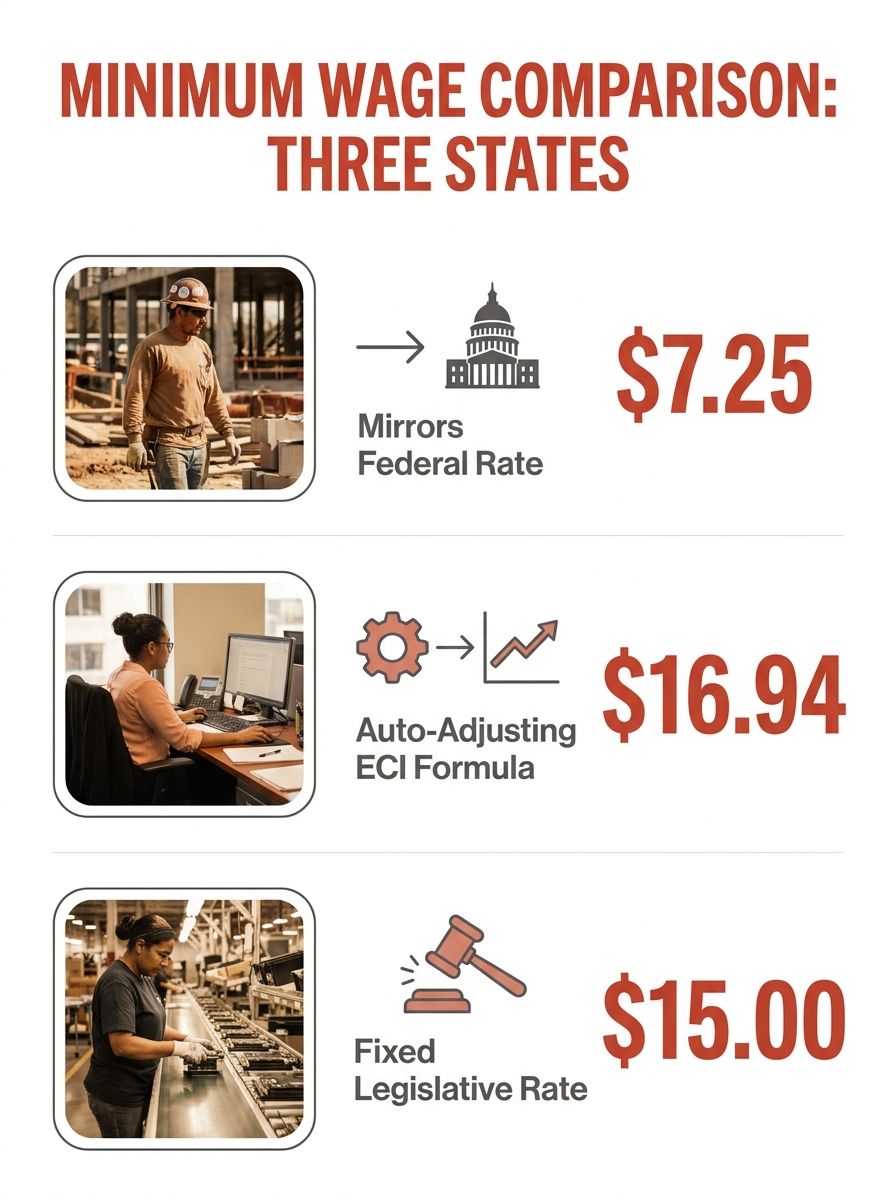
This design differs sharply from states like Connecticut, where an auto-adjusting formula tied to the Employment Cost Index pushed the rate to $16.94 in 2026. It also differs from Massachusetts, where legislators set a fixed $15.00 rate through direct statute. Texas did neither. It outsourced the decision entirely to the federal government, then built legal walls to make sure no one else could step in.
The Tipped Wage and Tip Credit Arithmetic
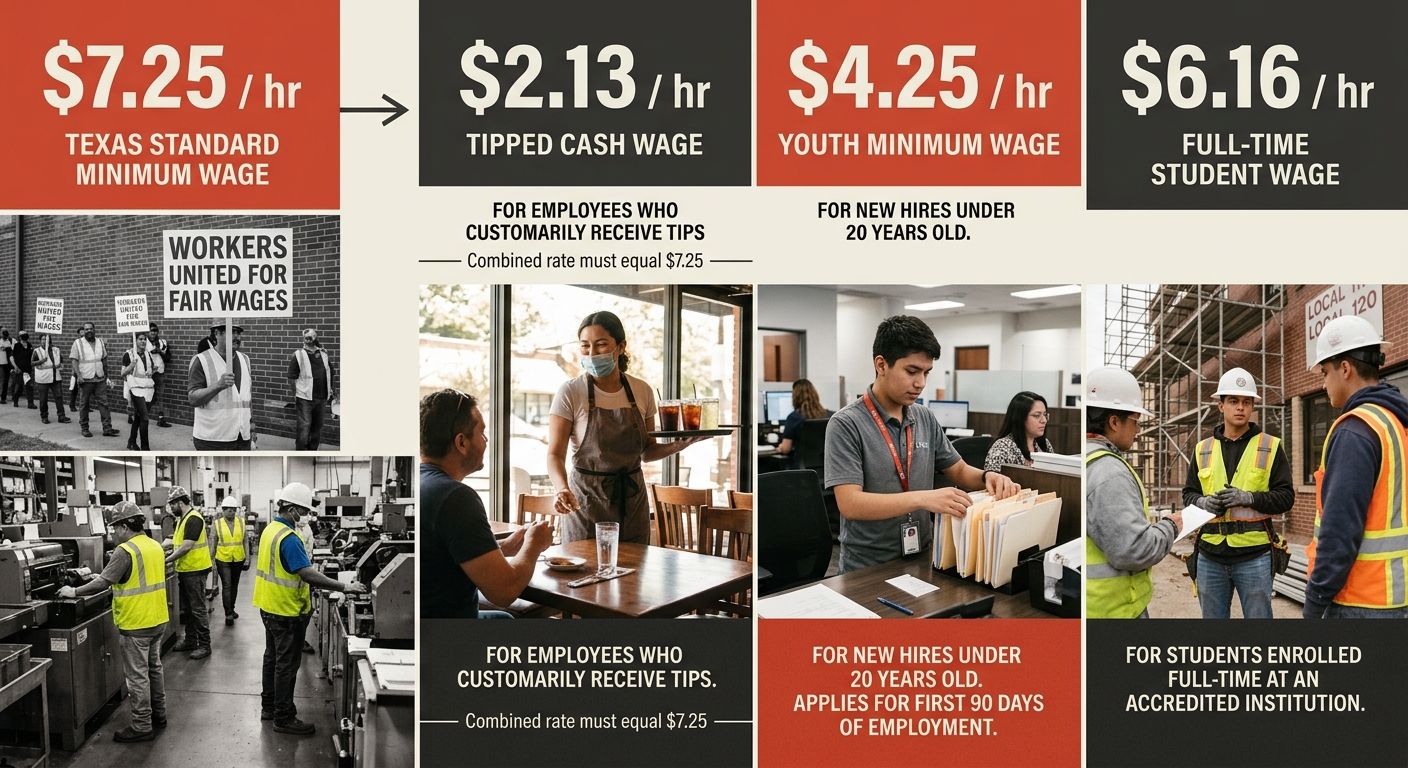
Employers in Texas can pay tipped workers a cash wage of $2.13 per hour, provided the worker's tips bring total hourly earnings to at least $7.25. If tips fall short, the employer is legally required to make up the difference. The Texas Workforce Commission defines a tipped employee as someone who regularly receives more than $20 per month in tips, a lower threshold than the federal standard of $30 per month.
Here's how the arithmetic works on an actual shift. A tipped server works 8 hours and earns $30 in tips. The employer pays $2.13 × 8 = $17.04 in cash wages. Tips add $30. Total compensation: $47.04. Divide by 8 hours, and the effective rate is $5.88 per hour. That's below $7.25, so the employer owes an additional $10.96 to bring the worker to the legal floor. If that same server earns $50 in tips, total compensation reaches $67.04, or $8.38 per hour, clearing the threshold with no employer top-up required.
The system assumes tips reliably close the gap. For workers in slow-shift restaurants, catering halls during off-seasons, or newly opened establishments without steady clientele, the gap often stays wide open. Enforcement depends entirely on workers knowing the law, tracking their own hours and tips, and filing claims through the TWC's Payday Law program.
Who Gets Paid Less Than $7.25
Federal law permits a sub-minimum youth wage of $4.25 per hour for workers under 20 during their first 90 consecutive calendar days of employment. After 90 days, the standard $7.25 applies regardless of age.
Full-time students employed in retail, service, agriculture, or at colleges and universities can be paid 85% of the minimum wage, or roughly $6.16 per hour, under a federal certificate program. Workers with disabilities may also receive sub-minimum wages under Section 14(c) certificates, though the use of these certificates has faced growing criticism and legal challenges nationwide.
Wage Category | Hourly Rate | Conditions |
|---|---|---|
Standard minimum | $7.25 | All covered workers |
Tipped cash wage | $2.13 | Tips must bring total to $7.25; employer covers shortfall |
Youth wage | $4.25 | Workers under 20, first 90 days only |
Full-time student | $6.16 | Requires federal certificate; specific industries |
These carve-outs mean the $7.25 floor isn't universal. The workers most likely to encounter sub-minimum rates are young, working part-time, or employed in industries with thin margins and high turnover. These are also the workers with the least individual bargaining power.
Why No Texas City Can Set a Higher Rate
Under Texas Labor Code Chapter 212, local governments cannot pass ordinances requiring private employers to pay more than the $7.25 state and federal floor. As one state-level wage tracker noted, this prohibition holds "no matter how high the local cost of living runs."
The 2023 passage of HB 2127 reinforced this preemption, invalidating a broader range of municipal labor ordinances. The bill stripped cities of the power to create local wage, scheduling, and benefits rules that exceeded state standards. Austin, Dallas, Houston, and San Antonio all have costs of living well above the state average, but none of them can require private employers to pay a penny above $7.25.
This preemption structure is central to understanding why the Texas wage floor functions the way it does. Even if a city council unanimously wanted to raise the local minimum wage to $10 or $12, state law forbids it. The only paths to a higher floor run through Congress (changing the federal rate) or the Texas Legislature (amending or replacing the current statute). Neither has acted since 2009.
Compare this to states like North Carolina, which also sits at the $7.25 federal floor but lacks the same aggressive preemption framework. The preemption layer in Texas functions as an additional lock on the mechanism, closing off the local pressure valve that has historically pushed wage increases forward in other parts of the country.
What $7.25 Actually Buys in 2026
The Fort Worth Star-Telegram reported that at $7.25 an hour, a worker "would need to earn the equivalent of more than three full-time minimum-wage jobs to reach the living wage MIT estimates for a single adult without children in the DFW area."
A full-time worker at $7.25 per hour, working 40 hours per week for 52 weeks, earns $15,080 per year before taxes. The 2026 federal poverty line for a single-person household sits at approximately $15,060. A full-time minimum-wage worker in Texas barely clears the poverty threshold on paper.
MIT's Living Wage Calculator for Texas places the living wage for a single adult with no children significantly above $7.25 in every metro area. In the Dallas-Fort Worth region, a single adult needs roughly $20-$22 per hour to cover housing, food, transportation, healthcare, and taxes without public assistance. That's nearly three times the legal floor.
The Bureau of Labor Statistics' CPI-U index has risen roughly 40% since July 2009. A wage that bought $7.25 worth of goods in 2009 purchases closer to $5.10 in 2009-equivalent dollars today. Workers haven't received a pay cut on paper, but the floor has eroded steadily underneath them every single year.
While competitive labor markets in Austin, Dallas, and Houston often push starting wages to $12-$18 per hour, roughly 27% of Texas workers still earn less than $10 per hour. The legal floor matters most in rural areas, in small businesses, and in industries where individual bargaining power is weakest.
The Right to Bargain for More
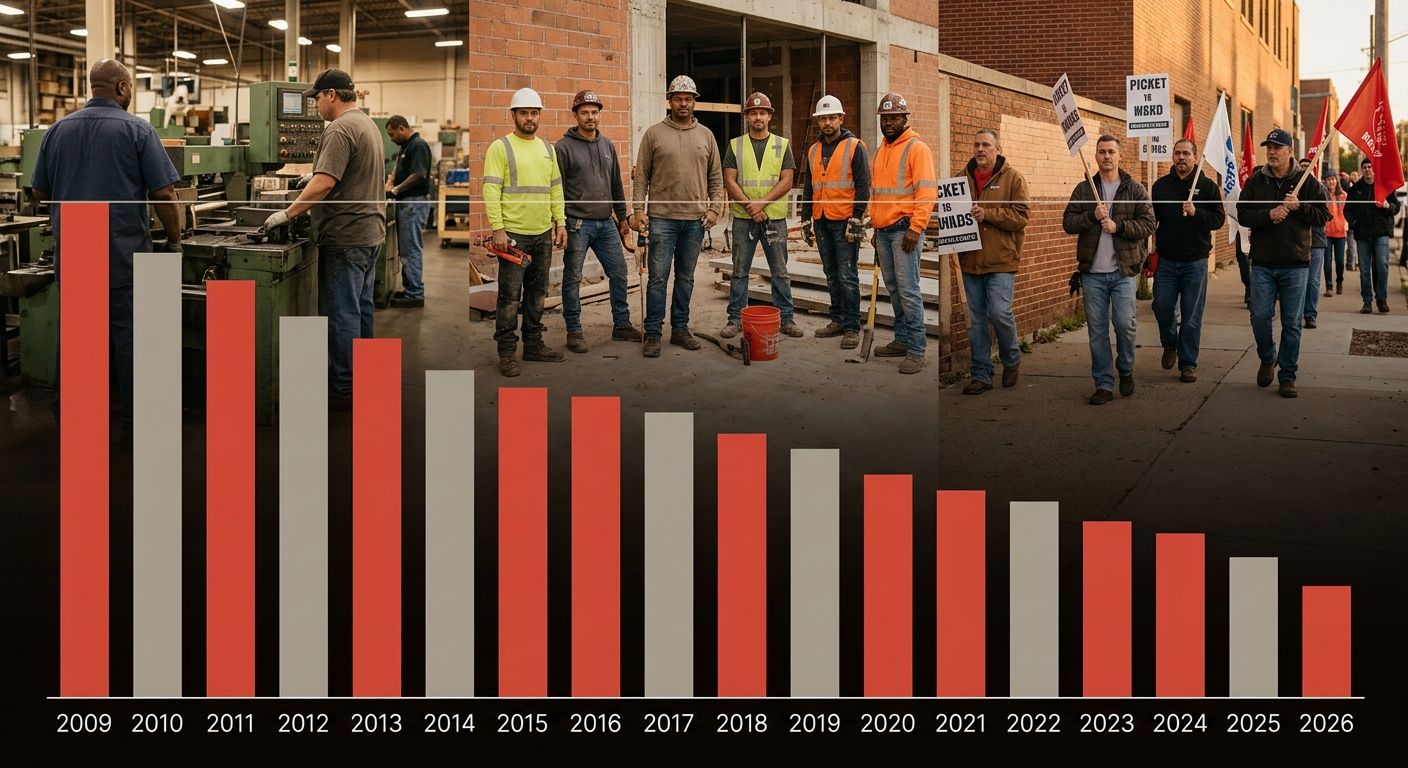
One line in the Texas Minimum Wage Act carries weight that workers should know about. The Texas Workforce Commission states that the law "does not prohibit employees from collective bargaining with their employers for a higher wage."
That sentence matters. Texas is a right-to-work state, meaning workers cannot be required to join or pay dues to a union as a condition of employment. But the minimum wage statute explicitly preserves the right to organize and negotiate. In a state where the legislature has refused to raise the floor for 17 years and has blocked cities from doing so, collective bargaining remains one of the few legal avenues workers have to push their wages above $7.25.
The mechanism functions as a one-way floor: the law sets the minimum, and organizing pushes individual workplaces above it. Grocery store workers, warehouse employees, hotel staff, and construction crews across Texas have used union contracts to negotiate wages of $14-$22 per hour in sectors where the legal minimum would otherwise be the default. Where organizing efforts have gained ground nationally, as we've seen in recent healthcare unionization drives, wages tend to rise well beyond statutory floors.
Where This Mechanism Breaks Down
The reference-adoption model works when Congress acts periodically on the federal minimum wage. It has broken in Texas because Congress hasn't acted since 2009. The entire design assumed regular federal updates. The reality delivered a 17-year freeze with no end in sight.
The preemption layer fails differently. It assumes the state legislature will step in when local conditions demand higher wages. But Texas legislators have rejected minimum wage increase bills in every session since 2009, and HB 2127 made the wall between cities and wage policy even higher. With local action blocked and state action stalled, the only remaining variable is federal legislation, and no active bill in Congress has the votes to pass.
The tipped wage system breaks down when enforcement is reactive. Workers must know the law, document their hours and tips, and file a claim themselves. In food service, hospitality, and retail, turnover is high and many workers never file. The distance between the legal right to $7.25 and the actual paycheck can be significant.
And the competitive-market argument breaks down outside major metro areas. The claim that employers pay $12-$18 regardless of the floor holds in cities with tight labor markets and multiple employers competing for the same workers. It does not hold in a small town where one employer dominates, where a worker has no realistic option of shopping for a better offer, and where the legal floor becomes the actual wage offer on the table. For workers with the least mobility and the fewest choices, the floor price is the real price.
Common Questions
Does Texas have its own minimum wage separate from the federal rate?
No. The Texas Minimum Wage Act adopts the federal minimum wage rate by reference and contains no independent dollar figure. The rate has been $7.25 per hour since July 24, 2009, because that's the last time Congress changed the federal minimum.
Can cities like Austin or Houston set a higher local minimum wage?
They cannot. Texas Labor Code Chapter 212 prohibits local governments from requiring private employers to pay more than the $7.25 state/federal floor. HB 2127, passed in 2023, reinforced this preemption by invalidating a broader set of municipal labor ordinances.
What is the minimum wage for tipped workers in Texas?
Employers can pay a tipped cash wage of $2.13 per hour, provided the worker's tips bring total hourly compensation to at least $7.25. Texas defines a tipped worker as someone earning more than $20 per month in tips. If tips fall short, the employer must cover the difference.
Is there a lower minimum wage for young workers?
Yes. Workers under 20 can be paid $4.25 per hour during their first 90 consecutive calendar days of employment. After that period, the standard $7.25 rate applies.
How can Texas workers earn more than $7.25 if the state won't raise the floor?
The Texas Minimum Wage Act explicitly preserves the right to collective bargaining. Workers can organize and negotiate higher wages through union contracts. Outside of collective action, wage increases depend on either federal legislation or a shift in the Texas Legislature's position, and neither has moved since 2009.
The Union Edge Staff
Frequently Asked Questions
- What is the current minimum wage in Texas?
- Texas's minimum wage is $7.25 per hour, which is the federal minimum wage set by Congress on July 24, 2009. Texas has no independent state minimum wage and instead adopts the federal rate by reference in its law.
- Can Texas cities like Austin or Houston set their own higher minimum wage?
- No. Texas Labor Code Chapter 212 prohibits local governments from requiring private employers to pay more than $7.25 per hour, regardless of local cost of living. HB 2127, passed in 2023, reinforced this preemption by invalidating a broader range of municipal labor ordinances.
- What is the minimum wage for tipped employees in Texas?
- Employers can pay tipped workers $2.13 per hour in cash wages, provided tips bring total hourly earnings to at least $7.25. If tips fall short, the employer is legally required to make up the difference to reach $7.25.
- How much can employers pay workers under 20 in Texas?
- Workers under 20 can be paid $4.25 per hour during their first 90 consecutive calendar days of employment. After 90 days, the standard $7.25 minimum wage applies regardless of age.
- How much does a full-time minimum wage worker earn per year in Texas?
- A full-time worker earning $7.25 per hour at 40 hours per week for 52 weeks earns $15,080 per year before taxes, which is approximately $20 above the 2026 federal poverty line for a single-person household.
- What is the living wage for a single adult in Dallas-Fort Worth according to MIT?
- MIT's Living Wage Calculator estimates that a single adult with no children in the Dallas-Fort Worth region needs roughly $20-$22 per hour to cover housing, food, transportation, healthcare, and taxes without public assistance.
- Can Texas workers negotiate for higher wages than the minimum?
- Yes. The Texas Minimum Wage Act explicitly preserves the right to collective bargaining, allowing workers to organize and negotiate higher wages through union contracts, even though Texas is a right-to-work state.
- How much purchasing power has the $7.25 minimum wage lost since 2009?
- The federal minimum wage now carries roughly 30% less purchasing power than when it was set in 2009. The Bureau of Labor Statistics reports that a wage buying $7.25 worth of goods in 2009 purchases closer to $5.10 in 2009-equivalent dollars today.
Related Articles

Minimum Texas Wage: What You Need to Know
Unlike 30 states that set independent minimum wage floors above the federal rate, Texas adopted the federal number by reference and then built a legal architecture that prevents any city or county from going higher. The result: the minimum wage in Texas has been $7.

What Is Minimum Wage in Texas: 2024 Guide
Texas does not set its own minimum wage dollar amount. The state's minimum wage law, administered by the Texas Workforce Commission, defers entirely to the federal Fair Labor Standards Act, which means workers in Texas earn a floor of $7.25 per hour, a rate unchanged since July 24, 2009.

Minimum Wage Texas: Current Laws & Rates
Chapter 62 of the Texas Labor Code contains no independent wage figure. It copies the federal minimum wage by reference, which means the texas minimum wage has been $7.25 per hour since July 24, 2009, and won't change unless Congress acts.
Also in the paper