
Minimum Wage in Colorado: 2024 Rates & Changes
Amendment 42, approved by Colorado voters in 2006, turned the state's minimum wage into a self-adjusting constitutional provision indexed to the Consumer Price Index for the Denver-Aurora-Lakewood metro area.

Minimum Wage in Colorado: How the Rate Gets Set and What Workers Actually Earn
Amendment 42, approved by Colorado voters in 2006, turned the state's minimum wage into a self-adjusting constitutional provision indexed to the Consumer Price Index for the Denver-Aurora-Lakewood metro area. The practical effect is a rate that climbs every January without a single legislative vote: $14.42/hour in 2024, $15.16 in 2026, and $15.71 announced for 2027.
How Colorado's Annual Adjustment Formula Works
Every September, the Colorado Department of Labor and Employment's Division of Labor Standards and Statistics (DLSS) calculates the next year's minimum wage based on inflation data from the Denver-Aurora-Lakewood metro CPI. The new rate takes effect the following January 1. No bill, no committee hearing, no governor's signature required.
The formula includes a built-in floor: if the CPI drops (deflation), the minimum wage holds steady rather than declining. This one-directional ratchet means the rate can only stay flat or climb. Between 2006 and 2024, the minimum wage in Colorado moved from $6.85 to $14.42, an increase of more than 110%.
Colorado's approach stands apart from states like Missouri, where voters had to pass separate ballot initiatives to schedule increases, or Pennsylvania, which still sits at the federal floor of $7.25. The CPI mechanism removes the annual political fight. It also removes the possibility of a large corrective jump, since each year's increase is capped by whatever inflation actually measured.
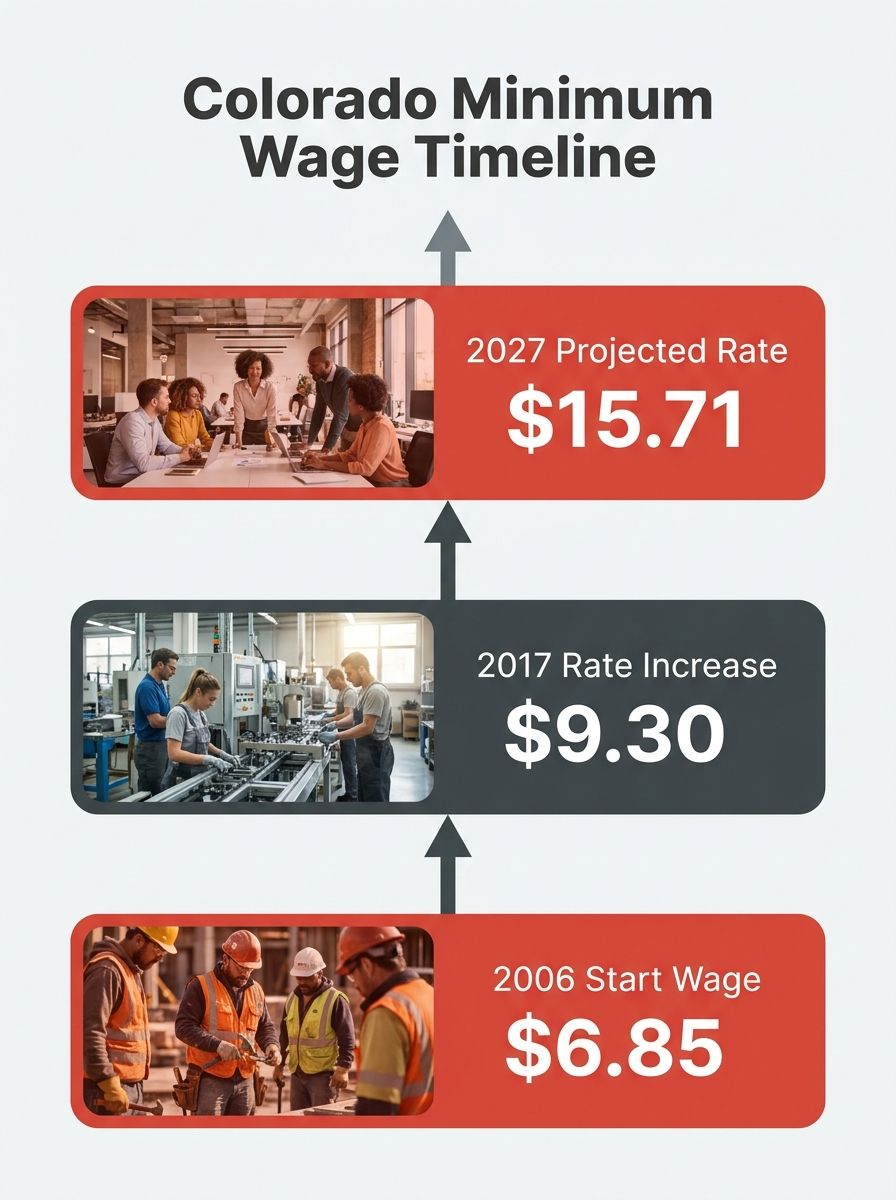
State Rates from 2024 Through 2027
The DLSS publishes each new rate in the fall before it takes effect. Here's the progression from 2024 forward, based on published DLSS announcements and the COMPS Order #39:
Year | Standard Minimum Wage | Tipped Minimum Wage | Increase from Prior Year |
|---|---|---|---|
2023 | $13.65 | $10.63 | , |
2024 | $14.42 | $11.40 | $0.77 (5.6%) |
2025 | $14.81 | $11.79 | $0.39 (2.7%) |
2026 | $15.16 | $12.14 | $0.35 (2.4%) |
2027 | $15.71 | $12.69 | $0.55 (3.6%) |
The 2024 increase of $0.77 was the largest single-year jump in this window, driven by the elevated inflation that followed 2022 and 2023 price surges. As CPI growth moderated, the 2025 and 2026 increases shrank. The uptick in the 2027 adjustment to 3.6% signals that inflation in the Denver-Aurora-Lakewood metro picked back up during the measurement period.
For context, the Colorado minimum wage ranked 7th highest among all U.S. states when the 2024 rate took effect, trailing Washington, California, Connecticut, Massachusetts, New York, and Oregon.
Additionally, the state's minimum salary requirement for exempt administrative, executive, and professional employees rose to $55,000 annually ($1,057.69 per week) effective January 1, 2024. A salaried worker earning below that threshold must be treated as non-exempt and is entitled to overtime pay at 1.5 times their regular rate. The state overtime minimum in 2024 was $21.63/hour ($14.42 × 1.5).
Local Floors That Exceed the State Baseline
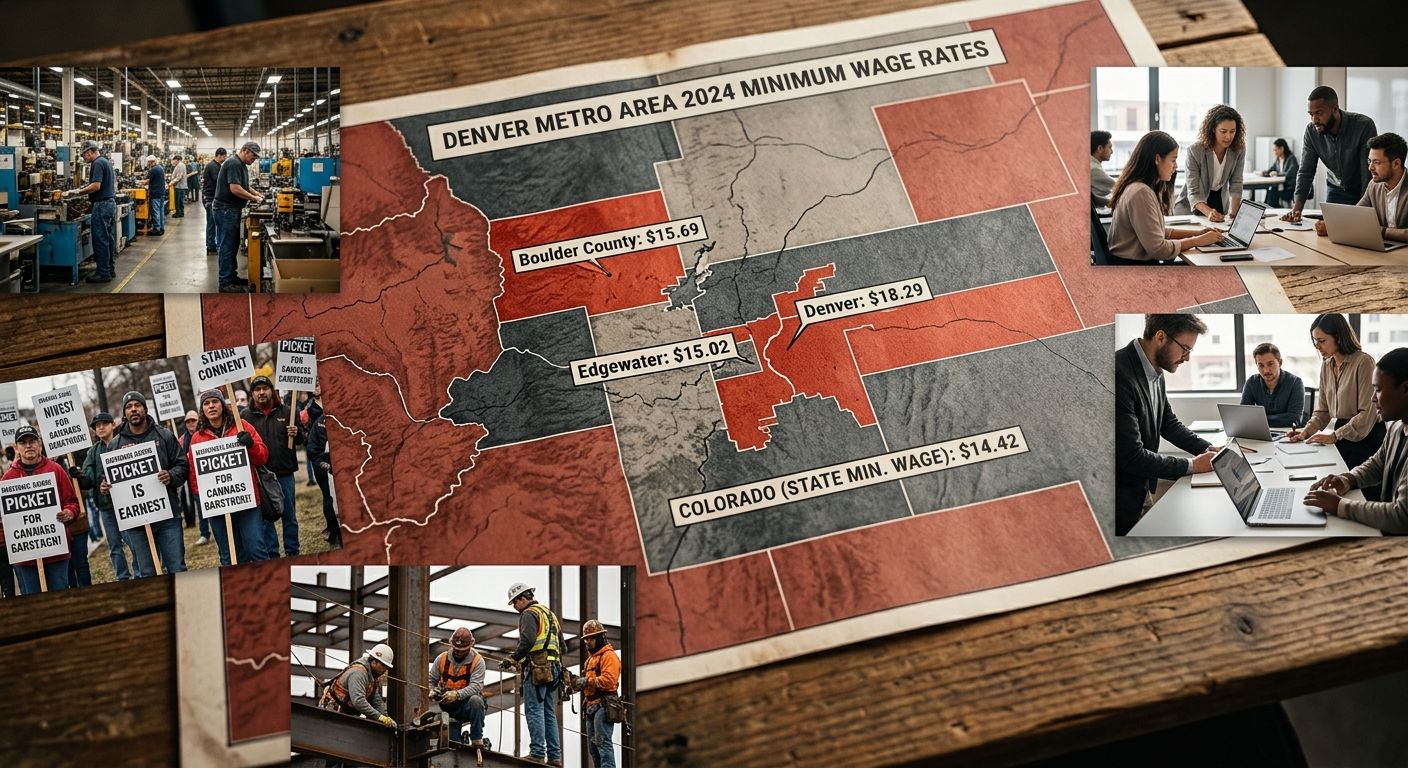
Colorado law allows municipalities to set their own minimum wages above the state rate. Three jurisdictions exercised that authority for 2024, creating a patchwork that workers and employers need to track carefully:
Jurisdiction | 2024 Standard Rate | 2024 Tipped Rate | Premium Over State |
|---|---|---|---|
State of Colorado | $14.42 | $11.40 | , |
Denver | $18.29 | $15.27 | +$3.87 |
Unincorporated Boulder County | $15.69 | $12.67 | +$1.27 |
Edgewater | $15.02 | $12.00 | +$0.60 |
Denver's $18.29 rate is the one that matters most by sheer population. The city's minimum wage ordinance, adopted in 2019, includes its own CPI-indexing mechanism separate from the state formula. A restaurant dishwasher in Denver earns a guaranteed floor nearly $4.00/hour higher than a counterpart working just across the city line in unincorporated Arapahoe County.
This geographic fragmentation creates real compliance headaches. An employer operating food trucks across Denver, Aurora, and Edgewater could face three different wage floors within a single metro area. Workers who don't know their jurisdiction's rate sometimes get shortchanged. Wage theft enforcement, already difficult for low-wage workers (as we've covered in reporting on truck drivers fighting federal enforcement gaps), becomes harder when the applicable rate depends on a municipal boundary that no one can see from the kitchen.
Tipped Workers and the $3.02 Credit
'Why does the tipped minimum wage exist as a separate, lower rate?' Because Colorado law allows employers to credit a portion of expected tips against the wage floor. Under the state's COMPS Order #39, employers may pay tipped employees $3.02 per hour less than the full minimum wage. In 2024, that meant a cash wage of $11.40/hour instead of $14.42.
The legal theory is simple: tips make up the difference. The lived reality is messier. Under Colorado law, if an employee's tips plus cash wage don't equal or exceed $14.42/hour in any given pay period, the employer must pay the shortfall. But tracking compliance requires workers to monitor their own tip income against their hours, something few have the tools or time to do during a busy shift.
The $3.02 gap has remained constant across recent years even as the base rate climbed. That means the tipped wage rises in lockstep: from $10.63 in 2023 to $11.40 in 2024 to $12.69 in 2027. The credit itself never shrinks. Advocates for tipped workers argue the credit should be eliminated entirely, pointing to states like California, where tipped employees receive the full state minimum before tips.
Tracing the Rate Back to 1958
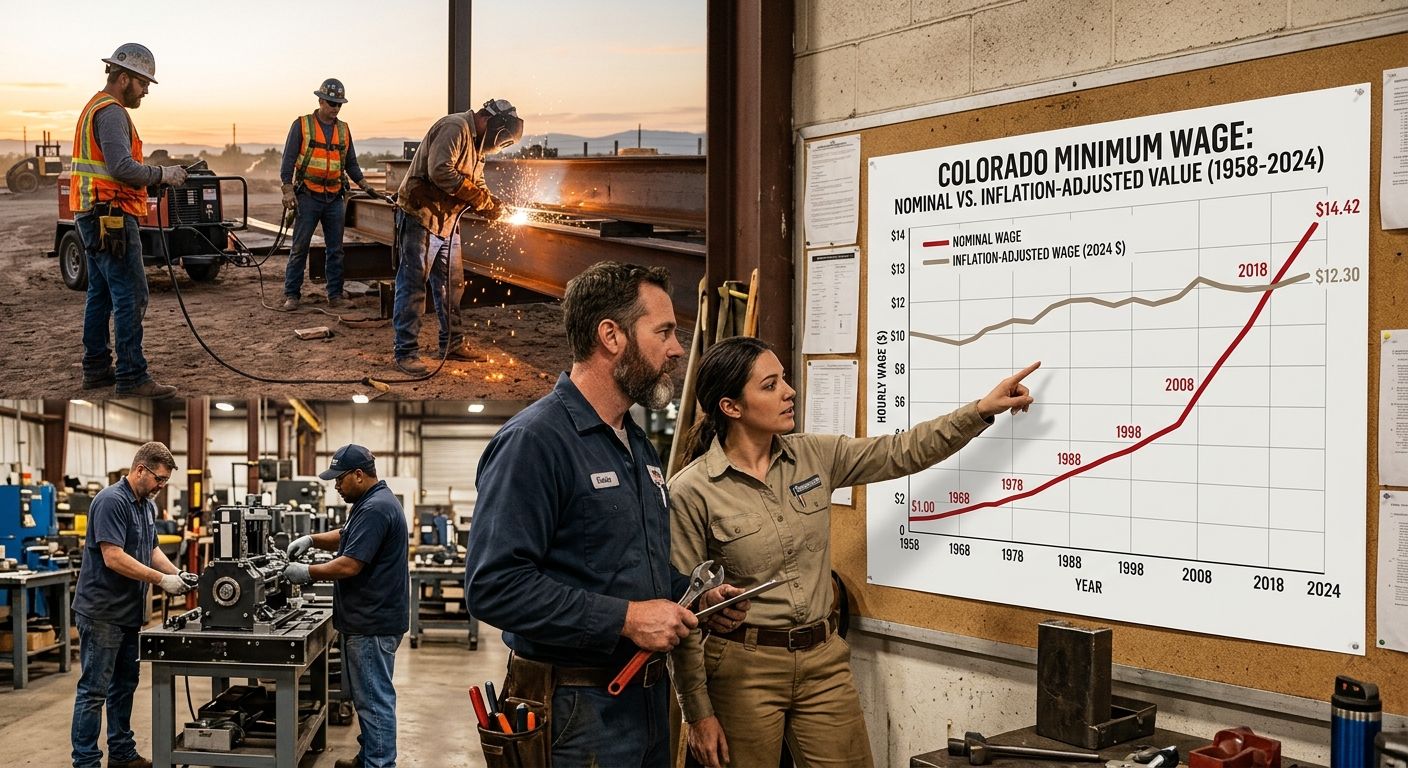
Colorado's first minimum wage for non-farm workers was $1.15/hour, effective October 24, 1958. Farm and ranch workers followed at $0.87/hour in 1964. A unified rate of $1.60 for all workers took effect on April 1, 1967, and was bumped to $1.80 that July.
The 58-year dataset tracked by Macrotrends and the Federal Reserve Bank of St. Louis shows a rate that stagnated during certain periods, particularly from the late 1990s through the mid-2000s when legislative action was the only path to an increase. Amendment 42 in 2006 broke that pattern by making adjustments automatic.
Adjusted for inflation, that original 1958 wage of $1.15 had purchasing power equivalent to roughly $12.00 in 2024 dollars. The 2024 rate of $14.42 exceeds that benchmark, but the margin is thinner than six decades of nominal growth would suggest. Workers earning minimum wage colorado in 2024 are modestly better off in real terms than their 1958 counterparts, not dramatically so.
Where the Formula Falls Short
The CPI-indexing mechanism protects against legislative inaction, and that is a genuine structural advantage over the federal minimum wage, frozen at $7.25 since 2009. But the formula carries tradeoffs that hurt the workers most dependent on the wage floor.
It tracks inflation, not cost of living. The CPI-U for the Denver-Aurora-Lakewood metro captures price changes in a basket of goods, but it doesn't ask whether $14.42/hour actually covers rent, food, and childcare in Colorado's most expensive cities. Denver's median one-bedroom rent exceeded $1,600/month in 2024. At $14.42/hour and 40 hours a week, a full-time worker grosses roughly $2,499/month before taxes. That math doesn't work in Denver, which is why Denver passed its own higher floor.
The formula can't correct a low starting point. Amendment 42 pegged incremental increases to inflation, but it didn't address whether the 2006 base rate of $6.85 was adequate. Every year since has been an incremental adjustment on that original foundation. If the base was too low, every subsequent rate inherits that structural deficit.
Local variation creates enforcement gaps. Three different municipal minimums in a single metro area mean workers must know which jurisdiction they're clocked into. Employers who operate across boundaries face compliance complexity, and some exploit the confusion. Colorado's wage theft enforcement relies heavily on worker-filed complaints, placing the burden on the people least equipped to navigate the system.
The tipped credit never shrinks. Because the $3.02 gap is fixed in regulation rather than pegged to a declining percentage, tipped workers' wages rise in absolute terms but never gain ground relative to the standard rate. The gap persists at every level: $3.02 when the base is $14.42, $3.02 when it reaches $15.71, $3.02 in perpetuity unless the legislature or a ballot initiative rewrites the rule.
For workers counting on automatic increases to keep pace with their expenses, the formula provides a floor. It does not provide a ladder.
Common Questions
Does Colorado's minimum wage apply to all workers?
The colorado minimum wage covers most employees, but exceptions exist. Workers under 18 can be paid $0.50 less than the standard rate during their first 90 days of employment. Federal employees, certain agricultural workers, and independent contractors fall outside the state wage floor. The applicable rules are detailed in the COMPS Order, updated annually by the DLSS.
Can an employer pay below the minimum wage if business is slow?
No. The minimum wage is a legal floor that applies regardless of business conditions, revenue, or hours scheduled. Paying below the applicable rate (state or local, whichever is higher) constitutes a wage violation under Colorado law. Workers who believe they've been underpaid can file a complaint with the CDLE's Division of Labor Standards and Statistics.
How does the Colorado minimum wage compare to the federal minimum?
The federal minimum wage has been $7.25/hour since 2009. Colorado's 2024 rate of $14.42 is nearly double that floor. When state and federal rates differ, employers must pay whichever is higher. Every covered Colorado worker earns at least the state rate, making the federal number irrelevant for most purposes here. States like North Carolina and Georgia that haven't set rates above the federal floor leave their workers at $7.25.
Will the Colorado minimum wage keep rising automatically?
Yes. The CPI-indexing mechanism written into the state constitution through Amendment 42 triggers an annual recalculation every September, with the new rate effective January 1. The DLSS announced on August 13, 2026, that the 2027 rate will be $15.71/hour. Barring a constitutional amendment that repeals the indexing provision, the automatic adjustment continues indefinitely.
Do Denver's higher rates apply to workers who live in Denver but work elsewhere?
No. The applicable minimum wage is based on where the work is performed, not where the employee lives. A Denver resident who commutes to a job in Centennial works under the state minimum of $14.42 (for 2024), not Denver's $18.29. A worker who lives in Aurora but clocks in at a Denver restaurant earns at least Denver's rate for every hour worked within city limits.
The Union Edge Staff
Frequently Asked Questions
- What is the Colorado minimum wage in 2024?
- Colorado's minimum wage in 2024 is $14.42/hour for standard workers and $11.40/hour for tipped workers. This rate is automatically adjusted each January based on inflation data from the Denver-Aurora-Lakewood metro area Consumer Price Index.
- How does Colorado's minimum wage increase each year?
- Colorado's minimum wage increases automatically every January through a constitutional formula established by Amendment 42 in 2006. Each September, the state calculates the next year's rate based on inflation data from the Denver-Aurora-Lakewood metro CPI, with no legislative action required.
- What is Denver's minimum wage?
- Denver's minimum wage in 2024 is $18.29/hour for standard workers and $15.27/hour for tipped workers. Denver's ordinance, adopted in 2019, includes its own CPI-indexing mechanism separate from the state formula.
- Can employers pay less than minimum wage if business is slow?
- No. The minimum wage is a legal floor that applies regardless of business conditions, revenue, or hours scheduled. Paying below the applicable rate constitutes a wage violation under Colorado law.
- Why is Colorado's tipped minimum wage lower?
- Colorado law allows employers to credit $3.02 per hour of expected tips against the minimum wage for tipped employees. If tips plus cash wages don't equal the full minimum wage in any pay period, the employer must pay the shortfall.
- What is the difference between Colorado and federal minimum wage?
- The federal minimum wage is $7.25/hour and has been frozen since 2009. Colorado's 2024 rate of $14.42 is nearly double the federal floor, and employers must pay whichever rate is higher.
- Which Colorado cities have higher minimum wages than the state rate?
- Denver ($18.29), Unincorporated Boulder County ($15.69), and Edgewater ($15.02) all enforce higher local minimum wages than the state rate of $14.42 for 2024.
- What will Colorado's minimum wage be in 2027?
- Colorado's minimum wage will be $15.71/hour in 2027 for standard workers and $12.69/hour for tipped workers, based on the announcement from August 2026.
Related Articles

State of Colorado Minimum Wage 2024: Rates & Changes
Colorado's state minimum wage rose to $14.42 per hour on January 1, 2024, set automatically by a Consumer Price Index formula that removes the state legislature from annual rate decisions entirely.

state of arizona minimum wage 2024 Guide
Arizona's state minimum wage in 2024 is $14.35 per hour, set by an automatic inflation-adjustment formula that voters embedded in state law through Proposition 206 in 2016.

State of Connecticut Minimum Wage 2024 Updates
Public Act 19-4 transformed Connecticut's minimum wage from a number set by legislators into a self-adjusting rate indexed to the federal Employment Cost Index. For 2024, that mechanism pushed the state of Connecticut minimum wage from $15.00 to $15.
Also in the paper