
state of washington minimum wage: 2024 Guide
Initiative 1433, which Washington voters approved in November 2016, built an automatic escalator into state law: the minimum wage rises every January 1 by the percentage change in the Consumer Price Index for Urban Wage Earners and Clerical Workers (CPI-W), producing a 2024 rate of $16.

State of Washington Minimum Wage: How the Automatic Escalator Works
Initiative 1433, which Washington voters approved in November 2016, built an automatic escalator into state law: the minimum wage rises every January 1 by the percentage change in the Consumer Price Index for Urban Wage Earners and Clerical Workers (CPI-W), producing a 2024 rate of $16.28 per hour and a 2026 rate of $17.13, all without requiring a single legislative vote.
What Initiative 1433 Created
The Washington State Department of Labor and Industries (L&I) calculates annual minimum wage increases using a formula tied to the rate of inflation, as directed by Initiative 1433. Before this ballot measure, Washington already had one of the higher state minimums in the country, but adjustments required legislative action, a process that stalled during economic downturns precisely when workers needed relief most.
Initiative 1433 did four things at once. It set a schedule of fixed increases from 2017 through 2020, bringing the wage from $9.47 to $13.50. It mandated CPI-W indexing for every year after 2020. It established paid sick leave requirements of one hour for every 40 hours worked. And it prohibited employers from paying tipped workers below the full state minimum.
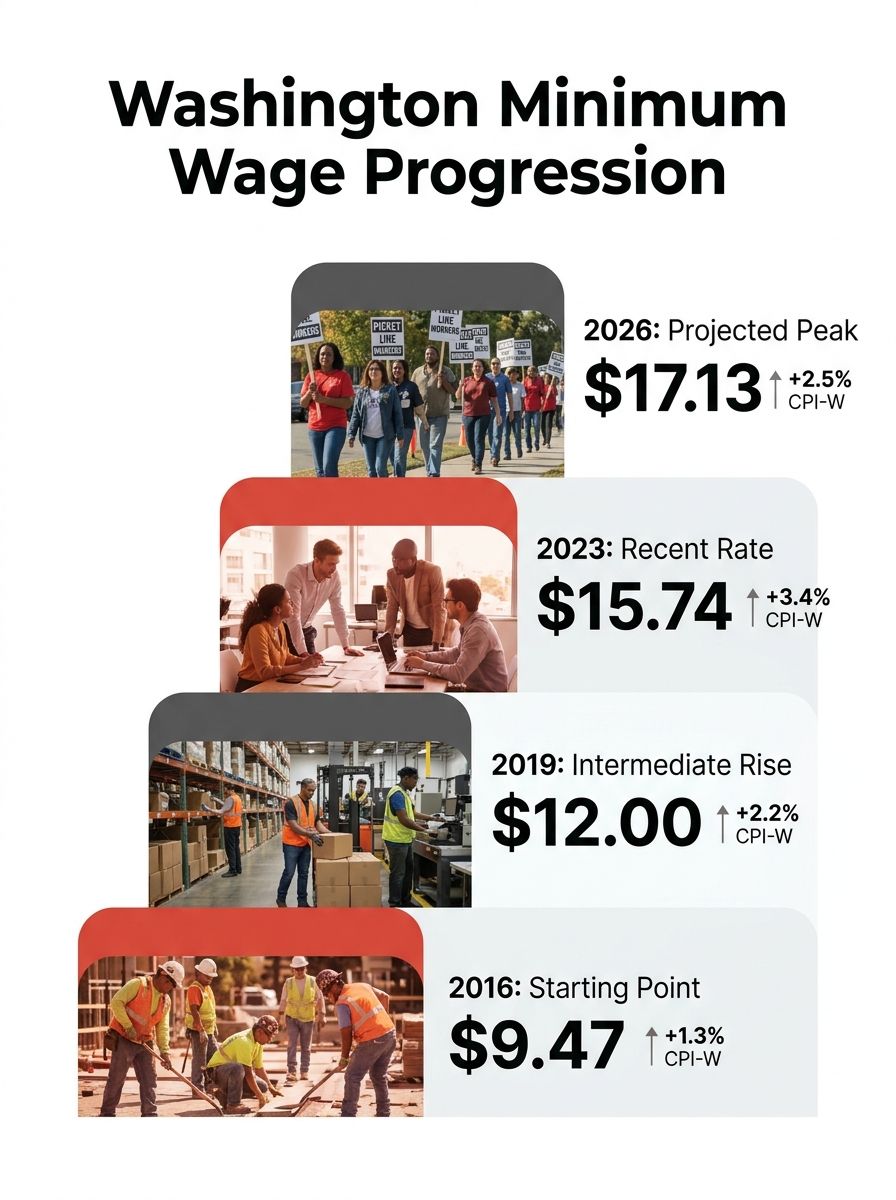
The 2024 increase to $16.28 per hour represented a 3.4% jump over the 2023 rate of $15.74. That 3.4% figure came directly from the CPI-W movement during the measurement period, L&I doesn't round, negotiate, or adjust it. The formula runs, and the number is what it is.
This automatic mechanism separates Washington from states like Texas, where the minimum wage has been stuck at the federal $7.25 since July 2009. The contrast matters: Washington's floor has increased by roughly 81% since 2016, while the federal floor has gained exactly zero.
The CPI-W Formula Under the Hood
L&I uses the Consumer Price Index for Urban Wage Earners and Clerical Workers, known as CPI-W, published by the U.S. Bureau of Labor Statistics. This particular index tracks spending patterns of households where more than half of income comes from clerical or hourly wage occupations, making it more representative of minimum wage workers than the broader CPI-U measure that dominates news coverage.
The calculation works like this. L&I takes the August CPI-W value from the current year and compares it to the August CPI-W from the prior year. The percentage change becomes the adjustment factor applied to the current minimum wage. The new rate takes effect the following January 1.
Two features of this formula deserve attention. The rate can only go up. If the CPI-W drops year over year, deflation, the minimum wage holds steady rather than falling. Washington's statute explicitly protects against downward adjustments, a safeguard that matters during economic contractions. And per Miller Nash LLP's analysis, the calculation rounds to the nearest cent, so workers see the full inflation adjustment reflected in their pay without rounding losses compounding over time.
The result is a wage floor that tracked real inflation from $13.50 in 2020 to $14.49 in 2021, $14.49 to $14.49 (held during a low-inflation period), then accelerated to $15.74 in 2023, $16.28 in 2024, and $17.13 in 2026. Each number is the output of the same mechanical process.
Workers aged 14 and 15 fall under a separate provision: employers can pay them 85% of the state minimum, which came to $13.84 per hour in 2024. Everyone 16 and older receives the full rate. There is no training wage, no probationary sub-minimum, and no seasonal exception.
Local Ordinances That Stack on Top
The state minimum is a floor, and several Washington cities have built significantly higher ceilings. Employers must pay whichever rate is highest, state, county, or city, for the jurisdiction where the work is performed.
The local landscape in 2024 looked like this:
Jurisdiction | 2024 Rate (Large Employers) | 2024 Rate (Small Employers) | Size Threshold |
|---|---|---|---|
State of Washington | $16.28 | $16.28 | No size distinction |
Seattle | $19.97 | $17.25 (with medical benefits) | 501+ employees |
SeaTac | $19.71 | $19.71 | Hospitality/transport employers |
Tukwila | $21.10 | Tiered schedule | Varies by employer size |
Renton | $18.90–$20.90 | Tiered schedule | Varies by employer size |
King County (unincorporated) | $20.76 | Tiered schedule | Varies by employer size |
Tukwila's $21.10 rate for large employers deserves particular scrutiny. That figure exceeded the Seattle rate in 2024, making a suburb with approximately 21,000 residents home to one of the highest minimum wages in the entire country.
As Davis Wright Tremaine documented, several cities including Seattle, SeaTac, and Tukwila require rates much higher than the state's $16.28 per hour. Seattle's ordinance draws an additional distinction for employers with 501 or more employees worldwide, requiring the $19.97 rate regardless of whether the employer contributes to medical benefits. Smaller employers in Seattle who contribute to employee medical benefits could pay $17.25.
This patchwork creates real compliance challenges. A janitorial company that sends crews to worksites in Seattle, Tukwila, and unincorporated King County might owe three different hourly rates in a single shift. Similar local-rate complexity exists in states like California, where county-level ordinances layer atop the state floor, and New Jersey, where the CPI escalator mechanism shares structural DNA with Washington's approach.
Why Washington Bans Tip Credits
The minimum wage in Washington state carries a provision that separates it from 43 other states: employers cannot apply tip credits. A tip credit is a mechanism that allows employers in most states to pay tipped workers a lower cash wage, as low as $2.13 per hour under federal law, and count customer tips toward the difference to reach the minimum.
Washington's prohibition means a server in Seattle earning $19.97 per hour in base wages keeps every dollar of their tips on top of that full hourly rate. Compare that to the federal tipped minimum of $2.13, where a server's take-home depends almost entirely on customer generosity and the employer's obligation to make up shortfalls goes largely unenforced.
The practical impact is significant. The U.S. Department of Labor's tipped employee data shows that only seven states, Washington, Oregon, California, Alaska, Minnesota, Montana, and Nevada, require the full state minimum before tips. Restaurant industry groups have repeatedly argued that tip credits keep menu prices lower, but the Washington restaurant sector has grown steadily despite the ban, suggesting that the apocalyptic predictions haven't materialized.
For union organizers, the no-tip-credit rule removes one of the most common sources of wage theft in the hospitality industry. When tipped workers receive the full minimum regardless, the math becomes simpler, violations become easier to detect, and employers have less room to manipulate pay records.
Exempt Salary Thresholds and Connected Regulations
The minimum wage for Washington state doesn't exist in isolation. It anchors a chain of salary thresholds that ripple across the entire employment landscape.
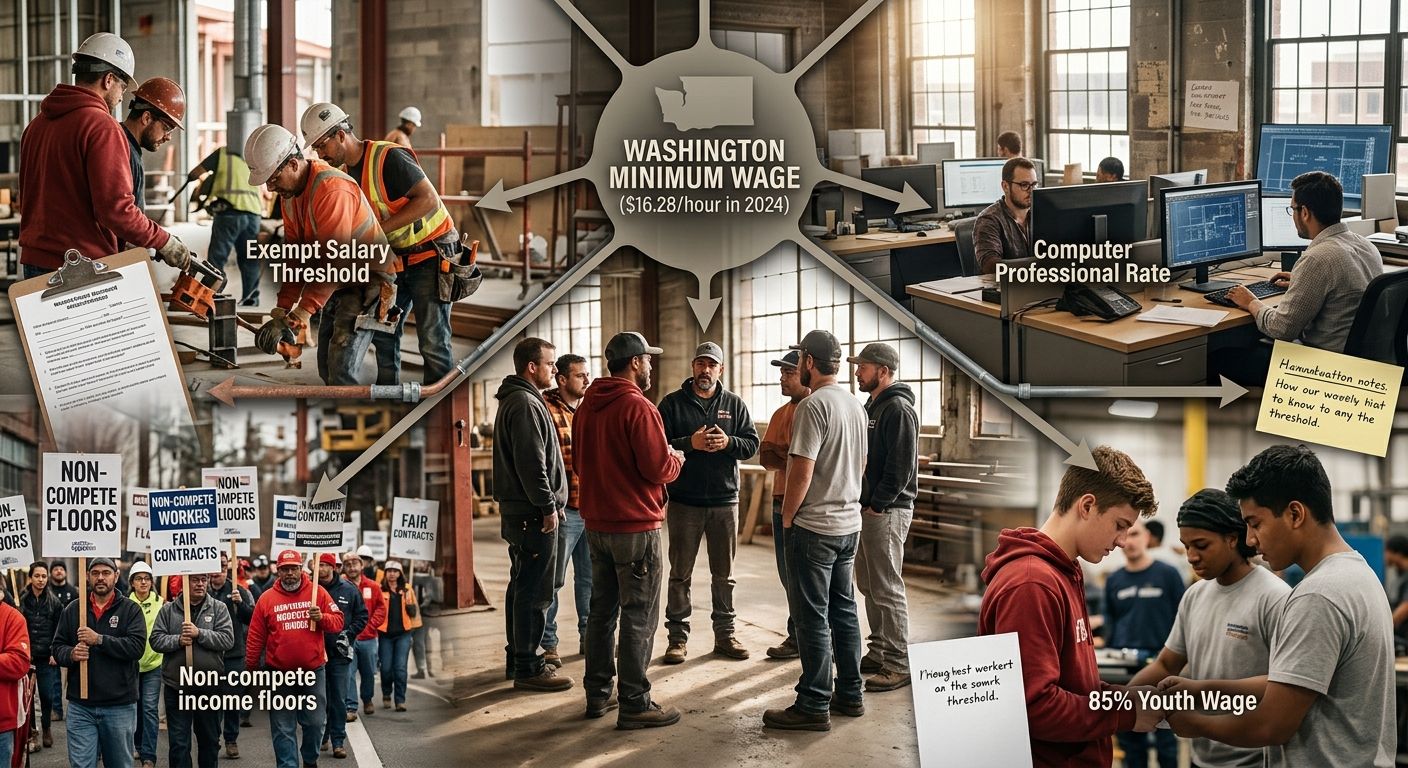
Effective January 1, 2024, the salary threshold for overtime-exempt employees, those classified as executive, administrative, or professional, increased to $67,724.80 annually, or $1,302.40 per week. This threshold applies to all employers regardless of company size, a change from earlier years when small and large employers faced different requirements. The formula ties directly to the state minimum: the exempt threshold equals 2 times the state minimum wage for a 40-hour week, multiplied by 52.
Computer professionals face an even higher bar. To qualify as exempt from overtime, a computer professional in Washington must earn at least $69.90 per hour, calculated as 3.5 times the state minimum wage. Below that figure, the worker is non-exempt and entitled to overtime pay at 1.5 times their regular rate.
Non-compete agreements carry their own income thresholds anchored to the wage floor. As of 2024, non-compete clauses are void for employees earning less than $120,559.99 annually and independent contractors earning less than $301,399.98. Violations make the employer liable for actual damages or $5,000, whichever is greater, plus attorney fees. These figures adjust annually, again tethered to the same escalator mechanism.
And a 2024 change to wage complaint settlements deserves attention from anyone who's filed or is considering filing a complaint with L&I: settlements now must include 1% monthly interest on all amounts owed, removing previous flexibility that allowed employers to negotiate away interest during the settlement process.
Where the Mechanism Breaks
The CPI-W escalator is elegant, but it has blind spots that workers and organizers should understand.
The formula measures national CPI-W, not Washington-specific price changes. When housing costs in the Puget Sound region spike faster than the national average, which they have consistently done since 2018, the state minimum adjustment lags behind what local cost-of-living data would justify. This is precisely why cities like Seattle, Tukwila, and Renton passed their own higher minimums: the state formula couldn't keep up with the regional reality.
The escalator also can't account for step-function shocks. When inflation surged in 2022 and early 2023, the CPI-W measurement period (August to August) captured much of the spike, but the new rate didn't take effect until the following January. Workers absorbed months of higher prices before the adjustment appeared in their paychecks.
Enforcement remains uneven. The Washington Department of Labor and Industries investigates wage complaints, but staff capacity hasn't grown proportionally to the complexity of the local patchwork. An employer paying Seattle workers the state rate of $16.28 instead of the city rate of $19.97 is committing wage theft of $3.69 per hour, roughly $7,675 per year for a full-time worker. How many of those violations get caught depends on whether workers know their rights and feel secure enough to file complaints.
The 85% youth wage provision, while limited to workers aged 14 and 15, creates a financial incentive to hire younger workers for roles that could go to older applicants. And the mechanism offers no protection against hour cuts: an employer who raises hourly pay from $15.74 to $16.28 but reduces weekly hours from 35 to 33 has complied with the law while cutting the worker's weekly income. Similar dynamics have played out among production assistants in Chicago, where a first union contract brought higher rates but triggered employer-side hour reductions.
Common Questions
Does the minimum wage in Washington state apply to all workers?
The $16.28 rate (2024) and $17.13 rate (2026) apply to all workers aged 16 and older. Workers aged 14 and 15 can be paid 85% of the state minimum, $13.84 in 2024. There is no separate tipped worker minimum, no training wage, and no seasonal sub-minimum in Washington law.
Do tips count toward the minimum wage for Washington state?
No. Washington is one of seven states that prohibit tip credits entirely. Employers must pay the full state or local minimum wage as a cash wage before tips. All gratuities belong to the worker (or are distributed through a valid tip pool limited to tipped employees). This rule applies statewide, including in cities with higher local minimums.
How is the annual increase calculated?
The Washington Department of Labor and Industries measures the change in the national CPI-W index from August to August each year. That percentage change is applied to the current minimum wage, rounded to the nearest cent. The new rate takes effect January 1. If the CPI-W declines, the wage holds steady rather than dropping.
Which rate applies when a city minimum is higher than the state rate?
Employers must pay whichever rate is highest, federal, state, county, or city, for the location where the work is performed. A Seattle-based worker at a company with 501 or more employees was owed $19.97 per hour in 2024, regardless of the state rate of $16.28. Employers with workers in multiple jurisdictions must track and apply the correct rate for each work location.
How does Washington's rate compare to other states?
Washington has maintained one of the highest state-level minimum wages in the country. The $16.28 rate in 2024 exceeded California's 2024 rate of $16.00 for most workers. By 2026, Washington's $17.13 rate continues to rank among the top state minimums nationally, though several city-level rates within Washington, and in other states, exceed the state floor. States without their own minimums or without CPI indexing, such as Texas at $7.25, fall dramatically behind.
The Union Edge Staff
Frequently Asked Questions
- What is the Washington state minimum wage for 2024?
- The Washington state minimum wage for 2024 is $16.28 per hour for workers aged 16 and older. Workers aged 14 and 15 can be paid 85% of the state minimum, which was $13.84 in 2024.
- How does Washington's minimum wage increase automatically each year?
- Washington's minimum wage increases automatically every January 1 based on the percentage change in the Consumer Price Index for Urban Wage Earners and Clerical Workers (CPI-W) from the prior year's August measurement. The Washington Department of Labor and Industries applies this percentage change to the current minimum wage, rounded to the nearest cent.
- Do tips count toward minimum wage in Washington state?
- No. Washington prohibits tip credits entirely, meaning employers must pay the full state or local minimum wage as base pay before tips. Workers keep all gratuities on top of their full hourly rate, and Washington is one of only seven states with this rule.
- What is the highest minimum wage in Washington state?
- Tukwila has the highest local minimum wage in Washington at $21.10 per hour in 2024 for large employers. Employers must pay whichever rate is highest—federal, state, county, or city—for the jurisdiction where work is performed.
- Can the Washington minimum wage decrease if inflation drops?
- No. Washington's law explicitly protects against downward adjustments, so the minimum wage only increases or stays the same. If the CPI-W declines year-over-year, the wage holds steady rather than falling.
- How much did Washington's minimum wage increase from 2023 to 2024?
- Washington's minimum wage increased from $15.74 in 2023 to $16.28 in 2024, a 3.4% increase that came directly from the CPI-W movement during the August-to-August measurement period.
- What is Washington's overtime exempt salary threshold for 2024?
- As of January 1, 2024, the salary threshold for overtime-exempt executive, administrative, or professional employees is $67,724.80 annually, or $1,302.40 per week. Computer professionals must earn at least $69.90 per hour to be exempt from overtime.
- Which Washington cities have minimum wages higher than the state rate?
- Seattle ($19.97 for large employers), SeaTac ($19.71), Tukwila ($21.10), Renton ($18.90–$20.90), and King County unincorporated areas ($20.76) all have local minimums exceeding the state rate of $16.28 in 2024.
Related Articles

Washington State Minimum Wage: 2024 Rates & Laws
Washington state doesn't have one minimum wage. It has at least seven. The statewide floor sat at $16.28 per hour for 2024 (rising to $17.

Minimum Wage of Washington: 2024 Update
Washington's minimum wage is set by an automatic annual formula tied to the Consumer Price Index for Urban Wage Earners and Clerical Workers (CPI-W), making it one of the few state wage floors in the country that rises without requiring new legislation each cycle. The 2024 rate of $16.

Minimum Wage Washington: 2024 Rates & Changes
Washington's minimum wage is an inflation-indexed floor set by state law, adjusted each September based on the Consumer Price Index for Urban Wage Earners and Clerical Workers (CPI-W), and effective every January 1 without a legislative vote. The 2024 statewide rate reached $16.28 per hour, a 3.
Also in the paper