
Arizona Minimum Wage 2026: What's Changing
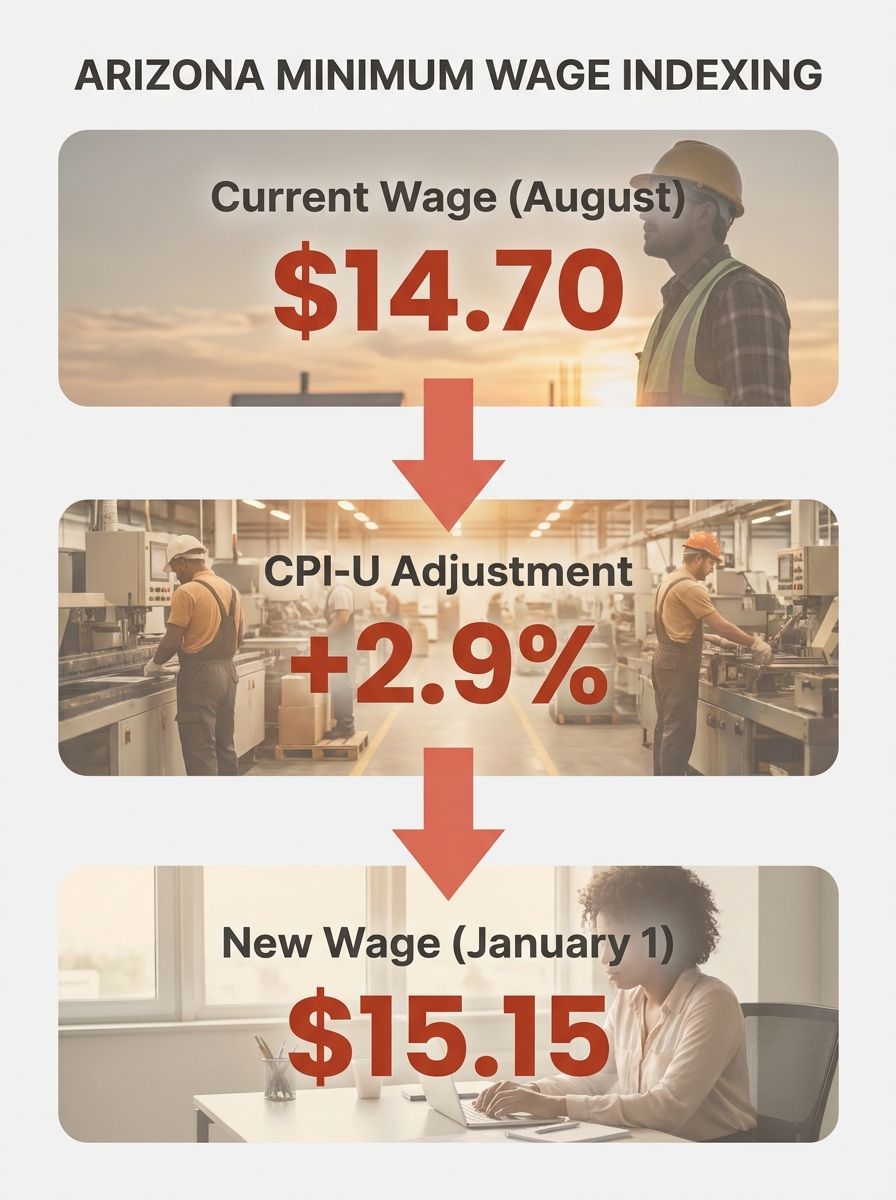
Proposition 206, the ballot initiative Arizona voters passed in 2016, built an automatic escalator into state law: each year, the minimum wage adjusts based on Consumer Price Index changes. That formula pushed the az minimum wage 2026 rate to $15.15 per hour on January 1, a $0.45 increase from $14.
Arizona Minimum Wage 2026: How the $15.15 Rate Actually Works
Proposition 206, the ballot initiative Arizona voters passed in 2016, built an automatic escalator into state law: each year, the minimum wage adjusts based on Consumer Price Index changes. That formula pushed the az minimum wage 2026 rate to $15.15 per hour on January 1, a $0.45 increase from $14.70.
The Proposition 206 Indexing Mechanism
Arizona's wage floor doesn't change through annual legislative battles. Voters removed that friction in 2016 when they approved Proposition 206, formally titled the Fair Wages and Healthy Families Act. The law established a base minimum wage and then hardwired annual increases to a federal inflation gauge, the Consumer Price Index for All Urban Consumers (CPI-U).
Here's how the formula operates under A.R.S. § 23-363(B): the Industrial Commission of Arizona (ICA) compares the CPI-U reading from August of the current year against August of the prior year. The percentage change gets applied to the existing minimum wage, rounded to the nearest $0.05. The new rate takes effect every January 1.
For 2026, the ICA measured a 2.9% increase in the CPI-U between August 2024 and August 2025. Applied to the 2025 rate of $14.70, that produced a $0.45 bump to $15.15. The commission published its determination in September 2025, giving employers roughly three months to adjust payroll.
This indexing approach has a critical design feature: the wage can go up but never down. Even if deflation hit, A.R.S. § 23-363(B) prevents the rate from falling below the prior year's level. Arizona shares this ratchet mechanism with roughly a dozen other states that index their wages to inflation, though the specific index used and rounding conventions vary.
The 2026 Rate Structure Across Worker Categories
The $15.15 statewide floor applies to all covered employees, but the rate branches into several categories depending on how workers are paid and how many hours they log.
Tipped workers receive a cash wage of $12.15 per hour under state law. Employers can claim a maximum tip credit of $3.00, meaning tips must bring the worker's total compensation to at least $15.15. If tips fall short during any pay period, the employer owes the difference. According to the NFIB's analysis of the 2026 changes, "the state's minimum wage increased by $0.45 to $15.15 an hour" and the corresponding tip credit adjustment requires careful payroll tracking.
Overtime kicks in at 1.5 times the minimum wage for covered employees working beyond 40 hours per week, establishing a floor of $22.725 per hour.
Workers familiar with how minimum wage structures work in other states will notice that Arizona's system is simpler than most. There are no regional tiers at the state level, no separate rates for small versus large employers, and no phase-in schedule. One number, statewide, adjusted annually by formula.
Category | 2025 Rate | 2026 Rate | Change |
|---|---|---|---|
Standard minimum wage | $14.70 | $15.15 | +$0.45 |
Tipped cash wage | $11.70 | $12.15 | +$0.45 |
Maximum tip credit | $3.00 | $3.00 | No change |
Overtime floor (1.5×) | $22.05 | $22.725 | +$0.675 |
Flagstaff and Tucson Override the State Floor
Arizona doesn't preempt local wage ordinances, which means cities can set rates above the state minimum. Two currently do, and the gap between their rates and the statewide floor reveals how differently Arizona communities experience the cost of living.
Flagstaff requires $18.35 per hour for all workers as of 2026, a full $3.20 above the state rate. The city has also eliminated its tip credit entirely, meaning tipped employees earn the full $18.35 in cash wages before tips. Flagstaff's rate adjusts annually by its own CPI formula, driven by the high cost of housing in a mountain college town where median rents compete with Phoenix metro prices despite a much smaller economy.
Tucson set its 2026 minimum at $15.45 per hour, with a tipped cash wage of $12.45, according to analysis from Allen Law AZ. The $0.30 premium over the state rate is modest, but it matters for the roughly 50,000 workers in Pima County earning near the floor.
Jurisdiction | 2026 Hourly Rate | Tipped Cash Wage | Tip Credit |
|---|---|---|---|
Arizona (statewide) | $15.15 | $12.15 | $3.00 |
Tucson | $15.45 | $12.45 | $3.00 |
Flagstaff | $18.35 | $18.35 | $0.00 |
Federal | $7.25 | $2.13 | $5.12 |
The federal minimum of $7.25, unchanged since 2009, is functionally irrelevant in Arizona. Every worker in the state is covered by rates at least double the federal floor. But the federal figure matters for one reason: it sets the baseline that courts reference when evaluating preemption challenges. States like Texas still operate at the federal floor, leaving Arizona workers comparatively better positioned by $7.90 per hour.

Why Healthcare Workers Feel This Wage Floor Most
The Healthcare & Labor angle here isn't abstract. Home health aides, certified nursing assistants, and medical office support staff in Arizona cluster disproportionately near the minimum wage. The Bureau of Labor Statistics reports the median hourly wage for home health and personal care aides nationally at roughly $15.50, meaning a significant share of Arizona's healthcare support workforce was earning at or just pennies above the old $14.70 floor.
When the floor rises by $0.45, it doesn't only affect workers earning exactly $14.70. It compresses the wage gap between entry-level and experienced aides, creating pressure on healthcare employers to raise pay across multiple tiers or risk losing trained staff to retail and food service jobs that now pay the same rate.
Arizona's home care sector has struggled with staffing shortages since 2020, and the state's aging population drives growing demand for in-home and facility-based care. Wage floors that don't keep pace with grocery and housing costs push aides out of the profession entirely. The Proposition 206 indexing mechanism provides automatic annual adjustments, but 2.9% inflation protection falls short when Phoenix-area rents have risen at faster rates in several recent years.
Healthcare employers in Flagstaff face the sharpest pressure. At $18.35 with no tip credit, a small assisted-living facility pays roughly $38,200 per year for each full-time minimum-wage aide before benefits and payroll taxes. Organizations monitoring labor standards across industries have documented how these compounding costs reshape staffing models, pushing facilities toward part-time schedules and contract labor.
The Compliance Layer
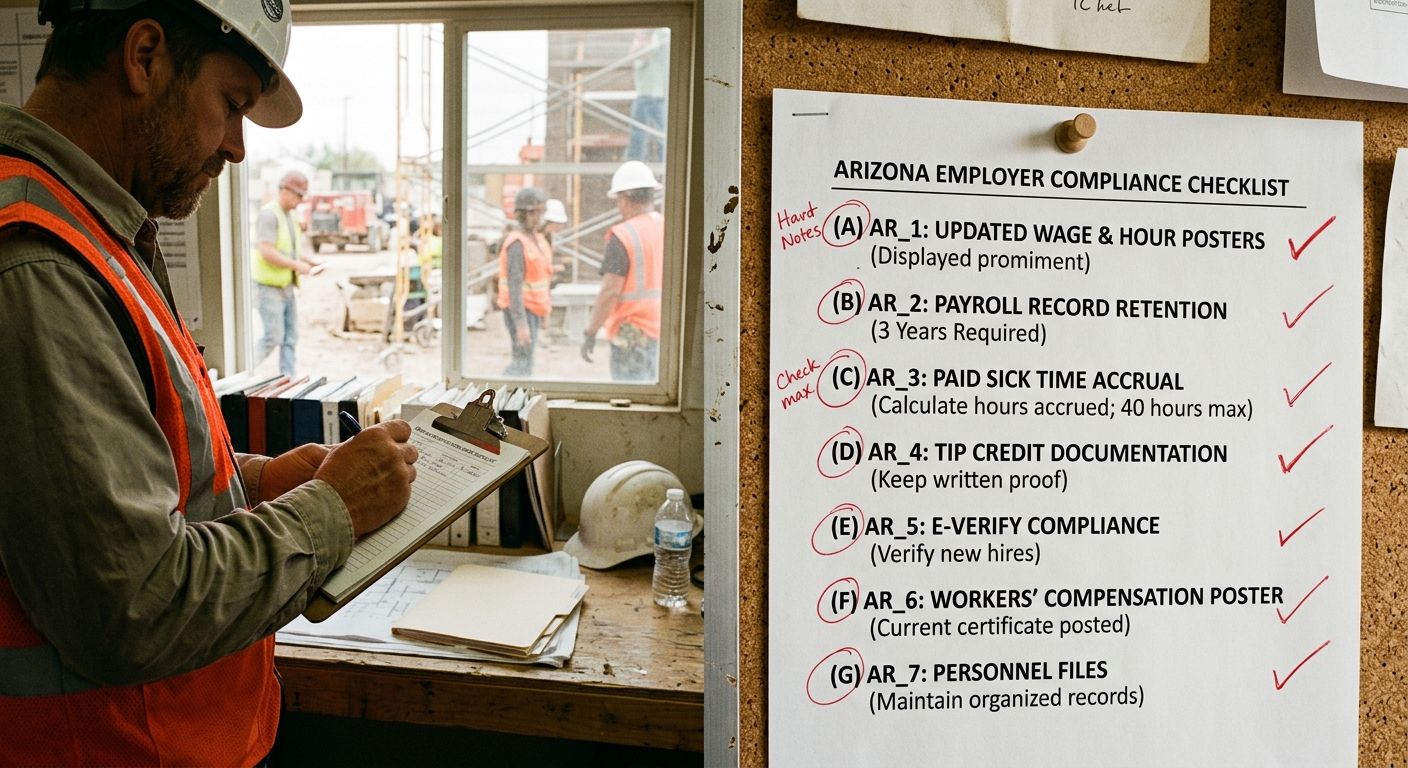
Employers covered by Arizona's minimum wage law must satisfy several administrative requirements beyond paying the correct rate. The ICA mandates that every covered employer display the official minimum wage poster in a conspicuous workplace location. The 2026 poster, available through the ICA's official release, must reflect the current $15.15 rate.
Record-keeping obligations under A.R.S. § 23-364 require employers to maintain payroll records for four years, including hours worked, wages paid, and any tip credit claimed. Workers who believe they've been underpaid can file complaints with the ICA, and the statute provides for recovery of unpaid wages plus an equal amount in liquidated damages.
The Proposition 206 framework also included earned paid sick time provisions, entitling workers to accrue one hour of paid sick leave for every 30 hours worked. Employers with 15 or more employees must allow accrual of up to 40 hours per year; smaller employers, up to 24 hours. These provisions interact with the wage floor because sick time is paid at the worker's regular rate, which for minimum-wage employees means $15.15 per hour.
Understanding how different states handle these combined wage-and-leave mandates helps clarify Arizona's position. California, for example, operates a different minimum wage structure with industry-specific carve-outs that Arizona's simpler formula avoids.
Where the Formula Falls Short
The CPI-U indexing mechanism is elegant, but it carries structural limitations that workers and advocates should understand.
The index measures national urban inflation, not Arizona-specific costs. Phoenix, Tucson, and Flagstaff experience different inflation profiles than the national average. A worker in Flagstaff paying mountain-town grocery prices gets the same state-level CPI adjustment as a worker in a lower-cost rural county. Local ordinances partially address this, but only two cities have bothered to enact them.
Rounding to the nearest $0.05 creates small but cumulative losses. A precise 2.9% increase on $14.70 equals $0.4263, which rounds down to $0.45. Over a decade of annual adjustments, these rounding gaps compound. Workers effectively lose a fraction of a cent per hour each cycle.
The formula cannot respond to sudden cost shocks. Because the adjustment looks backward at August-to-August CPI data, a spike in housing or food costs that hits in October won't be reflected until the following January, a 15-month lag. Workers absorb those costs in real time while the formula catches up.
There's no mechanism for structural raises. The CPI adjustment maintains purchasing power against inflation but doesn't increase it. A worker earning the minimum wage in 2026 has roughly the same real purchasing power as a worker earning the minimum wage when the indexing began. The formula preserves the status quo rather than improving it.
Common Questions
Does the $15.15 rate apply to all Arizona employers regardless of size?
Yes. Unlike some states that maintain different rates for small and large employers, Arizona's minimum wage under Proposition 206 applies uniformly. Every employer with at least one employee covered by state wage law must pay $15.15 per hour, with no small-business exemption.
Can Arizona's minimum wage ever decrease?
No. A.R.S. § 23-363(B) includes a ratchet provision ensuring the rate never falls below the prior year's level, even if the CPI-U registers deflation. The floor holds or rises; it never drops.
How does Flagstaff's elimination of the tip credit work?
Flagstaff requires employers to pay tipped workers the full $18.35 per hour in cash wages. Tips are earned on top of that amount. Employers cannot subtract any portion of tips from the base wage. This makes Flagstaff one of a small number of U.S. cities where tipped workers receive the complete local minimum before gratuities.
When will the 2027 rate be announced?
The Industrial Commission of Arizona will calculate the 2027 adjustment after the Bureau of Labor Statistics publishes the August 2026 CPI-U data, typically in September 2026. The new rate will be announced by October and take effect January 1, 2027. As noted by InflectionHR's analysis of the adjustment timeline, employers should review budgets, cash flow, and hiring plans each fall in anticipation.
How does Arizona's rate compare to neighboring states?
Arizona's $15.15 sits above New Mexico's and well above the federal floor that Nevada ties its rate to (with health benefit adjustments). California's statewide rate of $16.50 exceeds Arizona's, though Arizona's lower cost of living means the real purchasing power gap is narrower than the dollar difference suggests. Workers can explore how states like Connecticut and Massachusetts approach similar indexing questions.
The Union Edge Staff
Frequently Asked Questions
- What is Arizona's minimum wage for 2026?
- Arizona's minimum wage for 2026 is $15.15 per hour, effective January 1. This represents a $0.45 increase from the 2025 rate of $14.70, based on a 2.9% Consumer Price Index adjustment mandated by Proposition 206.
- How does Arizona's minimum wage adjust automatically each year?
- Arizona's minimum wage is indexed to the Consumer Price Index for All Urban Consumers (CPI-U) under Proposition 206. The Industrial Commission of Arizona compares the CPI-U reading from August of the current year against August of the prior year, applies the percentage change to the existing wage, and rounds to the nearest $0.05, with the new rate taking effect January 1.
- What is the tipped minimum wage in Arizona for 2026?
- Arizona's tipped cash wage for 2026 is $12.15 per hour, with employers allowed a maximum tip credit of $3.00. If tips do not bring the worker's total compensation to at least $15.15, the employer must pay the difference.
- What are the local minimum wages in Flagstaff and Tucson?
- Flagstaff requires $18.35 per hour for all workers in 2026 with no tip credit, meaning tipped employees earn the full amount in cash wages. Tucson's 2026 minimum is $15.45 per hour with a tipped cash wage of $12.45.
- Can Arizona's minimum wage ever go down?
- No. Arizona law includes a ratchet provision that ensures the minimum wage can only stay the same or increase—it can never decrease, even if the Consumer Price Index registers deflation.
- What overtime rate applies in Arizona for 2026?
- Overtime in Arizona is calculated at 1.5 times the minimum wage for covered employees working beyond 40 hours per week, establishing an overtime floor of $22.725 per hour in 2026.
- What recordkeeping and compliance requirements apply to Arizona employers?
- Arizona employers must display the official minimum wage poster in a conspicuous workplace location, maintain payroll records for four years including hours worked and wages paid, and ensure workers earn at least $15.15 per hour plus one hour of paid sick leave for every 30 hours worked.
Related Articles

Minimum Wage Arizona: 2024 Rates & Requirements
Arizona's minimum wage is $14.35 per hour, effective January 1, 2024, governed by an automatic annual formula tied to the Consumer Price Index that no legislature and no governor can override without a three-quarters supermajority vote.

state of arizona minimum wage 2024 Guide
Arizona's state minimum wage in 2024 is $14.35 per hour, set by an automatic inflation-adjustment formula that voters embedded in state law through Proposition 206 in 2016.

State of Colorado Minimum Wage 2024: Rates & Changes
Colorado's state minimum wage rose to $14.42 per hour on January 1, 2024, set automatically by a Consumer Price Index formula that removes the state legislature from annual rate decisions entirely.
Also in the paper